By 2026, 80% of enterprises will have used generative AI APIs or deployed GenAI-enabled applications, up from less than 5% in 2023, according to Gartner’s 2024 AI hype cycle research. Most of those users won’t be data scientists. They’ll be marketers writing copy, recruiters screening résumés, lawyers drafting contracts, and finance analysts building forecasts. Yet ISO/IEC 42001 Clause 7.2, the EU AI Act Article 4, and the NIST AI RMF Govern function all assume these same employees can identify AI risks, apply controls, and document decisions. They usually can’t, because nobody has trained them. This guide shows how to close that gap with a role-based AI governance training program that holds up to an audit, satisfies regulators across jurisdictions, and actually changes behavior on the ground.
Why AI Governance Training Now Belongs to Every Department
AI used to be contained. A handful of data scientists built models, shipped them through a controlled MLOps pipeline, and that was the governance perimeter. That perimeter no longer exists. Microsoft Copilot is in your sales team’s Outlook. ChatGPT Enterprise is drafting your HR policies. A junior analyst pasted client financials into a chatbot last Tuesday. The AI surface area has expanded faster than any compliance program built for it.
Regulators noticed first. The EU AI Act’s Article 4 on AI literacy came into force on 2 February 2025 and requires providers and deployers of AI systems to ensure their staff and anyone operating AI on their behalf have a sufficient level of AI literacy. The text is short. The implication is large: every employee who interacts with an AI system is now in scope for training, and the obligation falls on the deploying organization, not the vendor.
ISO/IEC 42001 takes the same view through a management system lens. Clause 7.2 (Competence) and Clause 7.3 (Awareness) require that anyone whose work affects the AI management system can demonstrate the relevant competence and understand how their role contributes to AI policy and objectives. NIST’s AI RMF reinforces this through the GOVERN function, particularly GOVERN 4 (a culture of risk management) and GOVERN 5 (engagement with relevant AI actors). All three frameworks converge on the same answer: training is no longer optional, and it cannot be limited to the engineering team.
Who counts as a non-technical AI user
The phrase non-technical team is broader than most compliance leaders assume. It includes:
- Legal and compliance: drafting contracts, reviewing policies, conducting DPIAs and AI impact assessments.
- HR and talent acquisition: résumé screening, interview scheduling, and performance analytics, which are also high-risk under EU AI Act Annex III.
- Marketing and communications: copywriting, image generation, audience segmentation, and customer profiling.
- Finance and procurement: forecasting, anomaly detection, and vendor due diligence on AI suppliers.
- Customer support and operations: chatbots, ticket routing, and quality assurance scoring.
- Executive and board members: approving AI strategy, signing off on risk appetite, and answering to investors.
Each of these groups makes decisions that create AI governance risk. None of them can read a model card. That gap is the entire reason this article exists.
What the Frameworks Actually Require From a Training Program
Compliance leaders often build training programs based on a vendor’s slide deck rather than the regulatory text. That works until the auditor asks for evidence. Here is what each framework actually says, and what an auditor will look for.
| Framework | Training requirement | Audit evidence expected | Who is in scope |
|---|---|---|---|
| ISO/IEC 42001:2023 | Clauses 7.2 and 7.3: competence and awareness for anyone affecting the AIMS | Training records, role-based competence matrix, awareness logs | All employees and contractors whose work affects the AI management system |
| EU AI Act | Article 4: ensure a sufficient level of AI literacy among staff and operators | Training program documentation, attendance records, role-specific content | Providers, deployers, and any natural persons operating AI on their behalf |
| NIST AI RMF 1.0 | GOVERN 4 and 5: build a culture of risk management and engage AI actors | Documented training plans, role profiles, evidence of culture indicators | All AI actors across the AI lifecycle, including non-technical roles |
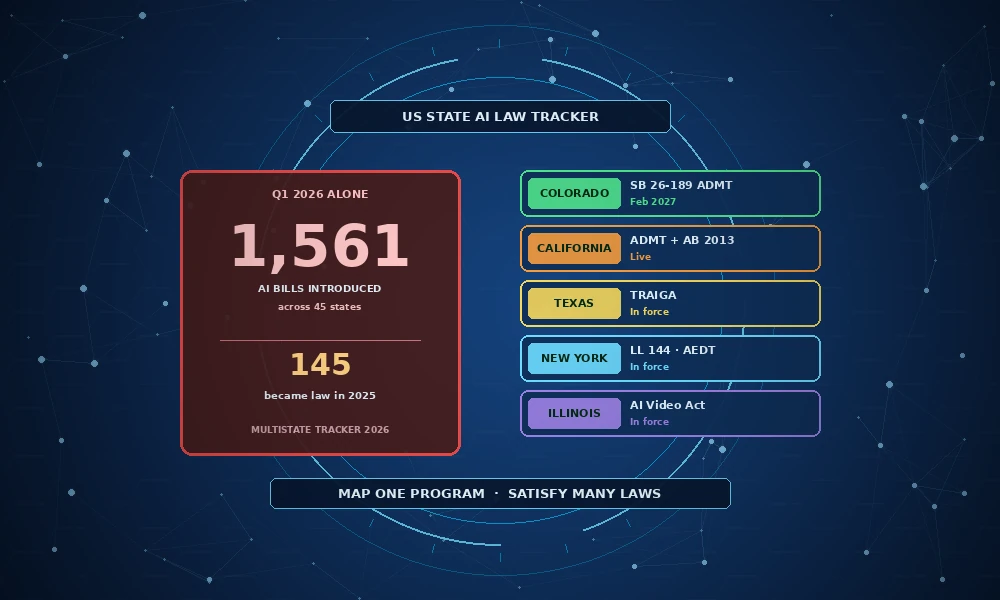
| US state laws (e.g., Colorado AI Act, NYC LL 144) | Bias testing notice and impact assessment training for HR and hiring teams | Notice records, bias audit summaries, candidate disclosure logs | HR, hiring managers, vendor managers handling automated employment decisions |
The pattern is consistent across all four sources. Auditors do not want a single annual e-learning module. They want a training program that is role-based, evidence-based, and current. Generic training that tells everyone the same thing fails the role-based test on its face. Training that produces no records of completion, comprehension, or remediation fails the evidence test. Training built on the 2023 EU AI Act draft when the final text and delegated acts have moved on fails the currency test. [VERIFY] — confirm latest delegated acts and Commission guidance applicable at publication date.
The Four-Tier Training Architecture That Actually Works
After watching enterprises succeed and fail at this, a clear pattern emerges. The programs that pass an ISO 42001 audit and survive an EU AI Act inspection share a four-tier structure. Each tier has a distinct audience, learning objective, and proof point.
Tier 1: Foundational AI literacy for all employees
Every employee, regardless of role, needs a baseline. This tier answers the most common questions an auditor will pose to a random staff member: what is an AI system, what could go wrong, and what should you do about it. Keep it under 45 minutes. Cover what a generative model is, what hallucination means in practice, what data should never be pasted into a public AI tool, and how to report an AI incident internally. The training is mandatory at hire and refreshed annually. Pair it with a short knowledge check, because attendance alone is not evidence of competence.
Tier 2: Role-based modules for high-touch functions
This is where most programs fall short. A marketing copywriter and a hiring manager use AI for entirely different purposes, with entirely different risk profiles. Generic content cannot serve both. Build dedicated modules for at least these six functions: HR and recruiting, legal and compliance, marketing, customer support, finance, and procurement. Each module should run 60 to 90 minutes and cover scenarios specific to the role: bias testing for hiring tools, hallucination review for legal drafting, IP and consent for marketing content, escalation triggers for support chatbots, model risk for finance forecasting, and AI vendor due diligence for procurement.
Tier 3: AI champions and product owners
Within each business unit, identify two or three people who will become local AI governance champions. These are not engineers. They are senior business users who can translate between the central AI governance team and their colleagues. Their training is deeper, around four to six hours over a quarter, and includes risk classification under EU AI Act Annex III, the ISO 42001 control catalog at a working level, and how to fill out an AI impact assessment without help. Champions own the model registry entries for their function.
Tier 4: Executive and board education
Boards and executive committees need a different conversation entirely. Their job is not to write prompt-engineering rules. It is to set risk appetite, approve the AI strategy, and respond credibly to investors and regulators. PwC’s 2024 AI Predictions survey found that boards consistently underestimate the difference between AI ethics and AI risk management, and overestimate their organization’s actual maturity. A two-hour quarterly briefing covering enforcement actions, framework updates, and the company’s own risk register usually does more than a 12-week course.
Designing Role-Based Modules That Survive an Audit
Most compliance teams build training content the way they build a corporate handbook: write it once, post it to the LMS, and forget it. That approach fails on first audit. An ISO 42001 lead auditor will sample three to five employees from different roles, ask them about an AI scenario specific to their job, and expect the answers to align with the training records. If a recruiter cannot describe how to handle a candidate’s request to opt out of automated screening, the training program is the finding, not the recruiter.
Build modules around real workflows, not abstract principles
Generic training tells people that AI systems can be biased. Useful training shows a recruiter the actual interface they use, the actual fields the AI weights, the specific bias indicators the platform reports, and the specific action they should take when the indicator crosses a threshold. The shorter the distance between training content and the employee’s actual screen, the more the training survives contact with reality.
Anchor every module to a regulatory clause and an internal control
Each module should map explicitly to two things: the regulatory clauses it satisfies, and the internal controls it operationalizes. A finance module on AI-driven forecasting, for example, should reference NIST AI RMF MAP 1.6 (model risk), ISO 42001 Annex A control A.6.2.4 (AI system impact assessment), and the company’s own MRM-04 control on model challenger validation. This mapping serves three audiences at once: the auditor sees compliance evidence, the employee sees why the rule exists, and the AI governance team can prove coverage when scope changes.
Embed assessment, not just attendance
An LMS completion record is not training evidence. It is participation evidence. Real evidence requires a knowledge check tied to the learning objectives, with a documented pass mark and a remediation path for failures. The minimum bar most certification bodies expect is 80% on a scenario-based assessment, with a retake option and a record of remediation. Anything less and the training program is decorative.
This is one area where Govern365.ai’s platform earns its place in the workflow. The AI model registry automatically maps each registered system to its applicable ISO 42001 clauses and EU AI Act risk category, and the compliance dashboard then derives the training scope by role from that mapping. Instead of a compliance manager guessing which roles need which content, the registry tells them. Audit evidence flows straight from training completion records into the same dashboard the auditor reviews.
The Implementation Timeline: 90 Days From Zero to Audit-Ready
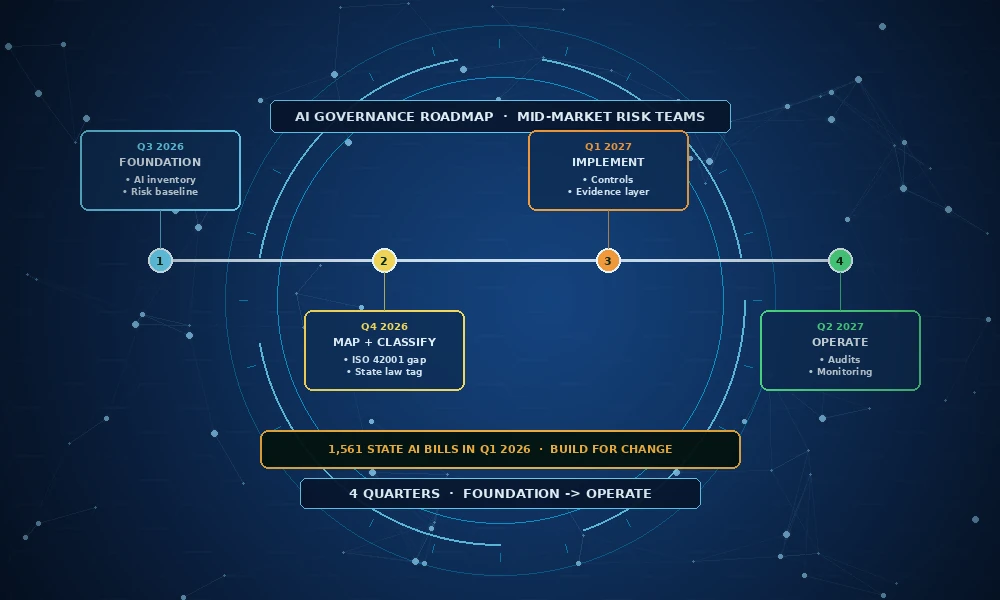
Compliance leaders often ask how long this takes. With executive sponsorship, a focused team, and a tooling backbone, a typical mid-sized enterprise can move from no formal program to audit-ready in 90 days. Without those three ingredients, expect 9 to 12 months and a rougher first audit.
Days 1 to 30: scope, baseline, and risk classification
- Inventory every AI system in use, including shadow AI tools employees adopted without IT approval. Anywhere between 30% and 60% of usage is typically off-IT-radar.
- Classify each system against the EU AI Act risk tiers (prohibited, high-risk, limited-risk, minimal-risk) and against your internal risk taxonomy.
- Map each system to the roles that interact with it, then group those roles into the four training tiers.
- Run a baseline AI literacy assessment across a sample of staff to identify the largest knowledge gaps. Use the results to prioritize Tier 2 module development.
Days 31 to 60: build, pilot, and refine
- Develop Tier 1 foundational content first. It is the broadest in scope and the easiest to standardize.
- Build two Tier 2 modules in parallel for the highest-risk functions, typically HR and customer-facing operations.
- Pilot with a single business unit, capture comprehension scores and qualitative feedback, and refine the content before broader rollout.
- Identify and brief the Tier 3 champions. Give them early access so they become advocates rather than skeptics.
Days 61 to 90: deploy, document, and prepare for assurance
- Roll out across the organization with a clear deadline and an escalation path for non-completion. Track completion by role, not just headcount.
- Run the executive briefing. Use real enforcement examples and your own risk register. Avoid hypotheticals.
- Conduct a mock audit. Pull five employees from three roles and ask them scenario questions tied to their training. Document the outcomes and remediate gaps before the real audit.
- Build the evidence package: training plan, role mapping, attendance records, assessment scores, remediation logs, and version history. This is what an ISO 42001 auditor or AI Act market surveillance authority will request first.
Common Failure Modes and How to Avoid Them
Several patterns of failure repeat across organizations that try this on their own. Each is preventable with foresight.
Treating training as an LMS problem rather than a competence problem. An LMS deploys content. It does not produce competence. Without scenario-based assessment and role-specific application, the training does nothing for the audit and even less for the actual risk.
Forgetting contractors and vendors. EU AI Act Article 4 explicitly covers anyone operating AI systems on the deployer’s behalf. That includes outsourced customer support, recruitment process outsourcing, marketing agencies using AI tools on your behalf, and developer contractors with access to AI development environments. If they are not in your training program, they are a finding.
Building once and never updating. AI regulation is moving faster than most compliance content cycles. The Colorado AI Act, the EU AI Act delegated acts, NIST RMF profile updates, and ISO 42001 implementation guidance all evolved meaningfully between 2024 and 2026. A training program that has not been updated in 12 months is already outdated.
Confusing AI ethics with AI governance. Ethics modules tend to focus on principles. Governance modules need to focus on controls, evidence, and decisions. Both have a place, but ethics content alone will not satisfy an ISO 42001 lead auditor or an EU AI Act notified body.
Underestimating the executive layer. When the regulator or the press calls, the spokesperson is rarely the head of MLOps. It is usually a CEO, GC, or board chair. If they cannot describe the company’s AI risk posture in two minutes, the training program failed at the most consequential level.
Measuring Whether the Training Actually Worked
Most compliance training is measured by completion rate and survey scores. Both are vanity metrics. The metrics that matter for AI governance training are different and more useful.
- Pre and post comprehension delta: the change in scenario-based assessment scores from before to after training. If the delta is small, the content is too basic or too abstract.
- Incident reporting volume: after Tier 1 rollout, AI incident reports usually rise before they fall. A rise indicates that staff are now spotting issues they previously missed.
- AI register coverage: the proportion of in-use AI systems registered in the central inventory. Tier 3 champions drive this number.
- Time to remediation: how long it takes to close a finding from internal AI audits. Trained teams remediate faster.
- Audit non-conformity rate: the number of training-related findings in internal and external audits. Targeting zero by year two is realistic.
Track these in the same compliance dashboard as your other AI governance KPIs. When training metrics, control effectiveness, and risk register status sit in one view, the board conversation becomes a strategic one rather than a status update.
Frequently Asked Questions
How often should AI governance training be refreshed for non-technical teams?
Annually at minimum, with event-based updates whenever a major framework change, regulatory enforcement action, or internal incident triggers a learning need. Tier 1 content should be reviewed every 12 months. Tier 2 role-based modules should be refreshed every 6 to 9 months because workflows change faster. Tier 3 champions need quarterly updates to stay current. Trigger-based micro-updates should follow any material change to ISO 42001, EU AI Act delegated acts, or NIST AI RMF profiles.
Does the EU AI Act’s AI literacy requirement apply to organizations outside the EU?
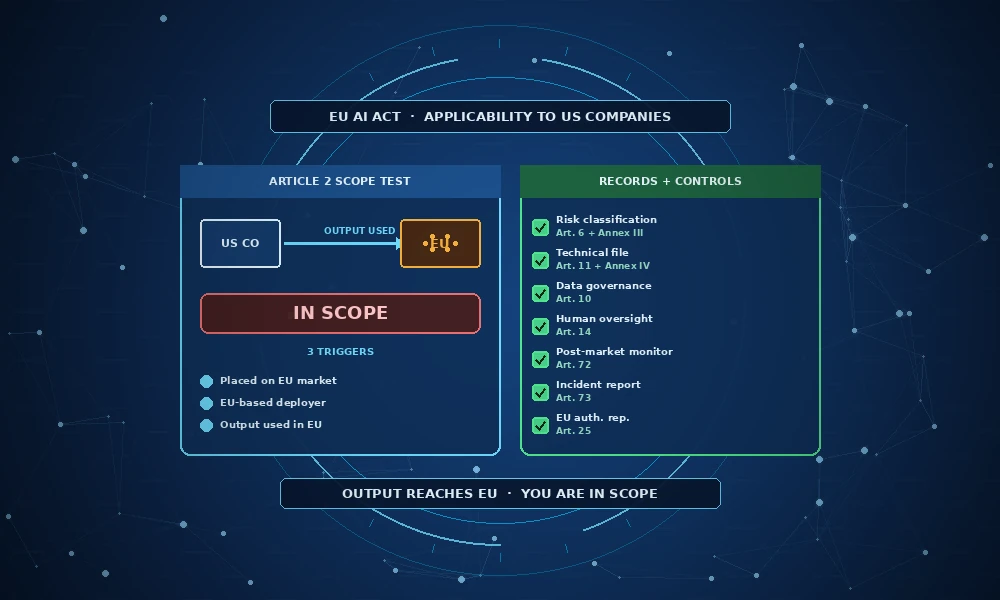
Yes, if you place an AI system on the EU market or its output is used in the EU. Article 4 applies to providers and deployers regardless of where they are established. A US-headquartered company whose marketing tool generates copy used by an EU subsidiary, or whose hiring AI screens EU-based candidates, falls within scope. Extraterritorial application mirrors the GDPR pattern, so most multinationals should plan for compliance even if their primary operations are outside the EU.
Can general AI ethics training count as ISO 42001 awareness training?
Not on its own. ISO/IEC 42001 Clause 7.3 requires awareness specifically of the AI policy, the individual’s contribution to AI management system effectiveness, and the implications of nonconformity. Generic ethics content rarely covers the company’s actual AI policy or operational controls. Use ethics content as a foundation, then layer organization-specific awareness material on top. The auditor will trace awareness back to your documented AIMS, not to a generic course.
How do we train employees on AI tools we have not officially adopted?
Treat shadow AI as an in-scope training topic. Tier 1 should cover what employees are allowed to use, what is prohibited, and how to request approval for new tools. Surveys consistently show shadow AI usage runs higher than IT estimates, so explicit guidance reduces risk faster than blanket prohibition. Pair the training with a frictionless approval workflow so employees have a legitimate path to the tools they want to use.
What is the minimum evidence we need to prove AI literacy compliance?
At minimum: a documented training plan with role-based scope, attendance records by individual, assessment scores with a defined pass mark, a remediation log for failures, and a version-controlled training content repository. Add a competence matrix mapping roles to required modules, and a periodic review schedule signed off by the AI governance lead. This package satisfies ISO 42001 Clause 7.2, EU AI Act Article 4, and NIST AI RMF GOVERN 4 in a single audit trail.
Should AI governance training be delivered in person or online?
Mostly online for Tier 1 and Tier 2, with live or hybrid delivery for Tiers 3 and 4. Foundational and role-based content benefits from consistent, on-demand delivery that scales across global teams. Champion training and executive briefings benefit from live discussion because the value is in the application of judgment to organization-specific scenarios. A hybrid model also generates richer audit evidence: attendance and Q&A logs from live sessions complement LMS records.
How do we handle AI training for multilingual or multi-jurisdictional teams?
Localize content by jurisdiction and language for the regulatory layer, while keeping the technical and policy content centralized. EU staff need EU AI Act specifics, US staff need state-level overlays such as Colorado AI Act and NYC LL 144, UK staff need the UK AI regulation principles, and APAC teams need country-specific guidance such as Singapore’s AI Verify and Australia’s voluntary AI safety standard. The core ISO 42001 and NIST RMF content can stay consistent globally.
Closing the AI Literacy Gap
AI is no longer the engineering team’s exclusive territory, and AI governance training cannot be either. The frameworks that matter, ISO/IEC 42001, the EU AI Act, NIST AI RMF, and the growing body of US state law, all assume an organization where every employee who touches an AI system understands the risks, the controls, and their personal responsibility. That assumption is rarely true today. Closing it is a 90-day project for an organization with the right backbone, and a 12-month project for one without it.
The most useful action this week: pull together a list of every AI tool in active use across your business units, including the ones IT does not know about, and map each to the roles that interact with it. That single artifact tells you the size of your training scope before you write a single module.
Govern365.ai, by the Global AI Certification Council, gives compliance and governance teams the registry, role mapping, and audit evidence layer to run this program at scale. Start your 14-day free trial at govern365.ai and see your AI literacy compliance posture in under an hour.