NIST AI RMF Compliance — Govern, Map, Measure, and Manage AI Risk with Confidence
Implement the NIST AI Risk Management Framework across your entire AI system lifecycle with Govern365’s comprehensive compliance platform.
- NIST AI RMF Certified
- SOC 2 Type II
- Government Ready
What Is the NIST AI Risk Management Framework?
The NIST AI Risk Management Framework (RMF), formally designated as NIST AI 100-1, is a comprehensive, voluntary guidance document published by the National Institute of Standards and Technology in January 2023. It represents the gold standard for managing risks associated with artificial intelligence systems throughout their entire lifecycle—from design and development through deployment and ongoing evaluation.
Unlike prescriptive regulations, NIST AI RMF is designed as a flexible, principles-based framework intended for use by AI system designers, developers, deployers, and evaluators. It provides organizations with a structured approach to identifying, assessing, and mitigating risks related to AI systems, including concerns around fairness, transparency, accountability, and security. The framework is technology-agnostic and applies to all types of AI systems, from machine learning models to generative AI applications.
The framework has become rapidly adopted as best practice across industries and is frequently required in U.S. government AI procurement, making it essential for government contractors and enterprises seeking to demonstrate mature AI governance practices. It complements and works alongside other standards like ISO 42001 (AI Management System) and the EU AI Act, enabling organizations to meet multiple regulatory and industry requirements within a unified governance structure.
The Four Core Functions of NIST AI RMF
GOVERN
Govern
Establishes the organizational culture, leadership structure, and practices for AI risk management across all operations. This function ensures that AI risk management is integrated into enterprise governance and decision-making processes.
Key Activities:
- Establish AI risk management policies and procedures
- Define roles, responsibilities, and accountability structures
- Implement training and competency development programs
- Build organizational awareness and culture around AI risks
- Monitor and report on AI risk management maturity
MAP
Map
Creates a contextual understanding of your AI systems, their stakeholders, and their impact. The MAP function requires documenting AI system characteristics, intended uses, and potential risks across your organization’s AI portfolio.
Key Activities:
- Build an inventory of AI systems and models
- Document system characteristics and intended use cases
- Identify stakeholders and affected parties
- Classify AI systems by risk category and impact level
- Determine relevant risk factors and contexts
MEASURE
Measure
Employs quantitative and qualitative methods to analyze, assess, and benchmark AI systems against identified risks. This function evaluates performance, fairness, bias, robustness, and security to understand the actual risk profile of your AI systems.
Key Activities:
- Conduct risk assessments and impact analyses
- Evaluate AI system performance and accuracy
- Assess fairness, bias, and discrimination risks
- Test security vulnerabilities and robustness
- Benchmark performance against established standards
MANAGE
Manage
Allocates resources and implements risk response strategies to mitigate identified risks. This function ensures continuous monitoring, management, and improvement of AI systems throughout their operational lifecycle.
Key Activities:
- Develop and implement risk mitigation strategies
- Allocate resources for risk management activities
- Monitor system performance and risk indicators
- Manage incidents and adverse events
- Drive continuous improvement and iteration
NIST AI RMF Profiles — Tailoring the Framework to Your Context
NIST AI RMF provides guidance through the concept of profiles—tailored approaches that allow organizations to adapt the framework to their specific contexts, risk appetites, and operational requirements. Organizations can develop profiles at two levels:
Organizational Profiles describe how your organization prioritizes and applies the framework’s functions based on your industry, size, risk tolerance, and strategic objectives. An AI-first technology company might weight the MEASURE function heavily, while a financial services firm might prioritize the GOVERN function for compliance and audit trails.
Use Case Profiles tailor the framework to specific AI applications or systems. A computer vision model used in hiring would have different risk profiles than a recommendation engine, requiring customized assessment and mitigation strategies for each use case.
The NIST AI RMF Playbook provides practical, step-by-step guidance for implementing the framework, complemented by companion resources including the Generative AI Profile (NIST AI 600-1), which provides specific considerations for managing risks unique to generative AI systems like large language models and multimodal AI.
How Govern365 Operationalizes NIST AI RMF
GOVERN Function Support
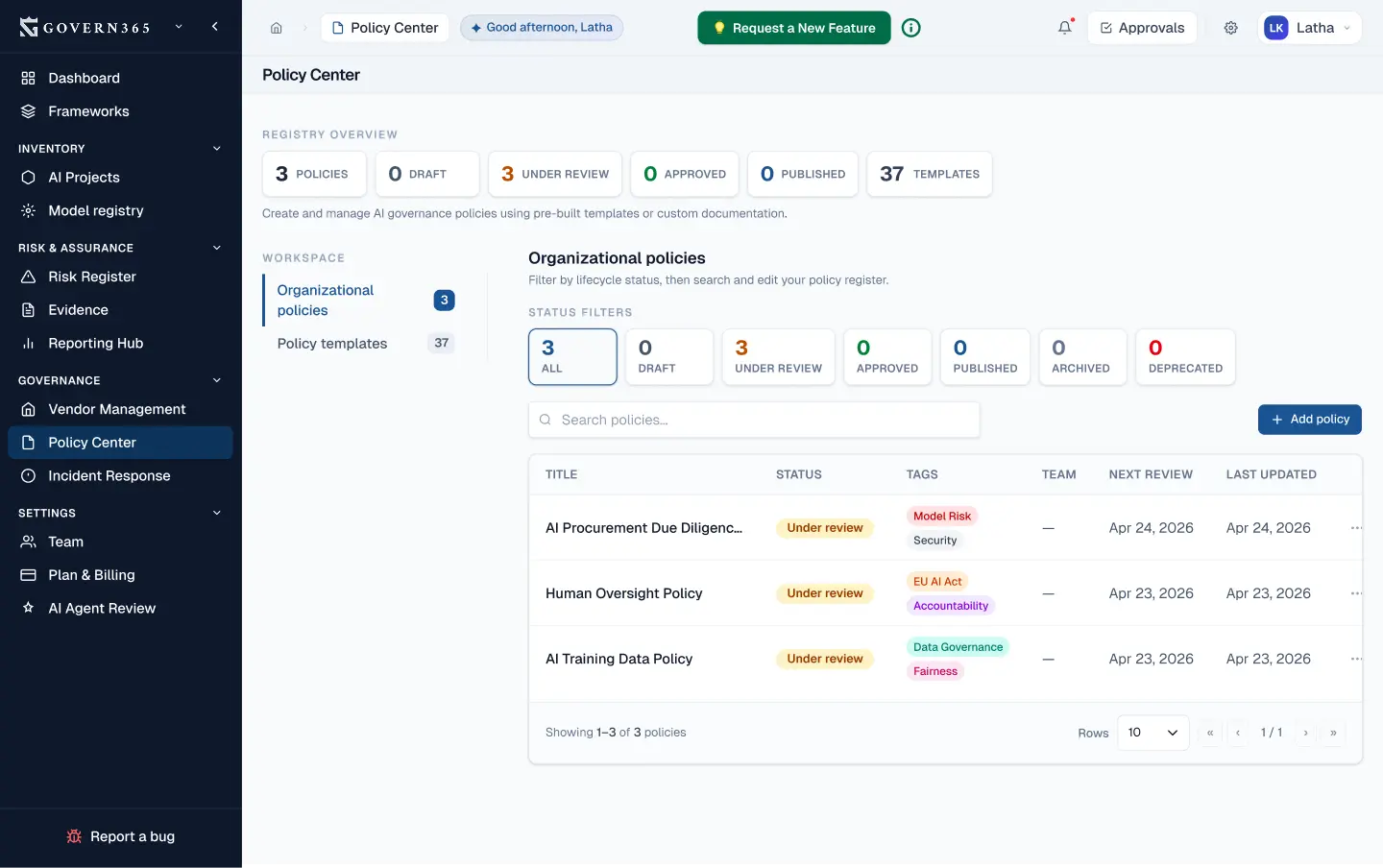
Establish AI governance structures with our policy manager, pre-built governance workflows, and role-based access controls. Create, version, and distribute AI risk policies across your organization.
MAP Function Support
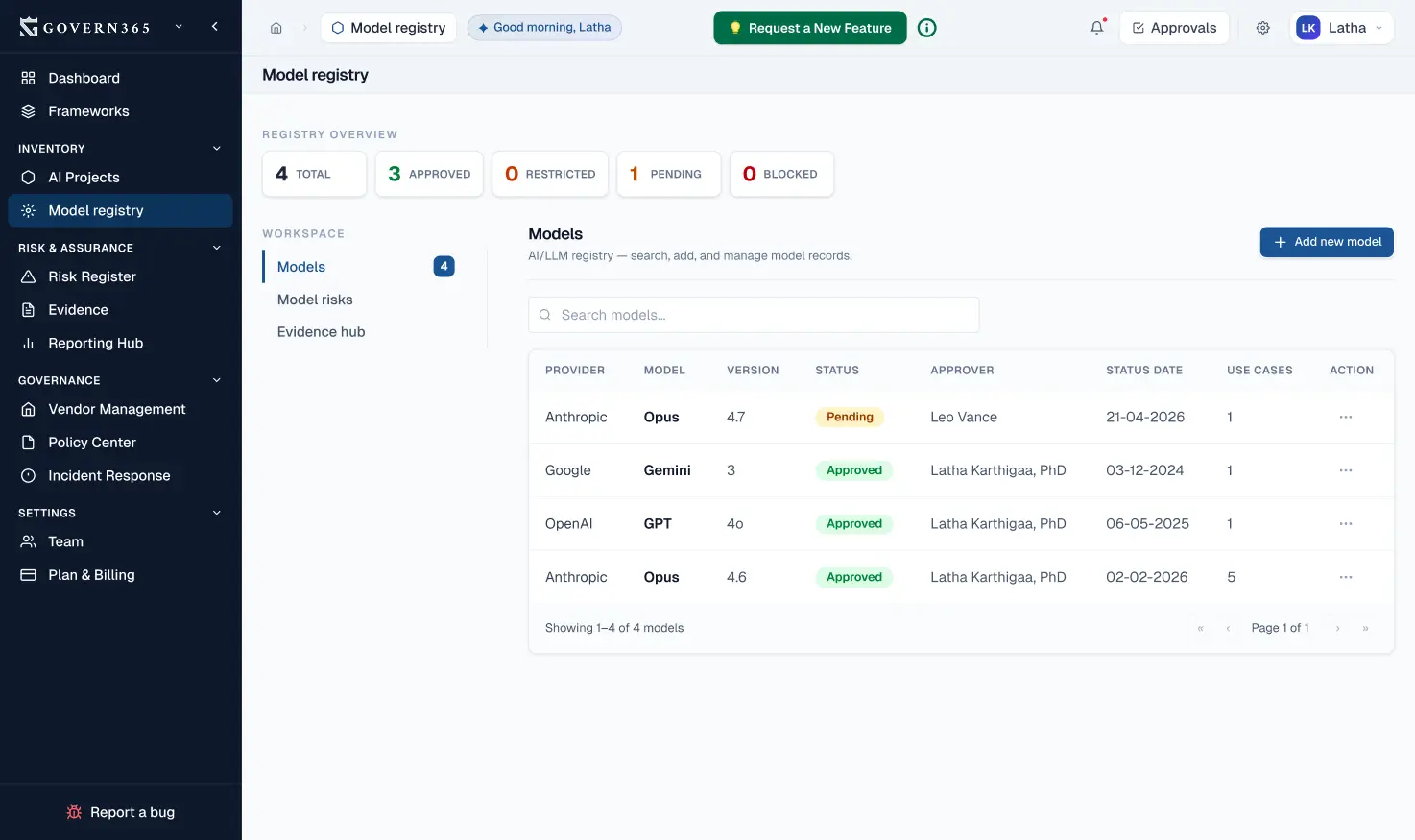
Build a comprehensive inventory of your AI systems with our model registry. Classify AI applications, document intended uses, and map stakeholders and impact zones for each system.
MEASURE Function Support
Assess and benchmark AI systems with our risk assessment engine. Conduct fairness evaluations, performance testing, and security assessments with contextual scoring and evidence documentation.
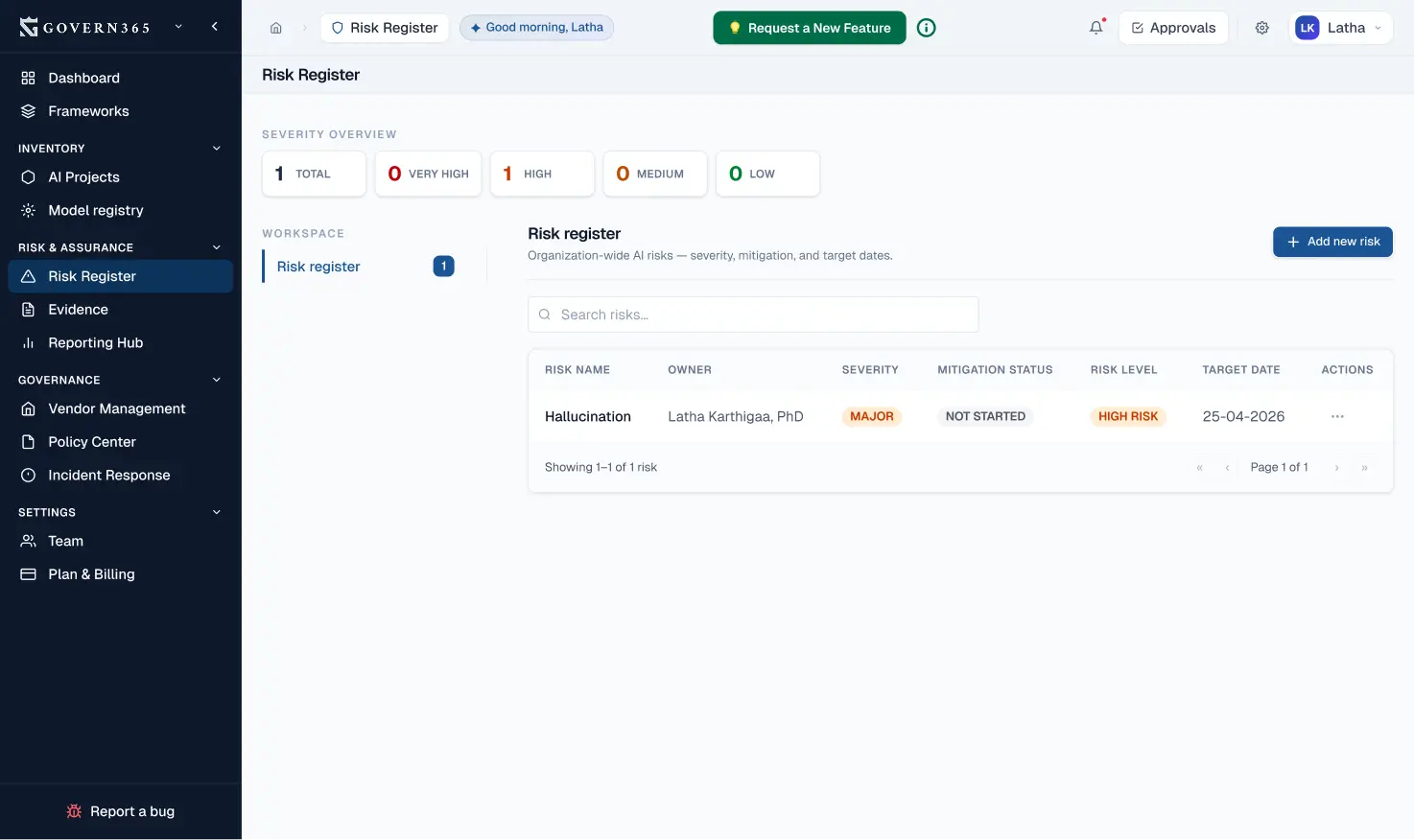
MANAGE Function Support
Monitor and manage AI risks with automated risk registers, remediation workflows, and incident management. Track mitigation actions and monitor risk indicators in real-time.
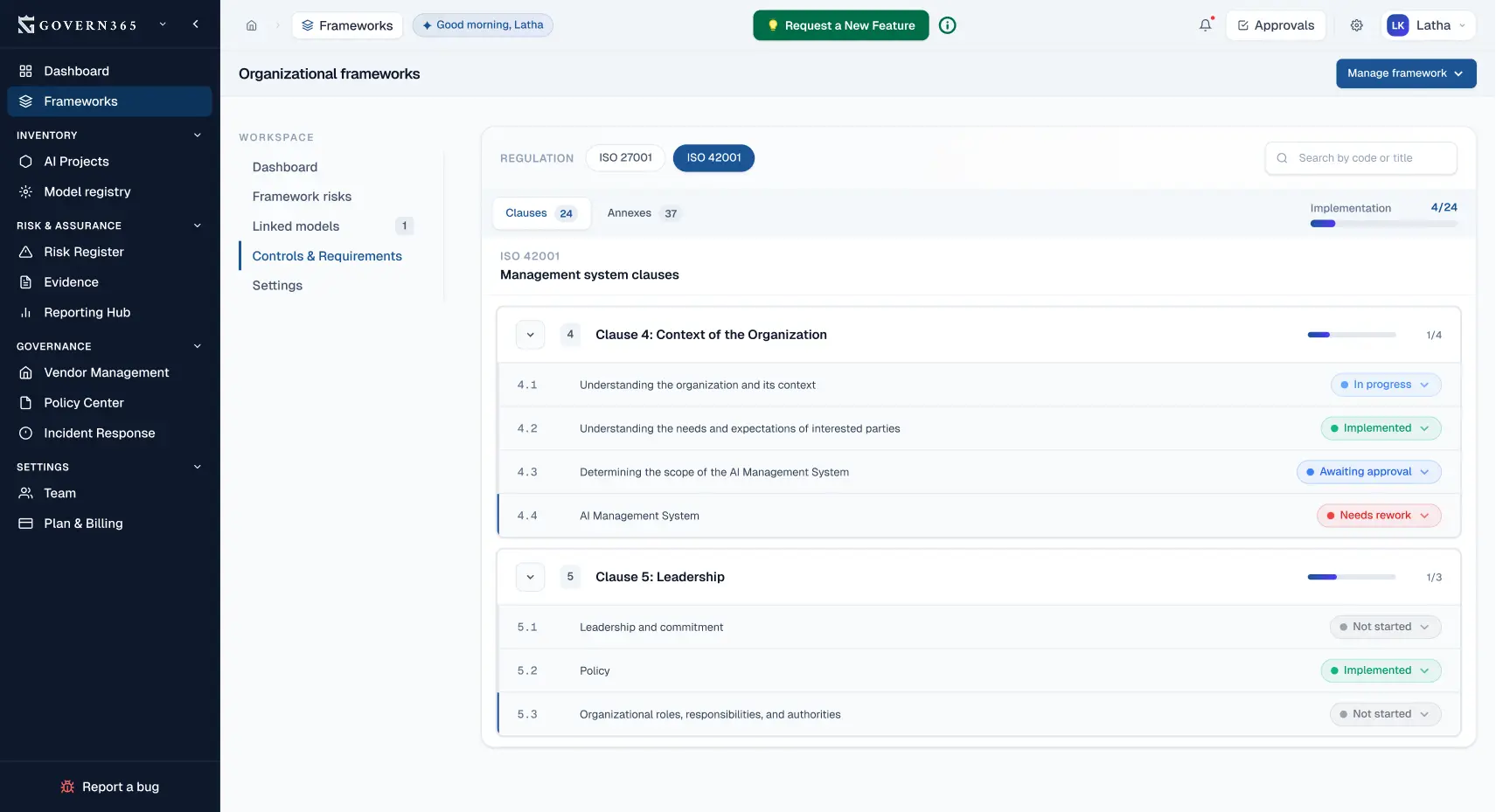
Evidence & Documentation Vault
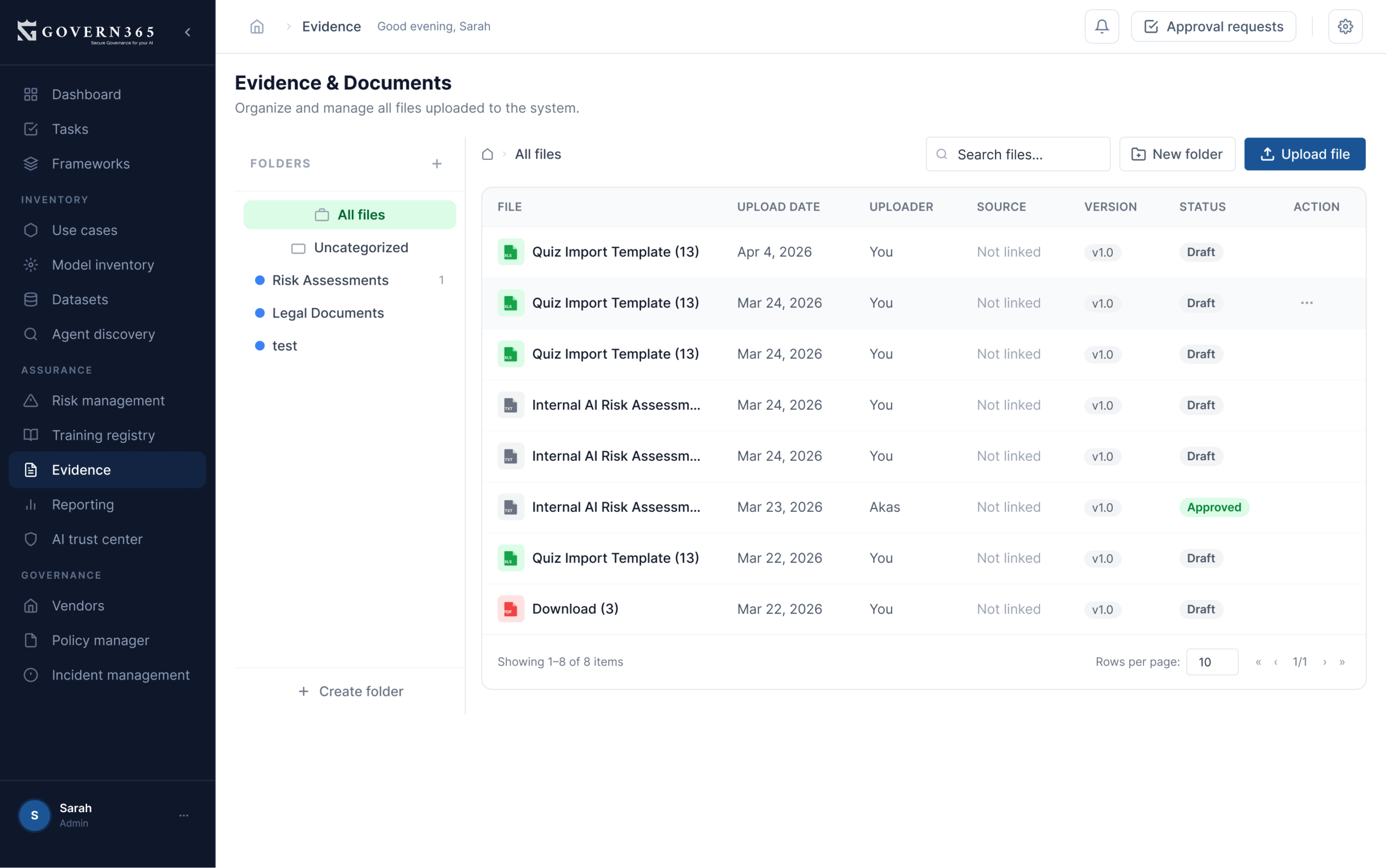
Centralize all NIST AI RMF artifacts including policies, assessments, test results, audit logs, and compliance certificates. Organize evidence for audits and regulatory reviews with version control and audit trails.
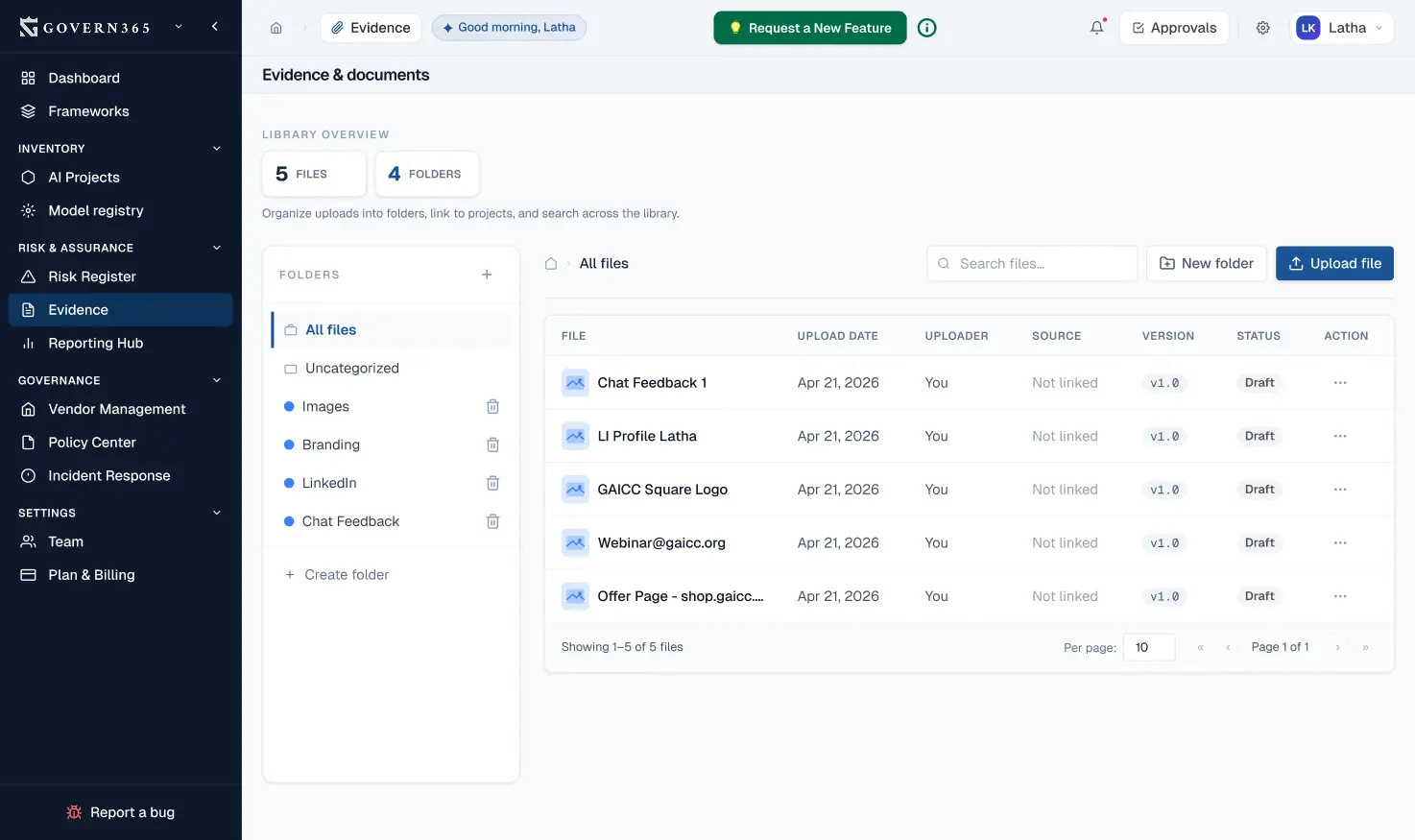
Compliance Dashboard
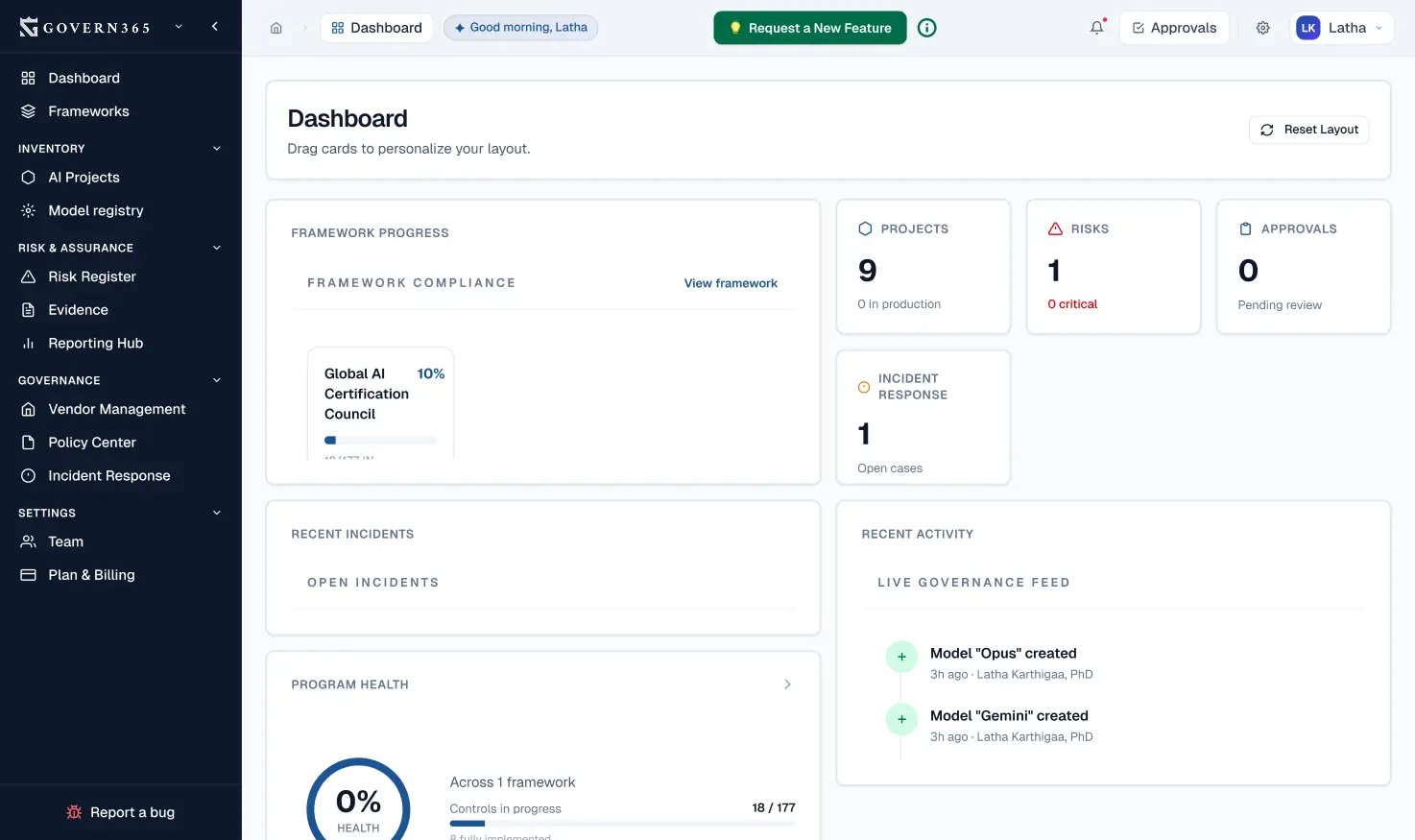
Track your progress across all four functions with real-time dashboards showing compliance posture, implementation status, and risk exposure. Identify gaps and prioritize remediation efforts.
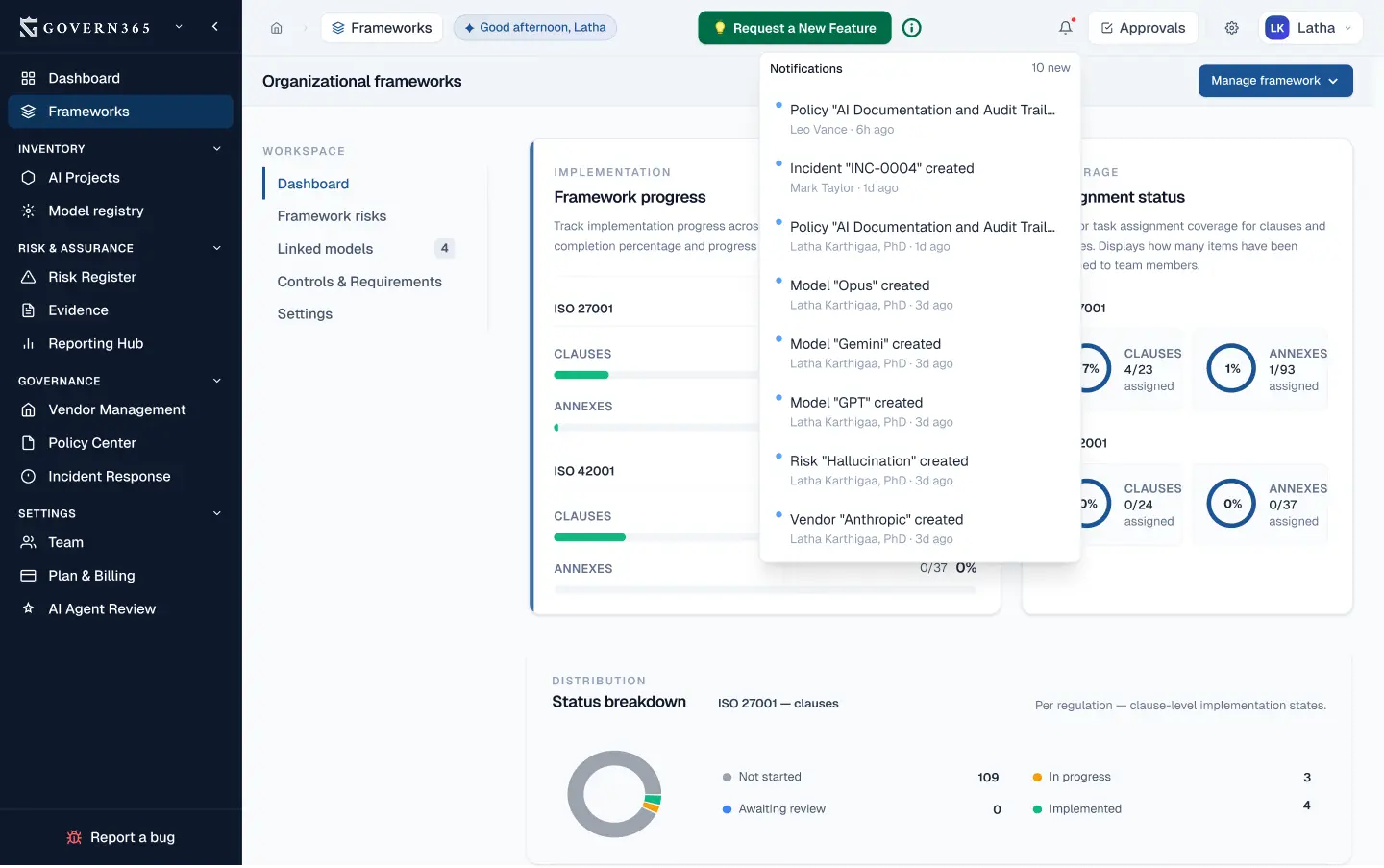
NIST AI RMF Reports
Generate comprehensive compliance reports aligned to NIST AI RMF requirements. Export evidence packages for audits, government procurement, and internal stakeholder reviews.
Templates & Playbook
Accelerate implementation with 37+ built-in templates covering policies, risk assessments, mitigation plans, and documentation. Leverage best practices aligned with NIST AI RMF guidance.
How NIST AI RMF Works Alongside Other AI Frameworks
Organizations today face a complex landscape of AI governance requirements. NIST AI RMF provides a comprehensive, principles-based foundation, but it often needs to be complemented by other standards and regulations:
NIST AI RMF + ISO 42001: While NIST AI RMF focuses on risk management specific to AI systems, ISO 42001 provides a broader management system standard for AI governance and processes. These frameworks are highly complementary—NIST AI RMF risk assessments feed into ISO 42001’s management system structure, creating a holistic governance approach.
NIST AI RMF + EU AI Act: The EU AI Act requires risk classification and management practices that align closely with NIST AI RMF’s MAP and MEASURE functions. Organizations selling AI products to EU customers benefit from implementing NIST AI RMF’s structured risk assessment approach, which provides the evidence base needed for EU AI Act compliance.
NIST AI RMF + Other Regulations: Depending on your industry, you may also need to address sector-specific regulations (HIPAA for healthcare, PCI-DSS for payments, GLBA for financial services). NIST AI RMF’s flexible framework accommodates these requirements by allowing tailored risk assessments and mitigation strategies.
Govern365’s Unified Approach: Govern365 supports NIST AI RMF, ISO 42001, and EU AI Act within a single platform, eliminating the need for multiple disconnected systems and reducing compliance overhead. Your evidence, assessments, and controls address multiple frameworks simultaneously.
Who Should Implement NIST AI RMF?
Government Contractors
U.S. federal contractors and subcontractors face growing requirements to demonstrate AI governance and compliance with NIST standards when bidding on government contracts.
U.S.-Based Enterprises
Large organizations in the U.S. are adopting NIST AI RMF as a de facto standard for responsible AI governance, risk management, and stakeholder trust.
Global Organizations
Multinational companies with U.S. operations or government exposure need NIST AI RMF as part of their broader AI governance strategy across jurisdictions.
AI Developers & Startups
AI vendors and startups building generative AI or ML solutions benefit from NIST AI RMF as a credibility signal to customers, investors, and regulators.
Trusted by Leading Organizations
500+
AI Systems Managed
40+
Enterprise Customers
15+
Government Agencies
99.99%
Uptime SLA
Frequently Asked Questions
What is NIST AI RMF?
Is NIST AI RMF mandatory?
What are the four functions of NIST AI RMF?
The four core functions are:
GOVERN: Establish organizational culture, policies, and practices for AI risk management.
MAP: Understand your AI systems, stakeholders, and impacts through contextual mapping and inventory.
MEASURE: Assess and benchmark AI systems using quantitative and qualitative methods to evaluate performance, fairness, and security.
MANAGE: Implement risk response strategies, monitor risks, and drive continuous improvement.