The European AI Office estimates that over 170,000 organisations outside the EU are directly in scope of the EU AI Act the majority of them US enterprises that have not yet conducted a formal compliance assessment. The August 2, 2026 enforcement deadline for high-risk AI systems is no longer a distant calendar item. It is a present operational priority.
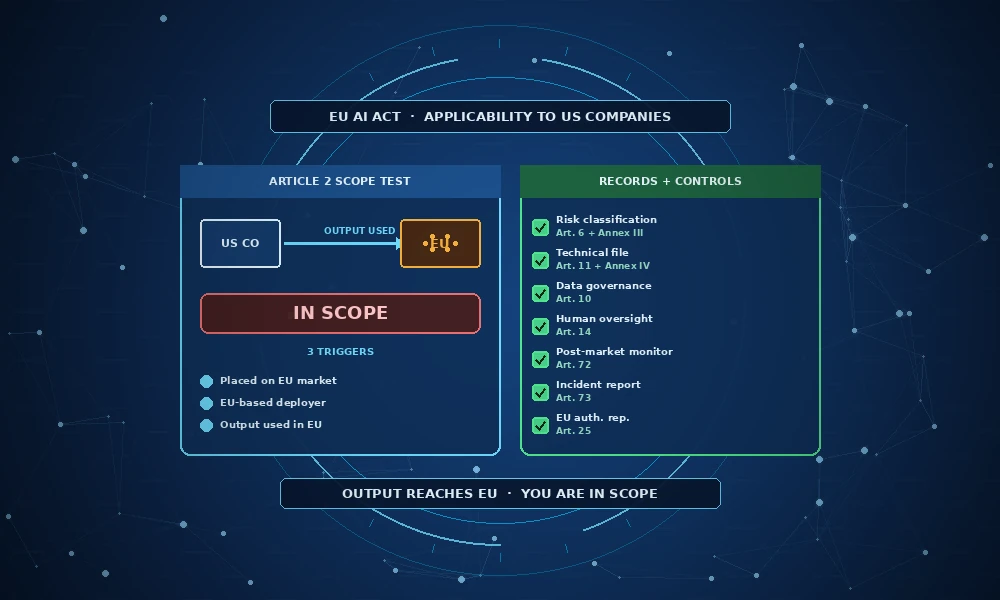
For US companies, the compliance picture is complicated by a common misconception: that a regulation enacted in Brussels has no teeth in Chicago, Dallas, or San Francisco. It does. The Act’s extraterritorial scope captures any organisation whose AI system is placed on the EU market or whose AI outputs affect individuals within the EU regardless of where the company is headquartered. If your AI system screens EU job applicants, scores EU credit applications, or provides services to EU users, you are in scope.
This checklist walks through every step required to achieve EU AI Act compliance before August 2026: from confirming your obligations and classifying your AI systems, to building the governance infrastructure and completing conformity assessment.
The EU AI Act Applies to Your US Company: Here Is Why
Article 2 of Regulation 2024/1689 establishes three categories of non-EU entities that fall within scope. First, providers placing AI systems on the EU market any US software company selling an AI product to EU customers. Second, deployers using AI systems that produce outputs affecting people within the EU. Third, importers and distributors handling non-EU AI systems intended for the European market.
The critical threshold is not where your company is incorporated. It is where your AI system’s output has effect. An AI hiring tool that screens applications from EU-based candidates brings its US developer into scope. A recommendation engine used by EU subscribers brings its US operator into scope. A credit scoring model applied to EU loan applications brings its US provider into scope.
This is the Brussels Effect in practice. The EU AI Act is the world’s first comprehensive AI regulation, and its architects designed it explicitly to reach beyond European borders. US companies that wait for domestic AI legislation before building compliance programmes are misreading the regulatory timeline enforcement of the EU Act’s prohibited practices provisions began in February 2025. GPAI model rules have been active since August 2025.
| ROLE CLARIFICATIONProvider vs Deployer: Your role determines your obligations. Providers (who develop or commission AI systems) carry the heaviest compliance burden. Deployers (who use AI systems for specific purposes) have a narrower but still substantial obligation set under Articles 26–27. |
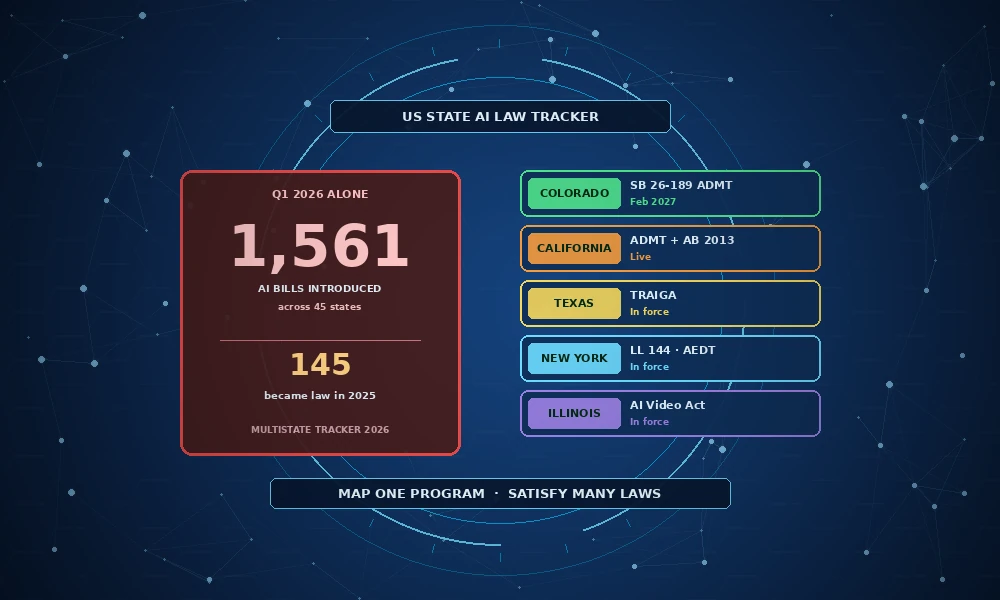
The contrast with the US regulatory environment is sharp. As analysis from STACK Cybersecurity notes, EU companies can comply with a single unified framework across 27 member states, while US companies navigate a fragmented state-by-state patchwork Colorado, California, Texas, and growing with no federal preemption currently enacted. Demonstrating EU AI Act compliance increasingly serves as the de facto global standard for enterprise AI governance.
How to Classify Your AI Systems: The Four-Tier Risk Framework
Classification determines everything. The EU AI Act’s obligations are not uniform they scale with risk. Getting classification wrong, in either direction, carries consequences: over-classification wastes resources on unnecessary controls; under-classification creates enforcement exposure on systems that should have undergone conformity assessment.
The Act sorts AI into four tiers:
| Risk Tier | Classification | Compliance Obligation |
|---|---|---|
| Unacceptable | Banned outright (Art. 5) | Prohibited since February 2, 2025. Includes social scoring, untargeted biometric scraping, emotion recognition in workplaces and schools. |
| High | Annex III (standalone) or Annex I (embedded in regulated products) | Full Chapter III requirements: risk management, data governance, technical documentation, human oversight, accuracy/robustness. Conformity assessment required before deployment. |
| Limited | AI interacting with humans, generating synthetic content, performing biometric categorisation | Transparency obligations: users must be informed they are interacting with AI. AI-generated content must be labelled. |
| Minimal | All other AI — spam filters, video games, inventory management | No specific legal obligations under the Act. Voluntary codes of conduct encouraged. |
The Annex III categories: the eight high-risk domains.
Annex III lists eight categories of AI systems classified as high-risk under Article 6(2): (1) biometric identification and categorisation, (2) critical infrastructure management, (3) education and vocational training access decisions, (4) employment, workers management, and access to self-employment, (5) access to essential private and public services including credit and insurance, (6) law enforcement, (7) migration, asylum, and border control, (8) administration of justice and democratic processes.
Each category contains detailed sub-use-cases. An AI system that schedules maintenance shifts does not necessarily fall under the employment category the question is whether it manages or determines access to employment opportunities. Classification requires reading the specific sub-bullets in the official EUR-Lex text, not just the category headings.
The Article 6(3) exemption pathway. A provider can argue that a system technically listed in Annex III does not pose a significant risk of harm to health, safety, or fundamental rights, given its intended purpose, output type, and conditions of use. This argument must be documented and the national market surveillance authority notified before placement. It is a legitimate pathway, but it requires rigorous documentation of the reasoning the kind of documentation that should be retained in an AI model registry.
The High-Risk AI Compliance Checklist: Eight Mandatory Requirements
High-risk AI systems must satisfy eight specific requirements before they can be placed on the EU market, detailed in Chapter III of Regulation 2024/1689. These are not aspirational principles. They are enforceable obligations with audit evidence requirements behind each one.
| Article | Requirement | What It Requires in Practice |
|---|---|---|
| Article 9 | Risk management system | A documented, lifecycle-spanning risk management system. Not a one-time assessment must operate from design through decommissioning. Identify foreseeable risks, implement mitigating measures, test effectiveness. |
| Article 10 | Data and data governance | Training, validation, and testing datasets must meet defined quality criteria: representative, relevant, free from errors to the extent possible. Data governance practices provenance, bias testing, quality metrics must be documented. |
| Article 11 + Annex IV | Technical documentation | A comprehensive documentation package covering system purpose, architecture, design decisions, data lineage, testing methodology, performance benchmarks, and known limitations. Must exist before deployment. |
| Article 12 | Record-keeping | Automatic logging of events sufficient to trace AI system operation and identify changes. Logs must be stored and accessible for post-market monitoring and incident investigation. |
| Article 13 | Transparency and information provision | Users (deployers) must receive documentation enabling them to understand and use the system appropriately. Capabilities and limitations must be disclosed. Not the same as end-user transparency. |
| Article 14 | Human oversight | Technical measures enabling human operators to monitor, intervene, override, or halt the system. Oversight must be proportionate to the risk and practicable in operational conditions. |
| Article 15 | Accuracy, robustness, cybersecurity | Systems must achieve appropriate levels of accuracy for intended purpose. Must be resilient against adversarial inputs, errors, and inconsistencies. Cybersecurity measures throughout lifecycle. |
| Article 17 | Quality management system | 13 distinct documented elements including regulatory compliance strategy, design and development controls, testing specifications, data governance, risk management, post-market monitoring procedures, incident reporting, record-keeping, resource management, supply chain management, and an explicit accountability framework. |
Article 17 is the requirement most compliance programmes underestimate. Most checklists reference five or six Article 9–15 obligations and stop there. Article 17 imposes a quality management system with 13 explicitly enumerated elements, each requiring documented processes and operational controls. The Cloud Security Alliance research note on prEN 18286 and ISO 42001 identifies Article 17 as the primary compliance gap in current enterprise programmes organisations have reasonable practices but cannot demonstrate them because written records are incomplete.
Step-by-Step EU AI Act Compliance Checklist for 2026
One thing that consistently separates organisations that pass their first AI Act review from those that struggle is sequence. The ten steps below are ordered for operational efficiency each step produces an output that the next step depends on.
- Build a complete AI system inventory. Catalogue every AI system in production, development, or procurement including embedded AI in SaaS tools and third-party models. For each system, record intended purpose, context of use, affected populations, and data inputs. Organisations that lack this inventory cannot complete any subsequent step reliably.
- Classify each system by risk tier. Apply the four-tier framework against each inventoried system. Use the Annex III sub-bullets from EUR-Lex, not summaries. Document classification reasoning for every system, including those classified as limited or minimal risk documented exclusion reasoning is your audit defence.
- Determine your regulatory role. For each high-risk or GPAI system, determine whether your organisation acts as provider, deployer, importer, or distributor. Role determines which Articles apply and at what obligation level.
- Conduct a compliance gap assessment. Map your current practices against Articles 9–17 requirements for each high-risk system. Identify which requirements you meet, which you partially meet, and which have no current controls. This gap map becomes your remediation roadmap.
- Designate compliance roles and governance structure. Assign named accountability for each of Article 17’s 13 QMS elements. At minimum: an AI Compliance Officer, a data governance lead, and a technical documentation owner. Cross-functional legal, compliance, engineering, and product must all be represented.
- Prepare technical documentation packages. For each high-risk system, compile the Annex IV documentation: system purpose, architecture, risk management results, data governance records, performance benchmarks, testing methodology, known limitations. This package must be complete before conformity assessment.
- Complete conformity assessment. Most Annex III systems can use internal self-assessment (Annex VI). Systems used as safety components in regulated products (medical devices, vehicles) require notified body assessment (Annex VII). Document the assessment methodology and outcome.
- Register systems in the EU database. Article 49 requires registration before market placement. The EU database, managed by the European Commission, requires system descriptions, provider details, conformity assessment summaries, and intended purpose information. Update within 14 days of significant changes.
- Implement transparency disclosures for limited-risk systems. If AI systems interact with humans or generate synthetic content, deploy appropriate disclosures. Users must know they are interacting with AI unless it is obvious from context.
- Establish post-market monitoring and incident reporting. Article 72 requires ongoing monitoring of high-risk systems in production. Article 73 requires serious incident reporting to national competent authorities within defined timeframes. Build these operational processes before deployment, not after the first incident.
| CRITICAL NOTE Documentation is the most common audit failure point not inadequate practices, but inadequate records. An organisation can have excellent risk controls and still fail an audit because those controls are not documented. Build your documentation discipline from Step 1, not Step 6. |
Key Deadlines: What Is Already Enforceable and What Hits in August 2026
The EU AI Act entered into force on August 1, 2024, but its obligations have been phasing in on a rolling timeline. Several provisions are already active. Understanding what is enforceable now versus what arrives in August 2026 is essential for sequencing your compliance work.
| Date | What Becomes Active | US Enterprise Action Required |
|---|---|---|
| August 1, 2024 | EU AI Act enters into force | Begin scope assessment and inventory |
| February 2, 2025 | Prohibited AI practices banned; AI literacy obligations begin | Audit for prohibited practices (social scoring, workplace emotion recognition). Begin staff AI literacy programmes. |
| August 2, 2025 | GPAI model obligations; governance infrastructure; full penalty structure | If you operate or deploy GPAI models (including LLMs) in EU context: technical documentation packages required, available to European AI Office on request. |
| August 2, 2026 | Annex III high-risk system requirements fully enforceable; transparency rules for limited-risk | Full Chapter III compliance required. Conformity assessment completed. EU database registration complete. Post-market monitoring operational. |
| August 2, 2027 | Annex I systems (embedded in regulated products) must comply; legacy GPAI models | Healthcare, automotive, and other regulated-product AI systems must meet full requirements. |
| December 31, 2030 | Annex X large-scale IT systems placed on market before Aug 2027 | Extended transition for legacy large-scale EU infrastructure systems. |
The Digital Omnibus question. In November 2025, the European Commission proposed a ‘Digital Omnibus’ package that has been widely characterised as delaying the EU AI Act. The reality is more precise.
As CSA Lab analysis clarifies, the Digital Omnibus proposal does not unconditionally postpone the high-risk regime. It conditions application of Annex III obligations on the availability of supporting compliance infrastructure harmonised standards, common specifications, and Commission guidelines. Once the Commission verifies that adequate compliance support is in place, Annex III system providers get six months to comply, with hard backstops of December 2, 2027 (Annex III) and August 2, 2028 (Annex I).
For planning purposes: treat August 2026 as your binding deadline. Organisations that complete compliance preparation by August 2026 are positioned regardless of how the Digital Omnibus timeline evolves. Organisations that use it as a reason to wait until 2027 are betting on a specific regulatory outcome that is not yet confirmed.
How ISO 42001 and NIST AI RMF Accelerate EU AI Act Compliance
Organisations already certified to ISO/IEC 42001:2023 have a head start on EU AI Act compliance. Research suggests approximately 40–50% overlap between the standard’s requirements and the Act’s obligations, particularly across risk management, data governance, transparency, and documentation.
The overlap is real, but not complete. Understanding exactly where the standard carries you and where it does not is what separates a confident compliance programme from a false sense of security.
| ISO 42001 Clause | EU AI Act Alignment | Gap or Full Coverage? |
|---|---|---|
| Clause 8.2 AI risk treatment | Article 9 Risk management system | Strong alignment on risk identification and assessment methodology. EU AI Act additionally requires lifecycle-spanning documentation and explicit connection to technical documentation package. |
| Annex A.6 Data for AI systems | Article 10 Data and data governance | Strong alignment on data quality, representativeness, and bias considerations. EU AI Act specifies additional provenance and validation dataset requirements for high-risk systems. |
| Clause 7.2 Competence; Clause 7.3 | Article 4 AI literacy | Alignment on staff competence requirements. EU AI Act’s literacy obligation is broader encompasses all personnel involved in AI operations, not just technical staff. |
| Annex A.9 Supply chain | Article 25 Third-party obligations | Reasonable alignment. EU AI Act’s supply chain provisions for high-risk AI are more prescriptive about contractual flow-down requirements. |
| Not covered by ISO 42001 | Conformity assessment (Annex VI/VII) | ISO 42001 certification is a strong organisational signal but is not a substitute for Article 9–17 conformity assessment. These are separate processes. |
| Not covered by ISO 42001 | EU database registration (Article 49) | Entirely outside ISO 42001 scope. Requires direct regulatory interaction with European Commission systems. |
| Not covered by ISO 42001 | Serious incident reporting (Article 73) | ISO 42001 covers incident management generally. EU AI Act imposes specific notification timelines to national authorities this requires a separate operational process. |
The NIST AI RMF (AI Risk Management Framework) provides the risk methodology layer. Combined with ISO 42001’s management system structure and the EU AI Act’s legal requirements, the three frameworks form a cohesive compliance stack. Organisations implementing all three benefit from significant crosswalk efficiency if they use published alignment guides rather than treating each as a separate programme. The GAICC global AI governance comparison maps this crosswalk in detail, showing approximately 8–12 months total implementation timeline for a moderately complex organisation.
Govern365.ai’s AI model registry automatically maps each system to its applicable ISO 42001 clauses and EU AI Act risk categories, eliminating the manual cross-referencing burden that consumes weeks of GRC team time in most enterprise compliance programmes.
What Penalties Look Like and Why Documentation Failures Are the Most Common Finding
The EU AI Act’s penalty structure is calibrated to reach even the largest enterprises. Non-compliance with the prohibited practices provisions (Article 5) carries fines of up to €35 million or 7% of global annual worldwide turnover whichever is higher. Violations of high-risk AI system obligations attract fines of up to €15 million or 3% of global turnover.
These are not hypothetical figures. The full penalty structure has been active since August 2025. The European AI Office has enforcement authority over GPAI model providers. National competent authorities handle high-risk AI enforcement in their respective member states. Both have the power to demand access to technical documentation, inspect AI systems, and issue market suspension orders.
What actually triggers penalties. Enforcement cases rarely open because a company intentionally deployed a prohibited AI practice. They open because an organisation cannot demonstrate compliance — its documentation is incomplete, its risk management process exists only in slide decks, or its audit evidence is scattered across spreadsheets with no version history.
A Secure Privacy analysis of enterprise AI readiness found that over half of organisations lack systematic inventories of AI systems currently in production. Without an inventory, risk classification is impossible. Without classification, the compliance programme cannot start. The documentation failures compound from there.
Beyond monetary penalties, the non-monetary risks are equally material: mandatory product recalls, market suspension orders, restrictions on EU market access, and civil liability claims from individuals affected by non-compliant AI decisions. For enterprises where EU market access is material to revenue, these operational consequences may outweigh the financial penalties.
Building the Governance Infrastructure Behind the Checklist
A compliance checklist answers ‘what.’ Governance infrastructure answers ‘how.’ Most EU AI Act compliance programmes that struggle are not struggling because they don’t know the requirements — they’re struggling because no one has built the organisational capability to sustain compliance across a portfolio of AI systems, over time, through product changes and personnel turnover.
Here is what sustainable AI governance infrastructure looks like in practice:
Cross-functional team structure
EU AI Act compliance cannot live in legal alone, or in IT alone, or in a newly hired AI compliance officer working in isolation. The Article 17 quality management system requirements span regulatory strategy, design controls, testing specifications, data governance, and supply chain management. That is a cross-functional mandate.
Effective teams include: legal/compliance (regulatory interpretation, contractual flow-down), AI engineering (technical documentation, testing evidence, logging systems), product management (risk-benefit trade-offs, feature-compliance alignment), data governance (Article 10 requirements, bias testing), and HR/training (Article 4 AI literacy). Each function needs designated accountability, not just awareness.
Policy and process layer
Governance without documented processes is theatre. Before the first conformity assessment, organisations need written policies covering AI system classification procedures, AI development lifecycle controls, third-party AI vendor assessment requirements, incident identification and escalation procedures, and AI system change management processes.
These are not complex documents. They are the written institutional memory of how the organisation manages AI risk. The auditor will ask to see them. The answer cannot be ‘we do this informally.’
Continuous compliance vs point-in-time compliance
The EU AI Act is not a certification you achieve and file away. Post-market monitoring under Article 72 requires ongoing surveillance of high-risk systems in production: performance metrics, data drift detection, user feedback channels, and periodic re-evaluation. System changes that affect intended purpose, performance, or risk profile may require updated technical documentation or a new conformity assessment.
Organisations that treat compliance as a one-time project rather than an ongoing capability will face re-work every time their AI systems evolve — which is continuously. Govern365.ai’s compliance dashboards and audit evidence management provide the operational infrastructure for running a continuous programme: centralised evidence repositories, real-time monitoring dashboards, and automated compliance tracking against ISO 42001, EU AI Act, and NIST AI RMF requirements simultaneously.
Frequently Asked Questions
Does the EU AI Act apply to US companies with no EU offices?
Yes. The Act applies to any organisation whose AI system is placed on the EU market or whose AI outputs affect individuals in the EU, regardless of where the company is headquartered. Article 2 establishes scope based on where the AI system operates, not where the provider is located. A US company with EU customers and no European office is in scope if its AI systems produce outputs that affect those customers.
What are the penalties for EU AI Act non-compliance?
Penalties scale by violation type. Prohibited AI practices (Article 5) attract fines up to €35 million or 7% of global annual turnover. High-risk AI system violations (Articles 9–17) attract up to €15 million or 3% of turnover. Providing false or misleading information to authorities carries up to €7.5 million or 1.5% of turnover. The EU penalty structure has been fully enforceable since August 2025.
What is a high-risk AI system under the EU AI Act?
High-risk AI systems are those that fall under Annex III (eight categories including biometrics, critical infrastructure, employment, credit decisions, law enforcement, and education access) or that serve as safety components in products covered by EU harmonisation legislation (Annex I). An AI system is classified as high-risk based on its intended purpose and the nature of the decisions it informs or makes not its technical sophistication.
Does the Digital Omnibus proposal delay the August 2026 deadline?
Not unconditionally. The Digital Omnibus proposal, published November 2025, conditions the application of Annex III obligations on the availability of harmonised standards and Commission guidelines. If those are in place, Annex III providers get six months to comply, with a hard backstop of December 2, 2027. However, this is a conditional extension dependent on regulatory milestones. Planning against August 2026 remains the prudent approach.
How does ISO 42001 certification help with EU AI Act compliance?
ISO/IEC 42001:2023 certification covers approximately 40–50% of EU AI Act requirements, primarily across risk management, data governance, documentation, and AI literacy. It provides the governance infrastructure foundation. It does not cover conformity assessment procedures, CE marking, EU database registration, or specific incident reporting timelines to national authorities. Treat ISO 42001 as the governance foundation, then layer EU AI Act-specific requirements on top.
What is required in a conformity assessment for high-risk AI?
Most Annex III high-risk systems qualify for internal self-assessment using the Annex VI procedure. The provider conducts and documents an assessment against all Article 9–17 requirements using the technical documentation package as the primary evidence base. Systems used as safety components in regulated products (medical devices, machinery) require third-party assessment by a notified body using the Annex VII procedure. Assessment outcomes must be documented and retained.
Do GPAI model obligations apply to my organisation?
If your organisation develops, deploys, or places on the EU market a general-purpose AI model including large language models, multimodal foundation models, or any AI system designed for a wide range of tasks GPAI obligations under Chapter V apply. These include technical documentation, transparency, and copyright policy requirements. Organisations providing a GPAI model integrated into EU-market products must maintain documentation packages available to the European AI Office on request. These obligations have been active since August 2, 2025.
How long does EU AI Act compliance typically take to implement?
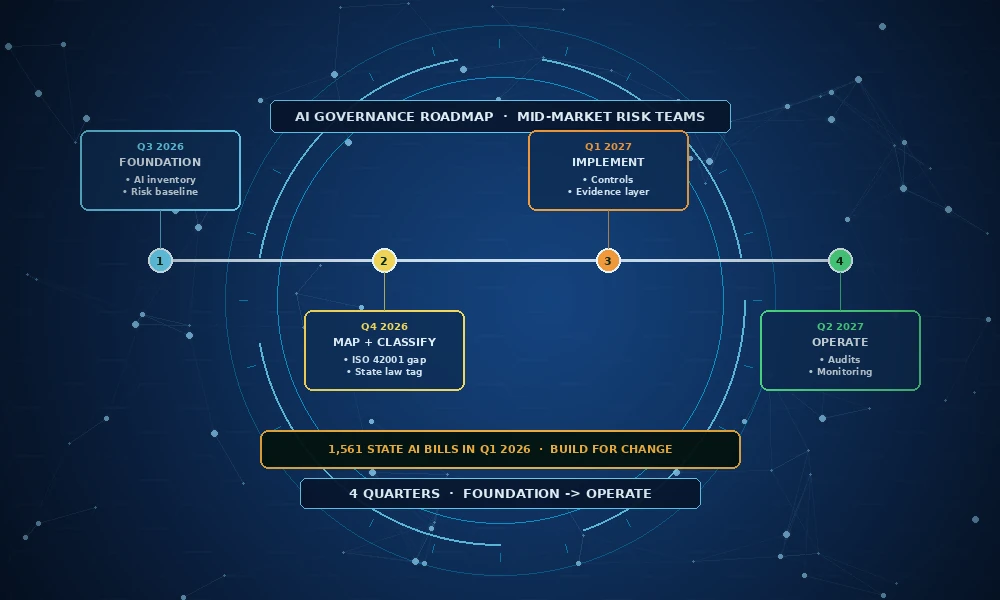
For a moderately complex organisation, implementing NIST AI RMF alignment takes 3–6 months; adding ISO 42001 certification adds 2–4 months; completing EU AI Act-specific requirements (conformity assessment, EU database registration, transparency disclosures) adds a further 2–4 months. Total realistic timeline: 8–12 months. Organisations without existing AI governance programmes should treat the August 2026 deadline as already close.
Where to Start
The EU AI Act is already in force. Three provisions are already being enforced. The August 2026 deadline for high-risk AI systems is the next major milestone, and the implementation work required to meet it inventory, classification, documentation, governance infrastructure, conformity assessment takes longer than most compliance teams estimate when they first look at it clearly.
The organisations that are best positioned right now are those that treated classification as a starting point rather than a finish line, built cross-functional governance structures before the technical requirements hit, and established documentation discipline from the first system inventory forward.
Your next step is concrete: if you do not have a complete inventory of AI systems in production and development, that is where this starts. Everything else follows from knowing what you have.
| Govern365.aiby the Global AI Certification CouncilThe EU AI Act compliance platform built by the people who wrote the standard.AI model registry. Risk assessment. Audit evidence. Compliance dashboards.Start your 14-day free trial → |