According to the ISO Survey of Management System Standards 2023, the adoption of AI-specific governance frameworks is accelerating faster than any management system standard since ISO 27001’s early growth years. ISO/IEC 42001:2023 is the first international standard for Artificial Intelligence Management Systems (AIMS), and organisations across every sector are now asking the same two questions: what will this actually cost us, and how long will it take?
The answers depend on factors most guides gloss over: your current governance maturity, the number and complexity of your AI systems, whether you already hold ISO 27001, and which accredited certification body you select. This article gives you the complete, honest picture, so you can plan and budget accurately before you commit.
By the end, you will understand the full cost structure by organisation size, the realistic five-phase timeline, what the certification audit actually involves, and where the hidden costs live.
What ISO 42001 Certification Actually Means
ISO 42001 certifies your management system, not your AI products. This is the single most important distinction, and the market keeps getting it wrong.
When your organisation receives ISO/IEC 42001 certification, the certificate says: this organisation has established, implemented, maintains, and continually improves an Artificial Intelligence Management System. It does not say that any specific AI model, algorithm, or application is safe, ethical, or compliant with the EU AI Act. Organisations that conflate the two spend months preparing for a certification that does not deliver what they expected.
The standard, published by ISO and IEC in December 2023, is structured around the familiar ISO High-Level Structure used in ISO 9001 (quality), ISO 27001 (information security), and ISO 22301 (business continuity). Clauses 4 through 10 cover context, leadership, planning, support, operation, performance evaluation, and improvement. Annex A provides 38 controls specific to AI governance, covering areas including AI system lifecycle, data quality, transparency, human oversight, and impact assessment.
For US organisations, this structure has two practical advantages. First, if you already hold ISO 27001, your management system framework transfers directly. You are adding AI-specific controls, not rebuilding from scratch. Second, the third-party certification process generates auditable evidence that procurement teams, federal agencies, and enterprise customers can verify, something that self-attested NIST AI RMF alignment cannot provide.
| CRITICAL DISTINCTIONISO 42001 certifies the organisation’s AI governance system. EU AI Act product-level obligations for high-risk systems are a separate, additional exercise. |
The Full Cost Breakdown: What You Are Actually Paying For
ISO 42001 certification costs vary more than most published ranges suggest. A small SaaS company certifying a narrow scope around a single AI feature will spend far less than a financial services firm certifying its entire AI operations. Here is where the money actually goes.
1. Gap Analysis: $3,000–$40,000
The gap analysis benchmarks your current AI governance practices against ISO 42001’s requirements, specifically the 38 Annex A controls and the management system clauses. It tells you what you have, what you are missing, and how much work lies ahead.
Most organisations with no existing AI governance infrastructure will have significant gaps in three areas: AI system documentation and inventory, AI risk and impact assessment processes, and human oversight mechanisms. For a mid-size organisation, expect a qualified consultant to spend three to five days on a credible gap analysis.
If your organisation has mature ISO 27001 controls, the gap is substantially narrower. The management system framework transfers, and you are focusing effort on AI-specific requirements, particularly Clause 6.1.2 (AI risk assessment), Clause 6.1.4 (AI impact assessment), and Annex A controls around transparency, fairness, and lifecycle governance.
2. Implementation: $10,000–$150,000
Implementation is where most organisations underestimate cost. Beyond consultant fees, there is significant internal resource time: someone must document every AI system in scope, conduct impact assessments, build evidence portfolios, train staff, and run an internal audit before the certification body arrives.
The biggest implementation variable is AI system boundary definition. With ISO 27001, scope follows your information assets. With ISO 42001, you must decide which AI systems are in scope, and in 2025 that is genuinely hard. Every software vendor claims their product uses AI. Your procurement team may have acquired a dozen tools in the past three years that technically qualify. Sorting this out requires analytical work that consumes real time.
Organisations that have implemented governance tooling, including AI model registries and structured risk assessment workflows, consistently report lower implementation costs. The evidence generation that would otherwise take weeks of spreadsheet work can be largely automated.
3. Certification Audit: $7,000–$25,000
The certification body fee covers a two-stage audit process. Stage 1 is a documentation review, where the auditor confirms your AIMS documentation is complete, your scope is defined, and your Statement of Applicability (SoA) is properly structured. Stage 2 is the substantive audit, where the auditor tests your AIMS in practice: interviewing staff, reviewing evidence, and validating that your controls operate as documented.
In the US, certification must come from a body accredited by the ANSI National Accreditation Board (ANAB). Schellman became the first ANAB-accredited ISO 42001 certification body in September 2024. SGS and A-LIGN have since achieved accreditation. Choose carefully: ANAB accreditation is the gold standard for US organisations, and many enterprise procurement teams and federal agencies require it explicitly.
Certification runs on a three-year cycle. After initial certification, annual surveillance audits cost $3,500–$9,000, and a full recertification audit occurs at year three.
Cost Summary by Organisation Size
| Organization Size | Gap Analysis | Implementation | Certification Audit | Total Range |
|---|---|---|---|---|
| Small (<100 employees) | $3,000–$8,000 | $10,000–$30,000 | $7,000–$15,000 | $20,000–$55,000 |
| Mid-size (100–1,000) | $8,000–$20,000 | $30,000–$70,000 | $12,000–$20,000 | $50,000–$110,000 |
| Large Enterprise (1,000+) | $15,000–$40,000 | $60,000–$150,000 | $18,000–$25,000 | $90,000–$215,000 |
Sources: Vanta ISO 42001 Cost Guide, CertBetter ISO 42001 Cost Analysis 2026. [VERIFY] Ranges represent US market data as of 2026.
| WHAT MOST GUIDES MISSThe biggest hidden cost is internal effort. Defining AI system boundaries, completing AI impact assessments, and building audit evidence for standards that auditors are still learning takes hundreds of person-hours that no cost table captures. |
The Five-Phase Certification Timeline
Most organisations complete ISO 42001 certification in four to twelve months. Smaller businesses with a narrow scope and mature governance foundations can achieve certification in three to four months. Large enterprises building AIMS capability from scratch should plan for twelve months or more.
Two variables do more than anything else to compress or extend that range: how much of your AI management system already exists, and how quickly you can define your AI system inventory and scope.
| Phase | Typical Duration | Key Activities |
|---|---|---|
| Phase 1: Gap Analysis | 2–6 weeks | Scope AI systems, assess against Annex A controls, document gaps |
| Phase 2: AIMS Design | 4–10 weeks | Develop AI Policy, Risk Methodology, SoA, AI Impact Assessment process |
| Phase 3: Implementation | 6–16 weeks | Deploy controls, train staff, build audit evidence, run internal audit |
| Phase 4: Stage 1 Audit | 1–2 weeks | Certification body reviews documentation and AIMS readiness |
| Phase 5: Stage 2 Audit | 1–3 weeks | On-site/remote evidence review, AIMS in practice assessment |
| Certification Issued | 2–4 weeks post-audit | Non-conformities closed, certificate issued (3-year validity) |
The Variable That Changes Everything: Existing ISO Certifications
Organisations that already hold ISO 27001 certification cut implementation time and cost materially. According to CertBetter’s 2026 analysis, a mid-size company adding ISO 42001 to an existing ISO 27001 programme spent approximately half what a comparable organisation building from scratch would spend. The management system framework, audit familiarity, documented information practices, and internal audit programme all transfer.
If your organisation holds both ISO 27001 and ISO 9001, ask certification bodies about integrated audit programmes. Several ANAB-accredited bodies now offer combined surveillance audits that reduce both time and cost across multiple standards.
What Genuinely Slows Certification Down
Three factors consistently extend timelines beyond original estimates:
- AI system inventory disputes. Getting cross-functional agreement on which AI tools and systems fall within the AIMS scope can take weeks. Procurement, IT, legal, and business units often have conflicting views. Build this conversation into your planning.
- AI Impact Assessment quality. ISO 42001 Clause 6.1.4 requires impact assessments covering potential consequences for individuals, groups, and society. These are substantive exercises, not checkbox forms. Auditors at mature certification bodies scrutinise them carefully, and thin assessments will generate non-conformities.
- Auditor availability. The supply of qualified ISO 42001 auditors is genuinely constrained. There are still relatively few certified lead auditors globally, and in the US most are concentrated at a handful of accredited certification bodies. Book early.
What the Certification Audit Actually Involves
The certification audit is two stages, and understanding what happens at each stage changes how you prepare.
Stage 1: Documentation Review
Stage 1 is typically conducted remotely. The auditor reviews your AIMS documentation to confirm readiness for Stage 2. The documents under review include:
- AIMS Scope Statement: which AI systems, processes, and organisational units are covered
- AI Policy: your organisation’s top-level commitment to responsible AI governance
- Statement of Applicability (SoA): which of the 38 Annex A controls apply, which are excluded, and why
- AI Risk Management Methodology: how your organisation identifies, evaluates, and treats AI risks
- AI Impact Assessment process and completed assessments
- Objectives and monitoring mechanisms
Stage 1 results in one of three outcomes: ready to proceed to Stage 2, proceed with minor concerns noted, or major gaps requiring remediation before Stage 2. The third outcome delays your timeline by four to twelve weeks.
Stage 2: AIMS in Practice
Stage 2 is where certification is won or lost. The auditor is testing whether your AIMS actually operates as documented, not whether your documents are well-written. Expect:
- Interviews with the AI Policy owner, risk assessment leads, and operational staff
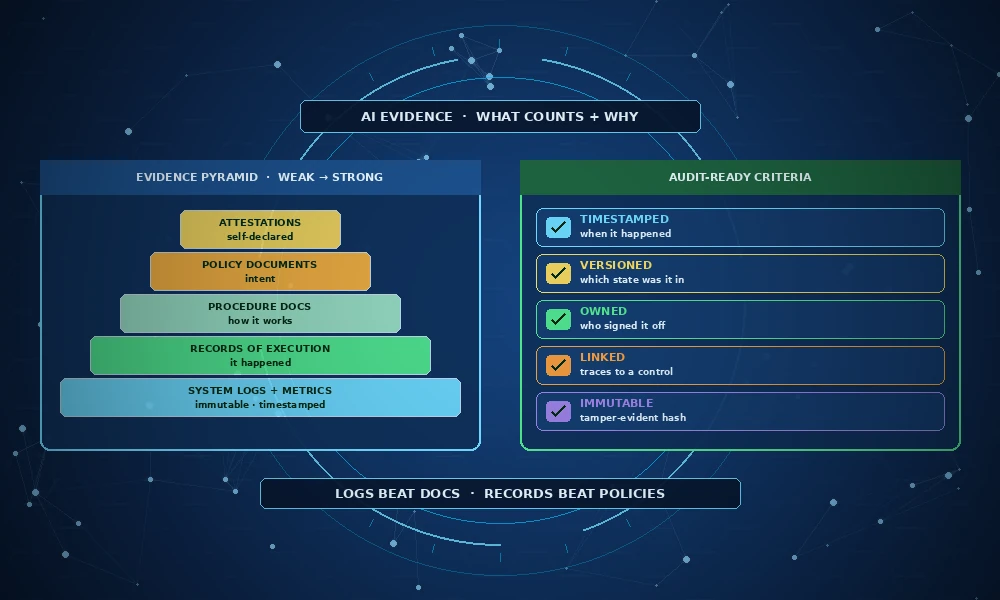
- Evidence review: meeting minutes, risk registers, training records, monitoring outputs
- Sampling of AI systems in scope to verify controls are functioning
- Review of internal audit results and management review records
Non-conformities from Stage 2 are classified as major or minor. Major non-conformities must be closed before certification is issued. Minor non-conformities require a corrective action plan. Most organisations close minor non-conformities within four weeks post-audit.
| WHAT AUDITORS ARE ACTUALLY LOOKING FORAuditors are not checking whether your AI is good. They are checking whether your management system for governing AI is real, operational, and evidenced. Organisations that treat AIMS as a documentation exercise fail Stage 2. |
ISO 42001 and the US Compliance Stack: NIST AI RMF and EU AI Act
US organisations pursuing ISO 42001 are almost always navigating multiple governance frameworks simultaneously. Understanding how they fit together avoids duplicated effort.
| Dimension | ISO/IEC 42001 | EU AI Act | NIST AI RMF |
|---|---|---|---|
| Nature | Voluntary standard (certifiable) | Binding EU law | Voluntary US framework |
| Scope | Organization-wide AIMS | AI system risk categories | AI risk management practices |
| Audit | Third-party certification audit | Notified body (high-risk systems) | Self-assessment or third-party |
| US Relevance | High (procurement, global sales) | Required for EU market access | High (federal contracts, enterprise) |
| Overlap | 40–50% overlap with EU AI Act | 73% of Clause 6.1 maps to Art. 9 | ~65% control alignment with ISO 42001 |
| Validity | 3 years (annual surveillance) | Ongoing compliance obligation | No formal expiry |
The frameworks are designed to complement each other. According to Trustible’s governance framework analysis, organisations running one integrated programme mapped across all three consistently outperform those running three parallel compliance efforts.
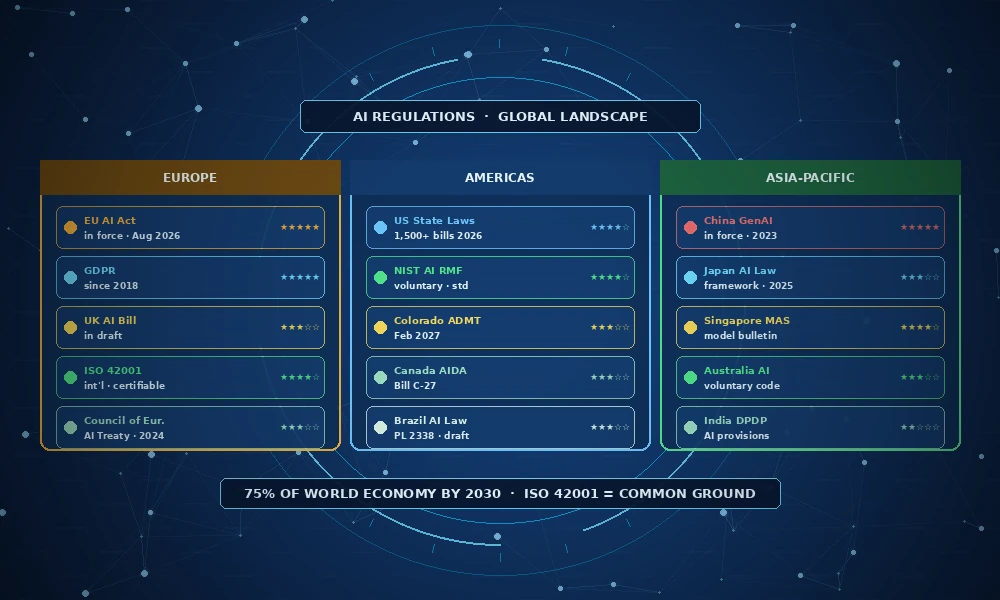
For US organisations, the practical sequence that minimises total effort is: implement ISO 42001 as your governance wrapper first, then layer EU AI Act obligations for systems in scope for EU market access, then map your NIST AI RMF alignment largely from the ISO 42001 controls already in place. The NIST AI RMF’s four core functions of Govern, Map, Measure, and Manage align substantially with ISO 42001 Clauses 4 through 10 and Annex A.
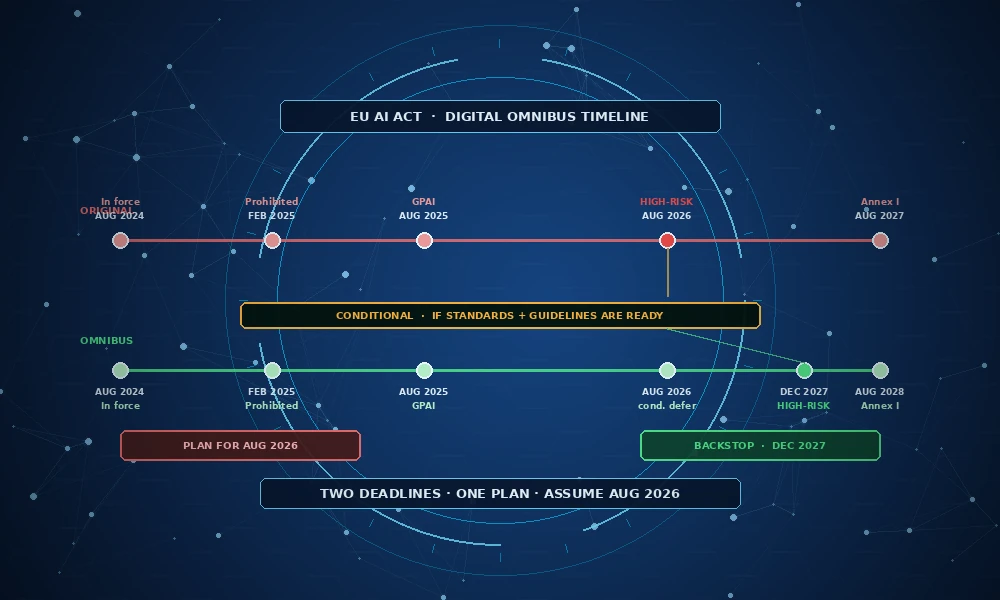
One critical note for US organisations: ISO 42001 certification does not substitute for EU AI Act product-level conformity assessments for high-risk AI systems. The EU AI Act Article 9 risk management requirements do overlap significantly with ISO 42001 Clause 6.1 controls (approximately 73% overlap per RSI Security’s NIST AI RMF/ISO 42001 crosswalk analysis), but the EU Act also imposes product-specific technical documentation, conformity assessments, and registration requirements that ISO 42001 certification does not cover.
The practical upside: Microsoft’s Supplier Security and Privacy Assessment (SSPA) programme now mandates ISO 42001 certification for AI systems in Sensitive Use cases. Enterprise procurement teams in financial services, healthcare, and public sector are following suit. For US organisations selling to large enterprises or government agencies, ISO 42001 is moving quickly from competitive differentiator to contract requirement.
Factors That Affect Your Specific Cost and Timeline
Three questions determine where you land in the cost and timeline ranges above:
1. How Many AI Systems Are in Scope?
Scope is the most consequential decision in the entire process. You can certify a single AI product, a business unit, or your entire AI operations. Narrow scope reduces cost significantly but limits what you can market. If you certify only your customer service AI system, your certificate is silent on every other AI system your organisation operates.
Most organisations certifying for competitive differentiation or enterprise procurement purposes choose a scope broad enough to cover the AI systems their clients care about. If your clients are asking about your AI governance for a specific product or service, scope to cover it.
2. What Is Your Current Governance Maturity?
Organisations that already have structured AI inventories, documented risk processes, and evidence management practices in place cut implementation time by 40–60%. The certification process becomes a formalisation exercise, not a construction project.
Organisations with no AI governance infrastructure and a large portfolio of AI systems should budget twelve months and plan for the gap analysis findings to generate a significant implementation workload.
3. Do You Have Existing ISO Certifications?
ISO 27001 holders have the most to gain. The management system structure, internal audit programme, documented information framework, and management review cadence all carry over. Adding ISO 42001 to an existing ISO 27001 programme typically costs 40–60% less than building from scratch, and several accredited bodies offer integrated audits.
ISO 9001 holders also benefit from familiarity with the High-Level Structure, even if fewer specific controls transfer.
How to Reduce Costs Without Cutting Corners
The cost levers are real, but not all of them are appropriate for every organisation. Here is what actually works:
- Define scope strategically, not minimally. A narrow scope that does not cover the AI systems your clients actually ask about generates a certificate that does not answer the question. Define scope around business value, not cost minimisation.
- Use existing ISO 27001 controls as your foundation. If you hold ISO 27001, map your existing controls to ISO 42001 requirements before commissioning a gap analysis. You will reduce the gap analysis time and your consultant will spend their days on AI-specific gaps rather than management system basics.
- Invest in a proper gap analysis before implementation. A credible gap analysis prevents you from building documentation for controls you already have. Organisations that skip this step consistently over-build, spending consultant days on work that was not needed.
- Automate evidence collection. The single biggest time sink in ISO 42001 implementation is building and maintaining the evidence portfolio for your AIMS. Organisations using governance platforms that automate evidence collection against specific controls report 30–50% reductions in internal staff hours through the audit cycle.
- Book your certification body early. Auditor availability is the real bottleneck in 2025–2026. Some accredited bodies have six-month lead times. If your programme timeline depends on a specific certification date, confirm auditor availability before you finalise your implementation schedule.
Govern365.ai’s AI model registry maps each system in your AIMS scope to its applicable ISO 42001 Annex A controls and EU AI Act risk categories automatically. For compliance teams running the gap analysis and evidence collection phases, this removes the manual mapping work that typically consumes the most consultant hours. Start your 14-day free trial to see how the platform handles your specific AI inventory.
Frequently Asked Questions
How much does ISO 42001 certification cost for a small business?
For small organisations (under 100 employees) with a narrow scope, total costs typically fall between $20,000 and $55,000, covering gap analysis, implementation support, and the certification audit. Organisations with existing ISO 27001 certification can reduce this by 40–60%. The certification body audit fee alone typically runs $7,000–$15,000 for initial certification from an ANAB-accredited body.
How long does ISO 42001 certification take?
Four to twelve months is the realistic range for most US organisations. Small businesses with narrow scope and strong existing governance can certify in three to four months. Large enterprises building AIMS capability from scratch should plan for twelve months. The single biggest variable is how quickly you can define your AI system inventory and complete AI impact assessments.
Is ISO 42001 certification mandatory in the USA?
No. ISO 42001 is a voluntary standard. However, it is becoming de facto mandatory in specific contexts: Microsoft’s SSPA programme now requires it for AI systems in Sensitive Use cases, and enterprise procurement teams in regulated sectors increasingly include it in vendor qualification criteria. Organisations selling AI products to government agencies or large enterprises should treat it as a near-term business requirement. See ANAB’s ISO 42001 accreditation page for current accredited certification bodies.
What is the difference between ISO 42001 certification and compliance with the EU AI Act?
ISO 42001 certifies your organisation’s AI Management System. The EU AI Act imposes product-level obligations for high-risk AI systems, including technical documentation, conformity assessments, and registration with EU authorities. An ISO 42001 certificate does not satisfy EU AI Act product conformity requirements. It does demonstrate organisational governance maturity that regulators consider, and it overlaps with approximately 40–50% of EU AI Act governance requirements.
What documents are required for ISO 42001 certification?
The core required documents include: an AIMS Scope Statement, an AI Policy, a Statement of Applicability (SoA) covering all 38 Annex A controls, an AI Risk Management Methodology, completed AI Impact Assessments, AI objectives and monitoring records, internal audit reports, and management review records. Additional documented information is typically needed for AI system lifecycle management, training, and corrective action processes.
Can we certify against ISO 42001 if we use third-party AI tools rather than building our own?
Yes. ISO 42001 applies to organisations that develop, provide, or use AI systems, which includes organisations that deploy third-party AI tools. Your AIMS must address governance of those tools within your scope, including procurement due diligence, risk assessment, and oversight mechanisms. The Annex A controls for AI supply chain and third-party AI system management are directly applicable.
Does ISO 42001 certification help with NIST AI RMF compliance?
Substantially. The NIST AI RMF’s four core functions of Govern, Map, Measure, and Manage align closely with ISO 42001 Clauses 4 through 10 and Annex A controls. Organisations that implement ISO 42001 and map their controls to NIST AI RMF typically find that 60–70% of the mapping work is already done. A formal crosswalk is available from NIST.
How long is ISO 42001 certification valid?
Three years. Annual surveillance audits (typically costing $3,500–$9,000 per year) are required to maintain the certificate. Surveillance audits are narrower in scope than the initial certification audit, focusing on whether your AIMS continues to operate effectively and whether any significant changes to your AI systems or processes affect your controls. Recertification at year three involves a full audit cycle.
Conclusion
ISO 42001 certification is a substantive investment, typically $20,000 to $215,000 depending on organisation size and scope, taking four to twelve months end-to-end. The cost and timeline are knowable in advance if you do the groundwork: a credible gap analysis, a well-defined scope, and clarity on whether your existing ISO certifications reduce the build. What most organisations underestimate is the internal resource cost and the time it takes to define AI system boundaries and complete credible AI impact assessments.
The single most effective thing you can do before engaging a certification body is build your AI inventory. Know what AI systems you operate, which processes they touch, and which stakeholders they affect. Everything else follows from that.
Govern365.ai, by the Global AI Certification Council, is built to help organisations make that first step faster and the certification journey more efficient. Start your 14-day free trial and see how the platform’s AI model registry, risk assessment tools, and audit evidence management cut through the compliance complexity that makes ISO 42001 harder than it needs to be.