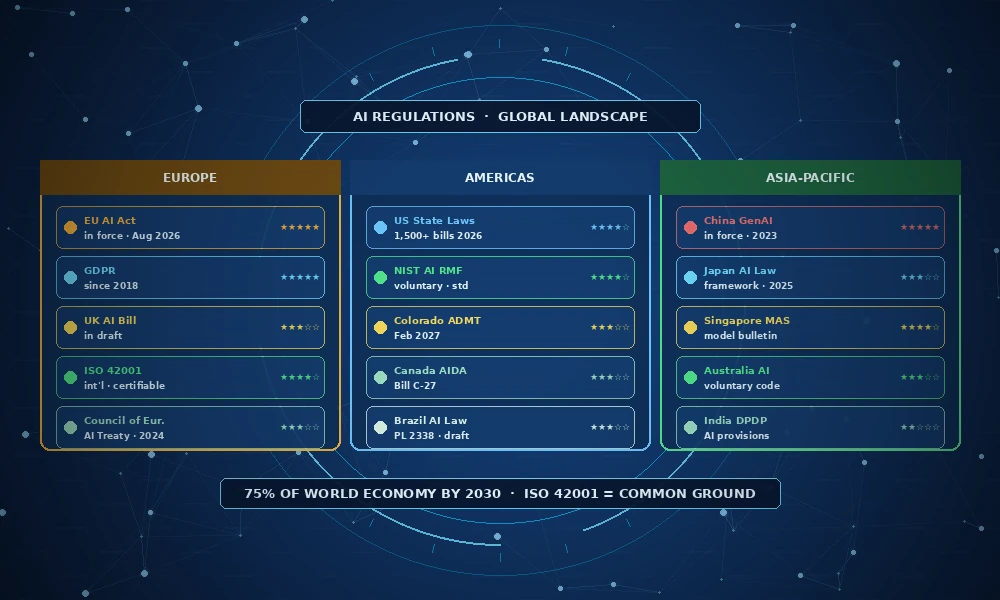
According to Gartner’s February 2026 forecast, enterprise spending on AI governance platforms is expected to reach $492 million in 2026 and surpass $1 billion by 2030, as fragmented AI regulation spreads to cover 75% of the world’s economies. That spending is happening now, and much of it is going to the wrong tools.
The market is crowded. Every vendor claims ISO 42001 alignment, EU AI Act readiness, and NIST AI RMF coverage. Some of those claims hold up under audit scrutiny. Many do not. For compliance teams, AI governance professionals, and the CTOs signing off on six-figure contracts, the difference between a genuine AI governance platform and a repackaged GRC tool matters enormously, both to certification outcomes and to the board conversations that follow.
This checklist gives you the requirements framework to evaluate any AI governance platform with the same rigour you would apply to an ISO 42001 audit. Use it before the RFP, during vendor demos, and as a final scoring tool before you commit.
Why Standard GRC Tools Fall Short for AI Governance
Most enterprise GRC platforms were built for a pre-AI regulatory world. They manage policies, track controls, and generate audit reports, but they were designed for static systems with stable risk profiles. AI systems are neither.
A machine learning model deployed in production is not a firewall rule. Its risk profile changes as training data drifts, as user inputs evolve, and as the model itself is retrained or fine-tuned. ISO/IEC 42001:2023 Clause 6.1 requires organisations to assess AI-specific risks, including impacts on affected persons and society, not just the organisation itself. Standard GRC tools typically have no mechanism for this kind of outward-facing, model-level risk assessment.
The EU AI Act compounds this gap. Under Articles 9 and 17, high-risk AI systems require documented risk management systems and post-market monitoring processes that are specific to each AI system’s intended purpose and operational context. A general-purpose policy management module in a legacy GRC platform cannot capture this specificity.
Three structural gaps separate purpose-built AI governance platforms from adapted GRC tools:
- AI model inventory with lifecycle tracking. You need a system of record for every AI system in your organisation, not a generic asset register. The platform must capture model version, training data provenance, deployment context, risk classification, and ownership, and it must update when any of these change.
- Framework-specific control mapping. A governance platform must be able to map a single AI system simultaneously to ISO 42001 clauses, EU AI Act articles, and NIST AI RMF categories. Manually maintaining three separate compliance programmes for the same system is unsustainable at enterprise scale.
- Continuous monitoring, not point-in-time audits. AI risk is dynamic. A platform that captures risk at onboarding and re-evaluates annually will miss the drift events, bias incidents, and model updates that constitute the most common sources of non-conformity in ISO 42001 certification audits.
| What most buyers get wrong:Evaluating AI governance platforms on compliance feature checklists alone. The more important questions are: can this platform produce audit-ready evidence packs on demand, and can it map one AI system to multiple frameworks simultaneously without duplicating governance effort? |
The 10 Core Requirements for an Enterprise AI Governance Platform
These requirements are drawn from ISO/IEC 42001:2023 clause structure, EU AI Act obligations for high-risk systems, NIST AI RMF core function requirements, and common findings from first-cycle certification audits. Vendors that cannot clearly demonstrate all ten during a structured evaluation should not be on your shortlist.
1. Centralised AI Model Registry
The platform must maintain a single, authoritative inventory of every AI system the organisation develops, deploys, or procures from third parties. Each record must include: system purpose, risk classification, applicable regulatory frameworks, owner, development status, and deployment environment. Without this, every downstream governance activity, risk assessment, compliance mapping, and audit evidence collection, operates on incomplete information.
ISO 42001 Clause 4.3 requires organisations to define the scope of their AI management system. That scope is only defensible if you have a complete, current inventory to scope from. Ask vendors: what triggers a registry update? How are third-party AI systems captured? What evidence of inventory completeness can you provide to an auditor?
2. AI-Specific Risk Assessment Engine
Generic risk matrices do not capture AI-specific harm vectors. The platform must support structured risk assessments that evaluate: algorithmic bias, data quality and provenance, explainability limitations, human oversight adequacy, and potential impacts on affected third parties. These are the risk dimensions that ISO 42001 Annex A controls are designed to address.
Under the EU AI Act’s Article 9, high-risk system providers must implement a risk management system that is continuous and iterative throughout the system’s lifecycle. A one-time intake assessment does not satisfy this. The platform must support scheduled re-assessment triggered by events: model updates, new data inputs, changes in deployment scope, or regulatory updates.
3. Multi-Framework Compliance Mapping
Every enterprise operating globally faces overlapping regulatory obligations. A US-headquartered organisation deploying AI that processes EU citizen data faces EU AI Act obligations. The same organisation may be pursuing ISO 42001 certification for contractual reasons while also aligning with NIST AI RMF for federal procurement requirements.
The platform must map a single control or evidence item to multiple framework requirements simultaneously. This is the governance equivalent of single-sourcing, where you build once and publish to many. Without it, your compliance team is maintaining three separate evidence sets for what is, in practice, the same AI governance programme.
| Framework | US Applicability | Key Obligations | Overlap with ISO 42001 |
|---|---|---|---|
| ISO/IEC 42001:2023 | Global standard; US federal procurement increasingly referenced | AIMS scope, risk assessment (Cl. 6.1), controls (Annex A) | Core framework; 100% coverage |
| EU AI Act | Applies to US orgs serving EU markets or using EU data | Risk classification, Art. 9 risk mgmt, Art. 17 QMS, post-market monitoring | ~73% clause overlap with ISO 42001 Cl. 6-10 |
| NIST AI RMF | US federal and voluntary; growing procurement requirement | Govern, Map, Measure, Manage functions | Complementary; NIST categories map to ISO 42001 controls |
| NIST AI RMF Gen AI Profile | US voluntary; July 2024 update covers LLM/GenAI risks | Hallucination, data provenance, CBRN risk, transparency | Extends ISO 42001 for generative AI use cases |
4. Audit Evidence Management
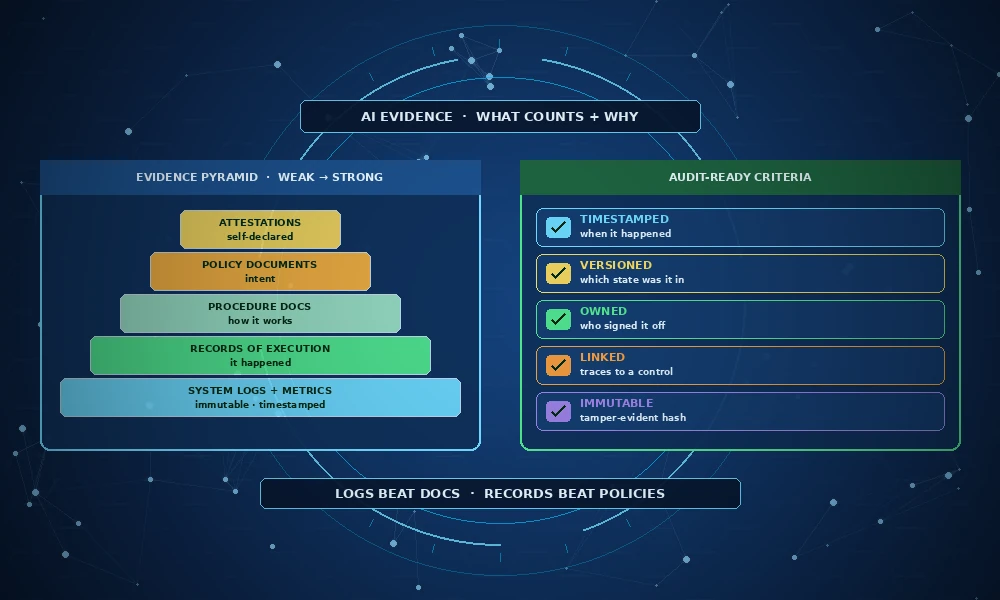
Certification auditors do not just read policy documents. They trace evidence: they want to see that a risk assessment was conducted on a specific model, reviewed by the right person, approved at the right level, and updated when the model changed. A platform that cannot produce this evidence trail on demand will fail an ISO 42001 Stage 2 audit.
The platform must support structured evidence collection that links directly to specific framework controls. When an auditor asks for evidence of compliance with ISO 42001 Clause 8.4 (documentation of AI system objectives and constraints), the platform should be able to surface the relevant records in seconds, not hours. Version history, approval timestamps, and ownership audit trails are not optional features. They are what separates a certifiable governance programme from a well-intentioned spreadsheet exercise.
5. Compliance Dashboard and Board-Ready Reporting
Two audiences need very different views of the same compliance data. Your GRC team needs control-level status, outstanding evidence gaps, and upcoming review deadlines. Your board needs a consolidated view of AI risk exposure, certification status, and regulatory coverage across jurisdictions.
A platform that only serves one of these audiences creates a data translation burden. Compliance teams spend time reformatting technical reports into executive summaries. Boards receive information that is already weeks out of date. The platform should support role-based views that allow each stakeholder group to see the information they need, at the level of detail they need it, drawn from the same underlying data source.
6. AI Lifecycle Governance Controls
ISO 42001 Clause 8 covers operational planning and control across the AI lifecycle, from design through deployment through decommissioning. Many platforms handle deployment-stage governance adequately. Fewer handle the full lifecycle.
The pre-deployment phase is where the most consequential governance decisions are made: what training data will be used, what bias testing will be conducted, what human oversight mechanism will be built in, and what the model’s intended use boundaries are. A platform that cannot capture and enforce governance gates at the design and development stage is not implementing ISO 42001 Clause 8, it is documenting after the fact.
Specifically, the platform should support: pre-deployment impact assessments, training data documentation, model card generation, human oversight documentation, and post-deployment monitoring thresholds. Each of these maps to specific ISO 42001 controls and EU AI Act requirements.
7. Third-Party AI Supplier Management
The majority of enterprise AI deployments now include components procured from third parties, foundation models, AI-enabled SaaS applications, and model APIs. ISO 42001 Clause 7.5 and EU AI Act Article 28 both impose obligations on organisations that deploy AI systems regardless of whether they developed them.
The platform must support a supplier governance workflow that captures: the AI systems procured from each vendor, the vendor’s own governance certifications and practices, contractual commitments on data handling and model updates, and the organisation’s downstream obligations when a vendor’s model changes. The SAP ISO 42001 certification model, where an enterprise platform vendor certifies its AI infrastructure and customers inherit partial coverage, represents one shared responsibility approach, but it requires the customer organisation to document what it relies on versus what it governs directly.
8. Policy Management with Version Control
AI governance policy is not static. As regulations are updated, as the organisation’s AI use cases evolve, and as incident learnings are incorporated, policies must change. The platform must maintain a complete version history for every policy document, including who approved each version, when, and what changed.
This is not a nice-to-have. ISO 42001 Clause 7.5 on documented information requires that organisations control the creation, update, and distribution of their governance documentation. An auditor conducting a surveillance audit will ask for evidence that your AI use policy was reviewed and updated following a specific event, such as a model change or a new regulatory requirement. If you cannot produce that evidence, the non-conformity is yours to own, regardless of whether the underlying governance decision was sound.
9. Integration with Enterprise Systems
A governance platform that operates in isolation from the systems where AI is actually built and deployed will always be working from incomplete information. At minimum, the platform should integrate with: your MLOps or AI development platform (to receive model version updates), your data governance tooling (to capture data lineage), your identity and access management system (for ownership and approval workflows), and your enterprise GRC platform (to feed AI risk data into broader enterprise risk management).
API-first architecture is the non-negotiable foundation. Vendor promises of integration should be tested in proof-of-concept before procurement, specifically with the systems you actually use, not with the systems the vendor most commonly integrates with.
10. Certification and Audit Readiness Workflows
This is the requirement most buyers add as an afterthought. It should be the first question. The platform must have been designed with the ISO 42001 audit process in mind, not adapted to it after the fact.
Ask the vendor to walk you through exactly what an external auditor would see when conducting a Stage 1 documentary review and a Stage 2 conformity assessment. If the vendor needs to prepare a bespoke report for the auditor, the platform has failed this requirement. The audit evidence pack should be a standard platform output, generated on demand, scoped to the certification audit period, and formatted in a way that an ISO 42001 lead auditor can navigate without training.
The Evaluation Checklist: Questions to Ask Every Vendor
Use this question set during vendor demonstrations. Score each requirement 0 (not present), 1 (partially addressed), or 2 (fully demonstrated). Require evidence for each 2-score claim, not verbal assurances.
| Requirement Area | Evaluation Question | Evidence to Request |
|---|---|---|
| AI Model Registry | Can you show us the full inventory view for a multi-system deployment including third-party models? | Live demo with sample registry; export functionality to Excel/PDF |
| Risk Assessment | Walk us through an AI-specific risk assessment for a high-risk system under EU AI Act Article 9. | Assessment template; sample completed assessment; re-assessment trigger workflow |
| Multi-Framework Mapping | Show us how a single control maps across ISO 42001, EU AI Act, and NIST AI RMF simultaneously. | Live framework mapping view; single evidence item mapped to multiple controls |
| Audit Evidence | Generate an ISO 42001 Stage 2 evidence pack for a specific AI system, on demand, right now. | Actual evidence pack output; auditor-facing report format |
| Reporting | Show us both the GRC team dashboard and the executive board report from the same data source. | Role-based dashboard demo; export a board-ready PDF summary |
| Lifecycle Coverage | Demonstrate governance controls at the pre-deployment design stage, not just post-deployment monitoring. | Pre-deployment checklist; impact assessment workflow; model card generation |
| Supplier Management | How does the platform handle an AI system where the foundation model is provided by a third party? | Supplier governance workflow; vendor certification tracking |
| Policy Management | Show us the version history for a policy document, including approvals and change log. | Policy document with full audit trail; version comparison view |
| Integrations | What is your documented integration with [your MLOps platform]? Provide reference customers who use this integration in production. | API documentation; reference customer contact |
| Certification Readiness | Generate the documentation package an ISO 42001 Stage 1 auditor would receive. How long does this take? | Live generation of audit pack; timing demonstration |
Framework Alignment: What Genuine Coverage Looks Like
Vendor marketing materials routinely claim alignment with ISO 42001, the EU AI Act, and NIST AI RMF. These claims are largely unverifiable from a website or a sales deck. The following indicators distinguish genuine framework coverage from surface-level alignment.
ISO/IEC 42001: Beyond Clause-Level Awareness
Genuine ISO 42001 coverage means the platform supports the full PDCA (Plan-Do-Check-Act) cycle of an AI Management System. Clause 4 (context) requires documentation of internal and external issues affecting the AIMS. Clause 6 (planning) requires AI-specific risk and opportunity assessments. Clause 8 (operation) requires documented operational controls. Clause 9 (performance evaluation) requires internal audit support and management review inputs. Clause 10 (improvement) requires documented nonconformity and corrective action tracking.
A platform that supports Clauses 6 and 8 but lacks internal audit management (Clause 9.2) or corrective action tracking (Clause 10.2) cannot support an ISO 42001 certification programme. Both are mandatory requirements. Both are commonly absent from platforms that have adapted GRC tooling rather than built natively for ISO 42001.
EU AI Act: Risk Classification as a Platform Function
The EU AI Act’s risk classification system, minimal, limited, high, and unacceptable risk, requires organisations to assess each AI system against criteria that include the system’s intended purpose, deployment context, affected populations, and potential harm severity. This is a structured decision workflow, not a static label.
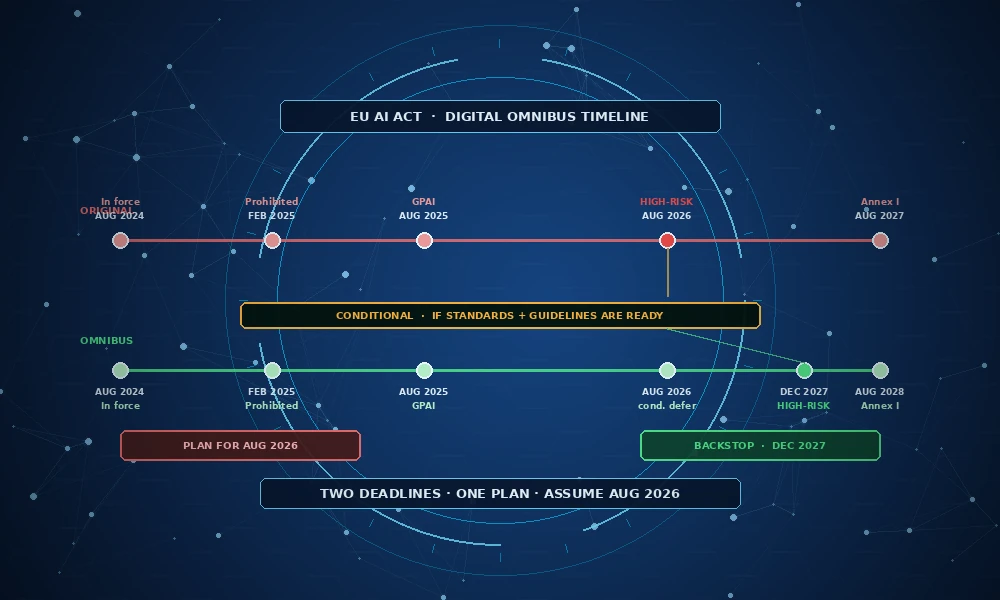
A platform that supports EU AI Act compliance must embed the risk classification logic as a guided workflow, not as a drop-down field the user populates manually. The distinction matters because manual classification creates audit exposure: if the classification is challenged, the organisation needs to be able to demonstrate the reasoning behind it, not just assert the outcome. The August 2026 compliance deadline for high-risk AI systems creates urgency here for US-based organisations that serve EU markets or process EU citizen data.
NIST AI RMF: The US Governance Anchor
The NIST AI Risk Management Framework organises AI governance into four core functions: Govern, Map, Measure, and Manage. Its July 2024 Generative AI Profile adds specific guidance for large language models and foundation model deployments. For US federal procurement and for organisations seeking to demonstrate responsible AI practices to US regulators, NIST AI RMF alignment is increasingly expected rather than optional.
The platform should map each NIST AI RMF subcategory to your specific AI systems. The Govern function, which covers organisational policies, risk tolerance, and accountability structures, overlaps substantially with ISO 42001 Clauses 4-7. A platform that supports both should be able to demonstrate that a governance control implemented for ISO 42001 simultaneously satisfies the relevant NIST AI RMF Govern subcategory, without requiring duplicate data entry.
Red Flags in the Evaluation Process
Vendors who cannot answer certain questions during a structured evaluation are telling you something important. These are the responses that should give a procurement team pause.
- “We support all major frameworks.” Without the ability to demonstrate specific control mapping, this is a marketing claim. Ask them to show you, live, how a single AI system maps across ISO 42001 Clause 6.1.2, EU AI Act Article 9, and NIST AI RMF Measure function. If they need more than a few minutes, the mapping is not native to the platform.
- “We can customise the platform to meet your requirements.” Customisation means the requirement is not currently met. Every custom field, custom workflow, and custom integration adds implementation time, ongoing maintenance cost, and audit complexity. A platform that requires significant customisation for core ISO 42001 requirements is not an AI governance platform; it is a configurable database.
- “Our customers have used this for ISO 42001 certification.” This is the right answer to the right question, but verify it. Ask for a reference customer contact (not a case study) who completed ISO 42001 certification using the platform as their primary governance tool. A 15-minute reference call will tell you more than a year of vendor-produced case studies.
- “We’re building that feature.” Evaluate what exists today, not what is on the roadmap. Certification deadlines and board commitments cannot wait for a feature that was promised for Q3 and shipped in Q1 the following year. If a capability appears on the roadmap rather than in the product, score it zero.
- No evidence of the vendor’s own AI governance posture. A vendor selling AI governance software should itself be governed. Ask about their own ISO 42001 certification status, their internal AI usage governance, and whether their product has been independently audited. A vendor that cannot answer these questions should not be trusted to help you answer them.
Assessing Implementation Readiness Before You Sign
Platform selection and implementation success are different problems. A platform that scores well on capability evaluation can still deliver a poor outcome if the implementation is poorly scoped, under-resourced, or disconnected from the certification timeline.
Three questions determine implementation readiness:
- What is the realistic timeline from contract signature to certification-ready? Not go-live, which is a technical milestone. Certification-ready means your governance programme is documented, your AI systems are inventoried and assessed, your controls are mapped to ISO 42001, and you can generate a complete evidence pack. For most enterprise implementations, this is 4-9 months from contract signature. Any vendor claiming less than 3 months for an enterprise deployment is either scoping a partial implementation or has not done this before.
- Who from the vendor team will be accountable for implementation success? AI governance implementation is not a standard SaaS onboarding. It requires people who understand both the platform and the ISO 42001 audit process. Ask specifically: will you have access to an ISO 42001 specialist during implementation, or only a technical implementation consultant? The gap between these two roles is where most implementation failures originate.
- What does ongoing support look like when regulations change? The EU AI Act delegated acts are still being published. NIST continues to update its AI RMF guidance. ISO 42001 will be revised. The platform must have a demonstrated process for incorporating regulatory updates into the framework mappings and control templates, and you need to know how quickly that process works and whether it requires paid professional services to implement.
| Govern365.ai implementation note:Govern365.ai’s AI model registry, risk assessment engine, and compliance dashboards are built natively for ISO 42001, EU AI Act, and NIST AI RMF, by a team that includes ISO 42001 lead auditors. Organisations using Govern365.ai for their first ISO 42001 certification cycle have documented evidence packs and audit-ready governance programmes. The platform is endorsed by the Global AI Certification Council (GAICC), the certifying body whose auditors conduct ISO 42001 assessments. That alignment is not coincidental: the platform was designed to meet the standard, not to describe it. |
Total Cost of Ownership: What the License Fee Doesn’t Tell You
The most common procurement mistake in AI governance platform selection is comparing license fees without accounting for the full cost of implementation and ongoing operation. Three cost categories are routinely underestimated.
Implementation and configuration costs. A platform that requires significant customisation to meet your requirements will incur professional services costs beyond the license. Get a detailed statement of work before signing, not an estimate. Ask specifically: which elements of the implementation are included in the license, and which require paid professional services?
Internal resource costs. Platform adoption requires internal change management. Someone in your organisation needs to own the governance programme, populate the AI model registry, conduct and document risk assessments, and manage the audit preparation process. If the platform is complex enough to require a dedicated full-time resource, that cost belongs in your total cost of ownership calculation.
Regulatory update costs. When the EU AI Act’s high-risk system provisions take full effect in August 2026, or when a new NIST guidance publication changes the expected controls, your platform needs to reflect those changes. Ask whether framework updates are included in the license or are delivered as paid professional services engagements. For US organisations subject to rapidly evolving state-level AI laws, such as Colorado’s SB 205, this question is not hypothetical.
Scoring Your Shortlist: A Weighted Evaluation Framework
Not all requirements carry equal weight. An organisation in the first year of its ISO 42001 journey has different priorities from one preparing for a surveillance audit. Adjust the weightings below to reflect your specific certification stage and regulatory exposure.
| Requirement | Weight (Year 1 Certification) | Weight (Ongoing/Surveillance) | Max Score |
|---|---|---|---|
| AI Model Registry | High (×3) | High (×3) | 6 |
| AI-Specific Risk Assessment | High (×3) | Medium (×2) | 6 |
| Multi-Framework Mapping | Medium (×2) | High (×3) | 6 |
| Audit Evidence Management | High (×3) | High (×3) | 6 |
| Compliance Dashboards | Medium (×2) | Medium (×2) | 4 |
| AI Lifecycle Controls | Medium (×2) | High (×3) | 6 |
| Supplier Management | Low (×1) | Medium (×2) | 4 |
| Policy Version Control | High (×3) | Medium (×2) | 6 |
| Enterprise Integrations | Medium (×2) | Medium (×2) | 4 |
| Certification Readiness Workflows | High (×3) | High (×3) | 6 |
Score each platform 0-2 per requirement (0 = not present, 1 = partially met, 2 = fully demonstrated with evidence), then multiply by the relevant weight. A platform scoring below 70% of maximum weighted points should not proceed to contract.
Frequently Asked Questions
What is the difference between an AI governance platform and a GRC tool?
A GRC tool manages policies, controls, and compliance records across any risk domain. An AI governance platform is AI-native: it understands AI-specific risk categories (model drift, bias, hallucination, data provenance), maps them to AI-specific regulatory requirements (ISO 42001, EU AI Act, NIST AI RMF), and tracks risk dynamically across the AI system lifecycle. The core difference is specificity. A GRC tool adapted for AI governance will typically lack the structured risk assessment templates, framework-specific control mappings, and lifecycle tracking that ISO 42001 certification requires.
Does our organisation need ISO 42001 certification to comply with the EU AI Act?
ISO 42001 certification is not legally required by the EU AI Act. However, the standard’s controls map closely to EU AI Act obligations for high-risk systems, particularly Articles 9, 17, and 72. Organisations that have implemented an ISO 42001-conformant AI management system will find the EU AI Act compliance pathway significantly shorter. More practically, ISO 42001 certification is becoming a procurement requirement in enterprise contracts, particularly for AI system providers, independent of regulatory mandates.
How long does ISO 42001 certification typically take?
For most enterprise organisations starting from scratch, ISO 42001 certification takes 9-18 months from programme initiation to Stage 2 audit completion. Organisations with existing ISO 27001 certification can often accelerate this timeline, as the management system structure and documentation practices are transferable. Organisations using purpose-built AI governance platforms with structured implementation programmes typically complete certification in 6-12 months. The most common delay is incomplete AI system inventory and risk documentation, which a well-implemented platform prevents.
Can a small compliance team manage an AI governance platform without dedicated IT support?
It depends on the platform. Purpose-built AI governance platforms designed for compliance and GRC teams should be operable without continuous IT involvement after initial setup. The test: can your team create a new AI system record, complete a risk assessment, map controls to ISO 42001, and generate an audit evidence pack without submitting an IT service ticket? If the answer is no, the platform’s operational complexity belongs in your total cost of ownership calculation.
What should we ask an AI governance platform vendor about their own AI governance practices?
Ask: Is your product itself covered by an ISO 42001 certification? Do you use AI in your platform, and if so, how is it governed? What is your process for updating framework mappings when regulations change? Have your platform’s framework mappings been independently validated by a recognised accreditation body? Vendors who cannot answer these questions directly are demonstrating, in real time, the governance gap their product is supposed to solve.
The Procurement Decision That Will Define Your Certification Outcome
The AI governance platform market is maturing fast, but it is still full of products that describe compliance rather than enable it. The $492 million enterprises are spending on AI governance this year will produce very different outcomes depending on whether the platform at the centre of that programme was designed for ISO 42001 certification or retrofitted for it.
The ten requirements in this checklist are not a wish list. They are the minimum functional foundation for a certifiable AI governance programme. Use them to filter your longlist before a single demo. Use them to score your shortlist after every demo. Use them to hold vendors accountable to evidence, not assurances.
Start your 14-day free trial of Govern365.ai, by the Global AI Certification Council, and see how a platform built by certification professionals maps to every requirement in this checklist.