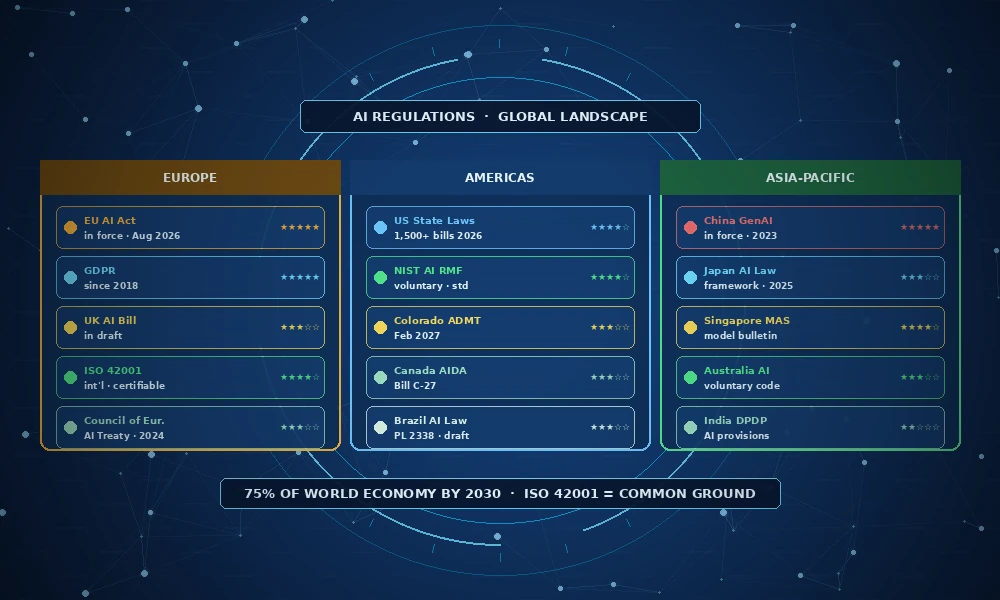
According to Gartner’s November 2025 Market Guide for AI Governance Platforms, fragmented AI regulation is forecast to quadruple and cover 75% of the world’s economies by 2030, driving $1 billion in total AI compliance spend. That spend is already moving procurement cycles are opening, audit deadlines are firm, and finance teams are being asked for budget numbers before anyone has scoped what a platform actually costs.
Most published pricing guides for AI governance platforms either list tools without cost data, or give ranges so wide they’re useless. This article does something different: it maps exactly what drives AI governance platform pricing, breaks down each cost component, benchmarks across organisation sizes, and gives you a working framework for scoping your own investment across ISO 42001, the EU AI Act, and NIST AI RMF.
What’s Driving AI Governance Platform Adoption in 2025
The short answer to ‘why now?’ is regulation but the full answer is more interesting.
The EU AI Act entered enforcement in stages: prohibitions on unacceptable-risk AI practices applied from August 2024, and high-risk AI system requirements take effect in 2026. Any US organisation serving EU customers or operating in European markets is within scope. Meanwhile, ISO/IEC 42001:2023 the first international standard for AI management systems (AIMS) was published in December 2023, and US enterprises are now beginning their first certification cycles. The NIST AI RMF, released in January 2023, has become the de facto US governance reference for regulated industries.
Gartner’s market data quantifies the response: the AI governance platform market is projected to reach $492 million in 2026, up from an early-stage market just two years ago. By 2030, Gartner forecasts that $1 billion in annual compliance spend will flow through dedicated governance tooling.
What actually triggers the purchase in most organisations isn’t a regulatory deadline it’s the third audit. Governance programmes built on spreadsheets and shared drives work until an auditor asks for version history on a risk assessment, or requests evidence that a policy change was communicated to the affected team. That’s when the hidden cost of manual governance becomes visible, and the conversation about platforms becomes urgent.
Shadow AI amplifies this. Unregistered AI tools being used across the enterprise coding assistants, content generators, customer-facing bots create governance gaps that spreadsheets cannot track. A platform that provides continuous AI system discovery, not just a static register, is increasingly the baseline requirement.
How AI Governance Platform Pricing Actually Works
Four pricing models dominate the market. Each makes different assumptions about what governance effort actually costs.
| Pricing Model | How It Works | Scales With | Best For | Typical Range |
|---|---|---|---|---|
| Per seat / per user | Fixed fee per named user per month or year | Team size | Small governance teams with defined headcount | $300–$1,200 per user/year |
| Per AI model / use case | Fixed fee per AI system governed | AI deployment footprint | Organisations with defined, bounded AI programmes | $500–$5,000 per model/year |
| Consumption-based | Variable fee tied to platform activity (API calls, assessments run, evidence generated) | Usage intensity | Unpredictable or seasonal compliance workloads | Base + variable overage |
| Flat enterprise license | Single annual fee for unlimited users and models within agreed scope | Negotiated at contract | Large enterprises wanting budget predictability | $120,000–$300,000+/year |
Per-Seat vs Per-Model: Which Scales Better for Governance?
Per-seat pricing is familiar it’s how most GRC and SaaS platforms work. The problem is that governance effort doesn’t scale with the number of compliance team members; it scales with the number of AI systems you’re governing. A ten-person GRC team overseeing 200 AI models has a fundamentally different workload than the same team overseeing 20 models. Per-model pricing reflects that reality.
This shift is visible in market data. Growth Unhinged’s 2025 State of B2B Monetization report found that seat-based pricing dropped from 21% to 15% of software companies in just 12 months, while hybrid models surged from 27% to 41%. For AI governance platforms specifically, this matters: as AI deployments grow, per-seat costs stay flat while governance complexity multiplies. Most enterprise platforms have already moved to a base platform fee plus a per-model or consumption variable.
Hybrid Models and What They Mean for Budget Forecasting
Hybrid pricing a fixed platform fee covering core modules plus a variable component for scale is now the default structure for mid-market and enterprise platforms. Budget forecasting requires you to estimate both the base commitment and the likely variable: how many AI systems you will bring under governance, and at what intensity of assessment and monitoring activity.
For budget planning purposes, model the variable at 120% of your current AI deployment count. Governance programmes consistently discover more AI systems during the registry phase than were initially declared.
Core Modules and What Each One Costs
Platform pricing isn’t a single number it’s a stack of modules, and which modules you include determines where you land on the cost curve. Here’s what each major module does and how it affects pricing.
| Module | What It Does | Typical Tier Availability | Cost Impact |
|---|---|---|---|
| AI Model Registry | Catalogues all AI systems; maps each to ISO 42001 clauses and EU AI Act risk tiers; tracks version, owner, and deployment status | All tiers (base module) | Included in base the floor of any governance platform |
| Risk Assessment | Structured AI risk assessment per ISO 42001 Clause 6.1; AI impact assessment per ISO 42005; outputs risk treatment plans | Mid-tier and above | Adds 20–40% to base tier cost when sold separately |
| Audit Evidence Management | Collects, versions, and presents compliance documentation; generates audit-ready evidence packages | Enterprise tier only in most platforms | Primary cost differentiator often the reason for enterprise pricing |
| Compliance Dashboards | Real-time framework compliance status; gap analysis; board-ready reporting | Mid-tier and above | Often bundled; occasionally add-on |
| Policy Management | AI policy creation, approval workflows, version control, staff acknowledgement tracking | Mid-tier and above | Bundled in most mid-market plans |
| Third-Party AI Vendor Risk | Risk assessments for external AI tools and suppliers; vendor governance workflows | Enterprise only | Significant add-on; relevant once supply chain AI exposure is mapped |
Which Modules Are Core vs Add-On?
The AI model registry is the non-negotiable foundation every platform includes it, and every governance programme starts there. If a vendor prices the registry as an add-on, that’s a signal about the platform’s maturity, not a feature choice.
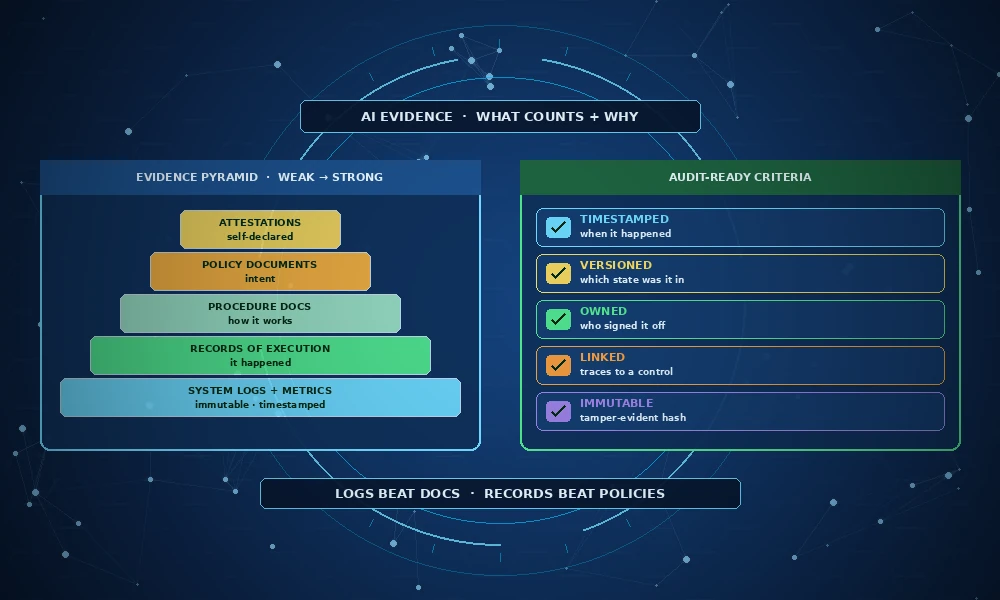
Audit evidence management is where the most meaningful pricing variance lives. Entry-level platforms provide documentation templates; enterprise platforms provide structured evidence collection with version history, audit trail, and certification body-aligned report generation. The difference matters enormously when your ISO 42001 Stage 2 audit begins.
Multi-Framework Coverage and Its Cost Premium
A platform that covers one framework is cheaper than one that covers three. But the question is whether the cheaper platform actually reduces your total compliance work. Section 7 of this article goes deeper on framework overlap the short version is that ISO 42001, the EU AI Act, and the NIST AI RMF share significant control areas, and a platform that maps them simultaneously eliminates a meaningful amount of duplicate effort.
Govern365.ai’s AI model registry automatically maps each AI system to its applicable ISO 42001 clauses and EU AI Act risk categories simultaneously which means a single assessment workflow covers obligations under both frameworks, rather than requiring two separate workstreams.
Price Benchmarks by Organisation Size
| Featured snippet target: AI governance platform pricing ranges from $10,000 to $300,000+ per year depending on organisation size, module scope, and framework coverage. Entry-level plans for small teams typically cost $10,000–$40,000 annually and cover a basic AI model registry and one compliance framework. Mid-market plans run $40,000–$120,000 and include full module suites. Enterprise deployments with multi-framework coverage and audit evidence management typically exceed $120,000 per year before implementation costs. |
| Tier | Annual Platform Cost | Included Modules | AI Use-Case Limit | Framework Coverage |
|---|---|---|---|---|
| Entry / SMB | $10,000–$40,000 | AI model registry, basic risk templates, limited dashboard | Up to 20 AI systems | 1 framework typically |
| Mid-market | $40,000–$120,000 | Full module suite: registry, risk assessment, dashboards, policy management | Up to 50–100 AI systems | 2–3 frameworks |
| Enterprise | $120,000–$300,000+ | All modules including audit evidence management, third-party AI risk, dedicated CSM | Unlimited | Multi-framework with clause-level mapping |
| Free / open-source | $0 | Basic policy templates, simple AI register | Limited | Framework guidance only not audit-ready |
For mid-market reference: Credo AI’s AWS advisory tiers a credible mid-market benchmark run from $40,000 to $95,000 for structured AI governance advisory packages. IBM watsonx.governance and OneTrust sit at the enterprise end and typically require six-figure commitments with implementation services included or quoted separately.
Two important caveats. First, these are platform license costs. Implementation and setup add 30–60% to year-one total cost (detailed in the next section). Second, most enterprise vendors don’t publish pricing these ranges are based on market signals and disclosed benchmarks. Treat them as planning inputs, not binding quotes.
Setup, Implementation, and Ongoing Costs
The subscription fee is the visible number in the procurement conversation. The implementation cost is the number that breaks budgets.
Year-One Cost vs Year-Two-and-Beyond Cost
| Cost Component | Year 1 (Setup + License) | Year 2+ (Ongoing) |
|---|---|---|
| Platform license | $10,000–$300,000+ | $10,000–$300,000+ (with annual increase) |
| Implementation / professional services | $20,000–$80,000 | $0–$20,000 (optimisation only) |
| Integration (MLOps, GRC, HR systems) | $10,000–$40,000 | $5,000–$15,000 (maintenance) |
| Internal staff time (0.5–1.5 FTE) | $40,000–$150,000 loaded cost | $40,000–$150,000 loaded cost |
| ISO 42001 certification audit (Stage 1+2) | $8,000–$30,000 | $5,000–$15,000/year (surveillance) |
| Year 1 total (mid-market example) | $130,000–$370,000 all-in | $65,000–$185,000/year ongoing |
Professional services gap analysis, AIMS documentation, control mapping, staff training range from $20,000 to $80,000 depending on organisational complexity. According to elevateconsult.com’s AI governance framework cost analysis, platform investment represents approximately 60% of total governance budgets, with architecture and compliance activities making up the remainder. More than 85% of organisations misestimate AI governance project costs by over 10%.
Internal resource costs are the component most frequently omitted from vendor-provided estimates. Even with a well-implemented platform, governance requires dedicated staff attention typically 0.5 to 1.5 FTE depending on AI deployment footprint. According to ISO 42001 certification cost research from ISMS.online, organisations often underestimate the internal documentation and evidence-gathering effort required for certification, which the platform facilitates but does not eliminate.
The Full-Cost Picture: TCO Beyond the Subscription
Total cost of ownership for an AI governance platform has six components, and most organisations budget for only two of them.
- Platform license (visible)
- Implementation and professional services (often underestimated)
- System integration (frequently forgotten until it becomes a crisis)
- Internal staff time (almost never included in vendor ROI calculations)
- Annual surveillance audits post-certification ($5,000–$25,000/year for ISO 42001)
- Remediation costs when governance gaps surface in audit
The remediation number deserves attention. Organisations that fail their first ISO 42001 Stage 2 audit typically spend $30,000–$100,000 on consultancy and platform reconfiguration before they’re ready for re-audit. That cost is entirely avoidable with the right platform scope from the outset but it rarely appears in pre-purchase budgets because buyers don’t plan for failure.
The spreadsheet alternative looks cheaper on a per-year basis. In practice, it isn’t. An AI governance programme running on shared drives and Excel generates consultant and remediation costs at certification that typically total $50,000–$150,000 equivalent to two to four years of a mid-market platform subscription. The 3-year TCO almost always favours the platform approach.
| Vendor lock-in: Ask before you sign whether your audit evidence and risk assessment data are exportable in an open format. Proprietary evidence stores can create switching costs equivalent to six to twelve months of re-setup work if you change platforms. |
Building the Business Case: What It Costs Not to Govern
The internal business case for an AI governance platform is easier than most compliance teams expect, because the cost of not governing is concrete and quantifiable.
Start with regulatory exposure. EU AI Act penalties for organisations with prohibited-practice violations reach €35 million or 7% of global annual revenue whichever is higher. For high-risk AI system non-compliance, fines reach €15 million or 3% of annual revenue. These aren’t theoretical figures; the enforcement regime began in 2024.
Add operational loss. EY research on enterprise AI risk found that 99% of organisations report financial losses attributable to AI-related risks, and 64% have suffered losses exceeding $1 million. The sources range from model bias incidents and data breach exposure to reputational damage from AI misuse.
The positive case is equally clear. One 200-person AI consultancy that achieved ISO 42001 certification in Q2 2024 reported a 400% return on certification investment within 12 months, attributable to three enterprise contracts previously inaccessible to uncertified vendors and a 25% reduction in sales cycle length due to pre-validated governance credentials.
Board-ready reporting adds a less visible but commercially significant benefit. Platforms that generate audit-trail evidence on demand reduce legal exposure in D&O liability scenarios and strengthen the organisation’s position when regulators, customers, or insurers request proof of AI oversight. That capability is hard to value precisely, but it becomes very easy to value after an incident.
Framework Coverage Depth as a Pricing Driver
This is the part of AI governance platform pricing that most buying guides miss entirely and it’s where organisations most consistently miscalculate their investment.
Single-framework platforms are cheaper. They’re also adequate if your obligations are genuinely limited to one standard. But most US enterprises facing ISO 42001 certification also have EU AI Act exposure (if they serve European customers or operate European subsidiaries) and are using NIST AI RMF as their internal governance reference. Buying a platform that covers only one of those frameworks means you’re doing the compliance mapping work twice in separate tools.
The 40-50% Overlap Between ISO 42001 and the EU AI Act
ISO 42001 and the EU AI Act share significant structural alignment. The EU AI Act’s Article 9 risk management requirements overlap substantially with ISO 42001 Clause 6.1 controls. Research from startbrain.ai estimates 40–50% overlap in high-level requirements between the two frameworks. A platform that handles both simultaneously eliminates that duplication from your compliance workload.
The practical impact: a team using a single-framework platform that later needs EU AI Act compliance coverage will spend 60–80% of their ISO 42001 effort again to map controls under the AI Act in a separate tool, with separate evidence stores. Multi-framework platforms front-load that mapping work, which is why the 30–60% price premium for comprehensive coverage typically delivers a positive return by year two.
| Framework | Core Governance Requirement | US Enterprise Relevance | Overlap With Others |
|---|---|---|---|
| ISO/IEC 42001:2023 | AIMS: risk management, policy, audit evidence, continuous improvement | Certification pathway; supply chain trust signal | High overlap with EU AI Act Article 9; moderate with NIST AI RMF |
| EU AI Act | Risk tiers, conformity assessment, human oversight, technical documentation | Required for EU market access; increasingly referenced by US regulators | ~40–50% overlap with ISO 42001; conceptual alignment with NIST |
| NIST AI RMF 1.0 | Govern, Map, Measure, Manage functions; voluntary but widely adopted | De facto US standard; referenced by CISA, FTC, financial regulators | Conceptual alignment with ISO 42001 Clause structure |
What Auditors Look for in Framework Evidence
The quality of framework coverage in a platform matters as much as the breadth. Platforms that offer ‘framework alignment’ through surface-level tagging marking a risk assessment as ISO 42001-compliant without mapping it to a specific clause don’t satisfy certification auditors.
What auditors require: documented evidence that specific Annex A controls have been assessed for applicability, that applicable controls are implemented, and that the Statement of Applicability links each control to evidence of implementation. Platforms that generate audit packages meeting this structure reduce certification preparation time significantly.
The difference between a certification-ready evidence package and a cosmetic one is exactly what separates platform tiers in the $40,000–$120,000 range. Before signing a contract, ask the vendor to provide a sample audit evidence package for ISO 42001 Stage 2. If they can’t, the ‘ISO 42001 support’ is marketing, not functionality. Govern365.ai, by the Global AI Certification Council, generates audit packages that reflect the evidence standards GAICC’s own certified auditors use in the field.
Frequently Asked Questions
How much does an AI governance platform cost?
AI governance platform pricing ranges from $10,000 to $300,000+ per year. Entry-level plans typically cost $10,000–$40,000 annually and cover an AI model registry and one compliance framework. Mid-market plans run $40,000–$120,000 with full module suites. Enterprise platforms with multi-framework coverage and audit evidence management exceed $120,000 per year. These figures cover platform licenses only implementation and setup add 30–60% in year one.
What’s included in the base price versus add-ons?
Base plans almost always include an AI model registry and basic compliance dashboards. Risk assessment modules, audit evidence management, policy management, and third-party AI vendor risk assessment are typically mid-tier inclusions or enterprise add-ons. The clearest signal of an enterprise-grade platform is whether audit evidence management structured evidence collection with version history and certification-body-aligned reporting is included or costs extra.
Is there a free AI governance platform?
Several platforms offer free tiers or open-source components that cover basic AI registers and policy templates. These are useful for scoping your governance programme and understanding what a full platform should do. They are not sufficient for ISO 42001 certification which requires documented evidence of Annex A control implementation or for EU AI Act conformity documentation. Free tiers are a starting point, not a destination.
How does AI governance platform pricing compare to traditional GRC platforms?
Traditional GRC platforms price on seat count and don’t account for the number of AI systems being governed. AI governance platforms typically use a hybrid model: base platform fee plus per-model or consumption variable. The result is that GRC platforms often appear cheaper per user but become more expensive at scale as AI deployment grows, because the governance workload multiplies faster than the user count.
What implementation costs should I budget for?
Budget 30–60% of the platform license for year-one implementation costs. This covers gap analysis, AIMS documentation, control mapping, staff training, and system integration. Professional services engagements run $20,000–$80,000 depending on AI deployment complexity and organisational size. Internal resource cost typically 0.5 to 1.5 FTE of governance staff attention is the most frequently omitted line item in pre-purchase budgets.
How does multi-framework coverage affect price?
Multi-framework platforms those covering ISO 42001, EU AI Act, and NIST AI RMF simultaneously typically carry a 30–60% price premium over single-framework tools. The premium is usually justified by year two, because the frameworks share approximately 40–50% of their high-level control requirements. A platform that maps them simultaneously eliminates significant duplicated effort, and the single evidence store supports multiple audit requirements without re-running assessments.
Can I start with a lower tier and upgrade?
Yes most platforms support modular upgrades. The important question is data portability: can your AI system registry, risk assessments, and evidence packages be carried forward to a higher tier or a different vendor without rebuild? Ask for this in writing before signing an entry-level contract. Proprietary data formats can make upgrading more expensive than it should be and switching vendors operationally disruptive.
What is the ROI of an AI governance platform?
ROI comes from three sources: regulatory penalty avoidance (EU AI Act fines reach €35M or 7% of global revenue), reduced audit preparation cost (governed organisations cut ISO 42001 preparation time by months versus manual approaches), and commercial benefit (ISO 42001 certification improves enterprise contract access and reduces sales cycle friction). EY research indicates 64% of organisations without structured AI governance have suffered AI-related financial losses exceeding $1 million.
Conclusion
AI governance platform pricing is only confusing if you treat it as a single number. It isn’t. It’s a combination of pricing model, module scope, framework coverage depth, implementation cost, and ongoing operational investment all of which scale with your actual AI deployment footprint, not with an arbitrary vendor tier.
The most useful thing you can do before approaching a vendor is a simple inventory: how many AI systems are in production or in development, which frameworks apply to your regulatory context, and which modules you’ll actually use for certification or audit readiness. That scoping work takes a few hours and will save you from both over-buying and under-investing.
Govern365.ai, by the Global AI Certification Council, is built around exactly that scoping logic with an AI model registry, risk assessment, compliance dashboards, and audit evidence management designed to support ISO 42001, the EU AI Act, and NIST AI RMF from a single platform. Start your 14-day free trial at govern365.ai and see how your AI system footprint maps to your compliance obligations before committing to a tier.