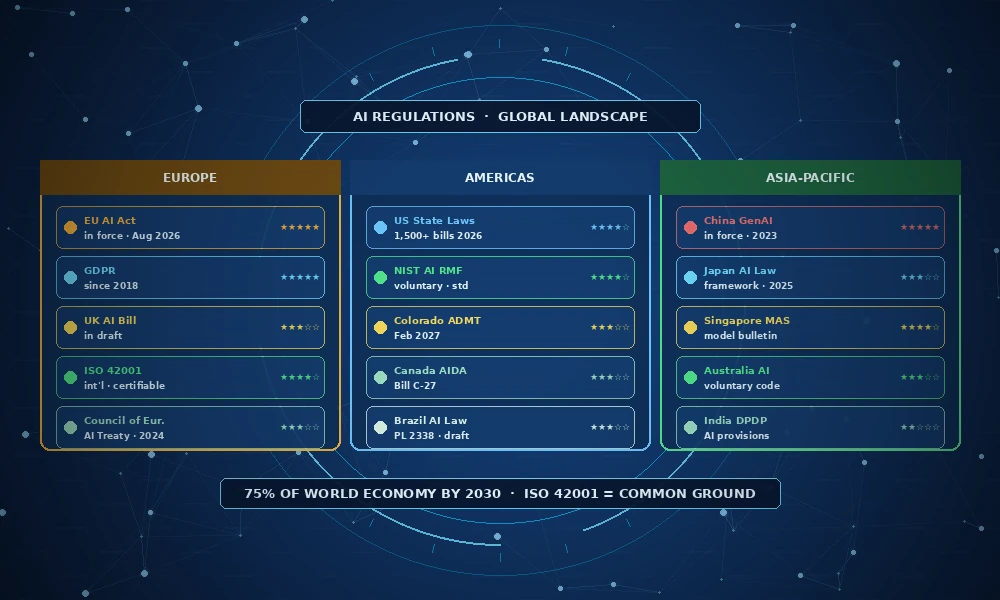
According to a February 2026 Gartner press release, global AI governance platform spending is projected to reach $492 million in 2026 and surpass $1 billion by 2030 driven by AI regulations expanding to cover 75% of the world’s economies. That investment only pays off if the records backing your governance programme can actually survive audit scrutiny.
Most compliance teams know they need documentation. What they underestimate is the specificity auditors now demand: not policies alone, but timestamped evidence that those policies ran, produced decisions, and were reviewed. An AI evidence vault is the structured system that makes that level of readiness achievable before the audit notice arrives, not after.
This guide covers the exact record types required under ISO/IEC 42001:2023, the EU AI Act, and the NIST AI RMF, plus how to organise them so retrieval takes minutes, not days.
What Is an AI Evidence Vault and Why Auditors Expect One
The phrase “AI evidence vault” is not a regulatory term. It describes a practical approach: a structured, version-controlled repository where every compliance record for your AI systems lives linked to the controls it evidences, the framework it satisfies, and the review cycle that keeps it current.
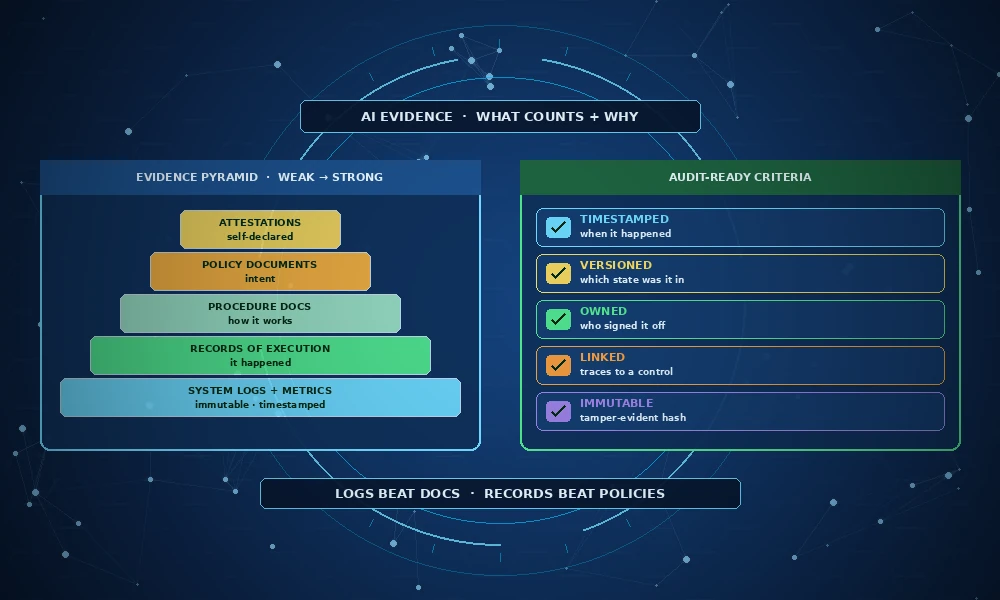
The distinction between a document store and a genuine evidence vault is operational. A document store holds policies. A vault holds proof that those policies were implemented, tested, and maintained over time. When an ISO/IEC 42001 certification auditor walks into a Stage 2 audit, they are looking for the second kind.
What drives this expectation is the PDCA (Plan-Do-Check-Act) structure at the core of ISO/IEC 42001. The standard does not simply require organisations to describe their AI Management System (AIMS) it requires evidence that the AIMS ran. Clause 9.1 mandates documented results of monitoring and measurement. Clause 9.2 mandates retained audit plans, checklists, reports, and corrective action records. Clause 9.3 mandates management review minutes. Each of these is a demand for stored evidence, not a statement of intent.
The EU AI Act reinforces this with legal force. Article 12 requires high-risk AI systems to maintain logs enabling full lifecycle traceability. Article 11 mandates technical documentation that describes system design, testing, and performance in enough detail for post-market surveillance. These are not aspirational requirements from August 2026, the European Commission can investigate and issue fines based on what documentation exists or doesn’t.
The practical implication for US organisations: even without direct EU AI Act exposure, the audit standard is shifting. ISO 42001 auditors, sector regulators referencing the NIST AI RMF, and enterprise customers conducting AI vendor assessments are all applying evidence-first thinking. An AI evidence vault is not a nice-to-have; it is the infrastructure layer that makes any governance programme defensible.
The Records an ISO 42001 Audit Will Look For
ISO/IEC 42001:2023 is a management system standard, which means its documentation requirements are structured, specific, and non-negotiable for certification. The ISO 42001 documentation checklist from Glocert International identifies two layers of required information: documents (controlled procedures and policies) and records (evidence that processes ran).
The mandatory records fall across seven clause areas:
Clause 6 – Planning records: Risk assessment results (Clause 6.1.2 and 8.2) must be documented for each AI system, showing identified risks, their likelihood and impact, and the treatment decisions made. AI impact assessment results (Clause 6.1.4 and 8.4) are a separate record this is where potential harms to individuals, groups, and society are analysed. Both must be versioned. An undated risk assessment tells an auditor nothing about whether it reflected the system’s current operational state.
Clause 7 – Support records: Competence evidence (Clause 7.2) covers training records, qualifications, and role-specific AI literacy documentation for everyone with AIMS responsibilities. This is frequently underprepared. Auditors regularly find that governance roles are defined but the evidence that those roles were filled by people with appropriate competence is absent.
Clause 8 – Operational records: This is the largest evidence category. It includes documented evidence of operational planning and control (Clause 8.1), which covers how AI systems moved through design, development, testing, and deployment in conformance with AIMS requirements. Model cards standardised documentation covering intended use, training data, architecture, performance benchmarks, and known limitations satisfy a significant portion of this requirement for ML-based systems.
Clause 9 – Performance evaluation records: Monitoring and measurement results (Clause 9.1): system event logs, performance evaluation reports, KPI dashboards, drift detection outputs. Internal audit records (Clause 9.2): the audit programme schedule, individual audit plans, auditor credentials, checklists used, findings, and corrective action assignments. Management review minutes (Clause 9.3): the formal record of leadership review of AIMS performance, including decisions made and resources allocated.
Clause 10 – Improvement records: Nonconformity records and corrective action evidence. When something goes wrong a model performing outside defined parameters, a documented incident, an internal audit finding the corrective action lifecycle must be recorded end-to-end: identification, root cause analysis, treatment, verification of effectiveness.
One pattern that consistently creates audit failures: organisations have the policy layer but treat operational records as ephemeral. An AI system that ran without generating retrievable logs, performance reports or review notes has no evidence of governance regardless of how sophisticated the underlying controls are.
ISO 42001 Mandatory Records by Clause
| Clause | Record Type | Typical Format | Audit Expectation |
| 6.1.2 / 8.2 | AI Risk Assessment Results | Risk register entries, scoring matrices | Versioned per system, updated at defined intervals |
| 6.1.4 / 8.4 | AI Impact Assessment Results | AIIA report, stakeholder review notes | Tied to lifecycle stage; pre-deployment required |
| 7.2 | Competence Evidence | Training records, role credentials | For all personnel with AIMS responsibilities |
| 8.1 | Operational Control Evidence | Model cards, deployment checklists, test results | Per AI system; covers design through production |
| 9.1 | Monitoring & Measurement Results | System logs, KPI reports, drift outputs | Continuous or periodic; retained per schedule |
| 9.2 | Internal Audit Records | Audit schedule, plans, reports, corrective actions | Complete programme; auditor credentials included |
| 9.3 | Management Review Minutes | Meeting records, decisions, resource allocations | Formal, dated, signed by leadership |
| 10.2 | Nonconformity & Corrective Actions | NCR log, root cause analysis, closure evidence | Full lifecycle; effectiveness verification |
EU AI Act Documentation Requirements: What the Articles Actually Say
The EU AI Act’s documentation requirements sit primarily in Articles 11, 12, 13, 14 and 17 and they apply specifically to providers and deployers of high-risk AI systems as defined in Annex III. For US organisations that build, deploy, or sell AI systems into the EU market, these articles are enforceable obligations, not guidelines.
Article 11 – Technical documentation: Providers of high-risk AI systems must prepare technical documentation before placing the system on the market. This documentation must be “sufficiently detailed” to allow competent authorities to assess conformity, and must include: a general description of the AI system; a description of the development process including data governance practices; risk management measures; validation and testing procedures with results; applicable standards; and the system’s intended purpose.
The practical scope here is significant. A model card alone does not satisfy Article 11. The technical documentation package needs to describe how training data was sourced, curated, and validated; how known limitations affect the system’s reliability in specific use cases; and how the system was tested against its intended operating conditions. This is engineering-level documentation, not a management summary.
Article 12 – Record-keeping: High-risk AI systems must be designed to automatically generate logs of operation throughout their lifecycle. The Act specifies that these logs must enable traceability and be retained for at least six months. For deployers using high-risk systems (covered under Article 26), the log retention obligation runs from the date of use. This is an architectural requirement systems that do not natively generate structured logs are non-compliant regardless of downstream record-keeping practices.
Article 14 – Human oversight evidence: Deployers must document how human oversight is implemented: who has oversight authority, under what conditions they can intervene or override, and how their review activities are recorded. This is the documentation requirement that most often reveals gaps. As HI AI Design notes, auditors see through “checkbox” oversight immediately true oversight requires documented criteria for when human review occurs and evidence that humans actually evaluate edge cases.
Article 17 – Quality management system documentation: Providers of high-risk AI systems must have a quality management system that includes documented strategies for regulatory compliance, design controls, data management procedures, risk management measures, post-market monitoring plans, and incident reporting procedures. This QMS documentation layer is what organisations implementing ISO/IEC 42001 are best positioned to satisfy the two frameworks share structural logic.
For US organisations not directly subject to the EU AI Act, this documentation architecture still matters. The NIST AI RMF’s Govern, Map, Measure, and Manage functions produce substantially the same artefacts. Organisations that build their evidence vault against this common pattern satisfy multiple regulatory expectations from a single documentation set.
EU AI Act Articles and Corresponding Evidence Records
| Article | Requirement | Evidence Record Required | Who It Applies To |
| Art. 11 | Technical documentation | System design docs, training data governance, testing results, performance benchmarks | Providers of Annex III high-risk AI |
| Art. 12 | Automatic logging | Structured operational logs; min. 6-month retention | Providers (architectural) + Deployers (retention) |
| Art. 13 | Transparency | Instructions for use, system limitations disclosure | Providers |
| Art. 14 | Human oversight | Override procedures, oversight role definitions, intervention records | Providers + Deployers |
| Art. 17 | Quality management system | QMS documentation, design controls, post-market monitoring plan | Providers |
| Art. 26 | Deployer obligations | Log retention records, worker notification documentation, risk management measures | Deployers of high-risk AI |
NIST AI RMF Evidence Artefacts: Govern, Map, Measure, Manage
The NIST AI Risk Management Framework (AI RMF 1.0) is the dominant voluntary standard for AI governance in the United States increasingly referenced by federal sector regulators including the CFPB, FDA, SEC, and FTC when setting expectations for responsible AI deployment. The framework does not mandate specific documents, but its four functions Govern, Map, Measure, Manage each produce a distinct class of audit-ready evidence.
GOVERN evidence: The Govern function requires documentation of AI governance policies, accountability structures, roles and responsibilities, and workforce competency requirements. Evidence artefacts include: a formal AI governance policy; an accountability matrix mapping AI systems to responsible owners; role definitions for AI oversight, review, and incident response; and competency records. As Techné AI notes, the documentation requirements map to GOVERN 1 (policies), with non-discrimination and fairness duties operationalised through Measure and Manage.
MAP evidence: The Map function centres on AI system context and risk identification. Its evidence layer includes: an AI system inventory documenting each deployed system, its purpose, data inputs, outputs, affected stakeholders, and risk classification; a risk identification report per system covering technical, ethical, and operational risks; and documentation of legal and regulatory requirements applicable to each system. This is where shadow AI creates the most significant gap systems deployed without going through a formal Map process have no inventory record, no risk classification, and no basis for ongoing governance.
MEASURE evidence: Measurement artefacts document how AI systems are evaluated against defined performance and trustworthiness characteristics. This includes: model evaluation reports covering accuracy, reliability, fairness, and explainability metrics; bias assessment results with testing methodology and findings; data drift monitoring logs; and third-party assessment records. The NIST Generative AI Profile (AI 600-1) adds specific measurement expectations for LLMs, including hallucination rate testing, safety evaluation results, and red-team findings.
MANAGE evidence: This is the operational evidence layer proof that risk treatments were implemented and maintained. The Manage function’s artefacts include: a risk register with prioritised treatments and residual risk acceptance records; incident response playbooks with documented activation records; model change-management logs for updates, retraining, and version transitions; decommissioning records for retired AI systems; and post-incident review reports. Without Manage-function documentation, Govern, Map, and Measure produce documents that age without consequence.
Model Cards, Risk Assessments and Impact Assessments: Getting the Depth Right
These three record types appear on every AI governance documentation list. What varies dramatically between organisations that pass audits and those that don’t is the depth and specificity of each.
Model cards: A model card is a standardised record documenting an AI system or ML model’s characteristics. As Elevate Consult’s ISO 42001 evidence guide describes it: a model card functions as both an instruction manual and accountability tool. A minimal model card covering intended use cases, architecture type, and training data source is not audit-ready. An audit-ready model card includes: the model name and version; intended and out-of-scope use cases; training data specifications including source, size, preprocessing steps, and known biases; performance metrics across different subgroups and operating conditions; known limitations and failure modes; ethical considerations; and update history.
The specificity requirement is not bureaucratic. An auditor reviewing a model card for a high-risk AI system will check whether it discloses the conditions under which the system degrades because Article 13 of the EU AI Act and ISO 42001’s risk assessment requirements both depend on this information being captured and available to users.
Risk assessments: ISO 42001 Clause 6.1 requires risk assessments that identify risks arising from the AI system throughout its lifecycle not just deployment risks, but risks introduced during design, training, and integration. The assessment must document: what risks exist, their likelihood, their potential impact, and the treatment decision (accept, transfer, mitigate, avoid). Critically, risk assessments must be revisited when the system changes a retraining run, a new data source, an expanded deployment scope. An undated risk assessment, or one that pre-dates major system changes, does not demonstrate active risk management.
AI impact assessments: ISO 42001 introduces AI Impact Assessments (Clause 6.1.4) as a distinct requirement from risk assessments. Where a risk assessment focuses on what could go wrong with the system, an impact assessment focuses on what effect the system’s decisions or recommendations have on people, groups, and society. This includes employment decisions, credit scoring, content moderation, and any domain where AI outputs affect individual rights or welfare.
For organisations operating in sectors covered by US state AI legislation Colorado’s AI Act, New York’s AI governance requirements, Illinois HB 3773 AI impact assessments are directly relevant to state compliance obligations as well. Building a single, well-structured impact assessment template that satisfies ISO 42001 Clause 6.1.4 and can be extended for jurisdiction-specific requirements is more efficient than producing parallel documentation sets.
Incident Logs, Override Records and Human Oversight Evidence
This is the evidence category most likely to be incomplete when an audit arrives not because organisations lack incident processes, but because they track incidents in tools that don’t produce retrievable, structured records suitable for third-party review.
Incident logs: An AI incident is any event where an AI system behaved in an unexpected, harmful, or unintended way including near-misses, not just confirmed failures. The incident log must capture: a unique identifier, the date and time of detection, the system involved, a description of what occurred, who identified it, what immediate action was taken, and the outcome of root cause analysis. For high-risk AI systems under the EU AI Act, serious incidents that result in risk to health, safety, or fundamental rights must be reported to the relevant market surveillance authority.
The financial services parallel is instructive. As Galileo notes in its AI compliance guidance, financial regulators treat missing traces as books-and-records violations. AI auditors are applying the same standard an AI system that operated without incident logs has no documented evidence of its decision history, regardless of how well it performed.
Override records: Human oversight of AI systems is not demonstrated by having an override button. It is demonstrated by records showing that overrides happened, who made them, under what documented criteria, and what the outcome was. Article 14 of the EU AI Act is explicit: human oversight measures must allow natural persons to intervene or interrupt the AI system. The oversight evidence must show this capability was active and exercised.
Approval and sign-off records: Every significant governance decision in an AI system’s lifecycle should have a documented approval: pre-deployment sign-off, risk treatment acceptance, impact assessment review, and management review outcomes. These records are often the simplest to produce but the easiest to let slip a deployment that happened without a documented approval, or a risk assessment that was reviewed verbally but never formally accepted, leaves a gap in the audit trail that no retrospective note can fully close.
One practical discipline that consistently improves this record category: require a named approver and timestamp for every AI system lifecycle event, captured in the same system as the event record itself. A separate approval log that must be cross-referenced is far less reliable than approvals embedded directly in the workflow.
Organising Your Evidence Vault: Version Control, Retention, and Retrieval
Collecting the right records is necessary. Being able to retrieve them quickly, demonstrate their currency, and prove their integrity is what actually satisfies an auditor.
ISO/IEC 42001 Clause 7.5 sets the baseline: documented information must be controlled for identification, format, review and approval, availability, and protection. This is not a suggestion it is a compliance requirement. Version control, access controls, and defined retention periods are mandatory, not optional enhancements.
Version control in practice: Every record in your evidence vault should carry a version number, an effective date, and the name of the person who approved the current version. For records that change frequently risk assessments, model performance reports a change log showing what changed and why is expected. An auditor who sees two versions of a risk assessment with the same date has an immediate question about which one was operative.
Retention schedules: The EU AI Act’s Article 12 specifies a minimum six-month retention period for operational logs of high-risk AI systems. ISO 42001 defers to the organisation’s defined retention requirements under Clause 7.5, but those requirements must be documented and applied consistently. In practice, most governance frameworks recommend retaining AI governance records for at least three to five years covering multiple audit cycles and potential regulatory inquiry periods.
Retrieval architecture: The most significant operational gap in AI evidence management is retrieval time. Records exist but cannot be located quickly under audit conditions. The solution is a structured evidence index: a master register that maps each compliance record to the control it evidences, the framework clause it satisfies, the system it covers, and its current status.
Govern365.ai’s audit evidence management module structures records exactly this way: each piece of documentation is tagged to the ISO 42001 clause, EU AI Act article, or NIST AI RMF subcategory it satisfies, so compliance gaps surface before an audit rather than during one.
| Records that cannot be located quickly under audit conditions are functionally equivalent to records that don’t exist. An evidence vault without a retrieval architecture is a storage problem, not a governance solution. |
Immutability and audit trail integrity: For records that must withstand regulatory scrutiny incident logs, override records, approval sign-offs immutability matters. A log that can be edited after the fact has no evidentiary value. This is an architectural requirement for any system used to manage AI governance records, and it is increasingly what auditors ask about first: not just “do you have the records?” but “can you demonstrate they haven’t been altered?”
Cross-Framework Evidence Mapping: One Record, Multiple Standards
Most enterprise AI governance teams are not managing compliance with a single standard. They are managing ISO 42001, the NIST AI RMF, EU AI Act obligations, and potentially sector-specific requirements (HIPAA, SEC AI guidance, NYC Local Law 144 for hiring systems) simultaneously. Producing separate documentation sets for each framework is the fastest path to unsustainable overhead.
The good news is that the core evidence types required across these frameworks are substantially overlapping. A well-structured AI risk assessment satisfies ISO 42001 Clause 6.1, supports the NIST AI RMF’s Map function, and provides the risk management evidence Article 9 of the EU AI Act requires. The effort multiplier comes from framework-specific formatting requirements and language, not from fundamentally different information needs.
A cross-framework evidence map makes this explicit. For each record type in your evidence vault, document which controls or clauses in each applicable framework it satisfies. This serves three purposes: it identifies genuine gaps; it eliminates duplication; and it gives auditors and your own governance team a clear view of the compliance posture without manual cross-referencing.
Cross-Framework Evidence Mapping: Key Record Types
| Evidence Record | ISO 42001 Clause | NIST AI RMF Function | EU AI Act Article |
| AI System Inventory | Clause 4.3 (Scope), 8.1 | MAP – AI system context | Art. 11, Art. 26 |
| Risk Assessment | Clause 6.1.2, 8.2 | MAP – risk identification; MEASURE | Art. 9 (risk management) |
| AI Impact Assessment | Clause 6.1.4, 8.4 | MAP – stakeholder impact | Art. 9.2, Annex IV |
| Model Card / Technical Docs | Clause 8.1, Annex A | GOVERN + MEASURE | Art. 11 |
| Operational Logs | Clause 9.1 | MANAGE – incident management | Art. 12 (6-month min.) |
| Internal Audit Records | Clause 9.2 | GOVERN + MANAGE | Art. 17 (QMS) |
| Incident Records | Clause 10.2 | MANAGE – incident response | Art. 73 (serious incidents) |
| Human Oversight Evidence | Clause 8.1, Annex A.8 | GOVERN – human considerations | Art. 14 |
| Management Review Minutes | Clause 9.3 | GOVERN – organisational integration | Art. 17 (QMS) |
| Competence Records | Clause 7.2 | GOVERN – workforce competency | Art. 4 (AI literacy) |
The organisations that manage cross-framework compliance most efficiently treat this mapping as infrastructure built once, maintained continuously, and surfaced automatically by their governance platform rather than assembled manually before each audit. Govern365.ai, by the Global AI Certification Council, is built specifically for this architecture: each record is tagged at creation to the controls it satisfies, so the cross-framework evidence map is always current without requiring a separate reconciliation exercise.
Frequently Asked Questions
What is an AI evidence vault?
An AI evidence vault is a structured, version-controlled repository that holds all compliance documentation for an organisation’s AI systems including risk assessments, model cards, audit records, incident logs, and oversight records. Unlike a general document store, an evidence vault is organised by control, framework clause, and AI system, so records can be retrieved quickly under audit conditions and gaps are visible before an audit begins.
Which records are mandatory for ISO 42001 certification?
ISO/IEC 42001 requires documented records across Clauses 6-10, including: AI risk assessment results, AI impact assessment results, competence evidence, operational control records (including model cards), monitoring and measurement results, internal audit records, management review minutes, and nonconformity and corrective action records. All documented information must be controlled per Clause 7.5, with version control, access controls, and defined retention periods.
How long must AI system logs be retained under the EU AI Act?
Article 12 of the EU AI Act requires that operational logs for high-risk AI systems be retained for a minimum of six months. Deployers of high-risk AI systems under Article 26 carry the retention obligation from the date of use. Organisations with ISO 42001 or broader GRC programmes typically apply longer retention schedules three to five years.
What is the difference between an AI risk assessment and an AI impact assessment?
A risk assessment (ISO 42001 Clause 6.1.2) evaluates what could go wrong with the AI system. An impact assessment (Clause 6.1.4) evaluates what effect the system’s outputs have on individuals, groups, and society. Both are mandatory for ISO 42001 certification and both are required under the EU AI Act for high-risk systems.
Does implementing NIST AI RMF satisfy ISO 42001 requirements?
Not automatically, but substantially. The NIST AI RMF’s four functions produce evidence artefacts that map closely to ISO 42001’s requirements across Clauses 6-10. The main gaps are ISO 42001-specific: the AIMS scope statement, Statement of Applicability, and formal certification audit process have no direct NIST equivalents.
What human oversight evidence does an auditor expect to see?
Auditors expect documented proof that human oversight was operational, not just designed. This includes: defined override criteria and procedures, records showing overrides or interventions actually occurred, identification of personnel with oversight authority, and evidence that those personnel reviewed AI outputs against defined thresholds. Under EU AI Act Article 14, evidence that the oversight capability was exercised is required for high-risk AI deployers.
Can a spreadsheet serve as an AI evidence vault?
A spreadsheet can function as a basic evidence index, but it cannot satisfy the version control, access control, immutability, and cross-framework mapping requirements that enterprise AI governance demands. Spreadsheets have no audit trail of their own, no tamper-evidence, and no automated gap detection. For organisations pursuing ISO 42001 certification or EU AI Act compliance, a purpose-built governance platform is the only practical architecture.
How does shadow AI affect an evidence vault?
Shadow AI creates an inventory gap that undermines the entire evidence vault. You cannot maintain risk assessments, model cards, or oversight records for systems you don’t know exist. ISO 42001 Clause 8.1 requires operational control over AI system design, development, and deployment. Shadow AI discovery should be a prerequisite step before any evidence vault is considered complete.
Conclusion
An AI evidence vault is not a documentation project it is the operational layer that makes AI governance real. Policies without evidence records are compliance aspiration. The specific records covered here risk assessments, impact assessments, model cards, operational logs, override documentation, audit records, and management review minutes are what auditors, certification bodies, and regulators actually examine.
The organisations that handle audits without disruption are the ones that built their evidence infrastructure before the audit notice arrived: records tagged to the controls they satisfy, retrieval measured in minutes, and gaps surfaced continuously rather than discovered under pressure.
| Build Your AI Evidence Vault Today: Start with the platform built for exactly this purpose structured evidence management, cross-framework mapping, and audit-ready records from day one. Start Your 14-Day Free Trial at Govern365.ai, by the Global AI Certification Council |