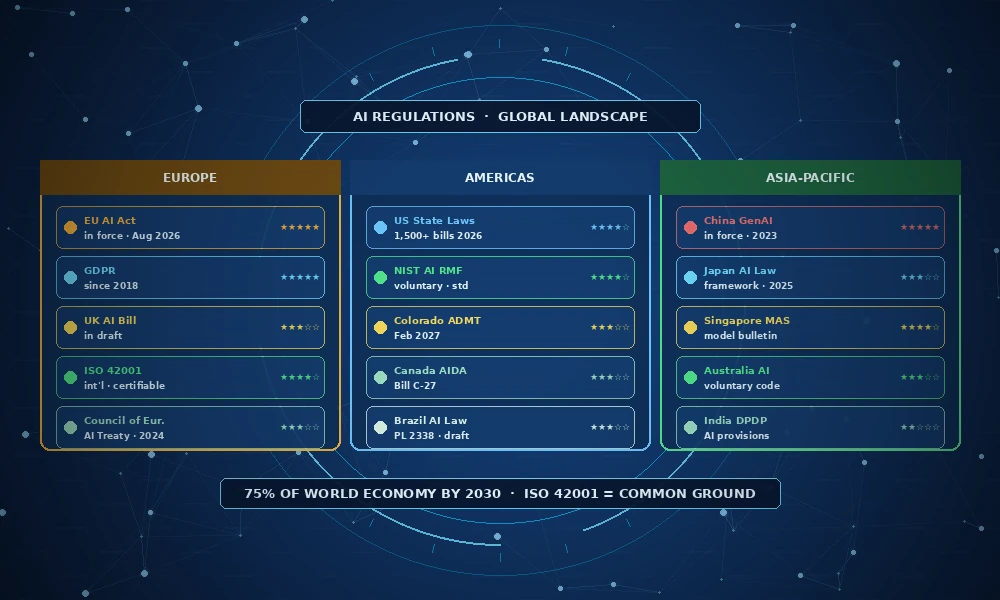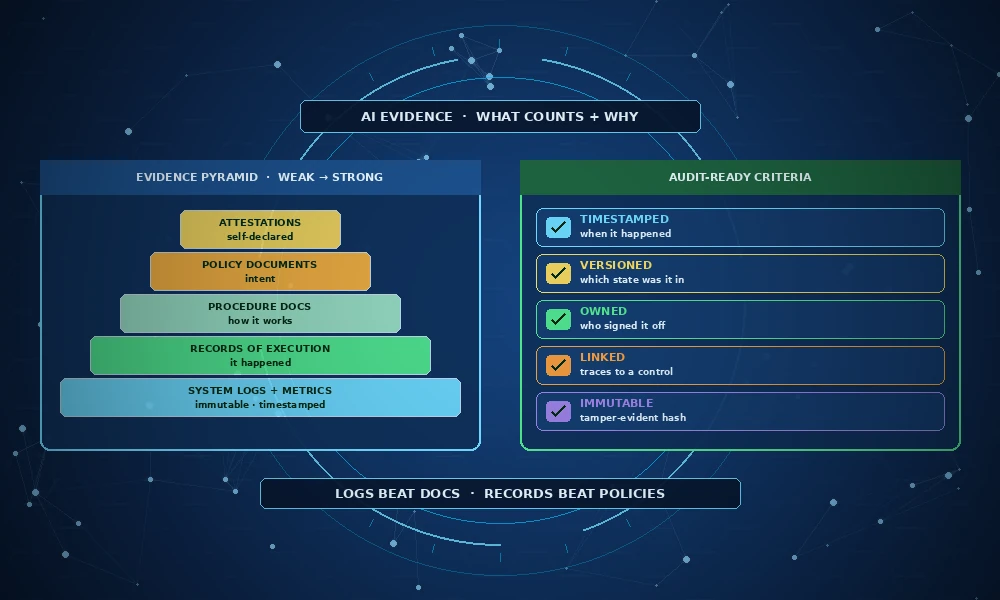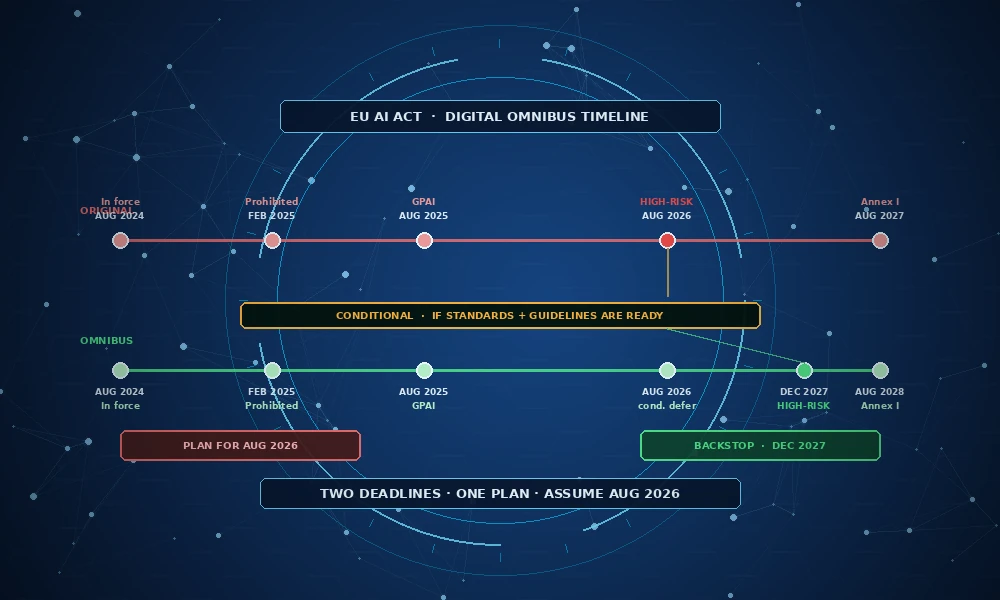
According to the NACD’s 2025 Board Practices and Oversight Survey, only 6% of boards have established AI-related management reporting metrics even as 72% of S&P 500 companies now disclose material AI risk in their annual filings. That gap is where the liability lives. The EU AI Act’s high-risk system obligations become enforceable in August 2026, and US regulators are scrutinising AI risk disclosures for substance, not just existence. A board that receives a generic “AI update” slide deck is not a board that can demonstrate governance.
This article covers what a defensible board-level AI risk report must contain: the AI system inventory, risk ratings, and open actions and how each component maps to ISO 42001, the EU AI Act, and the NIST AI RMF.
What Boards Actually Need from an AI Risk Report
The question most governance teams get wrong is: who is the report actually for?
Board members are not AI engineers. They are not reading your risk register to evaluate model architecture choices. They are asking three questions: What AI systems does this organisation operate? What is the current risk exposure? What is being done about it and is it being done fast enough?
That framing produces three non-negotiable components: an AI system inventory, a risk register with current ratings, and an open actions log with owners and due dates. Every other piece of information in a board AI risk report is either supporting context or detail that belongs in an operational annex.
The NACD data tells you how far most organisations are from this. Only 36% of boards have implemented a formal AI governance framework, and just 6% have established AI-related management reporting metrics. That means the majority of boards are making strategic and regulatory decisions about AI without the structured information they need to make them responsibly.
In a US securities context, that gap has consequences. 72% of S&P 500 companies disclosed at least one material AI risk in 2025, up from 12% in 2023. A board that cannot trace material AI disclosures to a governed, current AI system inventory faces the same exposure that boards faced with cybersecurity disclosures a decade ago before regulators started asking for the evidence behind the narrative.
The Three-Component Model
A board-level AI risk report is not a status update. It is a structured output from a functioning AI Management System (AIMS). The three components work as a chain:
- The AI system inventory establishes what exists every deployed system, its purpose, its owner, and its risk classification
- The risk register translates that inventory into assessed risk levels, showing both inherent exposure and residual risk after controls
- The open actions log shows what is being done about risks that exceed the organisation’s tolerance with owners, timelines, and current status
A report that has inventory but no risk ratings is a census without analysis. A report that has risk ratings but no open actions is analysis without accountability. All three are required for a board to exercise meaningful oversight.
The AI System Inventory: Your Board Report’s Foundation
Most governance teams underestimate how hard it is to produce a complete AI system inventory not because the data doesn’t exist, but because it’s scattered. HR has its own AI recruiting tools. Marketing is running predictive models through a third-party vendor. The data science team deployed three models last quarter that never made it onto any central register. The board doesn’t know any of this.
That’s shadow AI, and it is a board-reportable risk in its own right.
The EU AI Act’s high-risk obligations cover any system meeting the Annex III criteria, regardless of whether the deployer has formally catalogued it. Undisclosed systems aren’t protected by ignorance they’re exposed by it.
For board reporting purposes, the AI system inventory needs to contain more than a technical registry. A model registry might track algorithm version, training data provenance, and performance metrics. A board-visible inventory needs fields that answer governance questions.
Minimum Board-Visible Fields: AI System Inventory
| Field | Purpose for Board Reporting |
| System name and description | Basic identification |
| Business owner (named individual) | Accountability |
| Primary business function | Strategic context |
| Risk classification (High / Medium / Low or EU AI Act tier) | Risk visibility |
| Deployment status (Active / Under Review / Retired) | Operational status |
| Date of last risk assessment | Currency of governance |
| Associated open actions (count) | Remediation signal |
| Regulatory obligations triggered | Compliance linkage |
ISO 42001 Clause 8.4 requires organisations to conduct AI system impact assessments for systems within scope of the AIMS. The inventory is the mechanism by which organisations confirm which systems are in scope and therefore which have been assessed. A board that can see both the full inventory and the assessment coverage rate has a meaningful picture of AI governance maturity. A board that receives a curated subset of “important” systems has a false one.
Govern365.ai’s AI model registry maintains the full system inventory with direct linkage to risk assessments and compliance obligations giving governance teams a single source of truth that feeds the board report rather than a spreadsheet that needs to be reconciled before every meeting.
Risk Ratings That Mean Something to a Board
Here is where most AI risk registers fail at the board level: they present technical accuracy at the expense of clarity. A register that shows probability-weighted expected loss across forty-seven distinct risk categories is forensically impressive and practically useless for a board member who has twelve agenda items and forty minutes.
Board-visible risk ratings need to answer one question: is this system’s current risk level within the organisation’s tolerance, and is that position getting better or worse?
That requires two numbers, not one. Inherent risk is the exposure before any controls are applied it tells the board what the organisation is fundamentally exposed to by running this system. Residual risk is the exposure that remains after controls it’s what the board is actually living with. Presenting only residual risk hides the board’s dependency on those controls working. Presenting only inherent risk obscures how much the organisation has already done to manage the exposure.
EU AI Act Article 9 requires that the risk management system be a continuous, documented process throughout the high-risk AI system’s entire lifecycle not a one-time assessment at deployment. That means risk ratings in the board register need to reflect current conditions, not the state of the system when it was first deployed.
ISO 42001 Clause 6.1.2 requires organisations to identify AI risks, assess their likelihood and potential impact, and determine which risks require treatment. The risk register is the documented output of that process. When it feeds into the Clause 9.3 management review, the board is receiving exactly what the standard intends: a current, structured view of the organisation’s AI risk position.
AI-Specific Risk Dimensions Beyond Probability and Impact
Standard GRC risk matrices were built for operational and financial risks. They weren’t designed for the particular characteristics of AI systems. A well-constructed AI risk register adds at least three dimensions that standard matrices miss:
Autonomy level – how much human oversight exists before the system’s output affects a real-world outcome. An AI system that makes lending decisions without human review has a materially different risk profile than one that generates recommendations a human reviews before acting.
Explainability – whether the system can produce a rationale for its outputs. Low-explainability systems create heightened regulatory exposure under EU AI Act Article 13 and significant liability in any jurisdiction where automated decisions are challenged.
Bias/fairness assessment status – whether the system has been tested for discriminatory outputs, and when. A system that hasn’t been assessed since deployment represents an ongoing liability, not a managed risk.
These dimensions don’t replace likelihood and impact they inform them. A system with high autonomy, low explainability, and no recent bias assessment should carry a higher inherent risk rating than its raw probability/impact score might suggest.
Open Actions: The Board’s Accountability Signal
A risk register without an open actions log is a photograph. It shows the risk position at a point in time. But the board’s oversight function isn’t retrospective it’s prospective. What is happening, right now, to reduce the risk exposure the register describes?
Open actions are the answer. They represent every risk treatment not yet fully implemented, every nonconformity under remediation, every control gap with an assigned owner and a due date. They are the mechanism by which the board can answer, under regulatory or legal scrutiny: “We knew about this risk, and here is the evidence that we were actively managing it.”
ISO 42001 Clause 10.2 requires organisations to take corrective action when a nonconformity occurs identifying the cause, implementing the correction, and verifying its effectiveness with documented evidence. The open actions log is how that requirement becomes visible at the board level.
Action Aging: When “In Progress” Becomes a Board Problem
The field that most organisations omit and that matters most for board oversight is days open. An action raised three weeks ago against a medium-risk system is a normal part of governance operations. The same action, now five months overdue against a high-risk system, is a material governance failure.
Boards should receive open actions sorted by age, not by risk level alone. A low-risk action that has sat unresolved for nine months tells you something about operational capability that the risk rating doesn’t capture. High-risk actions that have aged beyond their due date without escalation should trigger immediate board-level inquiry.
Open Actions Report: Minimum Board-Visible Fields
| Field | Purpose |
| Action description | What needs to happen |
| Linked risk(s) | Which systems and risk ratings this addresses |
| Owner (named individual) | Accountability |
| Original due date | Commitment baseline |
| Days open | Aging signal |
| Current status | In Progress / Overdue / Escalated |
| Expected risk impact when closed | What residual risk level will be once the action is closed |
Linking Open Actions to Risk Ratings in the Board Report
The most common disconnect in board AI risk reporting is the absence of a visible relationship between the open actions log and the risk register. Actions exist in one column. Risk ratings exist in another. The board cannot see that the reason a system carries a high residual risk rating is precisely because four of its associated actions are overdue.
A board report that explicitly shows “System X: residual risk HIGH 2 actions overdue (90+ days)” is materially more useful than one that shows the risk rating and the actions in separate sections with no cross-reference. That explicit linkage is what transforms a status report into an oversight instrument.
Mapping the Report to ISO 42001, EU AI Act, and NIST AI RMF
This is where most AI risk reporting guidance falls short. Frameworks are mentioned as context. Specific obligations are rarely mapped to specific report components. For governance teams that need to demonstrate compliance, that’s not sufficient.
The table below maps each of the three board report components to the specific requirements of all three major frameworks:
Board Report Component × Framework Mapping
| Component | ISO 42001 | EU AI Act | NIST AI RMF |
| AI System Inventory | Clause 8.4 (impact assessment scope); Clause 9.3.2 (management review input) | Annex III (classification triggers); Article 17 (quality management documentation) | GOVERN 1.1–1.2 (accountability); MAP 1.1 (deployment context) |
| Risk Ratings | Clause 6.1.2 (risk assessment); Clause 9.1 (monitoring and evaluation) | Article 9 (continuous lifecycle risk management); Article 10 (data governance) | MEASURE 1.1–1.3 (risk metrics); MEASURE 2.5 (risk tolerance) |
| Open Actions | Clause 10.2 (corrective action with evidence); Clause 9.3.3 (review outputs) | Article 9.4 (post-deployment updates); Article 15 (monitoring actions) | MANAGE 1.3–1.4 (treatment and monitoring); MANAGE 3.1 (response) |
The practical implication of this mapping is significant: a board report designed to satisfy ISO 42001 Clause 9.3 management review requirements will simultaneously satisfy the core documentation obligations of EU AI Act Article 9 and operationalise the NIST AI RMF GOVERN and MANAGE functions. These are not competing requirements that need separate reports. They are complementary frameworks pointing to the same three data types.
ISO 42001 Clause 9.3: Management Review Requirements
ISO 42001 Clause 9.3 specifies that top management must review the AIMS at planned intervals, using inputs that include: the status of actions from previous reviews, changes in the external and internal context that affect the AIMS, AI risk assessment results and the status of risk treatments, nonconformities and corrective actions, and monitoring and measurement results.
That list is not a coincidence. It is exactly the AI system inventory (what changed, what’s in scope), the risk register (assessment results and treatment status), and the open actions log (status of corrective actions and previous review commitments) described in standard language. A governance team that builds its board report around these three components is building a Clause 9.3-compliant management review, not just a board presentation.
The standard’s output requirements for the management review (Clause 9.3.3) include decisions on continual improvement opportunities and changes to the AIMS. Those decisions need to be documented. The board report is that document.
EU AI Act Article 9 and the Board’s Risk Evidence Obligation
EU AI Act Article 9 requires that the risk management system be established, implemented, documented and maintained throughout the lifecycle of the high-risk AI system. The word “documented” is carrying significant weight here. In an enforcement context, “we have a governance process” is insufficient. The regulator will ask to see the documented outputs of that process.
The board AI risk report, produced regularly and retained as evidence, is precisely that documentation. A company that can produce twelve quarters of board-level AI risk reports showing inventory completeness trending upward, risk ratings shifting as controls are implemented, and open actions closing against due dates has a fundamentally different regulatory posture than one that can only describe its governance process verbally.
August 2, 2026 is the binding enforcement date for high-risk AI system obligations under EU AI Act Articles 9–17. Organisations that are building their board reporting infrastructure now will enter that enforcement window with evidence already in hand. Those that aren’t will be producing governance documentation retrospectively which is never a comfortable position with a regulator.
NIST AI RMF GOVERN: Board Accountability in Practice
The NIST AI Risk Management Framework (AI 100-1) establishes the GOVERN function as the foundation of the entire framework. GOVERN defines the policies, processes, procedures, and roles that enable AI risk management across the organisation and it specifically positions accountability at the enterprise level, not just the operational level.
GOVERN 1.1 requires that AI risk management policies, processes, and practices be established and communicated. GOVERN 1.2 requires that accountability for AI risk be assigned and documented. The board AI risk report is the mechanism by which those accountability structures are exercised and evidenced. Without it, GOVERN is a policy intent. With it, GOVERN becomes an operating reality.
Reporting Cadence, Format and What Boards Will Actually Read
The single most common failure in board AI risk reporting is not the content it’s the format. A 40-page risk register extract is not a board report. It is an operational document with a cover letter. The board will not read it, and the governance team will spend the meeting fielding questions that the document could have answered if it had been structured differently.
Board-level AI risk reporting works best at two levels:
Quarterly board summary – a single page (or equivalent dashboard view) containing: inventory count and coverage rate, risk distribution (count of High/Medium/Low systems with trend vs prior quarter), open actions summary (total open, overdue count, aged count), and any escalated items requiring board decision.
Monthly operational review – full register with all active risk assessments, complete open actions log, and supporting evidence. This stays at the AIMS governance level and informs the quarterly board summary.
| Quarterly Board Report | Monthly Operational Review | |
| Audience | Board / Audit Committee | AI governance team / CISO / CAIO |
| Format | 1-page summary + exception table | Full register + evidence pack |
| Risk content | Distribution summary + material items | All active assessments |
| Actions content | Overdue / escalated items | Full open actions log |
| Decision required | Yes on escalated items | No operational tracking |
| Retention | Formal board minutes | Operational record |
The metrics that signal AI governance health to a board over time are: the open action aging trend (are actions closing faster or slower than they’re being raised?), the residual risk distribution shift (is the proportion of High-risk systems decreasing as controls are implemented?), and the inventory growth rate (is the organisation identifying new systems at a rate that suggests governance is reaching shadow AI, or are only known systems appearing?).
A board that sees these three trend lines, quarter over quarter, has the information to ask the right questions. A board that sees a static list of risks at each meeting is receiving compliance theatre.
From Spreadsheets to Governed AI Risk Reporting
Most organisations start their AI risk reporting in a spreadsheet. That’s a reasonable starting point. It stops being reasonable about six months later, when the spreadsheet has three version-controlled copies in different SharePoint folders, nobody can agree which is current, and the auditor is asking for evidence of who reviewed what and when.
Spreadsheets fail at board AI risk reporting for three specific reasons: they have no audit trail (who changed the risk rating on System X, and on what basis?), no access control (anyone with the link can edit the register without oversight), and no real-time status (the snapshot in the board report is stale the moment it’s produced).
The capabilities a governed AI risk reporting tool must provide are:
- Centralised inventory management a single, version-controlled source of all AI systems with complete field-level history
- Integrated risk assessment risk ratings produced within the same system as the inventory, with documented methodology and assessment history
- Action tracking with evidence open actions linked to specific risks and systems, with status updates and document attachments that constitute audit evidence
The audit evidence argument is the decisive one. A board report produced from a governed platform where every risk rating is timestamped, every action update is logged, and every assessment has a documented reviewer is itself evidence of a functioning AI Management System.
Gartner projected AI governance platform spending to reach $492 million in 2026, driven precisely by this shift: organisations moving from describing their AI governance to evidencing it.
| Capability | Spreadsheet Approach | Governed Platform |
| Audit trail | None no change history | Full timestamped history per field |
| Access control | File-level only | Role-based, per system |
| Real-time status | Snapshot only stale at creation | Live across inventory and actions |
| Framework linkage | Manual no clause mapping | Automated to ISO 42001 / EU AI Act |
| Board report generation | Manual export and reformatting | Governed output from AIMS data |
Govern365.ai, by the Global AI Certification Council, delivers all three capabilities in a platform designed specifically for organisations pursuing ISO 42001 certification and EU AI Act compliance. The board reporting function is not a bolt-on dashboard it is the governed output of a complete AIMS running in the platform.
Frequently Asked Questions
What is board-level AI risk reporting?
Board-level AI risk reporting is the structured process of providing an organisation’s board of directors with current, actionable information about AI system exposure, risk assessment status, and remediation progress. It covers which AI systems the organisation operates, how their risks are rated, and what actions are open to address risks that exceed tolerance satisfying both ISO 42001 Clause 9.3 management review requirements and board oversight responsibilities under frameworks like the NIST AI RMF.
What should an AI system inventory include for board reporting purposes?
A board-visible AI system inventory should include, at minimum: system name, named business owner, primary business function, risk classification (or EU AI Act tier), deployment status, date of last risk assessment, count of associated open actions, and regulatory obligations triggered. Technical registry fields like model architecture and training data lineage belong in the operational register, not the board-facing view.
How does ISO 42001 Clause 9.3 relate to board AI risk reporting?
ISO 42001 Clause 9.3 requires top management to conduct regular reviews of the AI Management System using specific inputs: changes to the AIMS context, risk assessment results, treatment status, and the status of corrective actions from prior reviews. These inputs correspond directly to the three board report components inventory, risk ratings, and open actions. A board report structured around these three components satisfies the Clause 9.3 management review requirement.
What are “open actions” in an AI risk report?
Open actions are risk treatments that have been identified but not yet fully implemented. They include remediation items, control gaps, and nonconformities under correction, each with an assigned owner, due date, and current status. For board reporting purposes, open actions should show not just what needs to happen but how long each action has been open because actions that age past their due date signal a governance failure, not just an operational backlog.
How often should boards receive AI risk reports?
Most organisations operate a two-level cadence: a quarterly summary for the board or audit committee (covering inventory coverage, risk distribution, and material open actions), and a monthly operational review for the AI governance team and CISO. The quarterly board summary should show trend data across at least three reporting periods so the board can assess whether AI governance is improving or deteriorating not just the current snapshot.
What is the EU AI Act’s requirement for AI risk management reporting?
EU AI Act Article 9 requires providers of high-risk AI systems to establish, implement, document, and maintain a continuous risk management system throughout the system’s lifecycle. That documentation requirement is most effectively satisfied by a board-level AI risk report that records current risk ratings, treatment status, and open actions and that is retained as durable evidence of the organisation’s ongoing governance posture. Article 9 obligations become enforceable on August 2, 2026 for high-risk systems under Annex III.
Conclusion
The boards that enter the August 2026 EU AI Act enforcement window in a defensible position won’t be the ones that responded fastest to the deadline. They will be the ones that built a structured, continuous AI risk reporting process one where the inventory is complete, the risk ratings are current, and the open actions log is the evidence that governance is real, not performative.
One concrete step before your next board cycle: audit your AI system inventory for completeness. Count the systems you know about. Then ask your business unit leaders how many AI tools they’re using that aren’t on the list. The gap between those two numbers is your shadow AI exposure and it belongs in the board report.
Start your 14-day free trial of Govern365.ai, by the Global AI Certification Council, and build the board-ready AI risk reporting infrastructure your governance program needs.