Gartner‘s February 2026 research puts global AI governance platform spending at $492 million this year, with a clear trajectory toward $1 billion by 2030 driven directly by the documentation and evidence requirements that regulators are now enforcing. The pressure point is not AI deployment itself. It is the paper trail.
AI system lifecycle documentation the structured record of everything that happens to an AI system from intake request to decommission is now the central artefact that ISO 42001 auditors, EU AI Act conformity assessors, and US-based risk frameworks all converge on. Most compliance teams understand they need it. Far fewer have mapped what it actually includes at each stage, who owns it, and how the obligations change as systems age.
This article works through the full lifecycle, stage by stage, with specific reference to ISO/IEC 42001:2023 Clause 8, EU AI Act Article 11 and Annex IV, and the NIST AI Risk Management Framework so your programme captures everything an auditor will look for, not just the pieces that are easiest to document.
What AI System Lifecycle Documentation Actually Covers
The term gets used loosely in governance conversations, often conflated with a model inventory or a risk register. Those are components. Lifecycle documentation is the broader container.
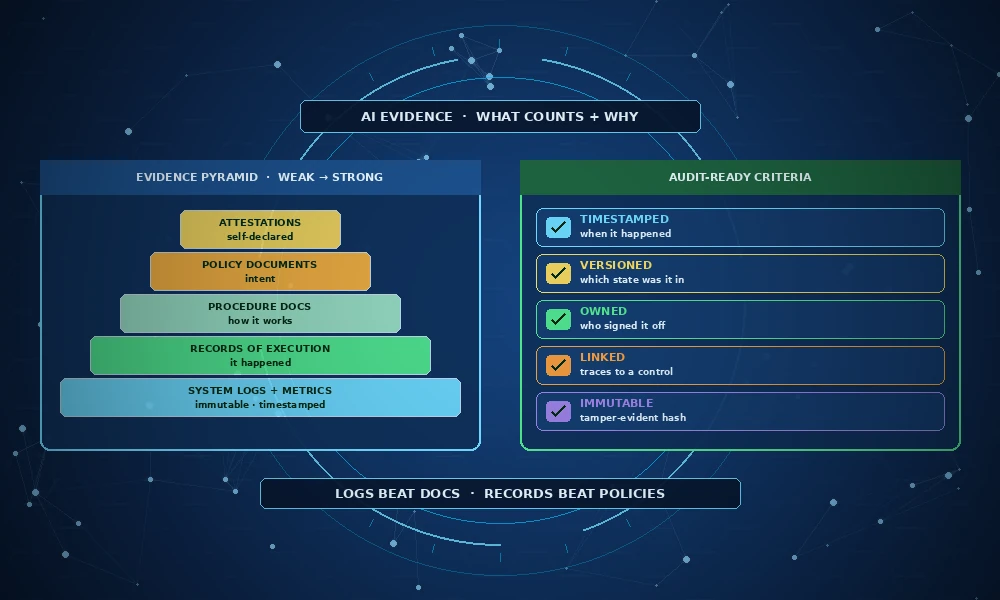
ISO/IEC 42001:2023 draws a sharp distinction carried through from ISO management system conventions between documents and records. Documents describe what your organisation plans to do: policies, procedures, system design specifications, data governance frameworks. Records prove what actually happened: completed risk assessments, version logs, approval sign-offs, monitoring results, incident reports. Both are required. Both serve different audit functions.
ISO/IEC 22989:2022, the conceptual vocabulary standard that ISO 42001 references, defines the AI system lifecycle across seven stages: inception, design and development, verification and validation, deployment, operation and monitoring, re-evaluation, and retirement. Each of these stages generates specific documentation obligations. The key architectural principle one that distinguishes mature governance programmes from ad hoc ones is that the documentation requirement attaches to the stage, not just to the system type. A low-risk internal analytics tool still needs intake and retirement records. A high-risk EU AI Act system additionally needs the full Annex IV technical file.
| Documents vs Records: The Audit-Critical DistinctionDocuments = intent. Records = evidence. ISO 42001 Clause 7.5 requires both to be controlled: version-managed, access-restricted, and retained according to defined schedules. Auditors will test whether your records match your documents. If your system design document says bias testing happens at validation, the bias testing record needs to exist. |
Stage 1 – Intake: Before Development Starts
The intake stage is where most documentation failures begin. Organisations build or procure AI systems without creating the foundational record that all subsequent governance depends on.
A properly structured intake record establishes three things: what the system is designed to do (intended purpose and use case), who is accountable for it (system owner, technical lead, risk owner), and what regulatory classification applies before a line of code is written. Under ISO 42001 Clause 8.1 operational planning and control organisations must plan how AI-related activities will be carried out under controlled conditions. That planning starts at intake.
For organisations subject to the EU AI Act, intake-stage classification matters even more. Article 6 and Annex III determine whether a system is high-risk. Documenting that classification decision at intake with the reasoning and the role responsibilities is what allows you to demonstrate compliance retrospectively during a conformity assessment. A classification decision made later and backdated is an audit finding waiting to happen.
Under the NIST AI RMF, the Govern 1.6 subcategory explicitly requires organisations to have mechanisms to inventory AI systems, resourced according to organisational risk priorities. The intake record is the first entry in that inventory.
| Intake Document | ISO 42001 Reference | EU AI Act Reference | NIST AI RMF Reference |
|---|---|---|---|
| AI system intake request / use case brief | Clause 8.1 | Art. 6 (risk classification) | Govern 1.6 |
| Intended purpose and use case definition | Clause 8.1, Annex A.6.1 | Annex IV, Section 1 | Map 1.1 |
| Preliminary risk classification | Clause 6.1.2 | Art. 6, Annex III | Map 2.1 |
| System owner and accountability assignment | Clause 5.3 | Art. 25 (deployer obligations) | Govern 1.1 |
| Stakeholder identification | Clause 4.2 | Art. 9 (risk management system) | Map 1.5 |
Stages 2 & 3 – Design, Development, and Validation
The design and development stage generates the highest volume of documentation, and the most consequential gaps. ISO 42001 Clause 8 requires controlled processes at each step from design through deployment. What that means in practice: every design decision that affects risk needs to be recorded, not just the outcome.
Training data provenance is a specific requirement under ISO 42001 Annex A.8 (data) and EU AI Act Article 10. The record needs to show what datasets were used, how their quality was assessed, whether bias evaluation was conducted, and what the results were. This is not a note in a model card it is a formal, version-controlled record attached to the system.
Architecture and algorithm documentation sits in EU AI Act Annex IV, Section 2. Providers of high-risk AI systems must describe design specifications, data requirements, and testing procedures with enough detail that a conformity assessor could evaluate whether appropriate safeguards are in place. As
As the Hogan Lovells legal briefing on Article 11 notes, this documentation must be prepared before the system is placed on the market not assembled after deployment in response to an audit request.
The validation stage adds a separate documentation layer: test datasets, evaluation criteria, performance metrics, and the reasoning behind the metrics selected. EU AI Act Annex IV, Section 4 specifically requires a description of why the chosen performance metrics are appropriate for the specific system — a nuance that generic documentation templates miss entirely.
Model Card and System Card: Distinct Documents
These two artefacts frequently get conflated. A model card describes the ML model: architecture, training data, performance characteristics, known limitations. A system card (or AI system card) describes the deployed system in its operational context: intended use, integration points, human oversight mechanisms, affected populations. ISO 42001 Annex A and EU AI Act Annex IV Section 1 both require system-level description. The model card alone does not satisfy this obligation.
Stage 4 – Deployment: The Record of Going Live
Deployment documentation is the least standardised part of most governance programmes. Teams treat it as a technical checklist rather than a governance record and then struggle to demonstrate approval lineage during audits.
A deployment record under ISO 42001 should capture: the version of the system deployed, the date of deployment, evidence of pre-deployment validation completion, the approval authority, and any conditions or constraints attached to the deployment (for example, geographic limits, user population restrictions, or human oversight requirements). This is the record that closes the loop between design-stage documents and operational reality.
For EU AI Act high-risk systems, Article 9 requires a risk management system maintained throughout the system lifecycle, documented in a way that shows how risks are identified, evaluated, and mitigated over time. The deployment record is where the risk treatment evidence from Clause 6 (planning) connects to real operational conditions.
NIST AI RMF’s Measure function requires assessment before deployment, and the documentation of those assessments feeds into the Manage function. Without a deployment record that references those assessments, the Measure-to-Manage link breaks creating a gap that AI security and risk reviewers will identify.
Cross-Framework Documentation Requirements by Lifecycle Stage
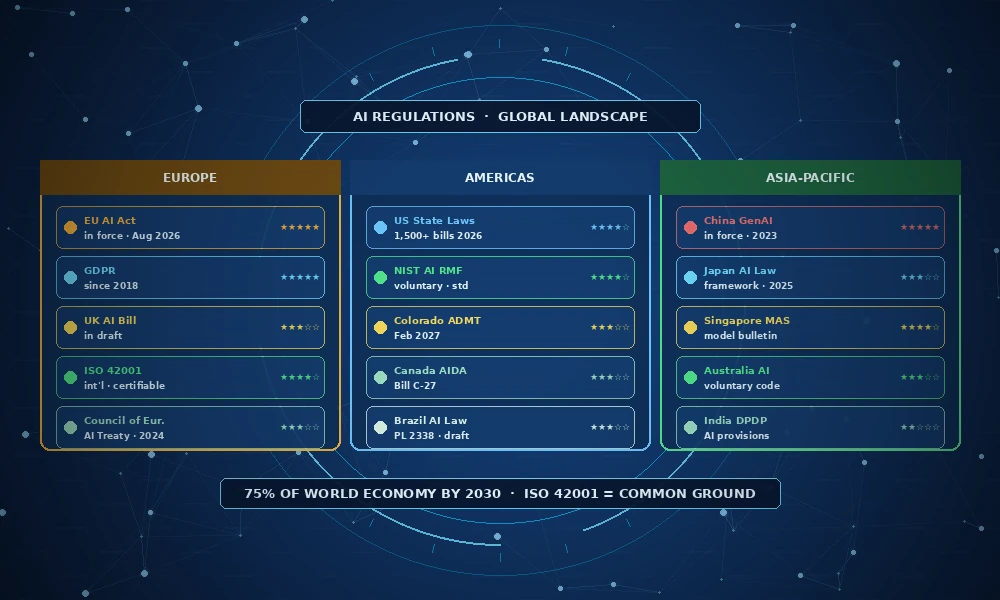
The practical challenge for most compliance teams is that ISO 42001, EU AI Act, and NIST AI RMF all reference lifecycle documentation, but use different terminology and organise requirements differently. The table below maps the major documentation obligations across all three frameworks by lifecycle stage.
| Lifecycle Stage | ISO 42001 Clause / Annex A | EU AI Act Article / Annex IV | NIST AI RMF |
|---|---|---|---|
| Intake & Classification | Cl. 4.2, 5.3, 6.1.2, 8.1 | Art. 6, Annex III | Govern 1.1, 1.6, Map 1.1 |
| Design & Development | Cl. 8.1, Annex A.6.1, A.8 | Art. 10, Annex IV §2 | Map 1.5, 2.1, Measure 1.1 |
| Validation & Testing | Cl. 8.1, Annex A.6.2.4 | Annex IV §4, Art. 9 | Measure 2.1, 2.5, 2.6 |
| Deployment | Cl. 8.1, 8.2, 8.3 | Art. 9, Annex IV §5 | Manage 1.1, 1.2, 2.2 |
| Operation & Monitoring | Cl. 9.1, Annex A.6.2.6 | Art. 12, Annex IV §9 | Manage 2.4, Measure 2.8 |
| Change Management | Cl. 8.1, Annex A.6.2.6 | Annex IV §6 (lifecycle changes) | Manage 3.1, 3.2 |
| Retirement | Cl. 8.1, Annex A.6.2.8 | Art. 18 (10yr retention) | Govern 1.7, Manage 4.2 |
Note: EU AI Act Annex IV section references reflect the official text at artificialintelligenceact.eu.
Stage 5 – Operation and Monitoring: Continuous Documentation
Deployment is not the end of the documentation obligation. For most regulatory frameworks, it is where the most demanding ongoing requirements begin.
ISO 42001 Clause 9.1 requires ongoing monitoring, measurement, analysis, and evaluation of AI systems. The key word is ongoing. Auditors will expect periodic monitoring records, not a single baseline report from the go-live date. Annex A.6.2.6 specifies controls for AI system operation and monitoring, including performance tracking and anomaly detection. Where monitoring reveals performance degradation or unexpected behaviour, the record must capture what was detected, when, and how the organisation responded.
EU AI Act Article 12 requires providers of high-risk AI systems to automatically log events relevant to the system’s operation a requirement that creates a continuing documentation burden distinct from what most enterprise risk management systems handle natively. Annex IV, Section 9 requires a post-market monitoring plan, which must be described in the technical documentation before deployment and then executed throughout the system’s operational life.
This is where Govern365.ai’s audit evidence management functionality addresses a genuine gap in most organisations’ programmes. Lifecycle records generated during operation monitoring logs, performance evaluations, incident reports need to be linked back to the AI system record and retained in a format that survives system changes and personnel turnover. A spreadsheet that lives in one team member’s OneDrive folder is not a controlled documented information record under ISO 42001 Clause 7.5.
Incident and Anomaly Records
ISO 42001 Annex A.8.4 covers communication of incidents. When an AI system produces unexpected outputs, causes harm, or triggers an alert through monitoring, the incident record needs to document: what happened, what the system was doing at the time, what the impact was, and what corrective action was taken. For EU AI Act high-risk systems, serious incident reporting obligations to national supervisory authorities carry additional formality requirements. These records should be linked to the system’s operational record from the moment they are created.
Stage 6 – Change Management: Documenting In-Life Modifications
One of the most underserved areas in AI governance documentation programmes is change management. AI systems are not static artefacts they are retrained, updated, and modified throughout their operational lives. Every significant change must be documented.
EU AI Act Annex IV, Section 6 explicitly requires a description of relevant changes made by the provider to the system through its lifecycle. This is not a generic change log it is a specific governance record that must be maintained as part of the technical documentation file.
As the AiActo analysis of Annex IV notes, every significant change algorithm updates, retraining, architecture modifications, changes in training data requires version traceability in the documentation.
Under ISO 42001, Clause 8.1 requires controlled processes not just for initial development but for any modification. If a change affects the risk profile for example, deploying the system to a new user population, retraining on a new dataset, or integrating with a new upstream data source the change record should trigger a re-evaluation of the risk assessment.
The practical implication: change records need to be linked to the original risk assessment, not stored separately as a technical changelog. An auditor reviewing compliance will trace the change record back to the risk treatment decision. If that chain is broken, the documentation fails its governance purpose even if the change itself was managed responsibly.
Stage 7 – Retirement: The Documentation Obligation That Doesn’t End
Most AI governance guides treat retirement as an afterthought. It is not. Retirement documentation is where EU AI Act obligations become legally binding in a way that outlasts the system itself.
Under EU AI Act Article 18, the technical documentation for a high-risk AI system must be retained for 10 years after the system is placed on the market or put into service. Hogan Lovells confirmed this in their Article 11 analysis: the documentation obligation does not terminate when the system is decommissioned.
ISO 42001 Annex A.6.2.8 covers AI system retirement controls. The retirement record should capture: the date and reason for retirement, the disposition of training data and model artefacts, the process for migrating or transitioning affected users, and confirmation that operational monitoring has ceased. NIST AI RMF Govern 1.7 explicitly requires processes and procedures for decommissioning and phasing out AI systems safely and this decommission documentation must be reflected in the organisation’s AI inventory.
| What a Retirement Record Must Include: 1. Retirement decision and authorisation who approved it and why 2. Date of retirement and end of operational monitoring 3. Data disposition record what happened to training data, inference logs, and personally identifiable information 4. Model artefact handling whether model weights were deleted, archived, or transferred 5. User/stakeholder transition notifications 6. Reference to the system’s complete lifecycle documentation file and retention location 7. Confirmation that the AI system inventory and registry have been updated |
One nuance that regularly catches compliance teams: the retirement record does not replace the lifecycle documentation file. It closes it. The entire file from intake through retirement needs to remain accessible in a controlled format for the retention period required by the applicable framework. For EU AI Act high-risk systems, that means 10 years of controlled access to documentation that may span multiple systems, teams, and organisational restructurings.
Frequently Asked Questions
What is the difference between AI system lifecycle documentation and a model inventory?
A model inventory is a catalogue a list of AI models in use, with attributes like owner, status, and risk classification. Lifecycle documentation is the full evidence record for each system: every document and record generated from intake through retirement. The inventory tells you what systems exist. The lifecycle documentation tells you everything that happened to each one, in a format that satisfies ISO 42001 Clause 7.5 controlled documented information requirements.
Does ISO 42001 specify a retention period for AI system lifecycle documentation?
ISO 42001 Clause 7.5 requires that documented information be controlled including retention requirements but does not prescribe a fixed retention period. Organisations must define retention schedules based on applicable legal obligations and operational needs. For organisations subject to the EU AI Act, Article 18 imposes a 10-year retention requirement for technical documentation of high-risk AI systems. That 10-year period governs regardless of whether the system has been retired.
What does ‘controlled documented information’ mean under ISO 42001 Clause 7.5?
Controlled documented information must be: identified and described (title, author, date, version), in an appropriate format and stored in an appropriate medium, reviewed and approved for suitability, accessible to those who need it, protected from unintended alteration or disclosure, and subject to defined retention and disposal procedures. Version control and access control are not optional features they are certification requirements.
Do NIST AI RMF documentation requirements apply to US government contractors?
The NIST AI RMF is voluntary for private sector organisations. However, it is increasingly referenced in federal acquisition requirements and sector-specific guidance. US federal agencies are directed to align with NIST AI RMF under Executive Order 14110 on AI safety. Organisations supplying AI systems to federal agencies should treat NIST AI RMF documentation expectations as functionally mandatory for contract compliance.
What happens during an ISO 42001 audit if lifecycle records are incomplete?
An incomplete lifecycle record for example, a monitoring log that stops six months after deployment, or an intake record that lacks risk classification is a nonconformity under Clause 8.1 or Clause 9.1, depending on the stage. Minor nonconformities require corrective action before certification is granted. Major nonconformities evidence that lifecycle controls are not being applied systematically can result in certification being withheld or withdrawn. Auditors specifically look for traceability across stages: can they follow a thread from intake through to current operation?
How should organisations handle lifecycle documentation for third-party AI systems they deploy but did not build?
ISO 42001 Clause 8.1 explicitly requires that third-party AI services be under governance control the “rogue AI projects” problem the standard was designed to address. For procured systems, the organisation should obtain available technical documentation from the provider (relevant to EU AI Act Annex IV obligations for deployers under Article 25), conduct and document its own risk assessment, and apply the same lifecycle monitoring and change record requirements it would apply to internally developed systems. Provider-supplied documentation supplements but does not replace the deployer’s own records.
What Complete Lifecycle Documentation Actually Achieves
The governance argument for comprehensive AI system lifecycle documentation is not about compliance paperwork. It is about maintaining organisational understanding of systems that outlive the teams that built them, that accumulate risk through change, and that create regulatory exposure that persists a decade after they are switched off.
Start with intake. Define your classification criteria before systems enter development. Build the record forward from there, stage by stage, so that by the time a system reaches retirement, the complete lifecycle file exists as a natural byproduct of how you managed the system not as a reconstruction exercise in preparation for an audit.
Govern365.ai, by the Global AI Certification Council, gives compliance and risk teams a single environment to manage lifecycle documentation across their AI estate from intake records and risk assessments through to retirement sign-off and post-decommission retention. Start your 14-day free trial at govern365.ai