A February 2026 Gartner press release found that organisations deploying purpose-built AI governance platforms are 3.4 times more likely to achieve high effectiveness in AI governance than those relying on general GRC tools yet most organisations still lack the structural foundation those platforms require: a ratified AI governance committee charter.
Without a charter, the committee has no formal authority, no defined decision rights, and no audit trail three things that both ISO/IEC 42001:2023 Clause 5 and the EU AI Act’s Article 9 risk management requirements treat as non-negotiable. Regulatory auditors and certification bodies are increasingly asking for the charter as a primary evidence document.
This guide provides a complete AI governance committee charter template, built around the operational needs of review and approval meetings, with cross-framework clause mapping across ISO 42001, the EU AI Act, and NIST AI RMF. Adapt it, ratify it, and use it to run governance that holds up under scrutiny.
What an AI Governance Committee Charter Actually Does
The charter is the constitutional document of your AI oversight function. It answers four questions that, without a written answer, will cause your committee to fail within its first year: Who has authority? Over what? By what process? And who is accountable when things go wrong?
That might sound administrative. It is not. The IAPP AI Governance in Practice Report 2024 identified unclear ownership as the single most common governance failure mode across organisations. Without explicit authority, committee recommendations become optional. Business units ignore them under deadline pressure. Decisions get made in departmental silos, and the committee becomes what practitioners call “governance theatre” meetings that produce minutes no one reads.
A properly drafted charter prevents this by establishing three things before the first meeting:
- Binding decision authority – the committee can approve, reject, or pause AI initiatives, not merely advise on them
- Scope boundaries – which AI systems, vendors, and use cases fall under committee jurisdiction, and which are delegated
- Escalation paths – when a decision moves from a delegated owner to the committee, and when it escalates further to the board
| Charter vs. Policy: The Key Difference |
| An AI policy states principles and requirements. A charter operationalises them. |
| Policy: “AI systems must be assessed for risk before deployment.” |
| Charter: “The AI Governance Committee reviews all high-risk AI proposals at its monthly meeting. The CTO holds delegated authority for low-risk tools below the defined threshold.” |
| Both documents are necessary. The charter gives the policy teeth. |
Committee Composition: Who Should Be in the Room
The committee composition question is where most organisations either under-build (a few IT leaders with no legal or ethics representation) or over-build (a seventeen-person committee that cannot reach quorum). The right number for most mid-market and enterprise organisations is five to nine members.
Each seat should be assigned a specific authority type before the first meeting:
| Role | Authority Type | Primary Contribution | Quorum Requirement |
| Chief AI Officer (or CTO/CDO) | Decision + Chair | Strategic alignment, casting vote | Required |
| Chief Information Security Officer | Decision + Veto (security) | Security risk assessment | Required |
| Chief Legal Officer / General Counsel | Decision + Veto (compliance) | Regulatory interpretation, EU AI Act | Required |
| Chief Risk Officer | Decision | Risk appetite, escalation thresholds | Required |
| AI/Data Science Lead | Advisory | Technical feasibility, model documentation | Recommended |
| Business Unit Representative (rotating) | Advisory | Operational context, use-case sponsorship | Optional |
| HR / People Lead | Advisory | Workforce impact, training requirements | Optional |
| Internal Audit | Observer / Advisory | Governance assurance, evidence review | Optional |
| External Expert (independent) | Advisory | Benchmarking, regulatory horizon scanning | Optional |
Three authority types should be defined in the charter:
- Decision authority: Can approve, reject, or modify AI proposals and policy updates
- Advisory authority: Must be consulted before decisions are made; holds no vote
- Veto rights: Can block any decision on compliance or security grounds, overriding a majority vote this is non-negotiable for CISO and Legal seats in regulated environments
Quorum should be defined as a minimum of all required-seat members. A meeting without Legal or the CRO present cannot bind the organisation on a high-risk AI approval.
The committee should oversee the organization’s employee AI use policy and review updates as AI technologies and regulations evolve.
Risk-Tiered Decision Authority Matrix
The most operationally important element of the charter is also the most commonly omitted: a clear definition of what requires committee approval versus what can be handled through delegated authority.
Without this matrix, one of two failure modes emerges. Either every AI initiative including low-stakes productivity tools gets queued for the next monthly committee meeting, creating bottlenecks that make governance the enemy of delivery. Or everything gets quietly delegated to individual business units, and the committee only sees AI systems after they are already in production.
Risk tiering solves this. Define thresholds explicitly:
| Risk Tier | Example AI Systems | Decision Authority | Review Cadence |
| High Risk | Automated credit decisions, clinical AI, hiring algorithms, public-facing generative AI with compliance exposure | Full committee approval required | Prior to deployment + annual review |
| Medium Risk | Internal analytics tools with automated outputs, customer-facing chatbots, AI-assisted performance management | Committee chair approval + CRO sign-off | Prior to deployment + bi-annual review |
| Low Risk | Internal productivity tools (AI writing aids, scheduling automation), pre-approved vendor SaaS with AI features | Delegated to AI/Data Science Lead | Registration in AI inventory + annual attestation |
| Excluded | Spam filters, search indexing, algorithmic recommendations within approved vendor platforms | No review required | Logged in inventory only |
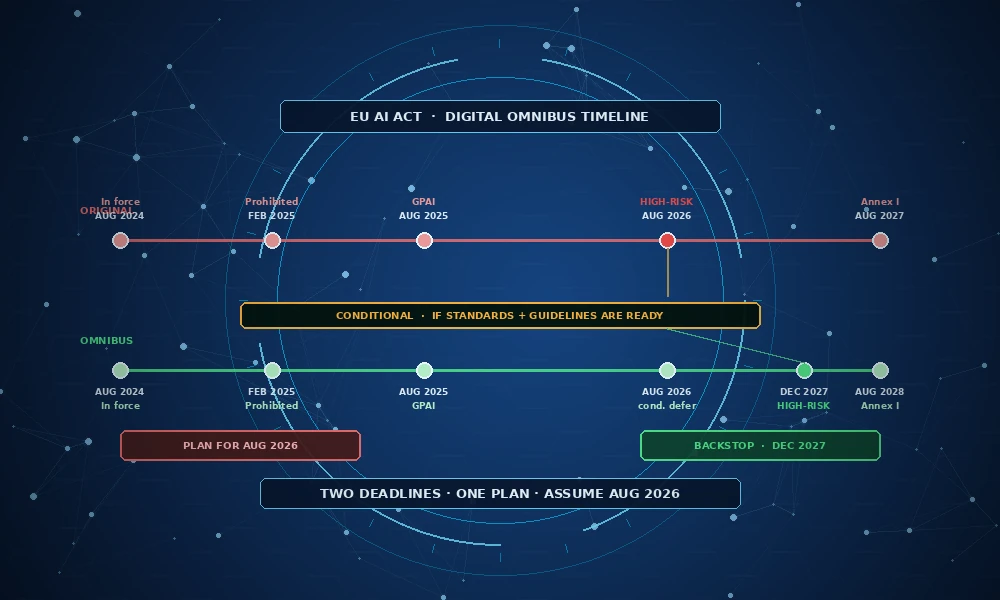
High-risk thresholds should explicitly reference EU AI Act Annex III categories if your organisation operates in or sells to EU markets. Under Regulation 2024/1689, Article 6, systems falling within Annex III classifications are subject to mandatory conformity assessment obligations the committee’s approval gate is the internal checkpoint before those external obligations are triggered.
| ISO 42001 Connection |
| ISO/IEC 42001:2023 Clause 6.1.2 requires the organisation to determine the significance of AI risks and establish corresponding controls. |
| Your risk tiering matrix is the operational implementation of this requirement. |
| During a certification audit, auditors will ask how the organisation determines which AI systems receive which level of oversight. The matrix is your answer. |
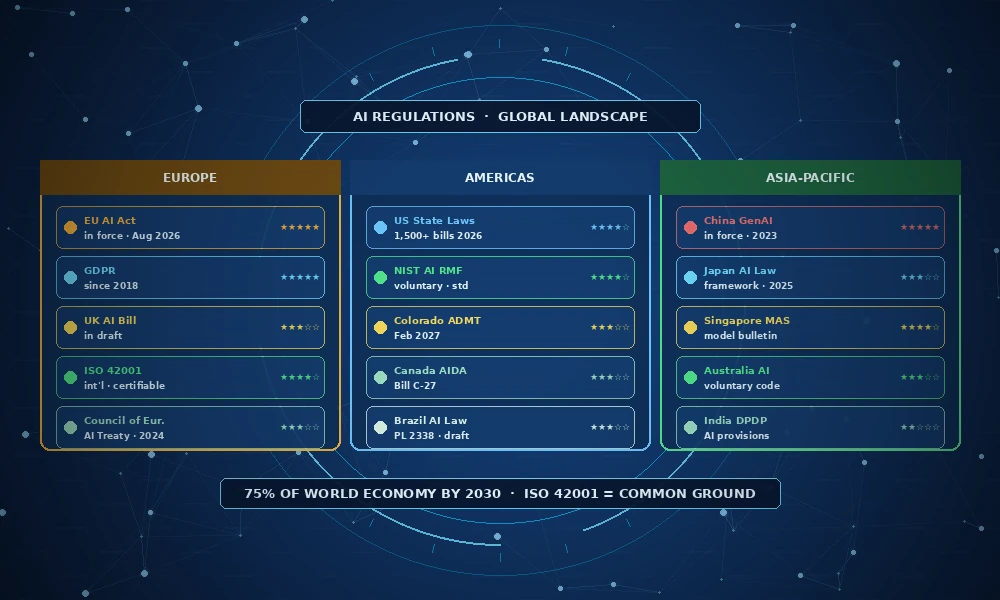
Cross-Framework Clause Mapping: ISO 42001, EU AI Act and NIST AI RMF
Most AI governance charters are written as internal policy documents with no connection to the external frameworks auditors and regulators use to evaluate them. This is a significant gap not just for certification preparation, but because it means the charter cannot demonstrate regulatory coverage to a board seeking assurance.
The table below maps each core charter element to its corresponding clause or function across the three primary frameworks:
| Charter Element | ISO/IEC 42001:2023 | EU AI Act 2024/1689 | NIST AI RMF 1.0 |
| Committee mandate & authority | Clause 5.1 (Leadership & Commitment), Clause 5.3 (Roles & Responsibilities) | Article 17 (Quality Management System) | GOVERN 1.1, GOVERN 1.2 |
| AI policy statement | Clause 5.2 (AI Policy) | Article 9(2)(a) (Risk management policies) | GOVERN 1.3 |
| Risk tiering / decision thresholds | Clause 6.1.2 (AI Risk Assessment) | Article 9(2)(b), Annex III (High-risk classification) | GOVERN 2.1, MANAGE 1.0 |
| Meeting cadence & quorum | Clause 9.1 (Monitoring & Measurement) | Article 9(4) (Ongoing risk management) | GOVERN 4.1, GOVERN 4.2 |
| Approval workflows & intake process | Clause 8.1 (Operational Planning), Clause 8.4 (AI System Lifecycle) | Article 17(1)(d) (Document management) | MAP 1.0, MAP 5.0 |
| Escalation paths to board | Clause 5.1, Clause 9.3 (Management Review) | Article 9(4) (Accountability chains) | GOVERN 1.2, GOVERN 5.1 |
| Charter review & amendment process | Clause 10.1 (Continual Improvement) | Article 9(6) (System review) | GOVERN 6.1, GOVERN 6.2 |
| Incident reporting to committee | Clause 8.5 (Monitoring of AI Systems) | Article 73 (Serious incident reporting) | RESPOND 1.0, RESPOND 2.0 |
This mapping does two things. First, it helps the committee understand which of its decisions generate regulatory evidence not every meeting action does, but the ones that do need proper documentation. Second, it provides the cross-walk an external auditor needs to confirm that the governance structure satisfies certification requirements.
Meeting Structure: Running Effective Review and Approval Meetings
Governance committees fail operationally when meetings lack structure. Members arrive unprepared, agenda items run over, decisions get deferred, and the meeting ends with action items that no one owns. The charter should prescribe meeting structure as tightly as it prescribes committee composition.
Meeting Cadence
- Full committee: Monthly (standing), with authority to call emergency sessions within 72 hours for critical incidents or urgent deployment decisions
- Chair + required seats only: Bi-weekly working sessions for time-sensitive approvals between full meetings (decisions made here are ratified at the next full meeting)
- Annual management review: A separate dedicated session aligned with ISO/IEC 42001:2023 Clause 9.3 Management Review requirements, reviewing the full AI governance program, not just individual decisions
Standard Meeting Agenda Template
| MONTHLY AI GOVERNANCE COMMITTEE MEETING – AGENDA TEMPLATE |
| 1. Quorum Confirmation (5 min) – Chair confirms required-seat attendance; records in minutes |
| 2. Previous Minutes & Action Item Review (10 min) – Confirm outstanding decisions, track completion |
| 3. AI System Inventory Update (10 min) – New registrations, changes to existing systems, deregistrations |
| 4. New Proposals: High-Risk Review (30 min) – Structured review using the AI Impact Assessment; vote to approve, reject, or defer with conditions |
| 5. New Proposals: Medium-Risk Ratification (10 min) – Ratify delegated approvals made since last meeting |
| 6. Incidents & Escalations (10 min) – Review any AI incidents flagged since last meeting; determine escalation to board if material |
| 7. Regulatory & Policy Updates (10 min) – Horizon scanning; any required policy amendments |
| 8. Any Other Business (5 min) |
| Target duration: 90 minutes. Minutes to be circulated within 5 business days. |
The 90-minute ceiling is intentional. Meetings that regularly run long signal either scope creep (the committee is reviewing decisions that should be delegated) or inadequate pre-meeting preparation. Both are charter failures, not calendar failures.
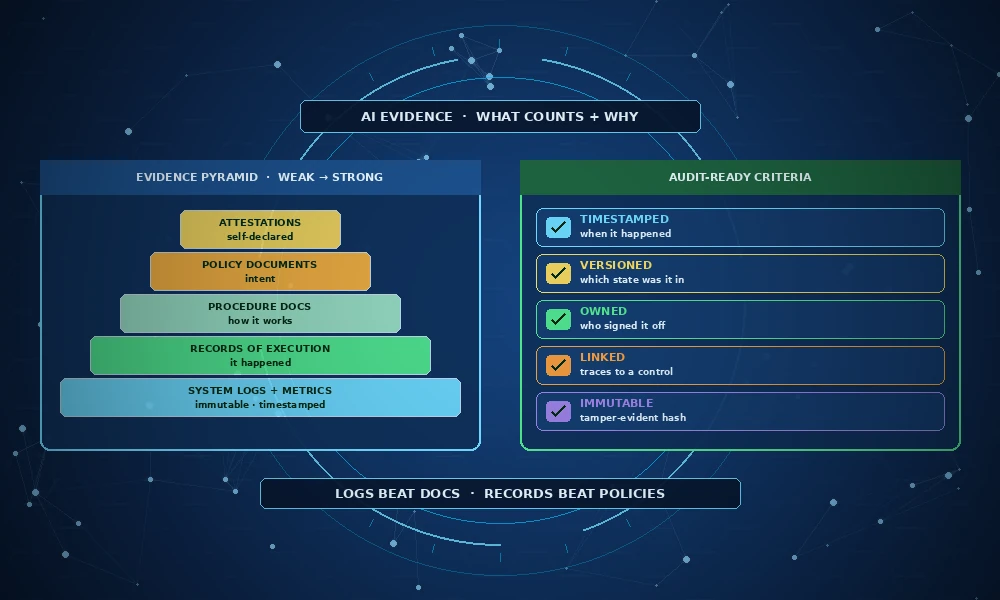
Decisions made in the meeting should be recorded using a standardised decision log: AI system name and version, risk tier assigned, decision (approved/rejected/deferred), rationale, conditions (if any), and the dissenting opinions of any veto holders. This log is dual-purpose: it is governance record-keeping and, under ISO 42001, primary audit evidence.
Intake and Review Workflows: From Proposal to Decision
The charter should define the intake process how an AI initiative enters governance review as precisely as it defines the committee’s authority. Without a defined intake process, proposals arrive in inconsistent formats, missing key information, which forces the committee to spend meeting time gathering data it should have received in advance.
Pre-Meeting Intake Requirements
All high-risk proposals must submit the following documentation at least 10 business days before the meeting at which they seek approval:
- AI Impact Assessment (AIIA) – covering intended purpose, training data sources, performance metrics, identified risks, and proposed mitigations
- Risk tier self-classification – with justification; the committee may reclassify upward
- Relevant vendor documentation – if third-party AI, include contractual data processing terms and vendor AI governance attestation
- Proposed monitoring plan – how the system will be tracked post-deployment, including KPIs and escalation triggers
- Applicable regulatory mapping – which EU AI Act risk category applies, which ISO 42001 clauses are relevant
Decision Outcomes
The committee should have four formal decision outcomes available, not just approve/reject:
- Approved – system may proceed to deployment
- Approved with conditions – system may proceed subject to specific mitigations being implemented before go-live; compliance officer confirms conditions met
- Deferred – proposal requires additional information or a revised risk assessment before the committee can vote
- Rejected – system does not meet the organisation’s risk tolerance or regulatory requirements; applicant may resubmit after material changes
Govern365.ai’s compliance workflow module automates the intake process routing proposals to the right reviewers, tracking documentation completeness, and generating a decision log that satisfies both ISO 42001 Clause 8.1 operational planning requirements and EU AI Act Article 17 documentation obligations. For organisations managing a growing AI portfolio, this transforms committee preparation from a manual coordination task into a governed workflow.
Use the AI governance checklist to verify governance activities before internal or external audits.
Charter Governance: Ratification, Amendment and Annual Review
The charter itself requires governance. An AI governance charter that is never reviewed becomes a liability it describes how decisions were made in a prior regulatory environment, not how they should be made now. EU AI Act enforcement obligations changed in phases through 2024 and 2025. NIST AI RMF is under active development. ISO 42001 is a living standard.
Ratification Requirements
The charter should be formally ratified by executive leadership typically the CEO or the Board Risk or Audit Committee before the governance committee holds its first formal meeting. This ratification signals that the committee holds organisational authority, not merely the interest of its members. Without ratification, business units can reasonably treat the committee as advisory.
The ratification process should be documented and the executed document retained as an artifact. Under ISO/IEC 42001:2023 Clause 5.1, top management commitment evidence is required the ratified charter is that evidence.
Amendment Process
- Minor amendments (clarifications, role updates, quorum adjustments): Chair authority, with notification to all members
- Substantive amendments (scope changes, new veto rights, decision threshold changes): Full committee vote, minimum two-thirds majority
- Major amendments (restructuring the committee, changing ratification authority): Requires re-ratification by executive sponsor or board
Annual Review Checklist
At a minimum, the annual review should assess:
- Whether the risk tiering thresholds remain calibrated to the current AI regulatory environment
- Whether committee composition reflects the current organisational structure and AI portfolio risk profile
- Whether meeting cadence and intake workflows are functioning as designed (measured by average time-to-decision and deferred proposal rate)
- Whether the charter’s cross-framework mapping remains current with any regulatory updates to ISO 42001, EU AI Act, or NIST AI RMF
- Whether any incidents from the past year indicate a gap in the charter’s scope or authority structure
The AI Governance Committee Charter Template
The following template provides a complete, adaptation-ready charter structure. Replace bracketed fields with your organisation’s specifics. Legal counsel should review before ratification, particularly for jurisdiction-specific regulatory references.
| [ORGANISATION NAME] – AI GOVERNANCE COMMITTEE CHARTER |
| Version: [x.x] | Ratified: [Date] | Next Review: [Date] | Executive Sponsor: [Name/Title] |
| 1. PURPOSE & AUTHORITY |
| The AI Governance Committee (“Committee”) is established by [Organisation Name] to provide formal oversight of the development, procurement, deployment, and ongoing monitoring of artificial intelligence systems within the organisation. The Committee holds binding authority over AI use case approval, AI policy, and AI risk management, as delegated by [Executive Sponsor / Board Committee]. |
| 2. SCOPE |
| This charter applies to all AI systems developed internally, procured from third-party vendors, or deployed as embedded components within other enterprise software — where such systems are used in, or materially influence, organisational decisions, products, or services. Exclusions: [define exclusions, e.g., personal productivity tools below defined threshold]. |
| 3. COMMITTEE COMPOSITION |
| Chair: [Role Title] | Required Members: [List roles with authority types] | Advisory Members: [List roles] | Quorum: All required-seat members present. |
| 4. DECISION AUTHORITY MATRIX |
| High Risk: Full committee approval required. | Medium Risk: Chair + CRO delegated authority, ratified at next full meeting. | Low Risk: Delegated to [AI Lead role]. | See Schedule A for risk tier definitions and EU AI Act Annex III cross-reference. |
| 5. MEETING CADENCE & PROCEDURES |
| Full Committee: Monthly. Emergency Session: Within 72 hours on request of Chair or any required-seat member. Annual Management Review: [Month each year]. Quorum: [Define]. Decision Recording: Decisions logged in the AI Decision Register within 5 business days of meeting. |
| 6. INTAKE & REVIEW PROCESS |
| All proposals must submit [list required documentation] no fewer than 10 business days before the relevant meeting. The Committee may classify or reclassify any proposal to a higher risk tier. Decision outcomes: Approved | Approved with Conditions | Deferred | Rejected. |
| 7. ESCALATION TO BOARD |
| The Committee Chair will escalate to the [Board Risk/Audit Committee] upon: (a) material AI incident with actual or potential regulatory exposure; (b) any rejected proposal where the business sponsor seeks board override; (c) annual management review findings material to the organisation’s risk profile. |
| 8. CHARTER AMENDMENT |
| Minor amendments: Chair authority. Substantive amendments: Two-thirds committee vote. Major amendments: Executive sponsor re-ratification. |
| 9. REGULATORY ALIGNMENT |
| This charter is designed to satisfy: ISO/IEC 42001:2023 Clause 5 (Leadership); EU AI Act Article 9 and Article 17; NIST AI RMF GOVERN function. See Schedule B for clause-by-clause cross-mapping. |
| 10. REVIEW CYCLE |
| This charter shall be reviewed annually, or upon material change to the organisation’s AI portfolio or applicable regulatory requirements. |
| Ratified by: [Name, Title] | Date: [Date] |
Frequently Asked Questions
What is the difference between an AI governance committee charter and an AI policy?
An AI policy establishes principles, requirements, and prohibited uses. A charter operationalises those principles by defining who holds authority, how decisions are made, and what processes govern review and approval. Both are required; the charter gives the policy its enforcement mechanism.
Who should ratify the AI governance committee charter?
The charter should be ratified by executive leadership typically the CEO, CFO, or the Board Risk or Audit Committee. Ratification by a C-level executive or board body signals that the committee holds binding organisational authority. ISO/IEC 42001:2023 Clause 5.1 specifically requires evidence of top management commitment, and the ratified charter is the primary document that satisfies this requirement.
How does an AI governance committee charter map to ISO 42001?
The charter directly addresses ISO/IEC 42001:2023 Clause 5 (Leadership and Commitment, AI Policy, Roles and Responsibilities), Clause 6.1.2 (AI Risk Assessment), Clause 8.1 (Operational Planning), and Clause 9.3 (Management Review). During a certification audit, the ratified charter and accompanying decision logs are among the first evidence documents reviewed. See the cross-framework mapping table in this article for clause-level detail.
How often should an AI governance committee meet?
For most organisations with an active AI portfolio, monthly full-committee meetings are appropriate, with bi-weekly working sessions for time-sensitive approvals. The charter should also mandate an annual management review separate from routine meetings, aligned with ISO 42001 Clause 9.3 requirements. Emergency sessions should be available within 72 hours for material incidents or urgent deployment decisions.
What decisions require full committee approval versus delegated authority?
This depends on your risk tiering matrix, which the charter should define explicitly. As a baseline: all high-risk AI systems (including EU AI Act Annex III categories) require full committee approval before deployment. Medium-risk systems can be handled by a smaller approval group between meetings, subject to ratification at the next full session. Low-risk tools can be delegated to a designated AI lead with mandatory registration in the AI inventory.
Can the AI governance committee charter be used as audit evidence?
Yes the ratified charter, meeting minutes, and AI Decision Register together form the primary governance evidence trail for ISO 42001 certification audits and EU AI Act compliance assessments. The charter establishes the structure; the minutes prove the structure is being followed. Both are expected by certification bodies and regulators reviewing an organisation’s AI Management System.
What happens if a committee member exercises veto rights?
The charter should specify that a veto by a designated veto-holder (typically CISO or Legal) blocks the decision unless overridden by a process defined in the charter for example, a unanimous vote of all other required-seat members plus escalation to the executive sponsor. The veto, the rationale, and the resolution should all be documented in the AI Decision Register. Veto rights without a resolution path create deadlock; define the path before it is needed.
Does the AI governance committee charter need to address AI agents specifically?
Increasingly, yes. AI agents systems that autonomously execute multi-step tasks, access tools, and make decisions without human review at each step present accountability challenges that standard model governance does not cover. Your charter should clarify whether agentic AI systems are classified as high-risk by default, what additional documentation is required for agent proposals, and how the committee monitors autonomous actions post-deployment.
Conclusion
The AI governance committee charter is not a compliance document. It is the instrument through which your organisation demonstrates that AI decisions are made deliberately, by accountable people, through a process that can withstand regulatory scrutiny. Without it, even a well-intentioned committee lacks the authority to do what governance requires: say no when a system is not ready, escalate when an incident is material, and hold the organisation accountable for the AI systems it chooses to deploy.
Start with the template in this guide. Map your charter to the cross-framework table. Ratify it before your committee’s first meeting, not after. Then run the process because a governance structure only produces evidence when it is actually used.
Govern365.ai, provides purpose-built infrastructure for AI governance committees from structured intake workflows and AI model registries to decision logs that satisfy ISO 42001 audit requirements out of the box. Start your 14-day free trial and bring your committee’s first meeting to order with the evidence architecture already in place