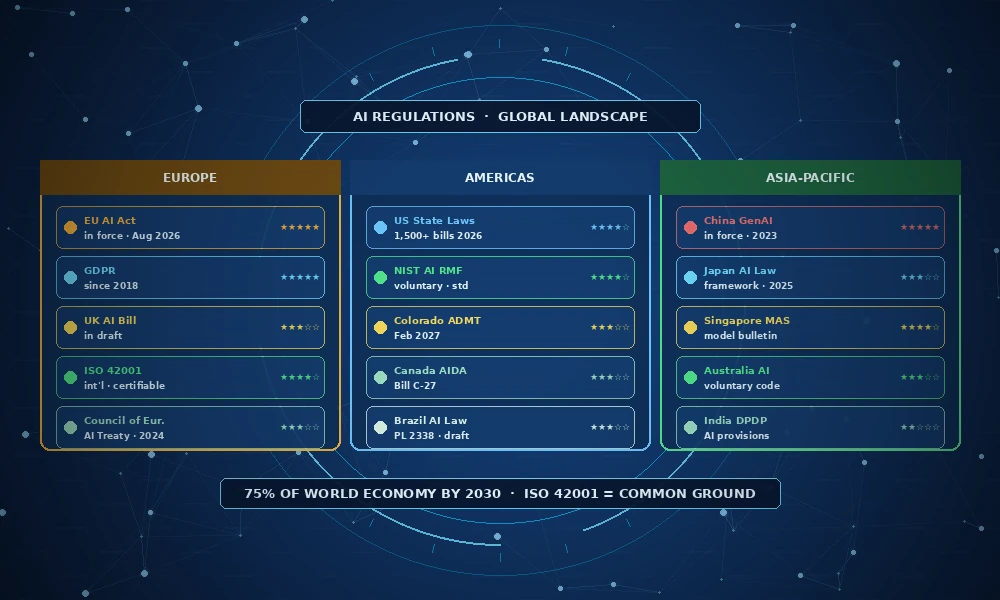
Spending on AI governance platforms will reach $492 million in 2026 and pass $1 billion by 2030, according to Gartner’s February 2026 analysis, which also projects that AI regulation will quadruple and reach 75% of the world’s economies by the end of the decade. Almost none of that money buys anything useful until one humble artifact exists: a complete inventory of the AI systems an organization actually runs. The AI system inventory is the record every framework quietly depends on, because you cannot classify, assess or govern a system you have not written down. This article gives you a working template, a four-tier structure for models, tools, agents and vendors, and a clause-level map showing how one inventory satisfies ISO/IEC 42001, the EU AI Act and the NIST AI Risk Management Framework at the same time.
Why the AI System Inventory Became the Load-Bearing Artifact
An AI system inventory is a structured register of every AI system an organization develops, buys, or operates, capturing each system’s purpose, owner, risk classification, lifecycle stage and supporting evidence. That definition sounds administrative. The reason it matters is that every downstream control inherits from it. Risk assessment needs a list of systems to assess. Impact assessments need scope. Audit evidence needs something to attach to. Remove the inventory and the rest of the program has nothing to stand on.
The frameworks make this dependency explicit. NIST AI RMF 1.0 names it directly in subcategory GOVERN 1.6, which calls for mechanisms to inventory AI systems resourced according to risk priorities, per the official NIST AI RMF to ISO/IEC 42001 crosswalk. ISO/IEC 42001:2023 routes operational planning through Clause 8 and its risk and impact assessment clauses (6.1.2 and 6.1.4), all of which assume you know which systems exist. The EU AI Act requires registration of high-risk systems in the EU database under Article 49 and full technical documentation under Article 11 and Annex IV. Three frameworks, one prerequisite.
For US organizations there is a sharper, money-side reason. There is still no comprehensive federal AI statute, but state laws have filled the gap, and several offer a safe harbor or rebuttable presumption of compliance when you adopt a recognized framework such as NIST AI RMF or ISO 42001. The Texas Responsible Artificial Intelligence Governance Act took effect on 1 January 2026, and the Colorado AI Act, the first comprehensive US high-risk statute with penalties up to $20,000 per violation, takes effect on 30 June 2026, according to a Baker Botts US AI law update. You cannot credibly claim framework adoption without an inventory that proves you know what you are governing.
The Four-Tier Taxonomy: Models, Tools, Agents, and Vendors
Most teams build one flat list of “AI systems” and discover, usually mid-audit, that the list hides four very different things behind one column. A fine-tuned classifier, a copilot baked into a SaaS suite, an autonomous agent that books refunds and a third-party API you call but do not control are not the same kind of object. They fail differently, they are owned differently, and the frameworks attach different obligations to each. Splitting the inventory into four tiers is the single change that separates a register that survives scrutiny from one that does not.
| Tier | What it covers | What makes it distinct | Primary risk |
|---|---|---|---|
| Models | Foundation models, fine-tuned and in-house ML models, embeddings | Provenance, training data, version lineage, drift | Performance decay, bias, opaque dependencies |
| Tools | AI features embedded in SaaS, copilots, plug-ins | Often invisible and configured, not built | Shadow AI, data leakage, ungoverned adoption |
| Agents | Autonomous and semi-autonomous systems that take actions | Action scope, tool access, runtime behavior | Unintended actions, accountability gaps |
| Vendors | Third-party AI providers, APIs, sub-processors | Contractual flow-down, value-chain role | Provider/deployer confusion, hidden sub-processors |
The agent tier is where most inventories quietly break. An agent is not just a model; it is a model plus the authority to act, which is exactly what regulators care about. Unregistered agents are both a governance gap and a compliance gap, because an action taken by a system nobody catalogued is an action nobody can explain. The vendor tier is the second blind spot: organizations record the contract and stop, missing the sub-processors and downstream model providers that the EU AI Act addresses through value-chain responsibilities in Article 25.
What Every AI Inventory Record Must Capture
Below is the core field set. Treat it as the shared schema that applies to every tier, then layer the tier-specific fields from the next section on top. Each field is annotated with the framework requirement it helps satisfy, so the inventory doubles as evidence rather than sitting beside it.
- System ID and name. A unique, stable identifier. Maps to ISO 42001 A.6.2 documentation and NIST MAP 1.1.
- Tier. Model, tool, agent, or vendor. Drives which extended schema and controls apply.
- Purpose and intended use. Plain-language description plus intended and prohibited uses. Required for EU AI Act Article 11 and Annex IV, ISO A.6.2.2, and NIST MAP 1.1.
- Owner and accountable executive. A named individual, not a team. Supports ISO Clause 5.3 roles, EU Article 26 deployer duties, and NIST GOVERN 2.1.
- Risk classification. The EU AI Act tier (prohibited, high, limited, minimal) plus your internal risk rating. Ties to EU Article 6 and Annex III, ISO 6.1.2, and NIST MAP 1.5.
- Lifecycle stage. Design, development, validation, deployment, operation, or retirement. Maps to the ISO A.6.2 life-cycle controls and NIST MANAGE.
- Data sources and sensitivity. Training, fine-tuning, and inference data, with classification. Supports ISO A.7 data controls, EU Annex IV, and NIST MAP 2.2.
- Model provenance. The underlying foundation or base model and its provider. Relevant to EU general-purpose AI obligations and NIST MAP 2.1.
- Human oversight mechanism. How and where a person can intervene. Required by EU Article 14 and reflected in NIST MEASURE and MANAGE.
- Vendor and contract reference. Provider, sub-processors, and the governing agreement. Maps to ISO A.10 third-party controls, EU Article 25, and NIST MAP 4.1.
- Autonomy and action scope. For agents: what the system may do unattended and which tools it can call. The control surface for accountability.
- Monitoring and performance metrics. What you measure and the thresholds that trigger review. Ties to ISO Clause 9, EU Article 72 post-market monitoring, and NIST MEASURE.
- Change and version log. Material changes, retraining, and incidents over time. Supports EU Article 72 and NIST MANAGE 4.
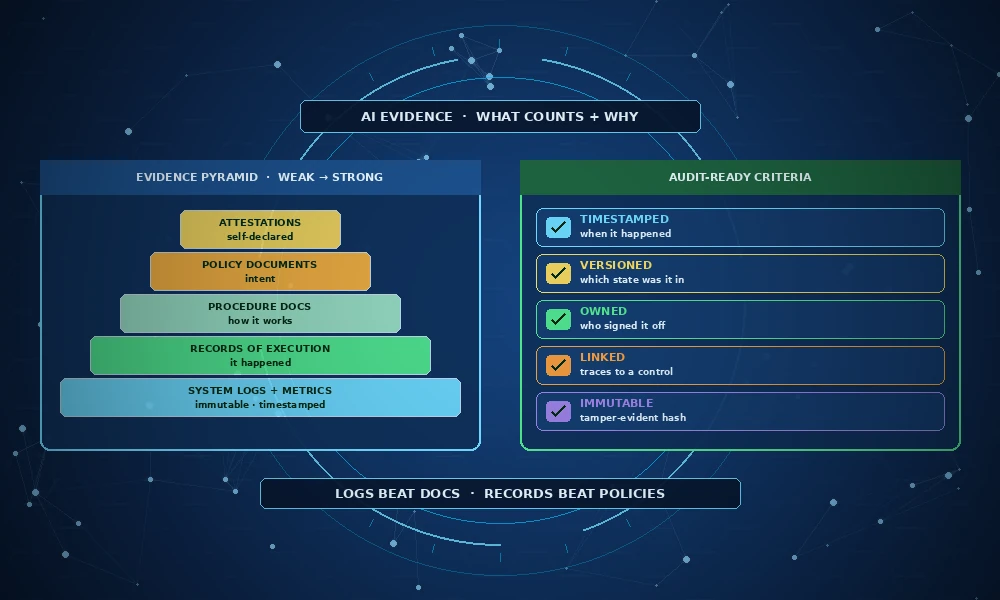
- Evidence location. Where the documentation, assessments, and approvals live. The link that turns the inventory into audit evidence.
- Compliance status. Current standing against each applicable framework, with open gaps and remediation dates.
This is the point where tooling earns its place. Maintaining fifteen fields across hundreds of systems in a spreadsheet is possible right up to the moment an auditor asks for the version history of a single classification decision. Govern365.ai‘s AI model registry maps each system to its applicable ISO 42001 clauses and EU AI Act risk category automatically, so the attribution column above is generated rather than hand-maintained.
Once your inventory is complete, use an AI audit evidence checklist to ensure every system has supporting documentation.
How One Inventory Satisfies ISO 42001, the EU AI Act and NIST AI RMF
The reason a single inventory can serve three regimes is that they converged on the same underlying functions, even though the vocabulary differs. The table below maps each inventory function to the specific clause, article, or subcategory it satisfies in each framework. This is the work most teams skip and most competitors never publish, and it is what lets one assessment produce evidence three times over.
| Inventory function | ISO/IEC 42001:2023 | EU AI Act | NIST AI RMF 1.0 |
|---|---|---|---|
| Maintain a complete system inventory | Clause 8.1; Annex A.4.3–A.4.5 (data, tooling, system resources) | Art. 49 (EU database registration) | GOVERN 1.6 |
| Classify each system by risk | Clause 6.1.2; 6.1.4 impact assessment | Art. 6 + Annex III; Art. 5 prohibited uses | MAP 1.1–1.5 |
| Document purpose and characteristics | Annex A.6.2 (life cycle) | Art. 11 + Annex IV | MAP 2.1–2.3 |
| Assign ownership and oversight | Clause 5.3; Annex A.3 | Art. 14; Art. 26 | GOVERN 2.1 |
| Track third-party and vendor AI | Annex A.10 (third parties) | Art. 25 (value chain) | MAP 4.1; GOVERN 6.1 |
| Monitor after deployment | Clause 9 performance evaluation | Art. 72 post-market monitoring | MEASURE 2.x; MANAGE 4.x |
ISO 42001 Annex A sub-control numbers (A.4.3–A.4.5, A.6.2, A.10) align with the NIST-published crosswalk, which references the corresponding Annex B implementation guidance (B.4.3–B.4.5). Confirm exact sub-clause numbering against the purchased ISO/IEC 42001:2023 text before publication.
One caveat keeps this honest. The EU AI Act is assessed system by system and role by role, not at the organization level, so the same company can be a provider for one system and a deployer for another, carrying different duties for each. ISO 42001 certification demonstrates management-system maturity but does not by itself satisfy the Act. The inventory is where those distinctions get recorded, which is why the “role” and “compliance status” fields are not optional.
Tier-Specific Fields: What Changes Across Models, Tools, Agents and Vendors
The shared schema gets each tier into the register. These extensions make each record actually useful for governing that kind of system.
Models
Capture training and fine-tuning data lineage, the base model and version, evaluation results, known limitations, and a drift-monitoring plan. Models are the tier most likely to degrade silently, so the version log and performance thresholds carry more weight here than anywhere else. A model card belongs in the evidence location field, not in place of the inventory record.
Tools
Most embedded AI features enter the organization through procurement or a checkbox in an existing product, not through an engineering decision, which is how shadow AI accumulates. For tools, record the host product, the specific AI capability enabled, the configuration, what data it can access, and whether end users can turn it on themselves. The hardest part is discovery, because nobody decided to deploy them in the first place.
Agents
This is the tier that earns a dedicated schema. Record the agent’s autonomy level, the tools and APIs it can invoke, the actions it may take without human approval, its escalation and kill-switch path, and its runtime guardrails. Because agents act, the inventory needs to reach into runtime, not just describe intent. Govern365.ai’s agent registry captures action scope and runtime behavior alongside the static record, so an agent’s authority is documented before it is exercised rather than reconstructed after an incident.
Vendors
For third-party AI, the record must state your role for that system (provider or deployer), the sub-processors and downstream model providers in the chain, the contractual flow-down of governance obligations, and the vendor’s own certifications and attestations. A vendor risk register that stops at the signed contract misses precisely the value-chain exposure that Article 25 of the EU AI Act exists to address.
How to Build the Inventory: From Discovery to Governance
A template is only as good as the process that populates and maintains it. The sequence below takes an organization from “we think we have some AI somewhere” to a living register that produces evidence on demand.
- Discover. Combine self-reporting with technical discovery: network and SaaS scans, procurement records, code repositories, and API gateways. Assume the first pass is incomplete, especially for tools and agents.
- Register and assign an owner. Every system gets a record and a named accountable owner before anything else happens. Ownerless systems are how inventories rot.
- Classify risk once, map it everywhere. Assign each system its EU AI Act tier and internal rating, then carry that single classification across ISO 42001, NIST AI RMF, and applicable state laws rather than re-classifying per framework.
- Attach evidence. Link impact assessments, technical documentation, and approvals to the record so the inventory becomes the index to your audit evidence.
- Review on a cadence. Set a quarterly review and event-based triggers (new system, material change, incident). A register reviewed annually is out of date by the second quarter.
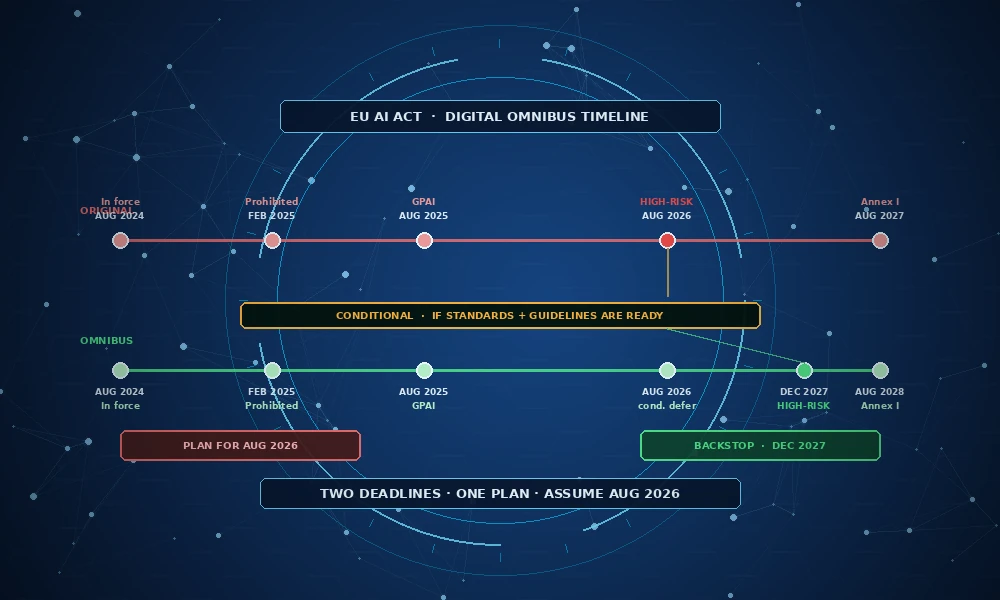
The EU timeline gives this urgency without giving anyone an excuse to wait. Under the Digital Omnibus agreement reached on 7 May 2026, high-risk obligations for standalone Annex III systems were deferred to 2 December 2027, per the European Council. The deferral moved the deadline, not the work. Finding every AI system and classifying it is the slow part, and it does not get easier by starting later. Transparency obligations and the new prohibition on certain synthetic-content systems still arrive on 2 December 2026.
For third-party AI providers, complete an AI vendor risk assessment questionnaire before adding them to your inventory.
Where AI Inventories Break Down
The failure modes are consistent enough to be predictable. Knowing them in advance is cheaper than discovering them during an audit.
- The spreadsheet hits its ceiling. A spreadsheet works until the third audit, when someone asks who changed a risk classification and when. Spreadsheets do not retain version history, access control, or evidence linkage, which is the moment most teams move to a registry.
- Agents go unrecorded. Because agents are often spun up by engineering teams to solve a local problem, they rarely make it onto the central list until they take an action someone has to answer for.
- Tools hide inside SaaS. Shadow AI lives in features that were switched on, not deployed. If discovery relies only on self-reporting, the tool tier will be the most incomplete.
- Vendor records stop at the contract. Sub-processors and downstream model providers are where value-chain risk actually sits, and they are exactly what a contract-only record omits.
- One flat list collapses the tiers. Treating a vendor API and an autonomous agent as the same row guarantees the wrong fields and the wrong controls for both.
Frequently Asked Questions
What is an AI system inventory?
An AI system inventory is a structured register of every AI system your organization builds, buys, or operates, recording each system’s purpose, owner, risk classification, lifecycle stage, and evidence. It is the foundational control that risk assessments, impact assessments, and audit evidence all depend on, which is why NIST AI RMF names it explicitly in GOVERN 1.6.
What should an AI system inventory template include?
At minimum: a unique system ID, tier, purpose, named owner, risk classification, lifecycle stage, data sources, model provenance, human oversight mechanism, vendor and contract reference, monitoring metrics, change log, evidence location, and compliance status. Each field should map to a specific framework requirement so the inventory serves as evidence rather than documentation that sits beside it.
Do I need to inventory third-party AI tools and vendors?
Yes. Third-party tools and vendor APIs carry real governance exposure, including sub-processors and downstream model providers you do not directly control. The EU AI Act addresses this through value-chain responsibilities in Article 25, and a vendor record that stops at the signed contract misses the part that matters. Record your role (provider or deployer) for each third-party system.
How is an AI agent inventory different from a model inventory?
An agent inventory adds the authority to act. Beyond the model details, it must capture autonomy level, which tools and APIs the agent can call, the actions it may take without approval, and its escalation and kill-switch paths. Because agents take actions, their inventory has to reach into runtime behavior, not just describe intended use.
Does ISO 42001 require an AI system inventory?
Effectively, yes. ISO/IEC 42001:2023 does not use the word “inventory” as a single clause, but its risk assessment, impact assessment, and operational planning clauses all assume you know which AI systems exist. The official NIST crosswalk maps GOVERN 1.6 inventory mechanisms to the standard’s resource and documentation controls, confirming the inventory is the practical backbone of the management system.
How often should you update an AI system inventory?
Review at least quarterly, with event-based triggers for any new system, material change, retraining, or incident. AI systems change faster than annual review cycles can track, so a register updated once a year is typically out of date within months. Continuous or automated updates are the goal for organizations operating agents and frequently retrained models.
Is a spreadsheet enough for an AI system inventory?
For a handful of systems, briefly. Spreadsheets fail on version history, access control, and evidence linkage, which is exactly what an auditor asks for. Once you are tracking dozens of systems across multiple frameworks, a purpose-built registry that records who changed what and when, and links each record to its evidence, becomes the practical choice.
The Inventory Is the Program
The $492 million organizations will spend on AI governance in 2026 buys nothing without a register of what is being governed. The inventory is not the boring prerequisite to the real work; it is the artifact every framework, audit, and safe-harbor claim resolves back to. Build it in four tiers, give every record an owner and a risk classification, and map each field to the clause it satisfies, and one inventory will carry you across ISO 42001, the EU AI Act, and NIST AI RMF at once.
Start with discovery this week, because finding every system is the slow part and the clock on it is already running. When you are ready to move off the spreadsheet, Govern365.ai, by the Global AI Certification Council, gives you a model and agent registry with framework mapping built in. Start your 14-day free trial