By 2027, four in ten enterprises will demote or shut down autonomous AI agents after governance gaps surface in production, according to Gartner, which found that treating agent oversight as an all-or-nothing switch is the root cause. Chatbots, retrieval-augmented generation (RAG) pipelines and autonomous agents each carry a distinct risk profile under ISO/IEC 42001, the EU AI Act and NIST AI RMF, and a governance platform built for one rarely covers the others cleanly.
This piece maps the specific controls each LLM system type needs, shows exactly where ISO 42001, EU AI Act and NIST AI RMF clauses overlap and diverge for chatbots, RAG and agents, and gives you a working checklist to evaluate or build an LLM governance program.
What an LLM Governance Platform Actually Covers
An LLM governance platform is not the same thing as a model registry, and it is not the same thing as an AI security tool. It is the layer that connects the two: it inventories every chatbot, RAG deployment and agent in production, evaluates each one against a risk framework, and produces the evidence an auditor or regulator will eventually ask for.
Most GRC platforms were not built for this. They track vendors, contracts and policy attestations well, but they were never designed to capture a system prompt, a retrieval index, or an agent’s tool-calling permissions as governed artifacts. Traditional MLOps tools sit on the other side of the gap: they monitor latency and drift but stay silent on clause-level compliance.
A governance platform purpose-built for LLM systems needs to do four things continuously: maintain a live inventory of every generative AI system and its risk classification, evaluate each system against the controls a chosen framework requires, generate audit-ready evidence without manual screenshotting, and flag configuration drift, such as a chatbot losing its AI-disclosure banner after a UI update, before an auditor finds it first.
Why Chatbots, RAG Pipelines and AI Agents Need Different Controls
Grouping every generative AI deployment under one governance checklist is the fastest way to under-govern the riskiest systems while over-governing the safest ones. The three system types differ in where the risk actually lives.
Chatbots: disclosure and conversational scope
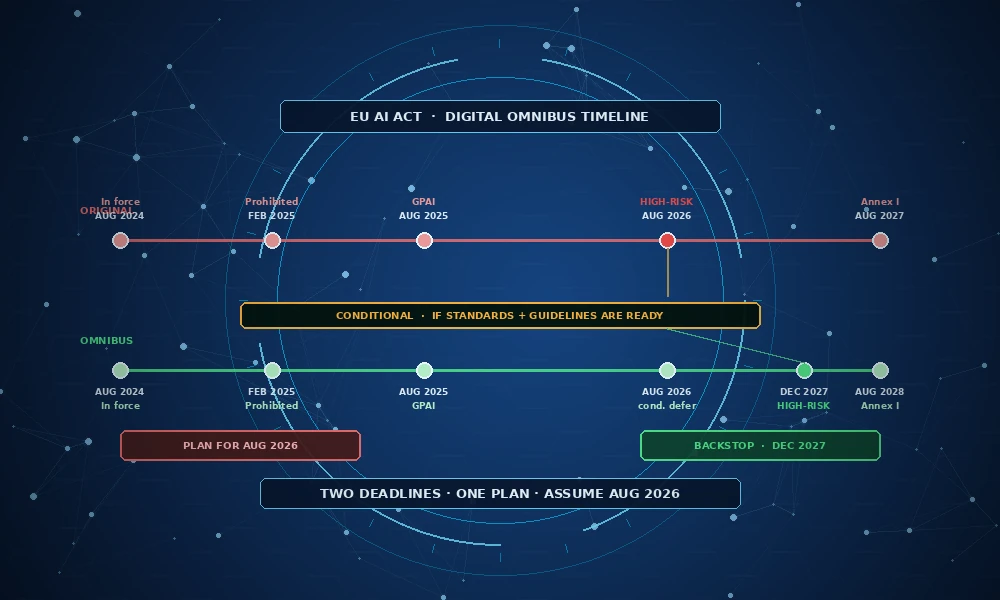
A customer-facing chatbot’s primary regulatory exposure is transparency, not model accuracy. Under Article 50(1) of the EU AI Act, providers of systems intended for direct interaction with a person must make the AI nature of the interaction clear, unless it would already be obvious to a reasonably informed user. That obligation, along with deepfake and synthetic-content labeling under Article 50(4), becomes enforceable on August 2, 2026, with fines that can reach 15 million euros or 3 percent of global turnover, whichever is greater.
For a US-based company with EU customers, that means every support widget, sales assistant and internal-facing copilot that reaches EU users needs a documented disclosure decision, not just a working chatbot.
RAG pipelines: data lineage and grounding
A RAG system’s governance burden centers on the retrieval layer: what data feeds the index, who can query it, and whether the model’s answer can be traced back to a specific retrieved document. This is where ISO 42001’s data governance requirements and the EU AI Act’s Article 10 data-quality obligations converge on a single question: can you prove what the system was allowed to retrieve, and did it stay inside that boundary.
Unpatched access controls on the underlying vector store are a common failure point. A RAG assistant is only as governed as the document permissions behind it, and those permissions rarely get audited with the same rigor as the model itself.
As organisations move beyond chatbots and RAG applications into autonomous agents, maintaining an AI agent registry helps track ownership, permissions, tool access and review status
Autonomous agents: permission scope and action logging
Agents introduce a category of risk that chatbots and RAG systems do not carry on their own: the ability to take actions, not just generate text. Gartner’s research draws the governance line at the intersection of an agent’s autonomy level and the scope of access it holds, and warns that applying the same static policy to a read-only research agent and a agent with write access to a production database is what produces failures.
This is also the newest ground for standards bodies. The OWASP Top 10 for LLM Applications ranks prompt injection as the top risk for conversational systems, while the emerging OWASP Top 10 for Agentic Applications extends that taxonomy to cover excessive agency, tool misuse and insufficient action logging, gaps that a chatbot-focused control set will not catch.
The Regulatory Drivers Behind LLM Governance in 2026
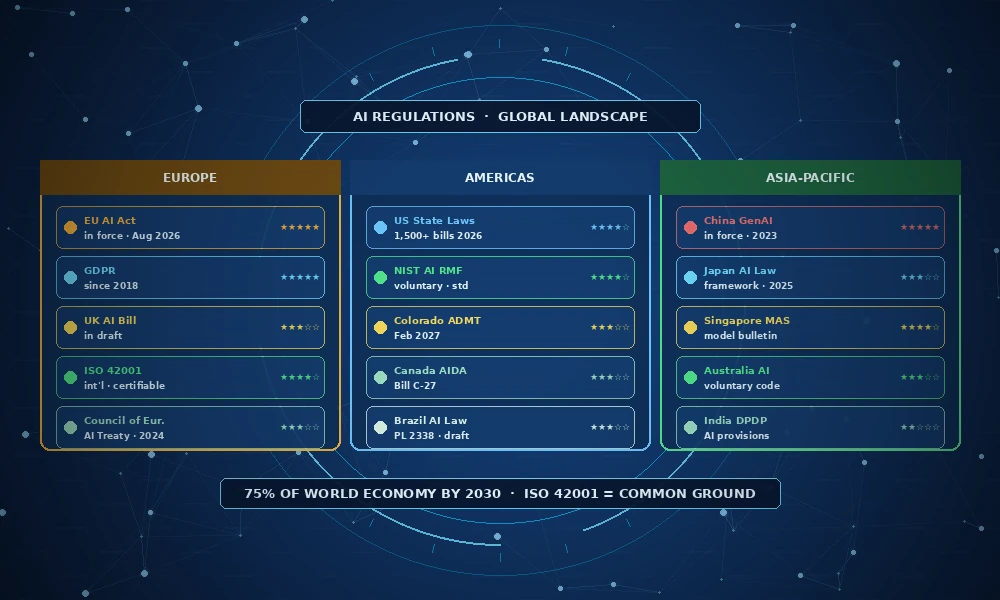
Three frameworks anchor most enterprise LLM governance programs today, and each one reached a meaningful milestone in the first half of 2026.
ISO/IEC 42001:2023 remains the only certifiable management system standard for AI, and generative AI systems fall within its scope through Clause 4, which requires organizations to define the context in which their AI management system operates, plus the Annex A controls. The standard does not contain generative-AI-specific clauses, so organizations have to interpret its control set against LLM-specific risks themselves, which is precisely where most implementation time gets spent.
The EU AI Act’s Digital Omnibus reached Council approval on June 29, 2026. Once formally published, it pushes the machine-readable marking obligation under Article 50(2) to December 2, 2026 for generative systems already on the market, while the core Article 50(1) chatbot-disclosure duty still takes effect August 2, 2026 on schedule.
NIST AI 600-1, the Generative AI Profile that extends the base AI RMF, was published in July 2024 and defines twelve risk categories unique to or worsened by generative AI, including confabulation, data privacy, information integrity and CBRN-related risks. It maps closely enough to the OWASP LLM risk taxonomy that most governance programs use the two side by side: OWASP for the technical control language, NIST AI 600-1 for the risk-management lifecycle.
Cross-Framework Mapping: ISO 42001, EU AI Act and NIST AI RMF for LLM Systems
This is the piece most LLM governance content skips. Vendor comparisons and framework explainers cover ISO 42001, the EU AI Act and NIST AI RMF as three separate reading assignments. In practice, a single control, say, human oversight of a chatbot’s escalation path, needs to satisfy all three at once, and knowing where the clauses line up is what actually shortens an audit.
Clause-level mapping: core LLM governance controls across ISO 42001, EU AI Act and NIST AI RMF
| Governance Control | ISO/IEC 42001:2023 | EU AI Act (Reg. 2024/1689) | NIST AI RMF 1.0 / AI 600-1 |
|---|---|---|---|
| AI system and model inventory | Clause 4.1-4.2; Annex A.6.2 (AI system inventory) | Art. 16 & Annex IV – technical documentation | MAP 1.1-1.3 – system categorization and context |
| Prompt injection & adversarial testing | Annex A.6.2, A.8 – AI system operation controls | Art. 15 – accuracy, robustness, cybersecurity | MEASURE 2.7; AI 600-1 Information Security category |
| Human oversight & escalation | Annex A.6.2.5 – human oversight measures | Art. 14 – human oversight | GOVERN 1.1; MANAGE 2.2 |
| Transparency & user disclosure (chatbots) | Annex A.7.2 – stakeholder communication | Art. 50(1) – disclosure of AI interaction | GOVERN 4.2 – transparency practices |
| Data governance & retrieval provenance (RAG) | Annex A.7.3-A.7.4 – data resources and quality | Art. 10 – data and data governance | MAP 2.3; MEASURE 2.9 |
| Incident reporting & post-market monitoring | Clause 10; Annex A.10 – nonconformity and improvement | Art. 26 & Art. 72 – deployer duties, post-market monitoring | MANAGE 4.1-4.3 |
| Third-party & foundation model risk | Annex A.9 – third-party and supplier relationships | Art. 25 & Art. 53 – provider obligations, GPAI duties | GOVERN 6.1; MAP 5.1 |
ISO/IEC 42001 Annex A sub-control numbers are flagged pending confirmation against the licensed standard text. EU AI Act article numbers reflect Regulation (EU) 2024/1689 as amended by the Digital Omnibus agreed by the Council on June 29, 2026; the Official Journal publication date remains pending.
Read the table by control, not by framework. A chatbot’s disclosure banner is one engineering decision, but it closes out an EU AI Act Article 50(1) obligation, an ISO 42001 stakeholder-communication control, and a NIST transparency practice simultaneously. Most audit preparation time gets wasted re-proving the same control three separate times because the evidence was filed under only one framework’s name.
Core Capabilities to Evaluate in an LLM Governance Platform
Vendor comparisons in this category tend to blur together, because most tools are strong in one lane and thin everywhere else. A 2026 market overview found that the most common buyer mistake is assuming an existing GRC or MLOps platform already covers AI governance with the specificity regulators now expect. It typically does not.
- System discovery and classification. The platform should find chatbots, RAG deployments and agents across your environment, including shadow AI built by individual teams, and classify each one by risk tier automatically rather than relying on a manual spreadsheet.
- Framework-mapped control libraries. Controls should be written once and mapped to every framework you report against, not duplicated per framework. This is the difference between a tool that helps with audits and one that just stores documents.
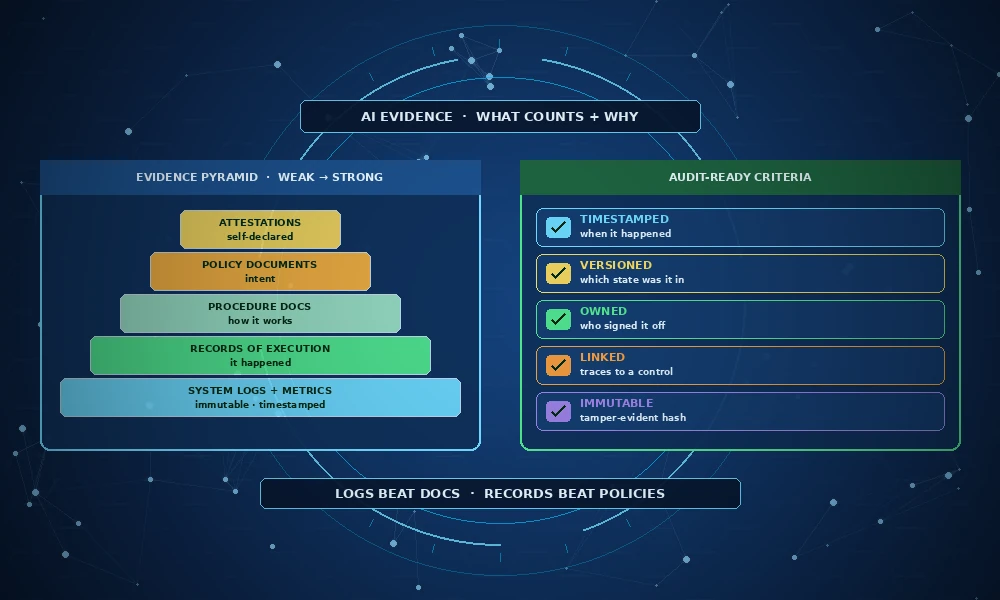
- Continuous evidence capture. Screenshots and quarterly attestations do not hold up well against auditors who expect continuous logs. Look for automatic capture of disclosure banners, access logs, and model version history as they change, not as a point-in-time export.
- Red-teaming and adversarial test evidence. NIST AI 600-1’s Information Security category expects adversarial testing evidence for prompt injection and jailbreak resistance, treated as a baseline requirement rather than optional hardening.
- Agent-specific permission and action logs. For agentic systems, evidence needs to include what tools an agent could call, what it actually called, and whether a human approved the action, not just the text of its final output.
- Board-ready reporting. C-suite sponsors need a rollup view that shows compliance posture by business unit and framework, not a raw control list. This is usually the difference between a platform that gets renewed and one that gets replaced after year one.
Governing RAG Pipelines: Data Lineage and Grounding Evidence
Most RAG governance failures are not model failures. They are access-control failures wearing an AI system’s name. If a vector index was built from a document store where permissions were never fully cleaned up, the RAG assistant will faithfully retrieve and surface content that a given user should never have seen, and it will do so with confident, well-formatted prose that makes the leak harder to notice than a raw file-share mistake would have been.
A governance platform should be able to answer three questions for any RAG deployment on demand: what data sources feed this index, what access controls apply to each source, and can a specific model output be traced back to the retrieved passage that produced it. That third question, grounding traceability, is what separates a defensible RAG deployment from one that will struggle under the EU AI Act’s Article 10 data-governance requirements or an ISO 42001 data-quality audit.
Retrieval provenance also matters for a reason auditors care about specifically: it is the fastest way to distinguish a hallucination from a data-quality problem. If an output cannot be traced to a source document, that is a model behavior issue. If it can be traced but the source itself was wrong or stale, that is a data governance issue with a different remediation path, and the distinction determines who owns the fix.
Governing Autonomous AI Agents: Scope, Permissions and Kill Switches
Agent adoption is moving faster than most governance programs can keep pace with. Gartner projects that task-specific agents will be embedded in 40 percent of enterprise applications by the end of 2026, up from under 5 percent in 2025, an eightfold jump in a single year. Governance maturity has not moved at the same speed.
The core governance mistake with agents is treating permission scope as a one-time setup decision instead of a continuously monitored control. An agent that was scoped to read-only access at launch can accumulate broader tool access over successive updates without anyone re-running a risk assessment, and that drift is exactly the gap Gartner’s research points to as the leading cause of agent governance failures.
Three controls matter most for agent governance specifically:
- Least-privilege tool access. Each agent should hold only the specific API and data permissions its task requires, reviewed on a schedule, not granted once and left standing.
- Human-in-the-loop checkpoints for consequential actions. Actions with financial, legal or customer-facing impact should route through an approval step rather than executing autonomously, satisfying both EU AI Act Article 14 human oversight and NIST AI RMF’s MANAGE function.
- Complete action logging with a kill switch. Every tool call an agent makes should be logged with enough context to reconstruct a decision after the fact, paired with the ability to suspend a specific agent instantly if it starts behaving outside its scope.
Govern365.ai’s AI model registry extends this same risk classification to agents, mapping each one’s permission scope to the applicable ISO 42001, EU AI Act and NIST AI RMF controls automatically, so a scope change triggers a re-assessment instead of waiting for the next audit cycle.
Building an LLM Governance Implementation Roadmap
Most organizations do not need to govern every system at once. A phased rollout that starts with the highest-exposure systems produces defensible evidence faster than a program that tries to boil the ocean in month one.
LLM Governance Implementation Checklist
- Inventory every chatbot, RAG deployment and agent in production, including shadow AI built outside formal channels (ISO 42001 Clause 4; NIST MAP 1.1)
- Classify each system by risk tier and regulatory exposure, prioritizing anything customer-facing or EU-reachable (EU AI Act Art. 6; NIST MAP 1.2)
- Confirm chatbot AI-disclosure banners are live and cannot be silently removed by a UI update (EU AI Act Art. 50(1))
- Audit vector store and document permissions feeding every RAG index (EU AI Act Art. 10; ISO 42001 Annex A.7.3 [VERIFY])
- Document tool-calling permissions for every agent and set a recurring review cadence (NIST MANAGE 2.2; Gartner agent governance guidance)
- Run adversarial and prompt injection testing before each production release (NIST AI 600-1 Information Security; OWASP LLM01)
- Establish an incident reporting workflow with defined ownership and timelines (EU AI Act Art. 26, 72; ISO 42001 Clause 10)
- Build a board-ready compliance dashboard mapped across all three frameworks at once (GAICC cross-framework mapping practice)
Govern365.ai‘s compliance dashboard and audit evidence management modules are built around this exact sequence, so a system moves from inventory to audit-ready evidence without a separate spreadsheet tracking which framework has been checked off.
Frequently Asked Questions
What is an LLM governance platform?
An LLM governance platform inventories, classifies and continuously monitors chatbots, RAG systems and AI agents against compliance frameworks such as ISO 42001, the EU AI Act and NIST AI RMF. Unlike a general GRC tool, it captures generative-AI-specific artifacts, such as system prompts, retrieval permissions and agent tool access, as governed evidence rather than static documents.
How is LLM governance different from traditional model risk management?
Traditional model risk management was built for structured, deterministic models with fixed inputs and outputs. LLM systems generate novel, non-deterministic outputs and, in the case of agents, take actions, which means governance has to cover prompt behavior, retrieval provenance and tool permissions, not just accuracy metrics.
Do chatbots need to disclose they are AI under the EU AI Act?
Yes. Article 50(1) requires providers of systems intended for direct interaction with a person to make clear that the user is talking to an AI, unless that is already obvious from the context. This obligation becomes enforceable on August 2, 2026, with penalties reaching 15 million euros or 3 percent of global annual turnover.
What NIST framework applies to generative AI risk specifically?
NIST AI 600-1, the Generative AI Profile, extends the core AI RMF with twelve risk categories unique to generative AI, including confabulation, prompt injection and information integrity. It was published in July 2024 and is widely used alongside the OWASP Top 10 for LLM Applications for technical control language.
Does ISO 42001 cover RAG pipelines and AI agents?
ISO/IEC 42001:2023 does not contain clauses written specifically for RAG or agentic systems, but generative AI falls within its scope through Clause 4 and the Annex A control set. Organizations typically have to interpret those controls against LLM-specific risks themselves, since the standard remains technology-neutral by design.
What is the biggest governance risk with autonomous AI agents?
Permission scope creep is the leading cause of agent governance failures. Gartner’s research found that applying uniform, static governance regardless of an agent’s autonomy level and access scope is the root cause of failures identified after production incidents, projecting that 40 percent of enterprises will demote or decommission agents for this reason by 2027.
How do OWASP LLM Top 10 risks map to compliance frameworks?
OWASP’s top risk, prompt injection, maps directly to NIST AI 600-1’s Information Security category and to EU AI Act Article 15’s robustness and cybersecurity requirements. Most governance programs use OWASP for technical control language and NIST or ISO for the surrounding risk-management lifecycle.
How long does it take to implement an LLM governance program?
Timelines vary by system count and risk tier, but a phased rollout starting with customer-facing chatbots and EU-reachable systems typically produces audit-ready evidence faster than an all-at-once approach. Organizations using structured governance tooling generally move through inventory, classification and control mapping in weeks rather than the months a manual, spreadsheet-based process takes.
Conclusion
Chatbots, RAG pipelines and agents fail audits for different reasons, and a governance program that treats them identically will miss the risk that actually matters for each one. The organizations moving fastest through certification are mapping controls once, across ISO 42001, the EU AI Act and NIST AI RMF simultaneously, instead of re-proving the same evidence three times over.
Start with an honest inventory of every generative AI system in production, including the ones nobody officially approved, and classify each by its actual exposure before writing another policy document.
Govern365.ai‘s AI model registry, risk assessment and audit evidence tools are built around this cross-framework approach. Start your 14-day free trial to map your chatbots, RAG systems and agents against ISO 42001, the EU AI Act and NIST AI RMF in one place.