Prompt injection has held the number one spot on the OWASP Top 10 for LLM Applications for the second consecutive edition, and security teams still cannot patch their way out of it. It is not a bug in a specific model. It is a structural consequence of how large language models process instructions and untrusted data in the same channel.
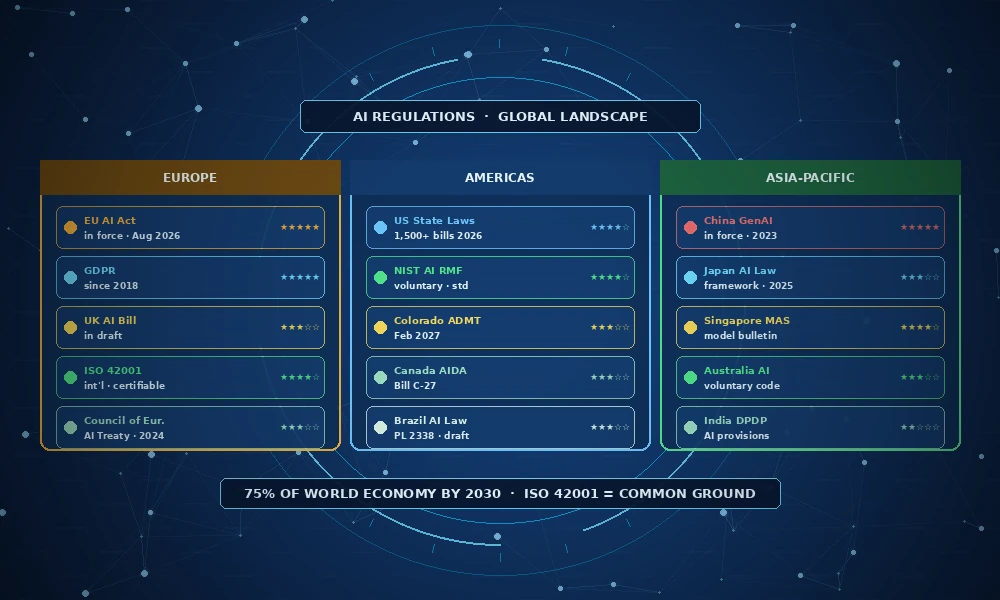
That distinction matters more than most enterprise AI programs currently treat it. Prompt injection keeps getting handed to the security team as an application vulnerability, when the more durable fix runs through governance: system inventory, risk classification, testing evidence, and clause-level accountability under ISO/IEC 42001, the EU AI Act, and NIST AI RMF. This piece covers where prompt injection sits inside each framework, what is actually enforceable today versus what is still pending, and how to build a program an auditor will accept as evidence rather than intention.
What Prompt Injection Is and Why It Broke the Old AppSec Model
A large language model reads its system instructions and the content a user or an external source feeds it as one continuous stream of text. Nothing in the architecture marks one part as “trusted command” and another as “untrusted data.” Prompt injection exploits exactly that gap: an attacker crafts input that causes the model to disregard its original instructions and follow new ones instead.
Traditional application security assumes you can separate code from data. SQL injection gets fixed with parameterized queries because the database understands the boundary between a command and a value. LLMs have no equivalent boundary. NIST’s Generative AI Profile classifies prompt injection under Information Security risk, alongside data poisoning and model-weight exfiltration, precisely because conventional input validation was never built for a system where instructions and content look identical.
This is why filtering alone keeps failing. A rule that blocks the phrase “ignore previous instructions” does nothing against an attacker who rephrases the same intent in a different language, hides it inside a PDF’s metadata, or embeds it in an image the model is asked to describe. The vulnerability lives in the model’s inability to distinguish instruction from content, not in any single string a filter could catch.
Direct vs. Indirect Injection: How the Attacks Actually Work
Direct injection is the version most people picture: a user types an instruction straight into a chat window, trying to override the system prompt. It is the easier of the two to catch, because the attacker’s text arrives through the same interface every other user query uses.
Indirect injection is the version enterprise risk teams underestimate. The attacker never touches the model directly. They plant instructions inside a document, a webpage, a support ticket, or an email that the model will later process on someone else’s behalf. When an employee asks an AI assistant to summarize that document, the model reads the planted instruction as if it came from a trusted source and may act on it.
What makes this dangerous in 2026 is agentic deployment. A chatbot that only replies with text limits the blast radius of a successful injection to a bad answer. An agent that can send email, query a database, or call an API turns the same injection into a fraudulent transaction, a data exfiltration event, or an unauthorized system change.
Indirect attacks now account for more than half of observed injection incidents and carry meaningfully higher success rates than direct attempts, because they arrive disguised as ordinary business content rather than an obvious attack.
Where most people get the risk wrong: teams assume prompt injection is a chatbot problem. In practice, the highest-blast-radius incidents involve agents with tool access, not conversational interfaces. A model that only talks cannot wire money anywhere.
Why This Is a Governance Failure, Not Just a Security Bug
Security teams can reduce prompt injection risk with input sanitization, output filtering, and least-privilege tool access. None of that answers the questions a board, a regulator, or a customer’s procurement team will actually ask: Which of your AI systems can be manipulated this way? What did you test before deployment? Who signed off on the residual risk? What happens when it fails anyway?
Those are governance questions, and they require an inventory before they require a control. An organization cannot assess prompt injection exposure across its AI estate if it does not have a documented list of which systems process untrusted external content, which ones have tool or API access, and which ones sit in a regulated workflow like hiring, credit, or healthcare decisions. This is the same failure mode Colorado’s SB 26-189 and the EU AI Act’s Annex III both anticipate at the framework level: you cannot govern what you have not inventoried.
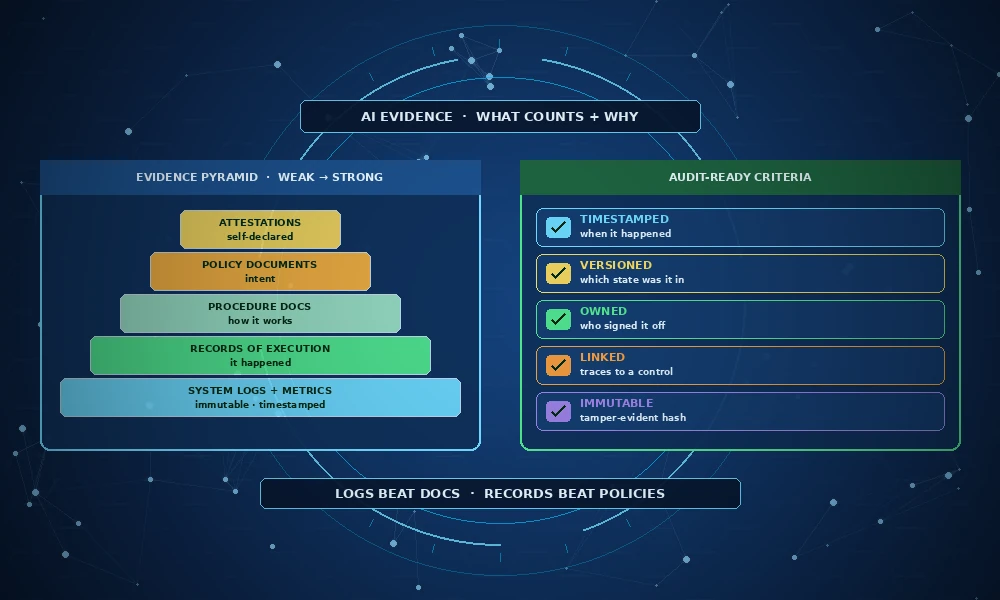
Treating prompt injection purely as a security ticket also creates an accountability gap. A patched filter does not produce audit evidence. A documented risk assessment, a testing log tied to a specific system in a registry, and a named risk owner do. That evidence is what a certification body, a regulator or an enterprise customer’s third-party risk questionnaire is actually going to ask for.
Mapping Prompt Injection to NIST AI RMF and the AI 600-1 Generative AI Profile
NIST AI RMF 1.0 organizes risk management around four functions: GOVERN, MAP, MEASURE, and MANAGE. The Generative AI Profile, NIST AI 600-1, extends that structure with twelve risk categories specific to generative AI, and places both direct and indirect prompt injection inside the Information Security category, alongside data poisoning and value-chain integrity risk.
In practice, that means prompt injection is not a one-time control to check off. It runs through all four functions:
- GOVERN – a documented policy on which AI systems may process untrusted external content, and who owns the residual risk when they do.
- MAP – identifying, per system, whether it ingests external content, whether it has tool or API access, and what the realistic blast radius of a successful injection would be.
- MEASURE – adversarial testing evidence: red-team results against direct and indirect injection scenarios, logged against the specific system in your registry, not a generic statement that “testing occurred.”
- MANAGE – least-privilege tool scoping, monitoring for anomalous agent behavior, and an incident response path specific to injection-driven actions rather than a generic security incident process.
NIST AI 600-1 is voluntary for private industry, but it has become the de facto technical reference federal contractors and their vendors are expected to align with, and it is the framework OWASP’s own guidance points back to for the governance layer that a security control alone cannot provide.
Prompt injection can also enter through retrieved documents and other external content, which is why RAG governance needs to address the retrieval layer as well as the model itself
EU AI Act Article 15 and the GPAI Track: What Applies Now vs. What’s Deferred
Article 15 of the EU AI Act requires high-risk AI systems to be resilient against attempts by unauthorized third parties to alter their outputs or performance by exploiting system vulnerabilities, and it names adversarial examples and model evasion explicitly among the attack types providers must address, alongside data poisoning and confidentiality attacks. Prompt injection sits squarely inside that language.
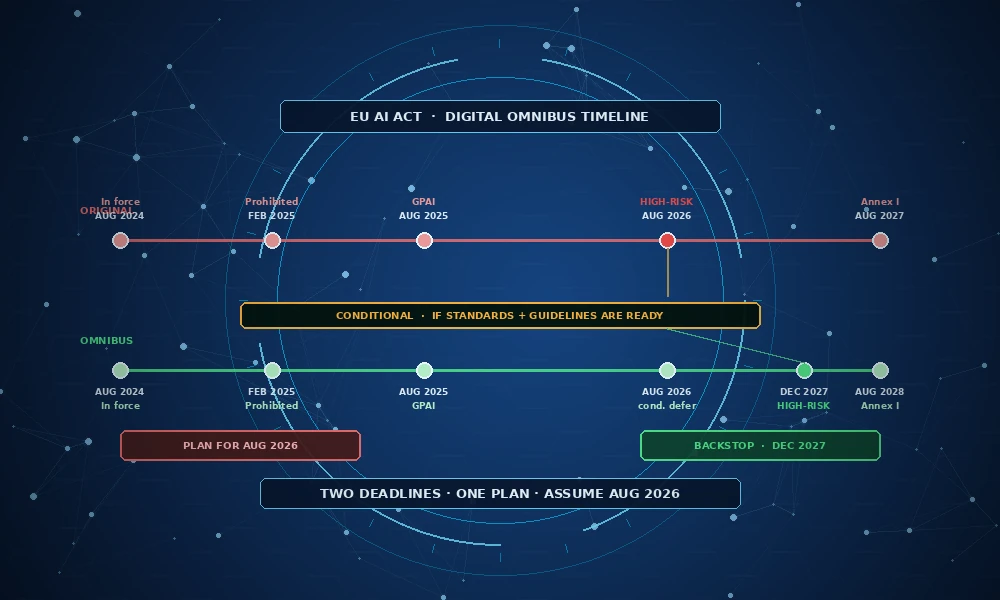
Timing matters here, and it has moved. The Digital Omnibus, formally adopted at the end of June 2026, deferred stand-alone Annex III high-risk obligations, which is where Article 15 lives for most enterprise use cases, from August 2, 2026 to December 2, 2027. If your LLM deployment sits in a high-risk Annex III category such as hiring, credit, or law enforcement-adjacent use, the Article 15 conformity clock now runs to that later date.
What did not move: obligations on general-purpose AI models with systemic risk under Articles 51 through 55 have applied since August 2025 and were untouched by the Omnibus. Most enterprise LLM deployments sit on top of a GPAI foundation model from a provider already subject to those obligations, which means the systemic-risk track is live now even while the Annex III high-risk track is deferred. A governance program built only around the deferred deadline misses the part of the Act that is already enforceable.
Where ISO/IEC 42001 Puts Prompt Injection Inside an AIMS
ISO/IEC 42001 is the management-system standard for AI, built on the same Plan-Do-Check-Act structure as ISO 27001. It does not name “prompt injection” as a term, because it is deliberately technology-neutral, but its Annex A controls on AI system security, data quality, and third-party and customer expectations are exactly where an organization documents how it manages this class of risk.
The practical value of ISO 42001 here is structural, not technical. Article 15 tells you the outcome an AI system must achieve. NIST AI 600-1 tells you which risk category and function the work falls under. ISO 42001 is what makes the whole thing operational and auditable: a management system with a defined AI risk assessment process, documented Statement of Applicability, internal audits, and management review, all of which a third-party certification body will actually examine.
Organizations pursuing ISO 42001 certification tend to discover their prompt injection exposure the same way they discover other AI risks under the standard: through the mandatory system inventory and risk assessment process, not through a security tool. That inventory becomes the single artifact that also satisfies the EU AI Act’s registration expectations and NIST’s MAP function, which is the basis of the cross-framework approach below.
Cross-Framework Mapping Table: ISO 42001 x EU AI Act x NIST AI RMF
Most compliance content covers one framework at a time. That leaves the actual work, translating a single risk into three sets of paperwork, on the reader’s desk. The table below maps prompt injection controls across all three frameworks simultaneously, at the clause level, so a single control decision satisfies all three at once instead of being documented three separate times.
| Governance Activity | ISO/IEC 42001 | EU AI Act | NIST AI RMF / AI 600-1 |
|---|---|---|---|
| AI system inventory noting external content ingestion and tool access | Annex A system inventory and risk assessment controls | Art. 16 provider registration; Art. 26 deployer obligations | MAP 1.1, MAP 5.1 |
| Adversarial / red-team testing for direct and indirect injection | Annex A AI system performance and monitoring controls | Art. 15(5) adversarial examples and model evasion | MEASURE 2.7, AI 600-1 Information Security (§2.9) |
| Least-privilege tool and API scoping for agentic systems | Annex A operational planning and control | Art. 15 cybersecurity proportionality requirement | MANAGE 2.2, MANAGE 4.1 |
| Incident logging and disclosure for injection-driven agent actions | Annex A nonconformity and corrective action | Art. 73 serious incident reporting (high-risk systems) | MANAGE 4.2, AI 600-1 Incident Disclosure |
| Named risk owner and management review of residual injection risk | Clause 9.3 management review; Annex A roles and responsibilities | Art. 26 deployer human oversight | GOVERN 1.1, GOVERN 3.2 |
Prompt injection control mapping across ISO/IEC 42001, EU AI Act, and NIST AI RMF
Prompt injection controls should be tested before release as part of broader LLM evaluation, rather than treated as a separate security check after deployment.
Building an Enterprise Prompt Injection Governance Program: A Working Checklist
The controls above translate into a build sequence most GRC teams can execute in a quarter, not a year:
- Inventory every LLM-based system that ingests external content, uses RAG, or has tool/API access, and flag which ones qualify as high-risk under Annex III or your internal risk tiering. (ISO 42001, EU AI Act)
- Classify by blast radius, not by model. A read-only chatbot and a tool-using agent with database write access are different risk tiers even on the same underlying model. (NIST AI 600-1)
- Run adversarial testing against direct and indirect injection scenarios before deployment and on a recurring cadence after, and log results against the specific system, not a program-wide statement. (NIST MEASURE, Art. 15(5))
- Scope tool permissions to least privilege for every agentic system, and document the scoping decision as part of the risk assessment file. (NIST MANAGE, ISO 42001 operational control)
- Assign a named risk owner per system who signs off on residual risk and is accountable in management review. (ISO 42001 Clause 9.3, EU AI Act Art. 26)
- Build an incident path specific to injection-driven actions that captures what the agent did, not just that an alert fired, so the log doubles as Article 73 evidence if the system is high-risk. (EU AI Act Art. 73)
- Review the register quarterly as new systems, agents, and third-party integrations get added, since a stale inventory is the single most common finding in early AI audits.
Teams managing this across a spreadsheet tend to lose the thread by the second or third system, because the inventory, the test evidence, and the framework mapping live in different files. Govern365.ai‘s AI model registry ties each system’s risk classification directly to its applicable ISO 42001 clauses and EU AI Act risk category in one record, so the testing evidence collected for MEASURE also satisfies the audit trail a certification body or an EU AI Act conformity assessment will ask to see.
Frequently Asked Questions
Is prompt injection the same thing as jailbreaking?
No. Jailbreaking tries to get a model to violate its own safety training and produce content it was designed to refuse. Prompt injection tries to override the application’s instructions entirely, often to make the model take an unintended action. The two can overlap in a single attack, but they target different layers of the system.
Can prompt injection be fully patched or prevented?
No current defense eliminates it. Because the model cannot structurally separate instructions from data, filtering and detection reduce risk but do not remove it. That is why frameworks like NIST AI 600-1 and EU AI Act Article 15 treat it as a risk to be managed and tested continuously, not a vulnerability to be closed once.
Does the EU AI Act’s Digital Omnibus delay mean we can deprioritize prompt injection testing?
No. The Omnibus deferred Annex III high-risk obligations, including Article 15, to December 2, 2027, but GPAI systemic-risk obligations under Articles 51 through 55 have applied since August 2025 and were unaffected. Most enterprise LLM deployments sit on a covered GPAI model regardless of their own Annex III status.
Which NIST function covers prompt injection testing specifically?
MEASURE, within the Information Security risk category defined in NIST AI 600-1, Section 2.9. It calls for adversarial testing that specifically includes direct and indirect prompt injection scenarios, logged as evidence tied to the individual AI system being evaluated.
Do ISO 42001 auditors actually test for prompt injection?
Certification auditors assess whether your AIMS has a documented risk assessment and testing process covering AI-specific security risks, including prompt injection where relevant to a system’s use case. They typically review your evidence and process rather than running the attacks themselves.
Is indirect prompt injection more dangerous than direct injection?
Generally yes, for enterprise deployments. Indirect injection is delivered through content the system already trusts, such as a document or webpage, which makes it harder to filter and gives attackers no need to access the interface directly. It also tends to carry a higher success rate against production systems.
What is the single biggest gap in most enterprise prompt injection programs?
A missing or stale AI system inventory. Without a documented list of which systems ingest external content and which have tool access, teams cannot prioritize testing or demonstrate governance evidence to an auditor, regulator, or customer, regardless of how good their filtering is.
Conclusion
Prompt injection will not be solved by a better filter. It gets managed the way every other durable AI risk gets managed: with an inventory, a risk classification, tested evidence, and a named owner, mapped consistently across ISO 42001, the EU AI Act, and NIST AI RMF instead of documented three separate times in three separate formats.
Start with the inventory. If you cannot list which of your AI systems ingest untrusted content or hold tool access today, that is the gap to close first, before the next audit or the next incident closes it for you.
Start your 14-day free trial of Govern365.ai and put your AI system inventory, risk assessments, and audit evidence in one place built around all three frameworks at once.