Published bias audit records have now been read closely enough, by two independent reviews, to count their mistakes. A research team from the ACLU, the University of Pennsylvania, Stanford and Harvard extracted every Local Law 144 audit they could find from July 2023 to early November 2024: 44 reports covering 116 audits. The New York State Comptroller then re-examined 32 companies the city had already reviewed and found at least 17 instances of potential non-compliance where the city had found one.
Each section below names one error from that record or from the federal guidance, says how often it appears where the evidence allows, and shows the correct method on a single constructed dataset. The tool in the dataset is a résumé-ranking language model. The model scored 2,000 applicants with recorded sex and race and advanced 777, and it scored 300 more whose demographics were unknown, advancing 105 of them.
Error one: a wrong comparator pushed impact ratios above 1.0 in 54% of audits
Impact ratio has one comparator under New York City law. The Department of Consumer and Worker Protection (DCWP) defines the ratio in 6 RCNY § 5-300 as “the selection rate for a category divided by the selection rate of the most selected category”, and defines selection rate as the share of a category “selected to move forward in the hiring process or assigned a classification” by the tool.
Impact ratios divided that way cannot exceed 1.0. The FAccT 2025 team still found that 54% of audits contained at least one ratio above one, which means the comparator was some other group. The authors trace it to differing views on which groups count when choosing the comparator: in one pattern, a category under 2% of the data had the highest rate, was left out as comparator, and still had its ratio reported.
Bias audit arithmetic on our dataset runs as follows: men advanced 445 of 1,080, a 41.2% rate, and women 332 of 920, 36.1%, so the ratio for women is 0.876. White applicants advanced at 41.6%, the highest race rate, and Black applicants at 34.0%, a ratio of 0.818. A reader can check any published bias audit the same way: if a ratio exceeds 1.0, the comparator is wrong or undisclosed.
Error two: treating four-fifths as a pass mark hides a gap of 2.34 standard deviations
Bias audit rules in New York set no threshold at all. The rules require ratios to be calculated and posted, so a summary showing 0.60 discharges the disclosure duty as fully as one showing 0.95, and any “pass” label is the auditor’s or vendor’s language.
Four-fifths comes from federal guidance. Section 1607.4(D) of the Uniform Guidelines on Employee Selection Procedures says a rate “less than four-fifths (4/5) (or eighty percent) of the rate for the group with the highest rate will generally be regarded by the Federal enforcement agencies as evidence of adverse impact”, and adds that “smaller differences in selection rate may nevertheless constitute adverse impact, where they are significant in both statistical and practical terms.”
Both headline impact ratios in our dataset clear four-fifths. A two-proportion test puts the sex gap at 2.34 standard deviations and the race gap at 2.60, with Fisher exact p-values of 0.021 and 0.010. Courts have treated two to three standard deviations as the significance line since Castaneda v. Partida in 1977, applied to hiring in Hazelwood School District v. United States the same year.
The 1979 federal Questions and Answers explain why the agencies still lead with four-fifths. Question 24 says that where samples are small, “even a large real difference between groups is likely not to be confirmed by a test of statistical significance”, so the ratio serves as “a practical and easy-to-administer measure”. Question 22 covers the opposite case: where large numbers are selected, “relatively small differences in selection rates may nevertheless constitute adverse impact”.
A bias audit that reports only the ratio therefore answers half the federal question. Question 19 is explicit that the rule “is not intended to resolve the ultimate question of unlawful discrimination”, a point several commenters on a June 2026 Hacker News thread about a Stanford hiring study were still arguing over.
Error three: dropping groups under 2% skips the one-person test in the federal guidance
Small categories may be excluded in New York. Rule 5-301(d) lets an independent auditor exclude “a category that represents less than 2% of the data being used for the bias audit”, provided the summary gives a justification and still reports the category’s applicant count and rate. The FAccT 2025 team found the exclusion “frequently resulted in impact ratios not being reported” for Native Hawaiian or Other Pacific Islander and American Indian or Alaska Native applicants.
The impact ratio for our two small groups is 0.601: 12 and 28 applicants, 0.6% and 1.4% of the data, each advancing at 25.0%, and neither gap is statistically significant, at 1.16 and 1.76 standard deviations.
Federal guidance applies a different test before calling a gap too small to matter. Question 21 says agencies will not assume adverse impact where numbers are so small “that it is likely that the difference could have occurred by chance”, and treats it as generally inappropriate to act where “the selection of one different person for one job would shift the result”.
Give each of our groups one more selection and the rates rise to 33.3% and 28.6%, still well below 41.6%, so neither gap is excused by the one-person test even though neither is significant.
The same question closes with a warning about time: “if a lower selection rate continued over a period of time, so as to constitute a pattern, then the lower selection rate would constitute adverse impact”.
Question 16 also measures 2% differently, against the relevant labour force, the applicant pool for hiring and the workforce for promotion, and says record keeping obligations apply “for all groups, even those which are less than 2%”. Excluding a group from a city bias audit does not excuse keeping its numbers.
Error four: stopping at sex and race tables misses a 0.662 ratio for Black women
Intersectional tables are a New York requirement. Rule 5-301 requires impact ratios for “intersectional categories of sex, ethnicity, and race”, in addition to the separate sex and race tables.
Federal guidance takes the narrower view. Question 17 says there is “no obligation to make comparisons for subgroups (e.g., white male, white female, black male, black female)”, while warning that “any apparent exclusion of a subgroup may suggest the presence of discrimination”. A bias audit built only for federal purposes can stop at two tables; a city bias audit cannot.
Impact ratios split fourteen ways put White men at the top, with 219 of 510 advancing, or 42.9%. Black women advanced 54 of 190, 28.4%, for a ratio of 0.662, a gap of 3.50 standard deviations and a Fisher exact p-value of 0.0005. At parity with White men about 82 Black women would have advanced; 54 did, a shortfall of 28 people.
The published record shows where disparities concentrate. In the FAccT 2025 data, every group-level ratio below 0.8 came from breakdowns by race or by intersectional category, and none came from sex alone.
Error five: unknown counts without bounds leave the women’s ratio anywhere from 0.642 to first place
Missing demographics are reported and rarely analysed. Rule 5-303 requires the summary to state “the number of individuals the AEDT assessed that fall within an unknown category”, and FAccT 2025 found that 83% of audits reported missing race or sex data for some applicants.
Bias audit data for our tool includes 300 applicants with no recorded sex or race, 13% of the 2,300 it assessed. Allocate the 195 rejected unknowns to women and the 105 advanced unknowns to men and the women’s ratio falls from 0.876 to 0.642. Reverse the allocation and women become the most selected group, with men at 0.819 of their rate.
Bounded impact ratios belong in the methodology section, not a footnote. Among audits disclosing missing counts, the FAccT team found that 70% of reported ratios had a possible lower bound below 0.8; under the milder assumption that unknowns mirror known applicants, the share was 28%.
Error six: scoring at the median instead of the live cutoff turns 0.852 into 0.775
Scoring tools use a different impact ratio input. DCWP defines scoring rate as “the rate at which individuals in a category receive a score above the sample’s median score”, and the ratio divides each group’s scoring rate by the highest group’s.
Impact ratios at the median flatter a tool, because employers rarely invite half the pool to interview. Suppose our model’s fit scores run 0.2 standard deviations lower for one of two equally sized groups. Above the median the scoring rates are 54.0% and 46.0%, a ratio of 0.852. At the top quarter, where this employer actually sets its interview cutoff, the ratio is 0.775, and at the top tenth it is 0.703.
Only the median figure has to be posted. The FAccT 2025 authors call the median choice “unrealistic” because employers set their own thresholds, and a methodology section should report the ratio at the live cutoff beside the required one.
Error seven: pooled or synthetic data describes a different deployment from yours
Data source rules are permissive by design. Rule 5-302 allows a bias audit on historical data “from one or more employers”, which an employer may rely on only if it contributed its own data or has never used the tool. Test data is allowed only “if insufficient historical data is available to conduct a statistically significant bias audit”, and the summary must explain how it was generated.
Practice has stretched both routes. FAccT 2025 found that 75% of audit reports used historical data, 16% used test data and 9% could not be classified, and that test data practices ranged “from audits that generated fake applicant AEDT scores using python’s random.uniform function” to test data “that produced equal selection rates for every group in the audit”. The team also found identical result tables posted by different employers for what appeared to be the same tool, which they named silent duplicates.
Bias audit independence is the other half of source integrity. Rule 5-300 disqualifies an auditor who was “involved in using, developing, or distributing” the tool, or who has an employment relationship or a direct financial interest with the employer or vendor during the audit. Ask for your own requisitions to be run separately and reported beside the pool: a vendor’s pooled ratio well above four-fifths can sit on top of your 0.876 with 2.34 standard deviations behind it.
Error eight: auditing the tool alone misses a whole-process ratio of 0.70
A Local Law 144 bias audit covers the automated tool, while federal guidance starts from the whole funnel. Question 13 says adverse impact “is determined first for the overall selection process for each job”, and Question 14 defines that as “the combined effect of all selection procedures leading to the final employment decision”.
In our dataset a human interview follows the model. Of the 445 men advanced, 134 received offers, 30.1%; of the 332 women, 80 did, 24.1%. The interview stage’s own ratio is 0.800, clearing four-fifths by 0.0002.
Impact ratios for two passing stages compound into a failing process: 12.4% of men and 8.7% of women received offers, a ratio of 0.701. The reverse case also exists, a low-ratio tool inside a balanced process, and section 1607.4(C) of the Uniform Guidelines treats a balanced “bottom line” as usually ending the federal inquiry. The Supreme Court limited that in Connecticut v. Teal in 1982, holding that a balanced bottom line does not defend a component that screens out a protected group.
Error nine: outcome ratios alone cannot detect name preference inside a language model
Outcome impact ratios measure only whoever applied. A résumé-ranking language model can also respond to the text itself, reading names, colleges, clubs and employment gaps as demographic signals, and an outcome ratio cannot separate that from genuine differences in the pool.
Counterfactual testing isolates the text. Kyra Wilson and Aylin Caliskan of the University of Washington paired more than 500 résumés with 500 job descriptions across nine occupations, varied only the names, and found massive text embedding models “significantly favoring White-associated names in 85.1% of cases”. Female-associated names were preferred in 11.1% of cases, and Black men were disadvantaged “in up to 100% of cases”. The paper appeared at the 2024 AAAI/ACM Conference on AI, Ethics, and Society.
Real deployment data shows the outcome side at scale. A Stanford team led by Rishi Bommasani studied 3.4 million people submitting 4 million applications to 1,700 postings at 150 employers, all screened by one vendor’s game-based assessment rather than a language model.
Applying four-fifths, they found that “26% of Black applicants and 15% of Asian applicants applied to positions where the AI system discriminated against their racial group”, and that about 40,000 more of those applications would have advanced at equal rates. The work was presented at FAccT in June 2026.
A language model bias audit needs both designs: the ratio on live outcomes, and matched résumé pairs that differ only in name or another proxy, with the preference rate reported. Protected characteristics outside the city’s categories need their own line too.
Local Law 144 uses EEO-1 sex and race or ethnicity categories only, so age never appears in a city bias audit, yet the collective action in Mobley v. Workday is brought under the Age Discrimination in Employment Act and covers applicants aged 40 and over.
Federal agencies are withdrawing the four-fifths benchmark while New York’s formula stays
Three federal copies of the Uniform Guidelines are on different tracks. The Office of Personnel Management removed references to them from federal hiring rules in an interim final rule effective 31 July 2026 (91 FR 48234). The Department of Labor’s final rule of 21 August 2026 (91 FR 54444) removes its copy at 41 CFR part 60-3 from 26 October 2026, stating that the step “does not impact other agencies’ interpretation and application of UGESP”.
EEOC‘s version remains in force. The electronic Code of Federal Regulations as of 17 September 2026 carries 29 CFR 1607.4, and the Justice Department’s copy at 28 CFR 50.14.
The Commission’s 2026 regulatory agenda lists RIN 3046-AB43, rescinding “the interpretive rulemaking portions” of the Guidelines and their appendix, at the final rule stage, with a separate entry, RIN 3046-AB45, for the record keeping provisions at the proposed rule stage. The Office of Legal Counsel opinion of 9 June 2026 supplies the rationale, concluding that disparate impact liability “as currently interpreted by EEOC is unconstitutional”.
New York’s arithmetic survives all of that. DCWP’s notice of adoption described its calculations as “consistent with Section 1607.4”, but the rule defines the impact ratio in its own text and never adopted the threshold, so federal rescission removes a benchmark while leaving the calculation, the posting duty and penalties the Comptroller puts at $500 to $1,500 per day in place.
DCWP generally agreed with the Comptroller’s recommendations, while maintaining that its own review had not revealed widespread non-compliance and acknowledging it had no process for monitoring the dates of bias audits.
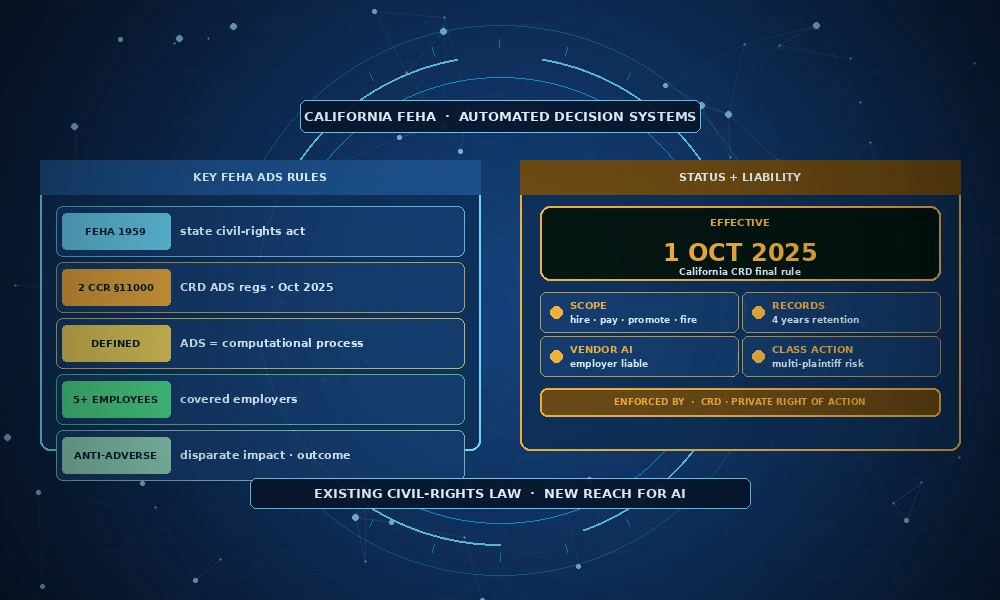
State and EU law keep testing relevant as evidence rather than as a formula. California’s automated-decision system regulations under the Fair Employment and Housing Act, in force since 1 October 2025, make the “quality, efficacy, recency, and scope” of anti-bias testing relevant to a claim.
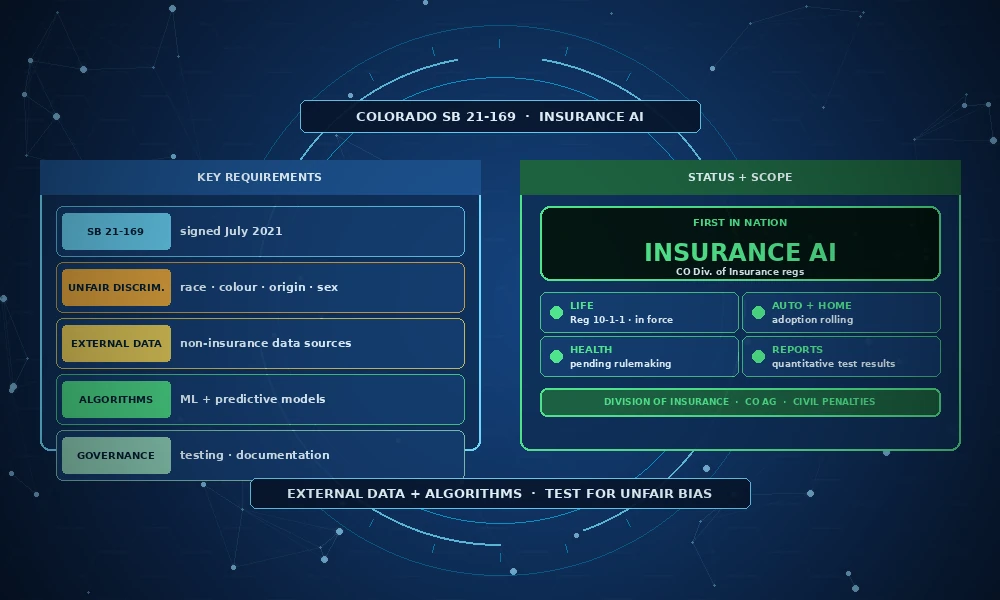
Colorado’s Senate Bill 26-189, signed on 14 May 2026, replaced the 2024 AI Act and dropped its impact assessment mandate. Under the EU AI Act, recruitment systems are high-risk and Article 10 requires providers to examine training data for possible biases, with the Annex III obligations now deferred to 2 December 2027.
The bias audit file: what each record proves
| Record | Required by | Value in this dataset |
| Comparator category per table | 6 RCNY § 5-300 definition | Men; White; White men |
| Significance test beside each ratio | 29 CFR 1607.4(D), Questions 22 and 24 | 2.34 and 2.60 standard deviations |
| Excluded categories with counts, rates and justification | 6 RCNY § 5-301(d) | 12 and 28 applicants at 25.0% |
| One-person shift check for small groups | Question 21 | Not excused for either group |
| Intersectional table | 6 RCNY § 5-301 | Black women 0.662 |
| Unknown count and bounded ratios | 6 RCNY § 5-303, FAccT 2025 method | 300 unknown; 0.642 to first place |
| Ratio at the live cutoff for scoring tools | Recommended, FAccT 2025 | 0.775 at top quarter |
| Stage and whole-process ratios | Questions 13 and 14 | 0.876, 0.800, whole process 0.701 |
| Data source, dates and own-data share | 6 RCNY § 5-302 | Own historical data |
| Counterfactual name test for language models | Recommended | Preference rate by name group |
Govern365.ai stores each bias audit file as linked evidence rather than a PDF attached to an email. Each record sits against the tool’s entry in the AI system inventory, carries the audit date and the date the next one is due, and keeps the comparator, exclusions, cutoff and data source as fields a reviewer can query.
The same entry maps to the EU AI Act’s data governance duties, ISO/IEC 42001 and the NIST AI Risk Management Framework, so the choice an auditor made for New York is visible to whoever answers the next regulator. For scope and candidate notices, see our NYC Local Law 144 bias audit requirements guide; for fairness metrics beyond the impact ratio, see AI bias risk detection, tes ting and mitigation.
Frequently Asked Questions
What is the formula for an impact ratio?
An impact ratio is a category’s selection rate divided by the selection rate of the most selected category. For scoring tools, New York uses each category’s rate of scoring above the sample median, divided by the highest category’s rate.
Can an impact ratio be higher than 1?
An impact ratio above 1.0 cannot arise if the comparator is the most selected category, as the New York definition requires. Such a ratio means a different comparator was used, which the FAccT 2025 study found in 54% of published audits.
Does Local Law 144 require a four-fifths pass?
No. The rules require impact ratios to be calculated and published but set no threshold, and they do not prohibit using a tool with a low ratio.
Is the four-fifths rule enough without a significance test?
No. A bias audit relying on four-fifths alone misses the rest of Section 1607.4(D), which says smaller differences can be adverse impact when statistically and practically significant, and Question 22 of the 1979 guidance says so directly for large samples.
When can an auditor exclude a small group?
Under Local Law 144, when the category is under 2% of the audit data, with a stated justification and the group’s count and rate still reported. The federal one-person test in Question 21 and record keeping duties still apply to it.
Does federal law require intersectional bias analysis?
No. Question 17 of the 1979 guidance says there is no obligation to compare subgroups, though apparent exclusion of a subgroup may suggest discrimination. New York City requires intersectional tables in every bias audit.
How should unknown demographics be handled?
Report the count, as New York requires, then report bounded impact ratios under stated assumptions. Unknowns of 13% moved one ratio in this dataset from 0.876 to anywhere between 0.642 and first place.
Can an employer rely on a vendor’s bias audit?
Only if the employer contributed its own historical data to it or has never used the tool. Test data is allowed only where historical data is insufficient, and its generation must be explained.
Who counts as an independent auditor?
Someone not involved in using, developing or distributing the tool, and with no employment relationship or direct or material indirect financial interest in the employer or vendor during the audit.
How do you bias-audit a résumé-screening language model?
Run impact ratios on real outcomes and a counterfactual test that swaps names or other proxies on identical résumés. Published research found embedding models preferred White-associated names in 85.1% of comparisons.
Is the four-fifths rule being abolished?
The Labor Department’s copy is removed from 26 October 2026 and the EEOC lists rescission of its version at the final rule stage, but 29 CFR 1607.4 was still in force on 17 September 2026. New York’s impact ratio requirement does not depend on it.
How often is a Local Law 144 bias audit required?
An employer may not use a tool if more than a year has passed since its most recent bias audit, and the summary must stay posted for at least six months after the tool’s last use.