In March 2024, a major US airline was ordered by a tribunal to honor a refund policy that its customer service chatbot had invented. The company argued the chatbot was a separate legal entity. The court disagreed. That single ruling captured what a lot of US executives are only starting to realize: once AI speaks on your behalf, you own the outcome, whether or not you signed off on the answer.
AI governance is the reason some companies absorb incidents like that as a footnote while others end up in court, on the front page, or explaining themselves to the FTC. It is the structure that decides what AI your business is allowed to use, who is accountable when it fails, and how you prove to a regulator, a customer, or a jury that you acted responsibly. This guide covers what AI governance actually means for a US business, the frameworks that matter, who should own it, and the practical steps to build a program that works in under 90 days.
What AI Governance Actually Means (Beyond the Buzzword)
Strip away the marketing language and AI governance is a simple idea. It is the set of policies, people, processes, and controls that determine how your organization builds, buys, deploys, and retires artificial intelligence systems. Everything else, ethics boards, model cards, bias audits, risk registers, is a component of that core idea.
The cleanest definition comes from NIST, which frames governance as the function that cultivates a culture of risk management across the entire AI lifecycle. That lifecycle matters. Governance is not a pre-launch checkbox. It starts the moment someone pitches an AI use case and continues until the last model is decommissioned.
Here is where most teams get confused: AI governance is not the same as AI ethics, and it is not the same as responsible AI. Ethics describes the principles, fairness, transparency, human oversight, privacy. Responsible AI is the aspiration. Governance is the machinery that makes the aspiration real. You can have a beautiful set of AI principles posted on your careers page and still fail a governance audit, because principles without controls are just decoration.
The working test: If a journalist called tomorrow asking which AI systems your company uses, who approved them, and what you do when they misbehave, could you answer within an hour? If not, you do not have AI governance yet. You have AI.
Why AI Governance Became a Board-Level Issue in 2025
Three years ago, AI governance was a topic for a handful of research labs and large banks. By late 2025 it had moved onto the agenda of every public company board in the S&P 500. The shift was not accidental. It was driven by four forces hitting at once.
The first is regulatory gravity. The EU AI Act entered into force in August 2024, with its prohibitions on unacceptable-risk systems already active and high-risk obligations phasing in through 2026 and 2027. Even US-only companies feel the pull because American enterprises selling into Europe or processing EU data inherit obligations. Domestically, the Colorado AI Act becomes enforceable in February 2026, New York City’s Local Law 144 already governs automated hiring tools, and the California CCPA now includes rules on automated decision-making.
The second is financial exposure. The FTC has already taken enforcement action against companies for misrepresenting AI capabilities, and its 2023 Rite Aid settlement banned the retailer from using facial recognition surveillance for five years. Class action firms have noticed. Claims under the Illinois BIPA and state consumer protection laws are multiplying, and the average settlement is climbing.
The third is shadow AI. According to Gartner, through 2026 at least 80 percent of unauthorized AI activity inside organizations will come from internal use, not external attacks. Translation: your biggest AI risk is probably an employee pasting customer records into a public chatbot right now, not a hacker.
The fourth is trust, which is harder to measure but easier to lose. Deloitte’s 2025 State of Generative AI in the Enterprise report found that 78 percent of organizations cite trust and governance as either critical or very important to their AI strategy, but fewer than 25 percent believe they are ready for the risks. That gap is the governance opportunity.
The Six Components of a Real AI Governance Program
A working AI governance program rests on six pillars. Miss any one of them and the others start to wobble. I have seen companies build elaborate policy documents with no enforcement, and others run brilliant technical controls with no executive sponsorship. Both fail for different reasons.
1. Policy and Principles
This is the constitution. A good AI policy is short enough to read in one sitting and specific enough that an employee can tell whether a given action is allowed. It covers what AI the company will and will not build, approved use cases, prohibited data inputs, vendor requirements, and the escalation path for exceptions. Avoid the trap of copying someone else’s principles. “We commit to fairness and transparency” means nothing if your hiring model has not been tested for disparate impact.
2. Roles and Accountability
Every AI system needs a named owner. Most mature programs use a three-line structure borrowed from financial risk management. The first line is the product or business team that deploys the AI. The second line is a central governance function, often reporting to the Chief AI Officer, CDO, or CRO, that sets policy and reviews high-risk use cases. The third line is internal audit, which independently tests whether the first two lines are actually doing their jobs.
3. AI Inventory and Risk Tiering
You cannot govern what you cannot see. An AI inventory is a living catalog of every model, LLM integration, and algorithmic decision tool in use, including third-party SaaS features that silently added AI last quarter. Each entry gets a risk tier, typically high, medium, or low, based on its impact on people, the sensitivity of its data, and its regulatory exposure. High-risk systems get the most controls. Low-risk systems get lighter-weight reviews so innovation does not suffocate.
4. Technical and Process Controls
This is where the rubber meets the road. Controls include bias testing against protected classes, explainability requirements, data lineage documentation, human-in-the-loop review for consequential decisions, red teaming for generative AI, and incident response playbooks. Controls should scale with risk tier. A chatbot that suggests internal help articles needs different guardrails than an algorithm that decides loan approvals.
5. Monitoring and Continuous Assurance
AI models drift. The data the model saw in training is not the data it will see next month. Governance programs need live monitoring for accuracy degradation, fairness drift, prompt injection attempts in LLM-powered tools, and anomalous usage patterns. A dashboard is fine. What matters is that someone is looking at it and knows what to do when a metric crosses a threshold.
6. Training and Culture
The best control in the world cannot survive an uninformed workforce. Governance training should be differentiated: a 30-minute overview for general employees, deeper modules for developers and data scientists, and scenario-based workshops for executives who will make escalation calls. Annual refreshers catch the regulatory updates. A quarterly “AI incidents in the news” briefing keeps the topic alive without turning it into theater.
The Frameworks a US Business Actually Needs to Know
The framework conversation gets noisy because every consultancy, every hyperscaler, and every standards body has published one. For US businesses the practical shortlist is three, and they complement each other rather than competing.
| Framework | Origin | Status | Best For |
|---|---|---|---|
| NIST AI RMF 1.0 | US Dept. of Commerce (2023) | Voluntary, free | Your starting point. Structured around Govern, Map, Measure, Manage. |
| ISO/IEC 42001:2023 | International Standards Org. | Voluntary, certifiable | Scaling programs, global ops, certification customers recognize. |
| EU AI Act | European Union (2024) | Mandatory for EU-facing systems | US companies with European customers, users, or data. |
| OWASP LLM Top 10 | OWASP Foundation | Voluntary security guide | Engineering teams securing LLM-powered applications. |
| Colorado AI Act (SB 205) | Colorado Legislature | Mandatory Feb 2026 | Companies using high-risk AI on Colorado residents. |
The practical sequence for most US businesses looks like this: start with NIST AI RMF because it is free, flexible, and written for American organizations. Layer ISO/IEC 42001 on top once you want a certifiable management system that auditors and enterprise customers will recognize. Then map your controls to the EU AI Act and any state laws that apply to your footprint. Doing it in that order means each layer reinforces the last rather than forcing rework.
What most guides get wrong: They present these frameworks as alternatives. They are not. NIST gives you the risk vocabulary, ISO 42001 gives you the management system to operationalize it, and the EU AI Act and state laws tell you the minimum legal floor. A mature program uses all three.
The NIST AI Risk Management Framework organizes controls into four functions: Govern, Map, Measure, and Manage and remains the voluntary starting point most US governance teams reach for first.
Where NIST is principles-based, the ISO/IEC 42001 AI Management System gives you 10 clauses and 97 Annex A controls you can actually certify against and procurement teams are starting to require it in RFPs.
The AI Risks a Governance Program Is Designed to Catch
Risk conversations in AI often stay abstract. Here is the concrete list of what a governance program should be actively hunting for inside your business.
Bias and discriminatory outcomes. The 2024 audit by Bloomberg of GPT-powered hiring tools found that resumes with names associated with Black applicants received the lowest ranking in 85 percent of test scenarios. Under Title VII of the Civil Rights Act, the EEOC can hold the employer liable regardless of whether a vendor built the tool.
Hallucinations and fabrication. LLMs generate plausible nonsense with total confidence. In a legal setting this has already produced sanctions, the 2023 Mata v. Avianca case saw lawyers fined for submitting ChatGPT-generated briefs citing non-existent cases. In a customer service setting it produces binding promises your business never authorized.
Data leakage. Employees paste confidential contracts, customer records, or source code into public AI tools. Samsung famously banned internal ChatGPT use in 2023 after three separate leaks in less than a month. Once data enters a third-party training set, it does not come back.
Prompt injection and adversarial attacks. LLM-powered agents can be manipulated by instructions hidden in documents, emails, or web pages they process. A customer-support bot with access to account data is only as secure as the weakest input channel.
Intellectual property exposure. Generative AI can reproduce copyrighted material, and models trained on scraped data create contested ownership questions. The 2023 New York Times v. OpenAI lawsuit is the flagship case, but hundreds of smaller claims are working through courts.
Regulatory penalties. The EU AI Act carries fines up to 35 million euros or 7 percent of global turnover for prohibited-practice violations. US state laws are starting to include private rights of action, which multiplies exposure because every affected consumer becomes a potential plaintiff.
Reputational damage. The hardest risk to quantify and usually the most expensive. A single viral screenshot of a chatbot saying something offensive can undo a year of brand investment.
Who Should Own AI Governance in Your Company
There is no universal answer, but there is a useful pattern. Ownership clusters around three models depending on company size and AI maturity.
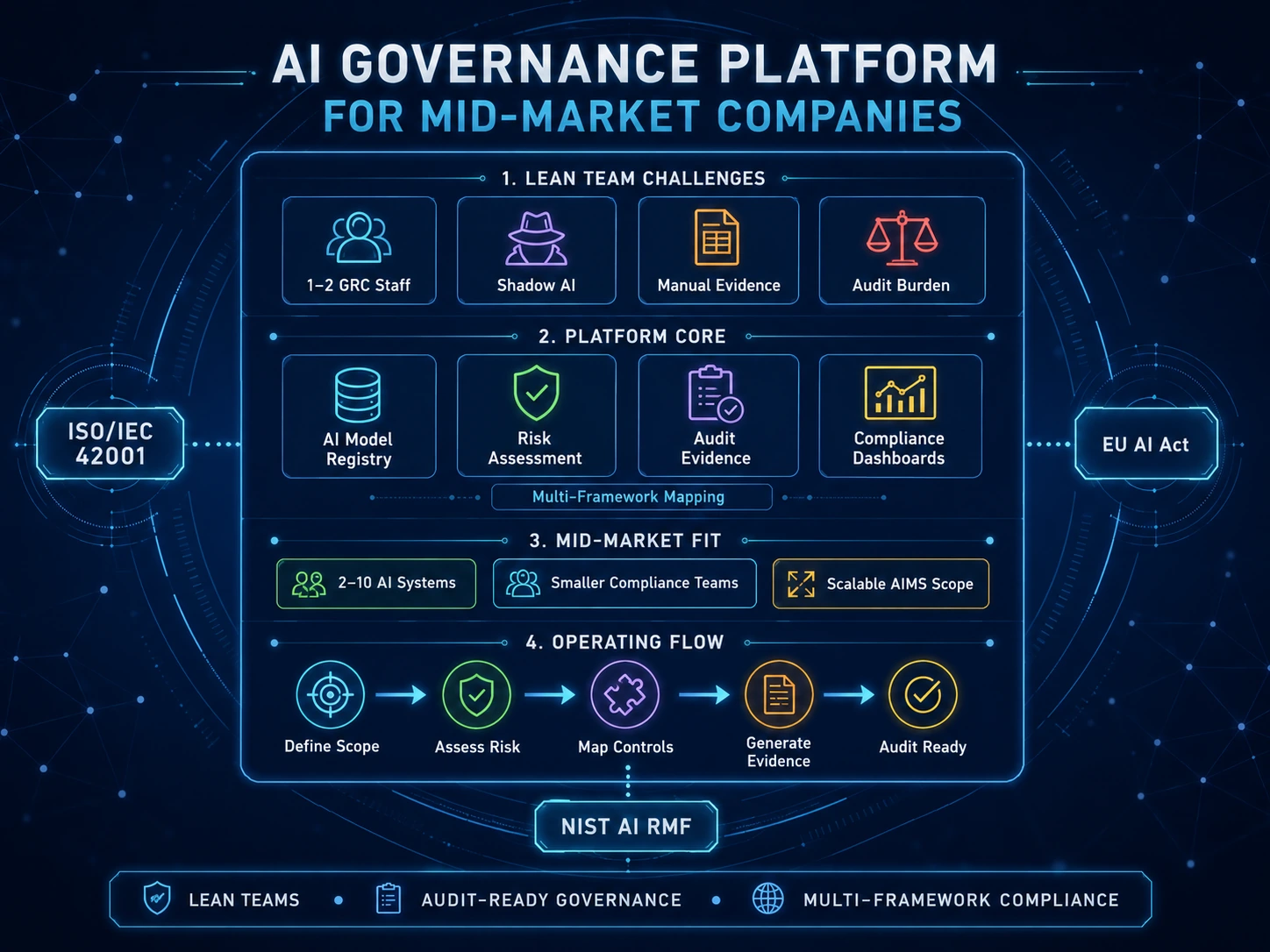
In smaller companies under 500 employees, AI governance typically sits with the General Counsel or the CIO, often as an additional responsibility rather than a dedicated role. This works as long as there is one named executive who owns the outcome and a cross-functional committee meeting at least monthly.
Mid-sized companies between 500 and 5,000 employees increasingly appoint a Chief AI Officer or AI Ethics Lead reporting to the CEO, CIO, or Chief Risk Officer. A 2025 PwC survey found 61 percent of US mid-market companies had created such a role or planned to within 12 months. The key is giving the position real authority, including the power to stop a deployment, not just a title.
Large enterprises run a full three-lines-of-defense model with dedicated AI risk teams embedded in compliance, a central governance office, and internal audit testing both. JPMorgan Chase, for example, runs a multi-disciplinary AI governance function that sits alongside model risk management, reflecting the same structure banks use for traditional model governance under SR 11-7.
Whichever model you pick, the AI governance committee itself should include representation from legal, security, data science or engineering, HR, the business unit deploying the AI, and, critically, someone senior enough to say no to a line of business. A committee that cannot decline a request is a rubber stamp.
A 90-Day Roadmap to Stand Up Your First AI Governance Program
The mistake most US businesses make is trying to build the perfect governance program before shipping version one. The companies that succeed ship a minimum viable program fast, then improve it in public. Here is a 90-day plan that has worked for mid-sized organizations.
Days 1 to 30: Discover and Define
- Run an AI inventory sprint. Send a survey to every department head asking what AI tools their teams use, including SaaS features labeled “AI” or “smart” or “copilot.” Expect to find twice what you thought existed.
- Identify your regulatory footprint. List every jurisdiction your AI touches, state laws, EU exposure, sector-specific rules in healthcare, finance, or hiring. This defines the minimum legal floor.
- Draft a one-page AI policy. Cover approved use cases, prohibited data inputs, vendor requirements, and the escalation path. One page. Not 40.
- Name an executive owner. One person, one job title, authority to stop a deployment.
Days 31 to 60: Build the Minimum Viable Program
- Create the AI governance committee. Five to seven people, monthly cadence, written charter.
- Tier your inventory by risk. High, medium, low. Use NIST AI RMF’s impact categories as your starting point.
- Stand up an intake process. Any new AI use case must be logged and tiered before procurement or development begins.
- Publish the policy and train the workforce. A 20-minute module for everyone. A deeper workshop for engineering and data teams.
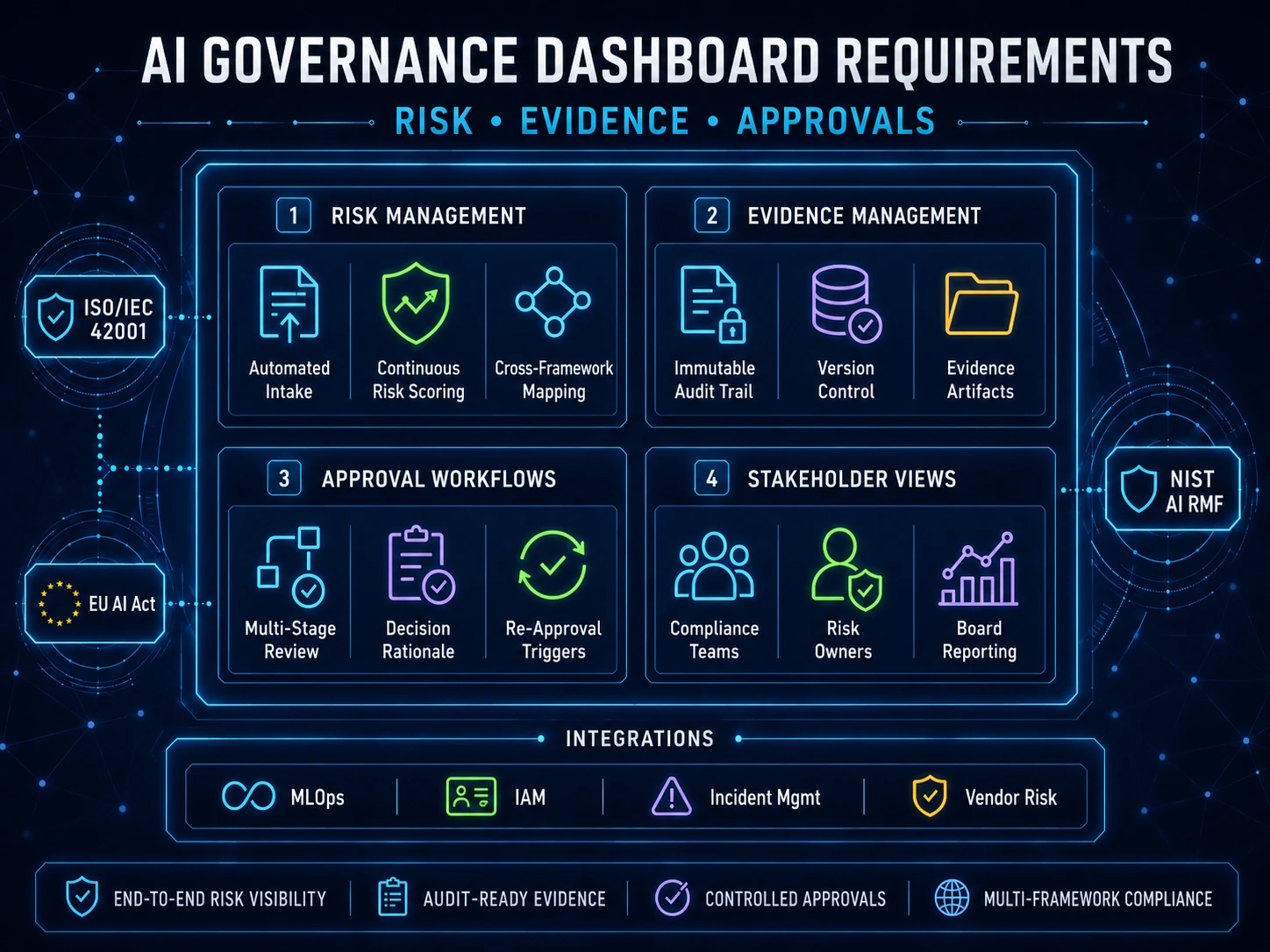
Spreadsheets collapse under their own weight by week four. Teams hitting the 90-day target consolidate onto a single platform that pairs an AI System Registry and Evidence Vault with pre-built policy templates and controls mapped to every major framework.
Days 61 to 90: Operationalize and Measure
- Run the first bias and security reviews on your two or three highest-risk systems.
- Build a simple governance dashboard. Number of systems in inventory, percentage reviewed, open incidents, training completion rate. Five metrics, not fifty.
- Test your incident response plan. A tabletop exercise with a fake AI incident exposes gaps no document can reveal.
- Report to the board or executive team. This is the step most programs skip, and it is the one that turns governance from a project into a function.
By day 90 you will not have a perfect program. You will have a defensible one, which is what actually matters when a regulator calls or a customer audits your AI claims.
Certifications and Training That Move the Needle
Individual credentials matter more in AI governance than in most adjacent fields because the discipline is new and hiring managers are trying to filter fluency from buzzword bingo. A few certifications have emerged as genuine signals.
ISO/IEC 42001 Lead Implementer is the credential for professionals responsible for designing and running an AI Management System inside an organization. It covers the full lifecycle from policy through audit readiness and is the most direct path for governance leads, compliance officers, and AI project managers. GAICC’s ISO/IEC 42001 Lead Implementer certification is structured around the 2023 standard and includes practical exercises aligned with real-world AI governance scenarios.
ISO/IEC 42001 Lead Auditor targets professionals who will conduct internal or third-party audits of AI management systems. As demand for certified AI auditors grows, particularly from enterprise buyers who want assurance about their vendors, this credential is quickly becoming one of the most economically valuable in the space.
AIGP (Artificial Intelligence Governance Professional) from the IAPP covers the legal and policy side of AI governance, with strong coverage of the EU AI Act and US regulatory landscape.
For executives who need fluency without becoming practitioners, a well-designed foundation course, typically two days, is enough to make informed decisions and ask the right questions of the people building the program.
Frequently Asked Questions
1. What is AI governance in simple terms?
AI governance is the set of policies, roles, and controls that decide how your organization builds, buys, deploys, and monitors AI systems. It answers who is accountable when AI fails, what data the models can use, and which decisions require human review. Think of it as the operating system for responsible AI.
2. Is AI governance legally required in the United States?
There is no single federal AI law, but several obligations already apply. The EEOC enforces anti-discrimination rules on AI hiring tools, the FTC polices deceptive AI claims, and states like Colorado, New York City, and California have passed specific AI statutes. Public companies also face SEC disclosure expectations around material AI risks.
3. What is the difference between AI governance and AI ethics?
AI ethics is the set of principles, fairness, transparency, accountability. AI governance is how you operationalize those principles through policies, roles, controls, and audits. Ethics tells you what good looks like. Governance makes it happen across every model, every team, every day.
4. How much does it cost to implement AI governance?
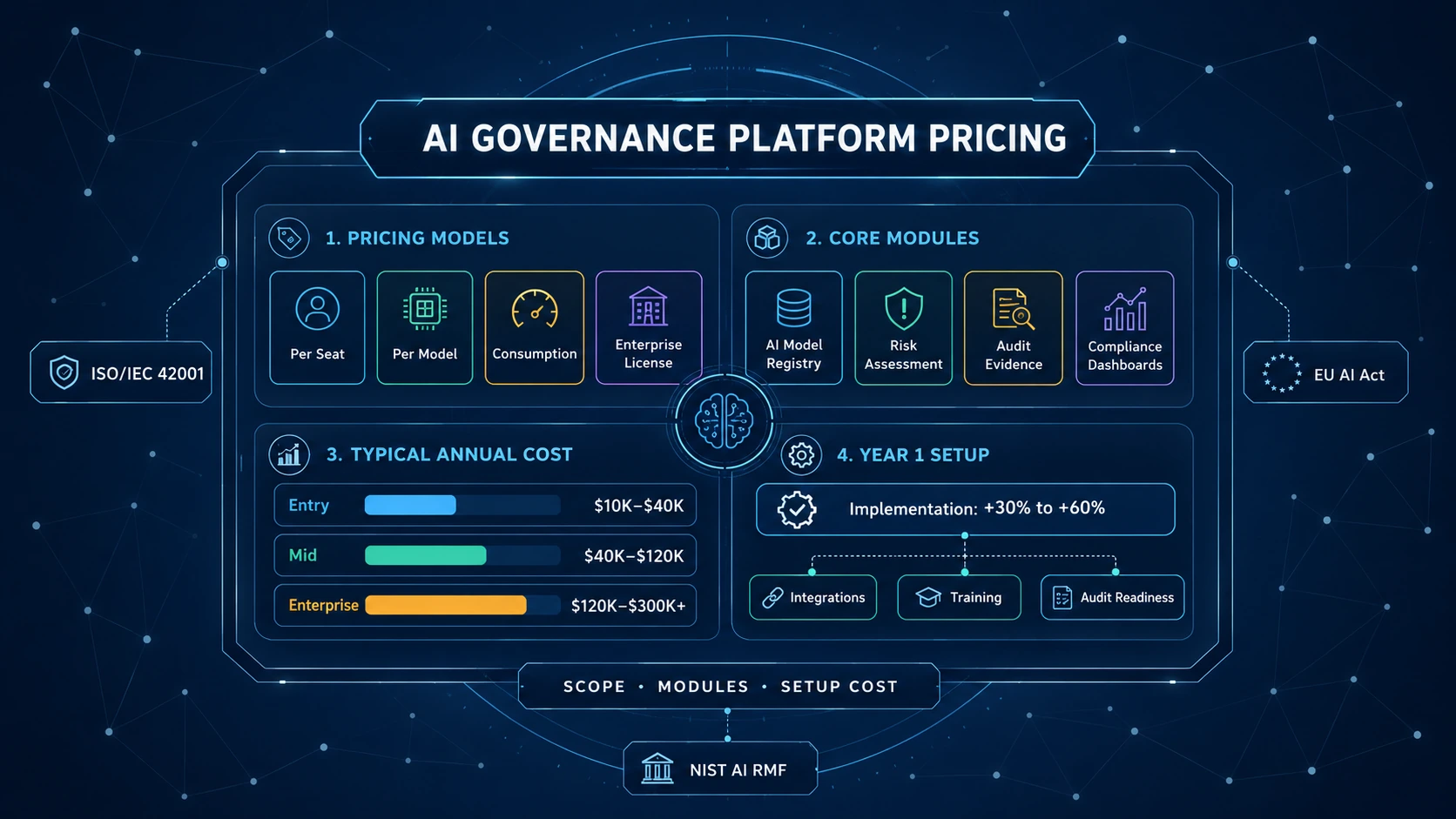
For a mid-sized US business, expect a first-year investment of roughly $75,000 to $250,000 covering staff time, tooling, and external advisory support. Costs scale with the number of AI use cases, regulatory exposure, and whether you pursue formal certification like ISO/IEC 42001. The cost of not governing, regulatory fines, lawsuits, or public failures, is typically an order of magnitude higher.
5. Which AI governance framework should a US business adopt?
Most US businesses start with the NIST AI Risk Management Framework because it is voluntary, free, and explicitly designed for American organizations. Companies operating internationally or seeking certification usually layer ISO/IEC 42001 on top. If you serve EU customers, you will also need to map your program to the EU AI Act.
6. Who should own AI governance inside a company?
AI governance is a shared responsibility, but it needs one accountable executive. Most US companies assign this to the Chief AI Officer, Chief Data Officer, or Chief Risk Officer. A cross-functional AI governance committee then brings together legal, security, data science, HR, and business unit leaders to make day-to-day decisions.
7. What is shadow AI and why does it matter?
Shadow AI is any AI tool employees use without IT or compliance approval, from pasting customer data into ChatGPT to running unofficial copilots inside sales workflows. Gartner estimates that through 2026, more than 80 percent of unauthorized AI activity will come from internal use, not external attacks. An AI inventory is the first line of defense.
8. How long does it take to build an AI governance program?
A minimum viable program, policy, inventory, risk tiers, and a review committee, can be stood up in 60 to 90 days. Reaching audit readiness for frameworks like ISO/IEC 42001 typically takes 9 to 18 months depending on organizational size and AI maturity. The mistake most companies make is waiting for the perfect program instead of shipping version one.
Conclusion: Governance Is What Turns AI From a Liability Into a Strategic Asset
The US companies pulling ahead in AI right now are not the ones with the biggest models or the flashiest copilots. They are the ones who can move fast without making the kind of mistake that ends up in a court filing or a congressional hearing. That speed comes from governance, not from the absence of it. A clear policy, a real inventory, a named owner, and a working review process let engineers ship confidently because the guardrails are explicit.
If you take one thing from this guide, take this: start this week. Send the AI inventory survey on Monday, name an executive owner on Tuesday, draft the one-page policy by Friday. Version one is always imperfect, and version one is always better than the program you are still planning to start.
Governance doesn’t have to be a six-month implementation. Govern365 is built to take you from zero to audit-ready in days, not quarters.