A February 2026 Gartner analysis put global AI governance platform spending at $492 million for 2026, on a path past $1 billion by 2030, and organizations using dedicated governance platforms were 3.4 times more likely to reach high governance effectiveness.
Most of that spending is now chasing a problem the original AI governance playbooks never anticipated: agents that call tools and APIs on their own. An AI agent is not a model producing text for a person to read. It is a system that plans, selects a tool, calls an API, and acts, sometimes before anyone sees the output.
This piece lays out the specific controls, identity, tool scoping, API access, and human review gates, that ISO/IEC 42001, the EU AI Act, and NIST AI RMF each expect once your AI systems start acting instead of just answering.
Why AI Agents Break the Governance Models Built for Chatbots
Most enterprise AI governance programs were built for a simple loop: a model generates an output, a person reads it, a person decides what to do next. AI agents remove the middle step. An agent can plan a multi-part task, call a CRM API to pull a customer record, call a second API to issue a refund, and log the action, all inside one execution that no human watched in real time.
That single change breaks three assumptions most governance frameworks quietly rely on. First, that risk is concentrated in the model’s output, not in what happens after the output. Second, that a human sees the result before anything external changes. Third, that one system, the model, is the unit of governance, rather than a chain of tool calls, sub-agents, and API permissions.
Security and compliance teams are already naming this gap directly. The OWASP Top 10 for Agentic Applications, published in December 2025 by the OWASP Gen AI Security Project, dedicates entries to tool misuse, identity and privilege abuse, and what it calls human-agent trust exploitation, where a user’s automation bias lets a manipulative or compromised agent get a harmful action rubber-stamped. None of those failure modes exist in a static text-generation risk register.
For a GRC team, the practical effect is that “we have an AI governance policy” is no longer the same claim as “we can control what our AI agents do.” The rest of this article works through the controls that close that gap, organized around the three places agent risk actually lives: identity and tool access, API-level permissions, and the human review points that catch what automated controls miss.
The Three Control Layers: Identity, Tool Scoping and API Permissions
Agent governance controls cluster into three layers, and skipping any one of them tends to be where incidents originate. The first layer is identity. Every agent needs a distinct, traceable identity, not a shared service account borrowed from a human user or another agent. When an agent acts under a generic API key, there is no way to answer a basic audit question: which agent, running which version of which prompt, took this action.
NIST is actively working this exact problem. On February 17, 2026, NIST’s Center for AI Standards and Innovation (CAISI) launched the AI Agent Standards Initiative, organized around three pillars: industry-led interoperability and security standards, community-led open protocol work including efforts adjacent to the Model Context Protocol, and applied research into agent identity and authorization. A companion NCCoE concept paper is examining whether existing identity standards such as OAuth and OpenID Connect can be adapted for agents, rather than requiring an entirely new authentication model.
The second layer is tool scoping: which tools can this agent invoke at all. This is where the OWASP taxonomy’s “least agency” principle applies, deploy autonomous tool access only where it adds real value, because every additional tool an agent can reach without restriction expands what a prompt injection, a goal-hijacking attempt, or a plain reasoning error can turn into an external action.
The third layer is API-level permission, and it is the one most organizations get wrong first. Tool scoping answers whether an agent can use the CRM tool at all. API permissioning answers what that tool is allowed to do once invoked, read-only lookups, field-level updates, or account-level deletions each carry different risk and should carry different authorization, not a single blanket grant because the agent “has access to the CRM.”
A practical rule that holds up across all three layers: authorization checks belong at every step of a workflow, not once at the start of it. An agent authorized to begin a task is not the same as an agent authorized to complete every action inside that task.
These controls are much easier to operate when every agent has a defined owner, documented permissions, approved tools and a clear review history.
Govern365.ai’s AI model registry extends to agent-level records, capturing each agent’s identity, its permitted tool set, and its API scopes in one inventory entry rather than scattering that context across engineering tickets.
Mapping Human Review to Risk, Not to Every Action
The instinct to put a human in front of every agent action is understandable and unworkable. Review everything and the agent delivers no efficiency gain; review nothing and you have handed autonomous execution to a system that cannot yet explain its own reasoning failures. The workable middle is a tiered review model where the review requirement scales with the reversibility and impact of the action, not with how the action happens to be phrased.
A useful three-tier split: low-impact, reversible actions, summarizing a document, drafting an email, classifying a ticket, can run without a synchronous approval gate, provided they are logged. Actions that change customer-facing state, touch money, or modify production systems should route through an approval step before execution. Actions that are irreversible once triggered, deleting records, sending external communications under the organization’s name, closing an account, warrant the highest bar: a named, accountable human approver, not a queue that auto-approves after a timeout.
This tiering is not a Govern365.ai invention. The EU AI Act’s Article 14 effectively builds the same logic into law for high-risk systems, requiring that oversight measures be “commensurate with the risks, level of autonomy and context of use,” rather than uniform across every system function. The Act does not require a human to review every decision; it requires that a human retain the practical ability to understand, intervene in and halt the system, calibrated to the stakes involved.
Where teams get this wrong most often is treating “human-in-the-loop” as a checkbox on a design document rather than an operating capability. A review gate that exists in a diagram but has no named reviewer, no defined response-time expectation, and no escalation path if the reviewer is unavailable is not a control. It is documentation that will not survive an incident review.
ISO/IEC 42001 Controls for Agentic AI Systems
ISO/IEC 42001:2023 was written as a management-system standard, not an agent-specific technical control set, which is exactly why it holds up well as agents enter the picture: it governs the process an organization uses to manage AI risk, and that process applies whether the AI system in question answers questions or takes actions.
Three parts of the standard carry direct weight for agent deployments. The AI system impact assessment expected under the standard’s risk management requirements needs to account for what happens when an assessed system is not just generating text but executing multi-step actions against live systems, the blast radius of a misconfigured agent is categorically different from a misconfigured chatbot.
The standard’s operational planning and control expectations extend naturally to tool and API governance: an organization managing AI risk under 42001 needs documented controls over what its AI systems are authorized to interact with, and agents are the clearest case where that authorization needs to be explicit rather than implied. And the standard’s monitoring and continual improvement cycle needs agent-specific telemetry, tool call logs and API action records, not just model output samples, to have anything meaningful to review.
The specific Annex A sub-control numbers that map most directly to agent tool governance and monitoring should be confirmed against the licensed ISO/IEC 42001:2023 text, since the standard itself is paywalled and control numbering should not be quoted from memory.
The practical takeaway for a certification-minded GRC team: an ISO 42001 audit for an organization running AI agents should expect auditors to ask not just “how do you manage AI risk” but “how do you know what your agents actually did,” which is a records and logging question as much as a policy question.
EU AI Act Article 14 and Human Oversight for Agents
Article 14 of the EU AI Act (Regulation 2024/1689) is the provision most directly tested by agentic systems, because it was written around a model that a human reviews and evaluates. Its text still holds up, but applying it to agents takes deliberate interpretation. The article requires that high-risk AI systems be designed so they “can be effectively overseen by natural persons,” with measures proportionate to the system’s risk, autonomy, and context of use, and it names specific enablement requirements: overseers must be able to understand the system’s capabilities and limits, remain aware of automation bias, correctly interpret outputs, and retain the ability to disregard, override, or halt the system through something like a stop function.
Two features of Article 14 matter specifically for agents. First, it does not require that a human review every decision, it requires that the capability to understand, intervene, and halt exists and is proportionate to risk, which is the same tiered-review logic covered earlier in this piece, now with legal backing for high-risk use cases. Second, the Act’s recitals address multi-agent architectures directly: where an orchestrating agent delegates to sub-agents, the compliance boundary extends to every agent in the chain that performs a high-risk function, not just the top-level agent a human interacts with.
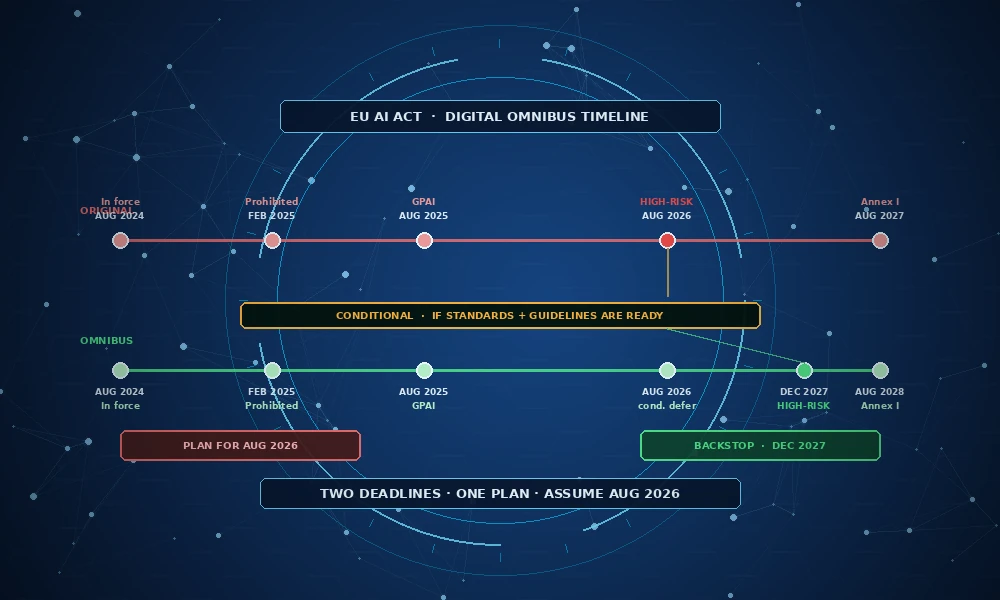
Timing matters here, and it has moved since the Act’s original text. Following the Digital Omnibus package the Council approved in June 2026, Article 50 transparency duties took effect from August 2026, but the Annex III high-risk system obligations, including Article 14 human oversight, were deferred to December 2, 2027, with obligations for AI embedded in regulated products under Annex I pushed to August 2, 2028. Content published before mid-2026 that cites an August 2026 deadline for Article 14 compliance is describing the pre-Omnibus timeline and should be treated as outdated.
For US-based organizations with EU exposure, the practical implication is a longer runway than many vendor blogs currently suggest, but not one worth spending carelessly: designing oversight capability into agent architecture from the start is materially cheaper than retrofitting a stop function and an audit trail onto an agent fleet that is already running in production.
Govern365.ai‘s compliance dashboards track framework deadlines like the Digital Omnibus deferral against each system in the inventory, so a status change in Brussels updates your organization’s obligation timeline instead of sitting in a policy binder.
NIST AI RMF and the Emerging Agent Standards Gap
NIST AI RMF 1.0, published in January 2023, remains the operative version of the framework, structured around four functions, GOVERN, MAP, MEASURE, and MANAGE, spanning 19 categories and 72 subcategories. It was not written with autonomous tool-calling systems in mind, and NIST has been explicit that this is a real gap rather than a matter of interpretation.
That gap is precisely what the AI Agent Standards Initiative NIST’s CAISI announced in February 2026 is meant to close. The initiative is explicitly voluntary and industry-facing rather than regulatory, its scope covers agent identity and authorization, security and risk management, and monitoring and logging, informed by a public request for information and an identity and authorization concept paper NIST ran for comment through early April 2026. Formal deliverables, including guidelines aimed at agent interoperability, are expected later in 2026, but the initiative had not published binding guidance as of this writing.
Until that guidance lands, organizations applying NIST AI RMF to agents are extending the existing four functions by analogy. GOVERN needs to assign accountability not just for “AI risk” generally but for specific agent behaviors and the tool permissions that enable them. MAP needs an inventory that captures each agent’s tool set and API scope as context, not just its model version. MEASURE needs metrics that go beyond model accuracy to track tool-call error rates, unauthorized action attempts, and override frequency. MANAGE needs incident response procedures that assume an agent can take an action before anyone reviews it, which is a materially different assumption than the framework’s original model-output-centric design implied.
The GenAI Profile (NIST AI 600-1, published July 2024) partially bridges this gap for generative AI risk categories, but its risk categories were built around content generation, not tool execution, so teams should treat it as a starting point for agent governance rather than a complete answer.
Cross-Framework Mapping: Agent Controls Across ISO 42001, the EU AI Act, and NIST AI RMF
The three frameworks use different vocabulary for the same underlying agent controls. The table below maps six core agent governance controls across all three simultaneously, something none of the top-ranking content on this topic currently does in one place.
| Agent Control | ISO/IEC 42001:2023 | EU AI Act (Reg. 2024/1689) | NIST AI RMF 1.0 |
|---|---|---|---|
| Agent inventory and registry | Clause 6 risk management planning; AI system documentation requirements [VERIFY exact Annex A control] | Art. 11 technical documentation; Art. 16 provider obligations | MAP 1.1-1.3, system categorization and context documentation |
| Risk and impact classification | AI system impact assessment within risk management process | Art. 6 and Annex III risk classification; Art. 9 risk management system | MAP 2, GOVERN 1.2 risk tolerance mapping |
| Tool and API access scoping (least privilege) | Operational planning and control of AI system interactions | Art. 15 accuracy, robustness and cybersecurity across the action layer | MANAGE 2.3, GOVERN 4 third-party and integration risk |
| Human oversight and review gates | Human oversight embedded in AI management system roles | Art. 14 human oversight, understand/intervene/halt capability | GOVERN 1.5, MANAGE 1.3 human-AI configuration |
| Logging and audit trail | Monitoring and measurement of AI system performance | Art. 12 record-keeping and automatically generated logs | MEASURE 2, MANAGE 4.1 monitoring for effectiveness |
| Incident response and kill switch | Continual improvement and nonconformity handling | Art. 20 corrective actions; Art. 73 serious incident reporting | MANAGE 4.2, MANAGE 4.3 incident response and recovery |
Govern365.ai’s audit evidence management maintains this simultaneous mapping per system, so a single agent record shows its ISO 42001 status, its EU AI Act article obligations, and its NIST RMF subcategory coverage without three separate spreadsheets.
Building an Agent Governance Control Checklist
Use this as a working checklist for an agent governance program, not a one-time audit. Each item is attributed to the framework or frameworks it most directly satisfies.
- Assign every agent a unique, traceable identity separate from shared service accounts or human credentials. [NIST AI RMF (GOVERN 1.1); EU AI Act Art. 11]
- Maintain a live inventory of agents, their permitted tools, and their API scopes, updated when any of the three changes. [ISO 42001 Clause 6; NIST AI RMF (MAP 1)]
- Classify each agent workflow by reversibility and impact before deciding its review tier. [EU AI Act Art. 9; NIST AI RMF (MAP 2)]
- Enforce authorization checks at every step of a multi-step workflow, not only at task initiation. [EU AI Act Art. 15; OWASP ASI least-agency principle]
- Define named, accountable human reviewers for irreversible or high-impact actions, with escalation paths for reviewer unavailability. [EU AI Act Art. 14; ISO 42001 human oversight roles]
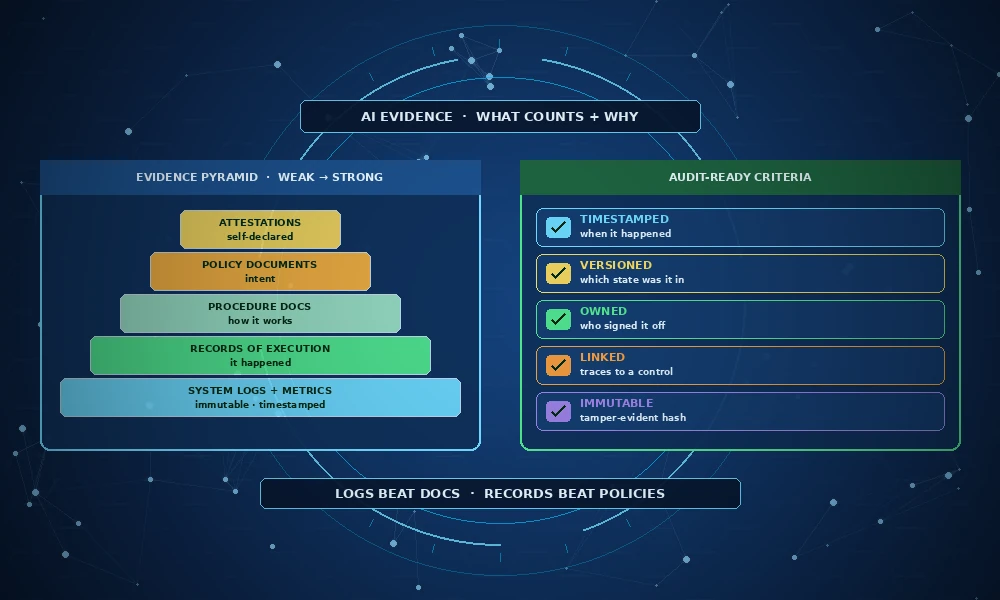
- Log every tool call and API action with agent ID, trigger source, data accessed, and policy version in effect. [EU AI Act Art. 12; NIST AI RMF (MEASURE 2)]
- Build and test a kill switch capable of halting an individual agent without taking down the broader system. [EU AI Act Art. 14(4)(e); NIST AI RMF (MANAGE 4.2)]
- Review override and escalation rates on a regular cadence to catch automation bias before it becomes a pattern. [EU AI Act Art. 14(4)(b); ISO 42001 continual improvement]
- Extend incident response procedures to cover actions an agent already completed, not only outputs a human rejected before acting. [EU AI Act Art. 73; NIST AI RMF (MANAGE 4.3)]
- Reassess tool and API scope whenever an agent’s underlying model, prompt, or orchestration logic changes materially. [ISO 42001 continual improvement; NIST AI RMF (GOVERN 1.2)]
Govern365.ai’s risk assessment workflows generate this checklist automatically per agent record and flag items that lack a completed control before the next audit cycle.
Common Failure Patterns in Agent Governance Programs
Most agent governance programs do not fail because the policy was wrong. They fail because the policy stopped describing what the system actually does. Three patterns show up repeatedly.
The first is paper governance: a control exists in a document but has no corresponding location in code, no named owner, and no artifact that proves it ran. A review gate that lives only in a design diagram is not a control, it is an intention. Treat a control as real only when you can point to where it executes and who is accountable for it.
The second is what OWASP’s agentic taxonomy calls human-agent trust exploitation, a genuinely new failure mode rather than a restatement of automation bias. An agent’s fluency and apparent confidence can lead a reviewer to approve an action faster and with less scrutiny than they would apply to a less articulate system, effectively laundering a flawed decision through a human’s rubber stamp. The person becomes the last line of defense in name only. The mitigation is procedural, not technical: require reviewers to document the specific reason for approval on high-impact actions, not just click approve, which forces genuine evaluation instead of pattern-matching to “this looks fine.”
The third is scope creep that outpaces the inventory. An agent approved for read-only CRM access during a pilot quietly picks up write permissions during a later integration, and the governance record never catches up because nobody re-runs the risk classification when scope changes. This is the single most common gap our reviews across recent AI governance content find: organizations treat agent approval as a one-time gate rather than a control that needs to be re-triggered by scope changes, not just by calendar dates.
Frequently Asked Questions
What is AI agent governance?
AI agent governance is the set of controls, identity management, tool and API access scoping, human review gates, logging, and incident response, that an organization applies to AI systems capable of taking autonomous action, not just generating output. It extends traditional model governance to cover what an agent does after it decides, not only what it says.
How is agent governance different from model governance?
Model governance evaluates outputs a human reviews before acting. Agent governance has to cover execution: which tools an agent can call, what an API permission allows once invoked, and whether a human retains a meaningful ability to intervene before an irreversible action completes. The risk moves from what the AI says to what the AI does.
Does the EU AI Act require human review of every AI agent action?
No. Article 14 requires that human oversight measures be proportionate to a system’s risk, autonomy, and context of use, not uniform across every action. High-risk agent workflows need a human retaining the practical ability to understand, intervene in, or halt the system, calibrated to the stakes of the specific action.
When do EU AI Act human oversight requirements for high-risk systems take effect?
Following the Digital Omnibus package the Council approved in June 2026, Annex III high-risk obligations, including Article 14 human oversight, were deferred to December 2, 2027. Article 50 transparency duties still took effect in August 2026. Content citing an August 2026 deadline for Article 14 predates this deferral.
Does NIST AI RMF cover AI agents specifically?
Not directly yet. NIST AI RMF 1.0 was designed around model-level risk categories. NIST’s CAISI launched the AI Agent Standards Initiative in February 2026 to address agent identity, security, and monitoring gaps, but as of this writing the initiative has not published binding agent-specific guidance, so organizations are extending the existing GOVERN, MAP, MEASURE, and MANAGE functions by analogy.
What is least privilege for AI agents?
Least privilege for AI agents means scoping both tool access and API permissions to the minimum needed for a specific task, rather than granting broad, standing access because an agent might need it later. It includes task-scoped, short-lived credentials and authorization checks at every workflow step, not just at task initiation.
What should an agent audit trail record?
A usable agent audit trail records the agent’s unique identity, the trigger source for each action, the specific tool or API called, the data accessed or modified, the policy version in effect at the time, and the named human approver if one was involved. Consistency across every action path matters more than capturing extra detail on some actions.
How does ISO 42001 apply to AI agents if it does not mention them by name?
ISO/IEC 42001:2023 governs the AI management system process, risk assessment, operational control, monitoring, and continual improvement, rather than prescribing agent-specific technical controls. That process applies to agentic systems directly, but organizations need to extend impact assessments and monitoring to cover tool calls and API actions, not only model outputs.
Getting Started
Agent governance is not a new framework layered on top of ISO 42001, the EU AI Act, and NIST AI RMF. It is the same three frameworks, applied to systems that act instead of only responding, with the review burden shifted toward identity, tool scoping, and API-level permission rather than output review alone. The organizations that get this right treat human review as a control that scales with consequence, not a checkbox applied uniformly or skipped entirely. Start by inventorying what your agents can already reach: which tools, which APIs, and under whose identity, before adding another policy document to the pile.
Govern365.ai’s AI model registry and risk assessment tools build that inventory and map it to all three frameworks in one place.
Start your 14-day free trial to see your agent fleet mapped against ISO 42001, the EU AI Act, and NIST AI RMF today. Govern365.ai, by the Global AI Certification Council.