Gartner’s February 2026 research projects AI governance platform spending will reach $492 million this year alone, more than double what it was two years ago. The driver is not enthusiasm for AI it is audit pressure. Regulators and certification bodies are now asking organisations to produce structured, traceable evidence that their AI systems were assessed, monitored, and governed throughout their operational lifecycle. Generic compliance tools were not built for that. Neither were spreadsheets. AI audit evidence software is the missing layer: purpose-built infrastructure for collecting, organising, and presenting the documentation that AI system reviews actually require.
What AI Audit Evidence Software Actually Does
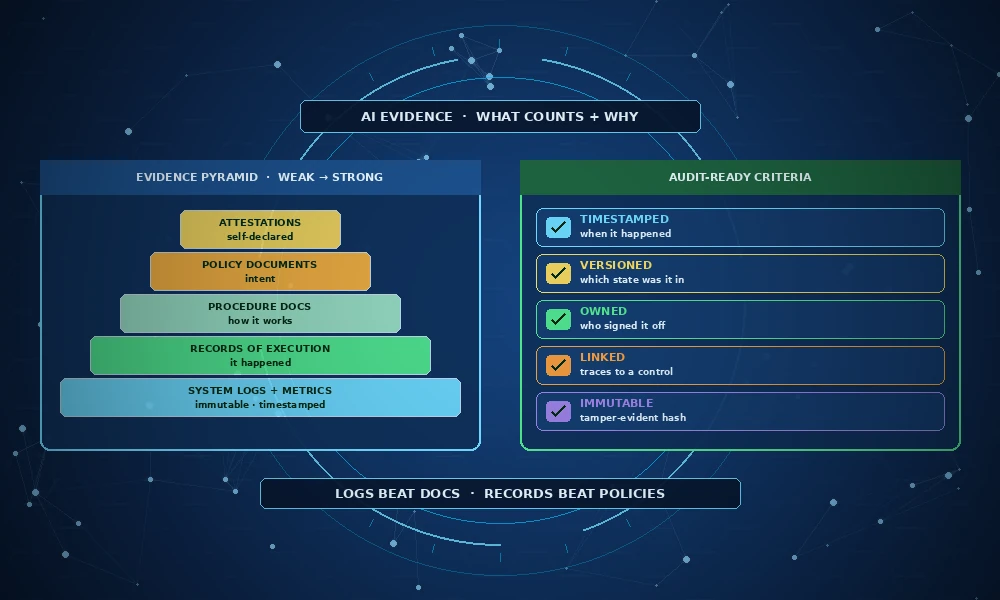
Audit evidence in the context of AI systems is not a set of policies in a shared drive. Certification bodies conducting ISO/IEC 42001 assessments expect 50 to 75 distinct artefacts depending on the number and complexity of in-scope AI systems, according to Elevate Consult’s ISO 42001 audit guidance. Those artefacts span risk assessments tied to specific clauses, model cards with training data lineage, impact assessment records, deployment approval logs, and performance monitoring results. Each one needs a version history, an approval chain, and a clear mapping to the relevant control.
AI audit evidence software manages that chain from end to end. The core capabilities are: a structured evidence repository linked to framework controls (ISO 42001 Annex A, EU AI Act Articles 9–17, NIST AI RMF functions), automated collection of technical artefacts from model pipelines, timestamped approval and sign-off workflows, and export-ready packaging for external auditors.
The distinction from a generic document management or GRC platform is architectural. Traditional GRC tools were designed around periodic control testing you conduct a test, attach a screenshot, and mark the control as passed. AI governance requires continuous evidence: a model’s fairness metrics from six months ago are not the same evidence as its fairness metrics today. The evidence chain must reflect the AI system’s full operational lifecycle, not a snapshot at audit time.
The Evidence Requirements That Are Driving Platform Adoption
Three regulatory and standards frameworks are converging on organisations with AI systems in production, and each has specific evidence requirements that general GRC tooling struggles to satisfy.
ISO/IEC 42001:2023 – The standard’s Clause 7.5 governs controlled documentation, requiring version control, approval processes, access controls, and defined retention periods for all records. Clause 6.1 requires documented risk identification and treatment for every AI system in scope. Clauses 8.2 and 8.3 require risk and impact assessment results to be retained as records. Annex A controls particularly A.5.3 on impact assessment documentation, A.6 on AI system lifecycle management, and A.8 on third-party and supplier governance each require specific evidence types that certification bodies will sample during a Stage 2 audit.
EU AI Act, Articles 9–17 and Article 12 – For high-risk AI systems listed in Annex III, Article 12 requires automatic logging of events throughout the system’s operational lifetime. Logs must capture the period of each use, input data characteristics, reference databases, and output verification records. Under Article 9, this logging data becomes the primary input into lifecycle risk management. Providers must retain these logs for at least six months and make them available to national competent authorities on request. The enforcement date for high-risk AI obligations is August 2, 2026.
NIST AI RMF – The Govern, Map, Measure, and Manage functions each generate specific documentation. Govern requires documented policies and accountability structures. Measure requires documented testing results, performance metrics, and bias evaluations. Manage requires incident records and corrective action logs. NIST AI RMF is voluntary in the US, but it is increasingly referenced in federal procurement requirements and sector-specific guidance, giving it de facto compliance weight for organisations working with government agencies.
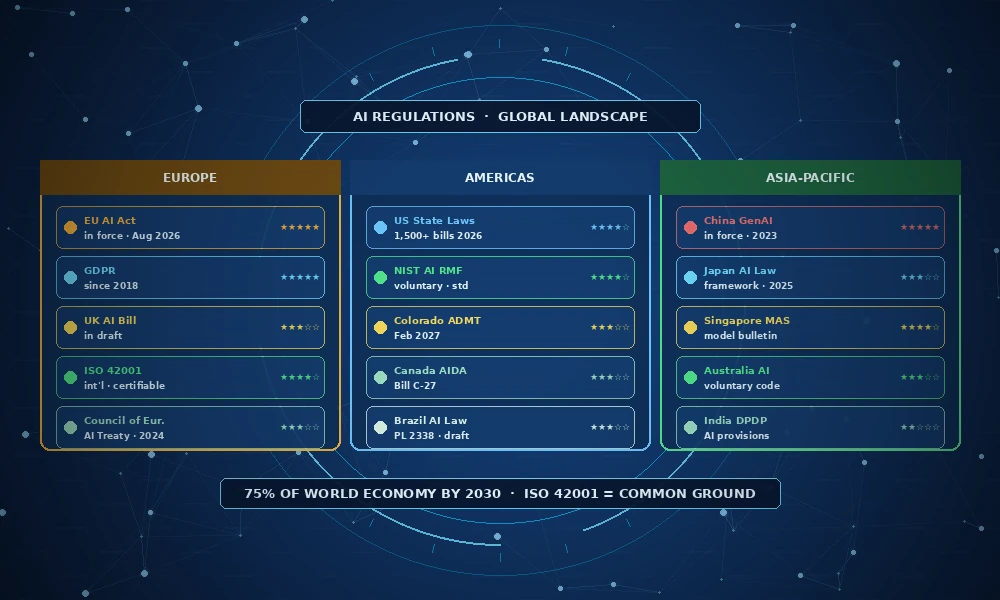
The overlap between these frameworks is significant. Controls mapped across ISO 42001 and the EU AI Act share substantial common ground in areas like risk management documentation, human oversight records, and post-market monitoring evidence. Organisations deploying AI in both US and EU contexts can consolidate much of their evidence collection if their tooling is designed for multi-framework mapping.
EVIDENCE REQUIREMENTS BY FRAMEWORK
| Framework | Evidence Type | Key Clause / Article | Retention Requirement |
|---|---|---|---|
| ISO 42001 | Risk assessment records, impact assessment results, model validation evidence | Clauses 6.1, 8.2, 8.3, Annex A.5.3 | Defined by organisation per Clause 7.5 |
| EU AI Act | Automatic event logs, technical documentation (Annex IV), conformity assessment records | Articles 9, 12, 17 | 6 months minimum for logs (Article 12) |
| NIST AI RMF | Risk profile documentation, measurement results, incident records, improvement actions | Govern, Measure, Manage functions | Not specified — organisational policy |
Where Generic GRC Tools Break Down
Most organisations already have a GRC platform. The natural instinct is to extend it to cover AI governance. That approach works for some elements policy management, vendor risk questionnaires, and awareness training records translate reasonably well. The gaps emerge when an auditor asks for something that requires AI-native data structures.
Consider model drift. An AI system deployed in a credit decisioning workflow may produce different outputs over time as the underlying data distribution shifts, even if the model weights have not changed. ISO 42001 Clause 9.1 requires monitoring and measurement of AIMS performance, and auditors will ask for evidence that drift was detected, evaluated, and addressed. A generic GRC platform can store a screenshot of a dashboard. It cannot natively ingest model performance metrics, flag drift events against predefined thresholds, or link those events to the risk treatment records that explain how the organisation responded.
The same problem applies to model cards, which are the standard documentation unit for machine learning models capturing training data sources, intended use, known limitations, evaluation results, and fairness metrics. Model cards are not a document type that exists in most GRC systems. Neither are shadow AI inventories: the ungoverned AI systems that employees adopt informally, which ISO 42001’s scope definition (Clause 4.3) requires organisations to understand and account for.
The structural mismatch is not a failure of GRC vendors. It is an architectural reality. GRC platforms were designed around the PDCA (Plan-Do-Check-Act) cycle applied to policies and controls. AI governance requires that same cycle applied continuously to living, learning systems whose behaviour changes in production. That requires different tooling.
Core Capabilities to Evaluate in AI Audit Evidence Platforms
Purchasing decisions for audit evidence software tend to get made on features rather than architecture, which leads to tools that look capable but fail when audit season arrives. The evaluation criteria that matter most are the ones that reflect how certification bodies and regulators actually review AI systems.
- Framework-native evidence mapping. The platform should map evidence artefacts to specific clauses and controls in ISO 42001, EU AI Act, and NIST AI RMF not at the category level, but at the clause level. When an auditor asks for evidence of compliance with ISO 42001 Clause 6.1.2 (AI risk identification), the platform should surface the specific artefacts linked to that clause, with version history and approval status visible.
- AI system inventory with lifecycle tracking. A compliant AIMS requires a structured, continuously updated inventory of all AI systems in scope. The platform must track each system from development through deployment to decommission, with governance records attached at each lifecycle stage.
- Automated evidence collection from technical sources. Manual evidence collection is the bottleneck in most AI audit preparations. Purpose-built platforms can integrate with model development environments, MLOps pipelines, and monitoring tools to pull technical artefacts test results, validation reports, performance metrics directly into the evidence repository.
- Tamper-evident audit trails. EU AI Act Article 12 requires logs that allow output verification, implying immutability. Platforms should maintain timestamped, access-controlled records with full change history.
- Multi-framework export packaging. The platform should produce framework-specific evidence packages an ISO 42001 Stage 2 evidence pack, an EU AI Act conformity assessment folder, an internal NIST AI RMF review report without manual reassembly of the same underlying artefacts.
How AI System Reviews Differ From Traditional IT Audits
IT audit practice has developed over decades of reviewing systems with relatively static behaviour. A firewall rule either permits or denies traffic. An access control either grants or denies permission. The state of the control at audit time is a reliable proxy for its state throughout the audit period.
AI systems do not work this way. A model deployed six months ago may behave materially differently today due to data drift, feedback loop effects, or changes in the population of users and inputs. An impact assessment conducted at deployment may not reflect the system’s actual impact on affected populations after six months in production. Human oversight mechanisms designed during development may have degraded in practice as operational teams developed workarounds.
This is why ISO 42001’s approach to internal audits (Clause 9.2) and the EU AI Act’s post-market monitoring requirements (Article 72) both emphasise operational evidence not just that controls were designed correctly, but that they functioned as designed across the review period. Auditors are increasingly asking for time-series evidence: performance data across the review window, incident logs with resolution timelines, model update records with approval chains.
| What separates organisations that pass their first ISO 42001 certification: Those that pass had been generating structured evidence continuously, not assembling it in the weeks before the audit. The auditor’s question is not ‘did you conduct a risk assessment?’ but ‘show me how the risk profile of this system evolved over the past year, and how your governance responded.’ |
The practical implication is that AI system reviews require continuous evidence collection, not periodic evidence assembly. Organisations that try to reconstruct a governance story from scattered system logs, email threads, and static documents before each audit will consistently struggle to satisfy auditors trained to ask about the gaps between those snapshots.
Building an Evidence Collection Architecture for AI Governance
The practical question for GRC directors and compliance architects is not which platform to buy but how to structure the evidence collection architecture so that audit readiness is an ongoing state rather than a pre-audit sprint.
A workable architecture has four layers:
Layer 1: AI System Registry. Every AI system in scope including third-party models, embedded AI features in enterprise software, and internally developed models is catalogued with its risk classification, applicable frameworks, responsible owner, and deployment context. This registry is the source of truth for audit scope.
Layer 2: Evidence Collection Pipelines. For each AI system, define the evidence types required and the sources from which they are collected. Where possible, automate collection so that evidence arrives in the repository as a byproduct of normal operations.
Layer 3: Control Mapping and Status Tracking. Map collected evidence to specific controls across your applicable frameworks. Maintain a live view of control status not just ‘compliant’ or ‘non-compliant,’ but last updated, next review due, and evidence completeness score.
Layer 4: Audit-Ready Packaging. Define standard evidence packages for each audit type you anticipate. When the audit is scheduled, the package is assembled from the live repository rather than built from scratch.
Govern365.ai‘s compliance dashboard and AI model registry are designed to support exactly this architecture maintaining live control status across ISO 42001, EU AI Act, and NIST AI RMF while linking evidence artefacts to the specific systems and lifecycle stages they document.
Evaluating AI Audit Evidence Software: A Buyer’s Framework
The market for AI governance platforms is expanding rapidly. Gartner’s February 2026 analysis identified AI governance platforms as essential infrastructure, moving from discretionary to mandatory as regulatory obligations mature. That market signal has drawn in both purpose-built vendors and established GRC platforms with AI governance modules. Distinguishing between them requires evaluating specific architectural properties, not feature checklists.
Questions that reveal architectural depth
- Can the platform maintain a version history for model cards that tracks changes over time?
- Does the platform support multi-stage approval workflows for AI system deployment decisions, with the approval record stored as structured evidence?
- Can the platform generate an evidence gap report a list of required artefacts that are missing or overdue?
- Does the platform support framework overlap analysis, showing which evidence artefacts satisfy requirements across multiple frameworks simultaneously?
- What is the platform’s approach to shadow AI discovery?
Red flags in vendor responses
- “We support ISO 42001” without being able to specify which clauses are mapped in the evidence schema
- Evidence stored as file attachments to a control record, with no structured metadata linking the evidence to the AI system or lifecycle stage
- No native concept of an AI system inventory separate from a generic asset register
- Audit preparation described as a manual export and packaging process
AI AUDIT EVIDENCE PLATFORM COMPARISON
| Capability | GRC Module / Generic Tool | Purpose-Built AI Governance |
|---|---|---|
| AI system inventory | Generic asset register | Lifecycle-tracked AI system registry with risk classification |
| Evidence linking | File attachments to controls | Structured artefacts linked to systems, clauses, and lifecycle stages |
| Framework mapping | Category-level | Clause-level mapping across ISO 42001, EU AI Act, NIST AI RMF |
| Audit trail | Activity log | Timestamped, versioned, tamper-evident evidence chain |
| Audit preparation | Manual export and assembly | Automated evidence package generation by audit type |
| Shadow AI | Not addressed | Discovery mechanisms and governance workflows |
US organisations without a dedicated GRC team face a particular challenge: they need the architectural depth of an enterprise AI governance platform without the implementation overhead of a full enterprise deployment. The right platform should be configurable to start with ISO 42001 core requirements and expand to EU AI Act and NIST AI RMF as regulatory obligations develop.
US Regulatory Context: Why Evidence Architecture Matters Now
US organisations sometimes view AI audit evidence as primarily a European compliance concern, given the EU AI Act’s explicit requirements. That framing is narrowing fast.
The NIST AI RMF, published in January 2023 and updated with the Generative AI Profile in 2024, has become the reference framework for US federal AI governance. Executive Order 14110 directed federal agencies to adopt NIST AI RMF guidance, and sector regulators the OCC, CFPB and EEOC among them have published AI-specific guidance that echoes NIST’s measurement and documentation requirements.
The extraterritorial reach of the EU AI Act is also a factor for any US company with EU operations, EU customers, or AI systems that affect EU residents. Cloud Security Alliance’s March 2026 analysis notes that deployers of third-party AI systems face Article 26 obligations including log retention requirements regardless of whether the provider has completed its own conformity activities. US-headquartered deployers with EU operations cannot delegate compliance to their AI vendors.
Beyond regulatory requirements, board-level AI governance accountability is increasing. 72% of S&P 500 companies disclosed at least one material AI risk in 2025, up from just 12% in 2023, according to The Conference Board and ESGAUGE. That disclosure trend creates internal pressure for documented evidence of AI oversight, independent of any external audit requirement.
Frequently Asked Questions
What is AI audit evidence software, and how does it differ from a GRC platform?
AI audit evidence software is purpose-built to collect, organise, and present the documentation that AI system reviews require under frameworks like ISO 42001, EU AI Act, and NIST AI RMF. Unlike generic GRC platforms, it supports AI-native constructs: model cards, system inventories with lifecycle tracking, performance monitoring records, and clause-level control mapping. GRC platforms can store documents; AI audit evidence software structures them as verifiable compliance evidence.
What types of evidence does an ISO 42001 Stage 2 audit typically require?
Stage 2 auditors typically request 50–75 artefacts, covering: the AI system inventory and scope definition, risk and impact assessment records per Clause 6.1 and 8.2–8.3, Annex A control evidence (particularly A.5.3 impact assessment documentation and A.6 lifecycle controls), internal audit records, management review minutes, and performance monitoring data. Each artefact requires version history and an approval or review trail.
Does the EU AI Act require audit evidence for all AI systems, or only high-risk ones?
Full audit evidence obligations apply to high-risk AI systems listed in Annex III, including systems used in employment, credit, education, and critical infrastructure. Article 12 requires automatic event logging throughout the system’s operational lifetime. Limited-risk systems face transparency obligations but not the full documentation and logging requirements. General-purpose AI models have separate obligations under Chapter V of the Act.
How does NIST AI RMF align with ISO 42001 evidence requirements?
NIST AI RMF’s four functions Govern, Map, Measure, Manage each produce documentation that overlaps substantially with ISO 42001’s evidence requirements. Risk identification records satisfy both NIST Map and ISO 42001 Clause 6.1. Performance measurement results serve both NIST Measure and ISO 42001 Clause 9.1. Organisations can design a unified evidence architecture that satisfies both frameworks from a single collection process, avoiding duplication.
What is shadow AI, and how should it be addressed in an AI audit evidence programme?
Shadow AI refers to AI systems typically third-party tools or consumer AI applications that employees use without formal IT or governance approval. ISO 42001’s scope definition (Clause 4.3) requires organisations to account for the boundary of their AI Management System. An effective evidence programme includes discovery mechanisms to identify ungoverned systems and onboarding workflows to bring them into the formal governance process before an audit.
How long does it take to build an audit-ready AI evidence repository?
Organisations starting from a defined AI system inventory typically reach a first ISO 42001 Stage 1 readiness point in three to six months using purpose-built tooling. Manual approaches using shared drives and spreadsheets typically extend that timeline to twelve months or more, and rarely produce the structured evidence chain that Stage 2 auditors require.
Can AI audit evidence software support both US and EU compliance requirements simultaneously?
Yes a properly designed platform maps evidence artefacts to multiple frameworks simultaneously, so a model validation report stored once can satisfy NIST AI RMF Measure requirements, ISO 42001 Clause 8.2 records, and EU AI Act Article 9 risk management documentation. Multi-framework overlap analysis shows which artefacts cover multiple obligations and where gaps remain.
The Evidence Gap Closes on Its Own Timeline
The audit pressure driving AI governance platform spending is not going away. Regulatory frameworks are multiplying, enforcement dates are arriving, and board-level accountability for AI risk is now a matter of public disclosure. The organisations that will navigate this environment without last-minute evidence scrambles are the ones building continuous, structured evidence architectures today not assembling compliance packages the month before an audit.
Start by completing your AI system inventory. If you do not know what systems are in scope, you cannot define what evidence you need. From there, map your evidence requirements to the frameworks applicable to your operating context, identify the collection gaps, and implement the tooling that closes them.
| Start Your 14-Day Free Trial Purpose-built AI audit evidence management from ISO 42001 Stage 2 readiness to EU AI Act Article 12 compliance designed for teams that need to move fast without cutting corners. Govern365.ai, by the Global AI Certification Council. |