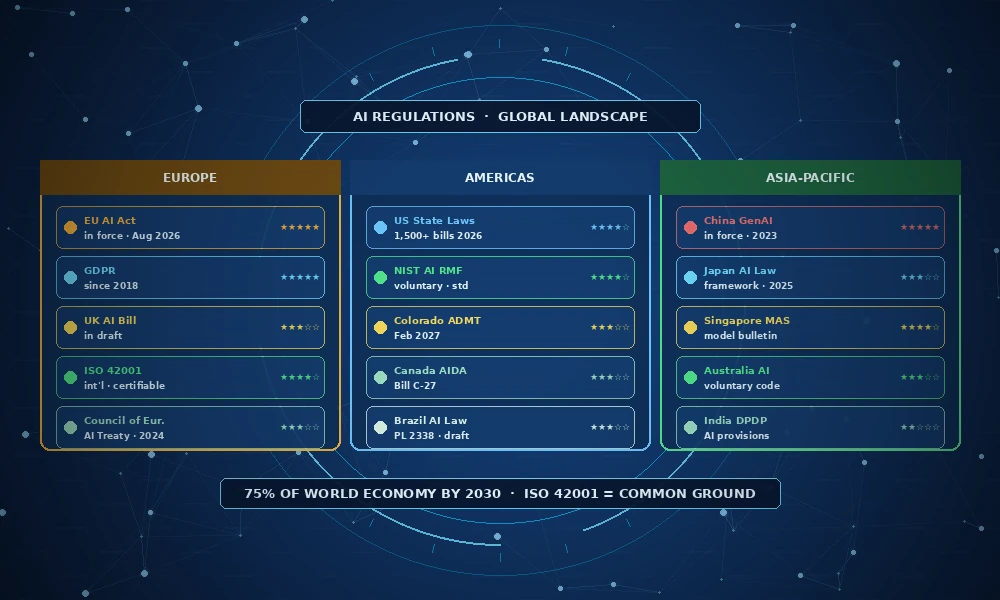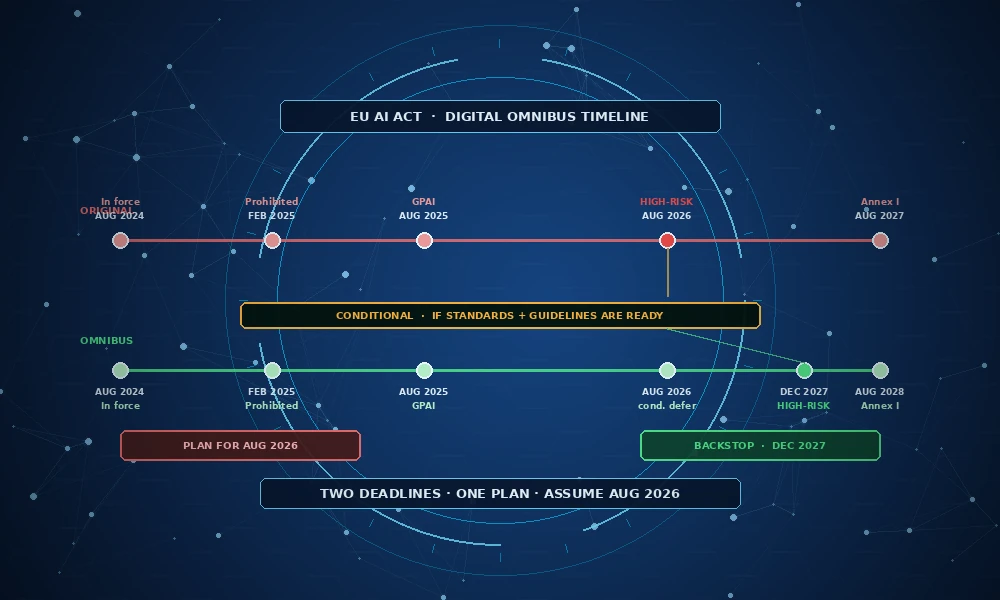
According to a February 2026 Gartner report, organisations that deploy specialised AI governance platforms are 3.4 times more likely to achieve high effectiveness in their governance efforts compared to those relying on traditional GRC tools and the market is responding accordingly, with spending projected to reach $492 million in 2026. The pressure behind those numbers is real: the EU AI Act’s full enforcement for high-risk systems begins August 2026, over 30 US states introduced or passed AI bills in 2025 alone, and the SEC has named AI governance a 2025 examination priority across regulated industries. For compliance and risk teams, the question is no longer whether a dedicated AI governance dashboard is necessary. The question is what it needs to do.
This article defines the core requirements across risk management, audit evidence, and approval workflows that separate a dashboard that supports genuine accountability from one that merely looks like it does.
Why Generic GRC Tools Fall Short for AI Governance
Traditional GRC platforms were designed for a world of static controls and annual reviews. An AI system is not a static control. It can drift. Its training data can degrade. Its outputs can shift as the environment changes around it. A compliance posture assessed at deployment can be materially inaccurate six months later and no spreadsheet or legacy risk register will surface that signal.
The structural gap is not just technical. It is architectural. Conventional GRC tools capture policies and point-in-time assessments. AI governance requires continuous monitoring across the full AI lifecycle: from intake and risk classification through deployment, ongoing monitoring, incident response, and decommissioning. That is a fundamentally different data model, and it requires a fundamentally different interface.
Three specific deficiencies show up consistently when compliance teams try to stretch traditional GRC platforms to cover AI:
First, AI systems generate governance events continuously model performance logs, drift alerts, inference anomalies, data access records. Traditional GRC tools have no native mechanism to ingest, structure, or surface this volume of operational data. The result is that evidence is manually assembled before audits, not generated automatically during operations. Regulators and examiners including the SEC can identify the difference between evidence generated continuously and evidence compiled in anticipation of review.
Second, AI risk classification requires multi-dimensional assessment across technical risk, regulatory category (EU AI Act risk tiers, for example), and deployment context. A generic risk matrix does not accommodate the layered logic required to map an AI system simultaneously to ISO/IEC 42001 Clause 6.1, EU AI Act Article 9, and NIST AI RMF Govern 1.1. Without that mapping, compliance teams cannot produce the cross-framework evidence that enterprise audits increasingly require.
Third, approval workflows for AI systems involve multiple disciplines data science, legal, information security, business operations with sequential and parallel sign-off requirements that generic workflow tools handle poorly. When a model re-training event requires fresh risk assessment and re-approval before re-deployment, the approval chain needs to be automated, auditable, and tied directly to the risk evidence that justified the decision.
Core Risk Management Requirements for an AI Governance Dashboard
A governance dashboard’s risk management capability is not a reporting layer bolted on top of operational data. It is the mechanism by which your organisation continuously knows the risk posture of every AI system in production. These are the requirements that matter.
Automated Risk Classification at Intake
Every AI system that enters the governance pipeline should be assessed against a configurable risk classification framework at the point of registration. For organisations operating under the EU AI Act, this means mapping each system to the Act’s four-tier risk hierarchy unacceptable, high-risk, limited-risk, minimal-risk based on use case, affected population, and output type. For ISO/IEC 42001 compliance, it means identifying applicable controls under Clause 6.1 (Actions to Address Risks and Opportunities) at intake, before development investment compounds the cost of remediation.
Continuous Risk Scoring
A risk score set at deployment is a liability if not refreshed. The dashboard needs to ingest operational signals model performance metrics, drift indicators, data quality flags, incident reports and update risk scores dynamically. When a system’s risk score crosses a threshold, the dashboard should trigger a re-assessment workflow automatically, not wait for the next scheduled review cycle.
Cross-Framework Control Mapping
Enterprise AI programmes rarely operate under a single regulatory regime. A financial services firm deploying an AI underwriting model in 2026 faces simultaneous obligations under the EU AI Act, NIST AI RMF, ISO/IEC 42001, and potentially sector-specific guidance such as OCC Bulletin 2011-12 model validation requirements. The dashboard must surface control overlaps and gaps across frameworks in a single view mapping the same AI system to all applicable requirements without requiring the compliance team to maintain parallel registers.
ISO/IEC 42001 vs EU AI Act: Dashboard Control Mapping
| Governance Area | ISO/IEC 42001 Clause | EU AI Act Article | Dashboard Feature Required |
|---|---|---|---|
| Risk Assessment | Clause 6.1 | Article 9 | Automated risk classification + continuous scoring |
| Technical Documentation | Clause 8.4 | Article 11 | Document vault with version control |
| Human Oversight | Clause 8.5 | Article 14 | Approval workflow + override logging |
| Incident Management | Clause 10.2 | Article 73 | Incident register + regulator notification tracking |
| Monitoring & Logging | Clause 9.1 | Article 12 | Continuous log ingestion + audit trail generation |
| Post-Market Surveillance | Clause 9.1 | Article 72 | Automated performance monitoring + re-assessment triggers |
The principle applies at the portfolio level as well. At any given moment, the Chief Risk Officer or CISO should be able to see the aggregate risk profile of the organisation’s AI systems: which carry the highest residual risk, which are overdue for re-assessment, and which have open findings from the most recent review cycle. That is a board-ready view, not an operational detail.
Audit Evidence Management: What the Dashboard Must Generate Automatically
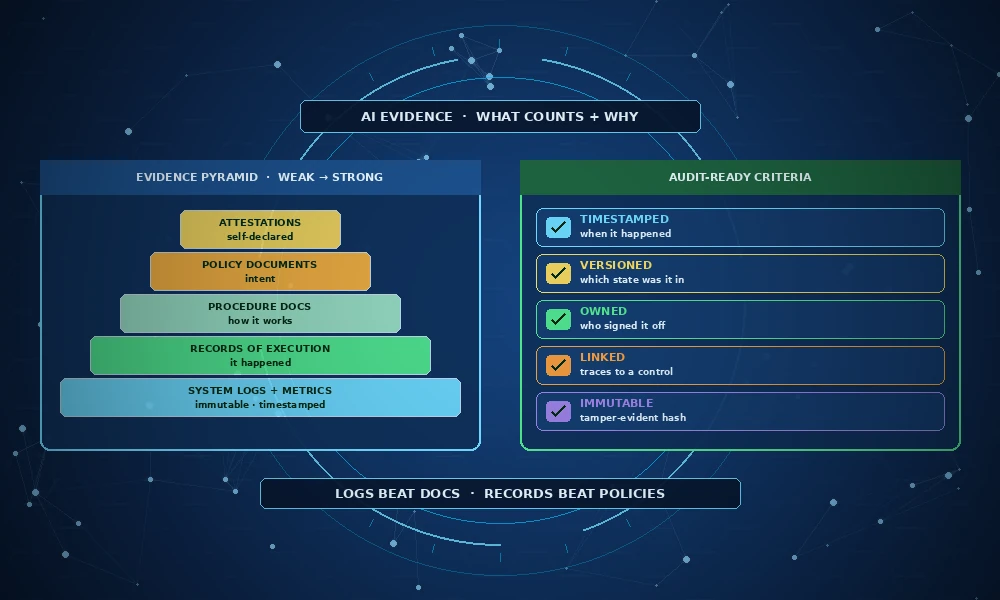
Audit evidence is where governance programmes succeed or fail in practice. Not in policy documents. Not in risk registers. In the ability to produce, on demand, a complete and timestamped record of every governance decision, control implementation, and monitoring result for every AI system in scope.
The distinction between evidence that was generated continuously and evidence assembled in anticipation of an audit is visible to experienced examiners. The SEC’s Division of Examinations made this explicit in its 2025 AI governance examination guidance: institutions that produce records dated continuously across the examination period demonstrate operational governance; those that cannot are demonstrating paper governance.
Immutable, Timestamped Audit Trails
Every governance event risk assessment completion, control implementation, approval decision, incident report, monitoring alert, and re-assessment trigger must be logged with a timestamp, the identity of the actor (human or automated system), and a link to the supporting evidence artifact. These records cannot be edited or deleted after creation. The audit trail is the proof of programme integrity.
Evidence Artifact Management with Version Control
Technical documentation, risk assessment reports, data governance records, training data summaries, and testing results must be stored in a structured repository with full version history. When an auditor asks ‘what did the risk assessment say at deployment, and what changed it six months later?’ the dashboard must be able to answer that question with linked, dated artifacts, not a reconstructed narrative.
Control Evidence Linking
Each control in the compliance framework must be linked to one or more evidence artifacts that demonstrate its implementation. The dashboard should surface gaps: controls that are mapped in the framework but have no attached evidence are an audit risk. ISO/IEC 42001’s conformity assessment process specifically requires that evidence of implementation be available for inspection not asserted, but demonstrated.
Automated Evidence Collection from Integrated Systems
Manual evidence collection is the single biggest scaling constraint in enterprise AI governance programmes. The dashboard should integrate with the systems that generate governance-relevant data model monitoring tools, data quality platforms, access management systems, incident management platforms and pull evidence automatically. A model performance log should become a timestamped evidence artifact without a human having to copy it.
Regulator-Ready Export Formats
When the EU AI Office, an external auditor, or a board audit committee requests evidence of compliance, the dashboard should be able to generate a structured export package: system documentation, risk assessment history, control evidence, approval records, and incident history for a specified AI system and time period. This is not a reporting feature. It is an accountability mechanism.
Approval Workflow Requirements: From Risk Assessment to Deployment Sign-Off
Approval workflows in AI governance are more complex than standard change management. An AI deployment decision involves risk assessments produced by data scientists, legal review of use case compliance, information security sign-off on data handling, and business ownership acceptance of residual risk. These steps may be sequential in some organisations and parallel in others. They may restart entirely when a model is re-trained with new data.
A governance dashboard must accommodate this complexity without creating bottlenecks that slow legitimate deployments. These are the requirements:
Configurable, Role-Based Approval Chains
The approval workflow for a high-risk AI system deploying in a regulated financial services context should look different from a minimal-risk internal productivity tool. The dashboard must allow governance teams to configure approval chains by risk tier, deployment context, and applicable regulatory requirements with different stakeholder groups assigned to different stages.
Conditional Approval Logic
Not every approval decision is binary. A system might be conditionally approved: approved for deployment provided a specific control is implemented within 30 days, or approved with mandatory re-assessment after 90 days of production operation. The dashboard needs to support conditional approvals with automated tracking of the attached conditions including automated alerts when conditions are approaching their deadlines and automatic escalation if they are not met.
Re-Approval Triggers on Material Changes
When a model is re-trained, when its deployment scope expands, or when a regulatory change materially affects its compliance requirements, the governance dashboard should automatically identify the affected approval and initiate a re-approval workflow. This is not optional under ISO/IEC 42001’s change management requirements (Clause 6.3) or under EU AI Act obligations for high-risk systems that undergo substantial modification.
Approval Audit Trail with Decision Rationale Capture
An approval record is not complete if it captures only ‘approved by [name] on [date].’ The dashboard must require approvers to record the decision rationale what evidence was reviewed, what residual risks were accepted, and what conditions were attached. This rationale becomes part of the immutable audit trail and, in the event of an incident, demonstrates that due diligence was exercised at the point of deployment.
Exception Management and Escalation
Governance programmes that have no mechanism for managing exceptions will be bypassed. When a business unit deploys an AI system outside the approved governance process, the dashboard needs to surface this as an exception ideally by integrating with IT asset management and procurement systems to detect unapproved AI use. Exceptions should trigger a retrospective governance review, not a blanket prohibition that incentivises concealment.
| 📋 PRODUCT NOTE: Govern365.ai‘s approval workflow engine supports configurable multi-stage approval chains with risk-tier-based routing, conditional approval tracking, and automatic re-approval triggers on material system changes with every decision logged to the immutable audit trail. |
Dashboard Views by Stakeholder: What Each Role Needs to See
A governance dashboard that serves the compliance analyst equally with the CISO and the board is not serving any of them well. Each stakeholder group has distinct information needs, and a well-designed AI governance platform surfaces the right data to the right audience without requiring custom reporting for every interaction.
GRC and Compliance Teams: Operational Depth
Their view should include every AI system in the inventory with its current compliance status, outstanding tasks, upcoming re-assessment deadlines, open non-conformities, and the evidence gaps that need to be closed before the next audit. The operational view is a work queue as much as it is a dashboard. Actions should be assignable, trackable, and linked directly to the evidence artifacts they produce.
AI Governance Professionals and Risk Owners: Contextual Analysis
This layer surfaces risk trends which systems are drifting toward higher risk scores, which control areas have the most open findings, which deployment approvals are overdue for re-assessment. It supports proactive governance decisions rather than reactive compliance fire-fighting. The risk heat map lives here, along with cross-framework gap analyses.
C-Suite and Board: Strategic Visibility
A CTO or CISO asking the board ‘can we defend our AI controls?’ needs to be able to pull a view that shows aggregate risk posture, regulatory coverage, pending regulatory changes that will affect the portfolio, and the overall health of the governance programme. According to a 2024 PwC Annual Corporate Directors Survey, 57% of directors report that the full board now has primary oversight of AI, with another 17% assigning it to the audit committee meaning board-ready AI governance reporting is no longer optional for enterprise risk functions.
The principle that applies across all three levels: the dashboard should reduce the time from ‘question asked’ to ‘evidence produced’ to minutes, not days.
Integration Architecture: What Your Governance Dashboard Needs to Connect To
A governance dashboard that exists in isolation from the systems that generate governance-relevant data will always be dependent on manual updates. Manual updates create latency, introduce error, and critically cannot produce the continuously-generated evidence that distinguishes operational governance from paper governance.
These are the integrations that enterprise AI governance dashboards must support:
- Model development and MLOps platforms Model training logs, evaluation metrics, data provenance records, and deployment manifests should flow from the MLOps environment directly into the governance dashboard at each lifecycle stage.
- Data quality and lineage tools ISO/IEC 42001 Clause 8.4 and EU AI Act Article 10 both impose requirements on training data quality and documentation. The dashboard must receive data quality assessments and lineage records from the platforms that perform these functions.
- Identity and access management systems Role-based access records are both a control evidence artifact and a security requirement. The dashboard should integrate with IAM systems to automatically record access control configurations and flag changes that affect governance-relevant permissions.
- Incident management platforms AI incidents must be documented in the governance record. Integration with existing ITSM or incident management platforms means incidents are automatically linked to the affected AI system’s governance record rather than tracked in a separate silo.
- Third-party and vendor AI risk management Vendor risk assessments, contractual governance obligations, and evidence of third-party compliance must be captured alongside internally developed systems. EU AI Act operators of high-risk AI systems have obligations regardless of whether the system was built internally or procured externally.
The integration architecture reflects a broader principle: the governance dashboard is not where evidence is created. It is where evidence from across the AI lifecycle is consolidated, structured, and made available for accountability purposes.
Compliance Reporting: ISO 42001, EU AI Act, and NIST AI RMF in One View
Governance programmes that serve a single regulatory framework are increasingly rare. An enterprise deploying AI across global operations in 2026 is simultaneously navigating ISO/IEC 42001 certification requirements, EU AI Act obligations for systems with European market exposure, and NIST AI RMF alignment as a de facto standard in US federal and regulated industry contexts. The governance dashboard must produce compliance evidence for all three without requiring the compliance team to maintain parallel records.
The framework alignment challenge is a data architecture problem. Each framework organises requirements differently ISO 42001 uses a Plan-Do-Check-Act management system structure, the EU AI Act applies a risk-tiered regulatory approach, and NIST AI RMF uses a four-function structure (Govern, Map, Measure, Manage). But the underlying governance activities risk assessment, control implementation, monitoring, documentation overlap substantially across all three. A unified governance record, mapped to all applicable frameworks, allows a single evidence artifact to satisfy requirements across multiple regimes.
ISO/IEC 42001 Certification Evidence
The certification body will ask for evidence of the full Plan-Do-Check-Act cycle: risk assessment and opportunity identification (Clause 6.1), documented AIMS objectives (Clause 6.2), operational controls (Clause 8), performance evaluation including internal audit (Clause 9), and management review records (Clause 9.3). Having this evidence in a structured, exportable dashboard view versus assembling it from scattered document repositories is the difference between a smooth audit and a stressful one.
EU AI Act High-Risk System Compliance
High-risk system operators require technical documentation per Article 11, quality management system records per Article 17, and human oversight documentation per Article 14. The dashboard must map each of these requirements to specific evidence artifacts and surface gaps before they become findings. For general-purpose AI model providers, Article 53 transparency obligations require a distinct set of documentation that the dashboard should track separately.
NIST AI RMF Alignment
The NIST AI RMF is not a certification standard, but it functions as a compliance framework in US federal procurement and is referenced in an increasing number of sector-specific regulatory guidance documents. The dashboard should map governance activities to the four core functions and their categories. Govern 1.1 (AI risk management policies) and Govern 1.2 (accountability structures) are foundational evidence of these creates the organisational context within which all subsequent risk management activities are assessed.
Evaluating Dashboard Readiness: A Requirements Checklist
Before evaluating vendors or scoping a governance dashboard implementation, the compliance team needs a clear picture of what ‘ready’ looks like. These are the capability areas that matter, organised by the governance function they serve.
| Capability Area | Requirement | Priority |
|---|---|---|
| AI Inventory | Complete catalogue of all AI systems including third-party and embedded AI, with risk tier, applicable frameworks, deployment status, and ownership | Critical |
| Risk Classification | Automated classification at intake against EU AI Act tiers, ISO 42001 Clause 6.1, and NIST AI RMF categories | Critical |
| Continuous Risk Scoring | Dynamic risk score updates triggered by operational data inputs; threshold-based re-assessment workflow triggers | Critical |
| Immutable Audit Trail | Timestamped, actor-attributed, non-editable records of all governance events linked to evidence artifacts | Critical |
| Evidence Artifact Management | Version-controlled document repository with control-to-evidence linking and gap surfacing | Critical |
| Approval Workflows | Configurable multi-stage chains by risk tier; conditional approval tracking; re-approval triggers on material changes | Critical |
| Decision Rationale Capture | Mandatory rationale fields on approval decisions, linked to immutable audit record | High |
| Cross-Framework Reporting | Framework-specific compliance summaries for ISO 42001, EU AI Act, NIST AI RMF from single governance record | High |
| Board-Ready Views | Aggregate portfolio risk views exportable without manual reformatting | High |
| MLOps Integration | API-level integration with model development platforms for automated evidence ingestion | High |
| IAM Integration | Automated access control record capture and change alerting | High |
| Incident Management Integration | Automatic incident linking to AI system governance records | High |
| Vendor AI Risk | Third-party AI system tracking with contractual obligation management | Medium |
| Regulator Export Packages | Structured evidence packages for specified systems and time periods, producible within minutes | High |
| Regulatory Change Modelling | Impact assessment of new or amended requirements against current AI inventory | Medium |
Frequently Asked Questions
What is the difference between an AI governance dashboard and a GRC platform?
A GRC platform manages static controls and point-in-time assessments across general risk and compliance domains. An AI governance dashboard is purpose-built for the dynamic nature of AI systems: it ingests continuous operational data (model performance, drift indicators, incident signals), maps systems to AI-specific frameworks (ISO/IEC 42001, EU AI Act, NIST AI RMF), and generates audit evidence automatically rather than through manual documentation. The architectural difference is fundamental not a feature gap.
What evidence does an AI governance dashboard need to generate for ISO 42001 certification?
ISO/IEC 42001 certification requires documented evidence of every Plan-Do-Check-Act cycle stage: risk assessments and opportunity identification (Clause 6.1), documented AIMS objectives (Clause 6.2), operational controls for AI system management (Clause 8), internal audit results and performance evaluation (Clause 9), and management review records (Clause 9.3). The certification body will verify that this evidence was generated during operations not assembled before the audit.
How should AI governance approval workflows handle model re-training events?
Model re-training events should automatically trigger a governance review in the dashboard, linking the new training run to the affected AI system’s record and assessing whether the changes constitute a substantial modification under applicable frameworks. Under ISO/IEC 42001 Clause 6.3 and EU AI Act obligations for high-risk systems, material changes require re-assessment and re-approval before the updated model is redeployed. The dashboard should automate this trigger not rely on a human to remember to initiate it.
Can one governance dashboard satisfy both EU AI Act and NIST AI RMF requirements?
Yes, if the dashboard uses a unified data model that maps governance activities to multiple frameworks simultaneously. The EU AI Act and NIST AI RMF share substantial conceptual overlap both require risk assessment, human oversight documentation, monitoring, and incident management. A governance platform that maps a single evidence artifact to multiple framework requirements avoids duplicate record-keeping and reduces the compliance burden without reducing compliance quality.
What should a board-level AI governance dashboard view include?
A board-ready governance view should show aggregate AI risk posture across the portfolio (by risk tier and business unit), overall framework compliance status, the number of AI systems pending re-assessment or with open non-conformities, and any regulatory changes that will affect the portfolio within the next 12 months. This view should be exportable without manual reformatting. Boards are increasingly treating AI governance as a fiduciary matter the 2024 PwC Corporate Directors Survey found 57% of boards have assumed primary AI oversight responsibility.
How does an AI governance dashboard handle third-party and vendor AI risk?
Third-party AI risk vendor-provided models, embedded AI features, procured AI services should be captured in the same inventory and governance record as internally developed systems. The dashboard should track vendor risk assessments, contractual governance obligations, and evidence of third-party compliance. EU AI Act operators of high-risk AI systems have obligations regardless of whether the system was built internally or procured externally, so the governance record must reflect both.
What does ‘continuously generated evidence’ mean in AI governance context?
Continuously generated evidence means governance records created as a byproduct of normal operational activity model monitoring logs timestamped during production operation, approval decisions recorded at the moment they are made, risk score changes triggered automatically by performance data rather than assembled retrospectively before an audit. Regulators, including the SEC in its 2025 AI governance examination guidance, treat the two categories differently. Evidence of when it was created tells the story of whether governance is real or performative.
The Accountability Infrastructure Beneath Every AI Programme
What makes an AI governance dashboard functional rather than decorative is not the number of its features it is whether those features are architecturally integrated with the systems that generate governance-relevant data, structured to produce evidence automatically, and designed to surface accountability at every level of the organisation. Risk management, audit evidence, and approval workflows are not three separate capabilities. They are three dimensions of a single governance record, and they need to work together.
The organisations that will navigate the EU AI Act, ISO/IEC 42001 certification, and the expanding US regulatory landscape with the least friction are those that built operational governance infrastructure before enforcement arrived.
Start with the requirements framework in this article then see how Govern365.ai, by the Global AI Certification Council, maps to each one. Start your 14-day free trial and build your AI governance dashboard on a platform designed by the people who wrote the standard.