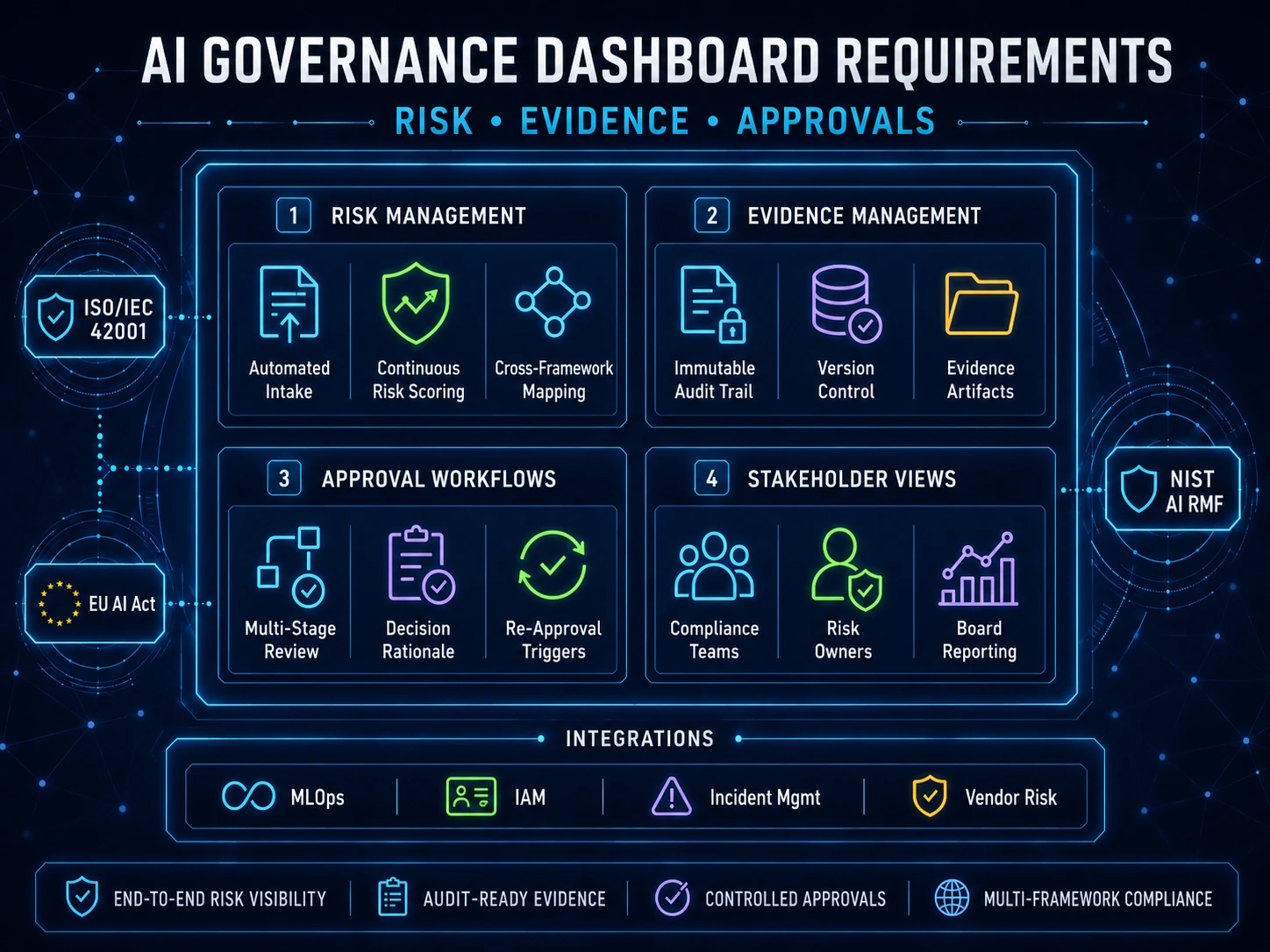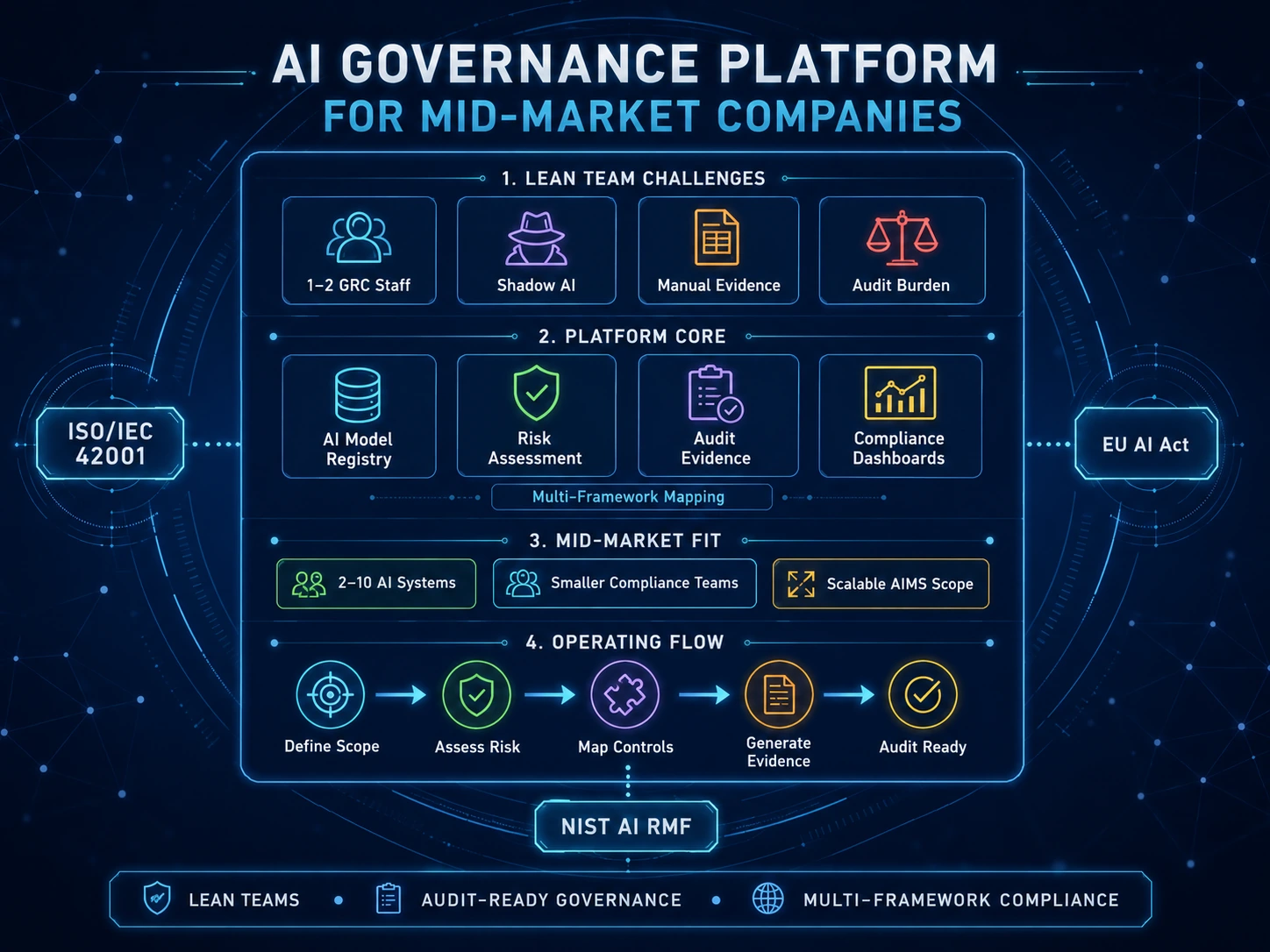
Forty-four percent of U.S. companies told McKinsey they hit at least one negative consequence from generative AI in 2024 — inaccuracy, IP exposure, or compliance failures yet fewer than one in five have a formal governance structure in place to prevent the next one. The gap between AI adoption and AI oversight is now the single largest source of enterprise risk in the technology stack. An AI governance framework closes that gap by giving leadership, engineering, legal, and risk teams a shared operating model for how AI gets built, deployed, and monitored. This article shows you how to structure one inside your organization, step by step, using the controls that align with ISO/IEC 42001 and the NIST AI Risk Management Framework.
What an AI Governance Framework Actually Is (and What It Isn’t)
An AI governance framework is the set of policies, roles, processes, and technical controls that determine how an organization decides whether to build an AI system, how that system gets developed and deployed, who is accountable when something goes wrong, and how outcomes are monitored over time. It is not a policy document. A 14-page PDF titled “Responsible AI Principles” sitting on a shared drive is not governance, it’s a wish.
The distinction matters because regulators, auditors, and increasingly customers are asking for evidence of operating controls, not statements of intent. The EU AI Act requires high-risk system providers to demonstrate a quality management system. ISO/IEC 42001 the first international AI management system standard, published in December 2023 requires documented processes for risk assessment, impact analysis, and continual improvement. Both want to see the framework working, not just written down.
A working framework has four characteristics:
- It assigns named accountability for every AI system in production, not vague “the team” ownership.
- It triggers different review depth based on the risk tier of the system, so a marketing chatbot doesn’t get the same scrutiny as a credit decisioning model.
- It produces audit-ready artifacts as a byproduct of normal work, not as a separate compliance exercise.
- It connects to existing enterprise risk, security, and privacy programs rather than running parallel to them.
The goal is not perfection. The goal is defensibility, the ability to show, on any given Tuesday, that a reasonable process governed how a specific AI system reached its current state.
The Five Layers Every AI Governance Framework Needs
Most organizations that try to build governance from scratch start with policies and stop there. The frameworks that actually function in U.S. enterprises and the ones ISO/IEC 42001 auditors expect to see have five distinct layers, each doing different work.
Layer 1: Strategic Direction and Board Oversight
The board or executive committee sets the organization’s risk appetite for AI: which use cases are off-limits, what level of automated decisioning is acceptable in customer-facing contexts, how much model error the business can tolerate in revenue-critical workflows. Without this layer, every downstream decision becomes a debate. NYC’s Local Law 144 and Colorado’s SB 205 both assume someone at the top has made these calls; if no one has, compliance becomes guesswork.
Layer 2: Governance Body and Roles
This is the operating committee that translates strategy into decisions. In most U.S. mid-market and enterprise organizations, it includes a Chief AI Officer or equivalent, the CISO, the General Counsel or Chief Privacy Officer, a senior engineering leader, and a business sponsor. ISO/IEC 42001 Clause 5 requires this leadership commitment to be documented and resourced. The committee meets monthly, owns the AI system inventory, and approves new high-risk deployments.
Layer 3: Policies, Standards, and Risk Tiering
Policies state intent (“we will not deploy AI that makes consequential decisions about employment without human review”). Standards are the testable rules (“all hiring AI tools must produce a bias audit per NYC LL 144 within 12 months of deployment”). Risk tiering classifies every AI system into categories typically minimal, limited, high, and prohibited, mirroring the EU AI Act structure even for U.S.-only operations because it’s the cleanest model available.
Layer 4: Operational Controls and Lifecycle Process
This is where governance meets engineering. Every AI system moves through a defined lifecycle: intake and use-case approval, data sourcing and validation, model development, pre-deployment impact assessment, production release, ongoing monitoring, and retirement. Each stage has gating controls. Each gate produces an artifact a data sheet, a model card, an impact assessment, a monitoring dashboard. ISO/IEC 42001 Annex A lists 38 controls organized this way.
Layer 5: Assurance, Audit, and Continual Improvement
Internal audit tests whether the controls actually work. Metrics get reported up to the governance body. Incidents trigger root-cause analysis and policy updates. This layer is what turns a framework from static to adaptive and it’s what external auditors look for first when assessing ISO/IEC 42001 readiness.
Choosing Your Foundation: ISO/IEC 42001 vs. NIST AI RMF vs. Custom
U.S. organizations building an AI governance framework typically choose one of three foundations. The choice shapes everything downstream terminology, control structure, audit posture, and how the framework maps to future regulation.
| Dimension | ISO/IEC 42001 | NIST AI RMF | Custom Framework |
|---|---|---|---|
| Type | Certifiable management system standard | Voluntary risk management guidance | Internal policy structure |
| Best for | Companies needing third-party certification or selling into regulated buyers | Federal contractors and risk-led organizations | Early-stage or low-risk AI portfolios |
| Audit posture | External certification by accredited body | Self-assessment, no certification path | Internal only |
| Time to baseline | 9–14 months | 3–6 months | 1–3 months |
| Maps to EU AI Act | Strong (designed to) | Partial | Depends on author |
The pragmatic answer for most U.S. organizations with active AI deployments and any kind of regulated customer base: build the operational controls to ISO/IEC 42001, use the NIST AI RMF Playbook for the day-to-day risk language, and let the two reinforce each other. The ISO standard gives you the management system spine; NIST gives you a vocabulary your engineers and risk teams already half-recognize.
Roles and Responsibilities: Who Owns What
Unclear ownership is the most common reason AI governance frameworks fail in their first 18 months. Either nobody knows who approves a new model, or three people think they do and quietly disagree. The fix is a roles matrix that names individual functions not committees against each major decision.
| Role | Primary Accountability | Key Artifacts Owned |
|---|---|---|
| Chief AI Officer / Head of AI Governance | Framework design, board reporting, regulatory readiness | AI policy, system inventory, annual governance report |
| AI Governance Committee | Approving high-risk use cases, reviewing incidents | Meeting minutes, approval log, risk register |
| Model Owner (business) | Use-case justification, business outcomes, decommissioning | Use-case brief, ROI tracking, sunset plan |
| ML/Data Engineering Lead | Model development, data lineage, technical controls | Model card, data sheet, evaluation results |
| Privacy & Legal | Regulatory mapping, contractual review, DPIA equivalents | Legal opinion memo, vendor contract terms |
| Information Security | Threat modeling, prompt injection defenses, access controls | Security review, penetration test report |
| Internal Audit | Independent testing of control effectiveness | Audit findings, management response |
Notice what’s missing from this table: a single “AI Ethics Lead” who owns everything. That model fails because ethics isn’t a department it’s a property that emerges from competent engineering, honest legal review, and informed business decisions working together. Concentrating it in one role makes the rest of the organization treat governance as someone else’s problem.
The AI Lifecycle: Where Controls Actually Live
Policies don’t catch problems. Gates do. An effective AI governance framework places mandatory checkpoints at each stage of the AI system lifecycle, and each checkpoint has a defined owner, a defined artifact, and a defined exit criterion. Here’s the lifecycle most U.S. enterprises converge on after their first year of operation:
- Intake. A business sponsor submits a use-case brief describing the problem, the proposed AI approach, the data needed, and the affected stakeholders. The governance committee assigns a risk tier within five business days.
- Risk and impact assessment. For limited and high-risk tiers, the model owner completes an AI impact assessment covering fairness, explainability, safety, and legal exposure. ISO/IEC 42001 Clause 6.1.4 makes this mandatory; the NIST AI RMF Map function aligns directly.
- Data sourcing and validation. Engineering documents data provenance, consent basis, representativeness, and known quality issues in a data sheet. This is where most fairness problems originate and where they’re cheapest to fix.
- Model development and evaluation. Standard ML practice, but with mandatory bias testing, performance disaggregation across demographic groups where relevant, and adversarial robustness checks for high-risk systems.
- Pre-deployment review. The governance committee reviews the model card, evaluation results, and impact assessment before production release. High-risk systems require sign-off from the General Counsel and CISO.
- Production monitoring. Drift detection, accuracy tracking, incident logging, and a feedback channel for affected users. High-risk systems get monthly review; lower tiers get quarterly.
- Retirement. Every model has a planned sunset condition performance threshold, regulatory change, or replacement. Models without sunset plans become technical debt that nobody dares touch.
The artifact discipline matters more than the stage names. If a regulator asks tomorrow how a specific production model was approved, you should be able to produce a use-case brief, an impact assessment, a model card, an approval record, and the most recent monitoring report within an hour, not a week.
Mapping Your Framework to U.S. Regulatory Reality
The United States doesn’t have a single federal AI law, and the Trump administration’s January 2025 executive order rolled back several of the prior administration’s reporting requirements. That hasn’t simplified the picture — it’s fragmented it further. State and sector-specific rules now drive most compliance work, and an AI governance framework needs to map cleanly to all of them.
The current regulatory pressure points for U.S. organizations:
- Colorado AI Act (SB 205). Effective February 2026, this is the first comprehensive U.S. state AI law. It requires developers and deployers of high-risk AI systems to use reasonable care to protect consumers from algorithmic discrimination, conduct impact assessments, and disclose AI use to affected individuals.
- New York City Local Law 144. Requires bias audits and candidate notification for automated employment decision tools. In effect since 2023; enforcement has accelerated.
- Illinois HB 3773. Amends the Illinois Human Rights Act to prohibit discriminatory use of AI in employment decisions, effective January 2026.
- Sector regulators. The EEOC, CFPB, FTC, and SEC have all issued guidance signaling that existing anti-discrimination, consumer protection, and securities rules apply fully to AI-driven decisions.
- State privacy laws. California’s CPRA, Virginia’s VCDPA, and twelve other state privacy laws now include automated decisionmaking provisions that overlap heavily with AI governance scope.
A framework built on ISO/IEC 42001 covers the substantive requirements of all of these because the underlying controls — risk assessment, impact analysis, documentation, human oversight, monitoring — are the same. The overlay work is mapping your existing artifacts to each statute’s specific evidence requirements. Build the framework once; produce regulator-specific reports from the same control library.
A 90-Day Plan to Stand Up Governance From Zero
Most U.S. organizations don’t have 14 months to build a perfect ISO-aligned framework before the next audit, customer security questionnaire, or regulator inquiry. The 90-day plan below gets you to a defensible baseline — not certified, but not embarrassing either.
Days 1–30: Inventory and Triage
- Run a discovery exercise to find every AI system in production and pilot. Include vendor tools, embedded ML in SaaS products, and internal scripts that use OpenAI or Anthropic APIs. Most organizations find 3–5x more than leadership expected.
- Risk-tier each system using a four-level scale. Document the highest-risk five systems in detail.
- Identify the three to five named individuals who will form the initial governance committee. Get an executive sponsor on record.
Days 31–60: Policies and Roles
- Publish a one-page AI use policy covering acceptable use, prohibited use cases, and the intake process for new AI systems. Keep it short enough that people will actually read it.
- Define the roles matrix. Assign owners to the highest-risk systems found during inventory.
- Stand up the intake process. Even a shared inbox and a Notion form is enough for month two.
Days 61–90: Controls and Cadence
- Complete impact assessments for the top five high-risk systems. These become your templates.
- Run the first governance committee meeting with a real agenda: inventory review, two new use-case approvals, one incident retrospective.
- Pick one ISO/IEC 42001 Annex A control area — typically data quality or human oversight — and implement it end-to-end. Concrete depth in one area beats shallow coverage of all 38.
After 90 days, you have a working framework, not a complete one. The next six months are spent broadening control coverage, training the wider organization, and tightening evidence collection. By month nine, ISO/IEC 42001 certification becomes a realistic conversation.
Teams that hit the 90-day target skip the spreadsheet phase on day one. A purpose-built platform gets them audit-ready in days, not quarters, with 37+ pre-built policy templates and controls pre-mapped to every major framework.
Five Mistakes That Quietly Kill AI Governance Programs
After watching dozens of U.S. organizations roll out governance frameworks, the failure modes repeat. Avoiding them is cheaper than recovering from them.
Confusing principles with controls.
Drafting a beautiful set of responsible AI principles and then doing nothing operational. Principles answer “what do we believe?” Controls answer “what do we do every Tuesday?” Auditors and regulators only care about the second question.
Building a parallel bureaucracy.
Creating an AI governance process that doesn’t connect to existing change management, security review, or privacy impact assessment workflows. Engineers route around it within three months. Bolt onto what exists; don’t build a new tower.
Over-engineering the risk tier model.
Designing a 12-criterion risk scoring rubric that takes two hours to complete per system. Four tiers with clear examples is enough. Precision is the enemy of adoption.
Ignoring vendor and embedded AI.
Governing only the models your team builds while ignoring the AI features in your CRM, HR platform, and developer tools. That’s where the regulatory exposure usually lives, and it’s where the EU AI Act and Colorado SB 205 explicitly assign deployer obligations.
No incident process.
Having no defined response when a model misbehaves, hallucinates in front of a customer, or starts producing biased outputs. Borrow the security incident response playbook, adapt it for AI failure modes, and run a tabletop exercise before you need it for real.
Frequently Asked Questions
1. How long does it take to implement an AI governance framework?
A defensible baseline takes about 90 days. ISO/IEC 42001 certification readiness typically takes 9–14 months for a mid-sized U.S. organization, depending on existing ISO 27001 maturity and the size of the AI portfolio. Companies with strong information security management systems already in place move faster because the management system spine leadership commitment, internal audit, document control carries over directly.
2. Do small companies need an AI governance framework?
Yes, but proportionally. A 50-person company doesn’t need a governance committee it needs a named owner, a use-case intake form, and a risk tier classification on every AI system. The Colorado AI Act applies regardless of company size when the use case is high-risk, and customer security reviews increasingly ask startups for AI governance evidence. Light structure beats no structure.
3. What’s the difference between AI governance and AI ethics?
AI ethics is the set of values an organization holds about how AI should be used. AI governance is the operational system that turns those values into repeatable decisions and verifiable artifacts. Ethics tells you what fairness means; governance is the bias audit, the impact assessment, and the approval gate that produces a fairness outcome you can defend to a regulator or a customer.
4. Should we use ISO/IEC 42001 or NIST AI RMF?
Use both. ISO/IEC 42001 gives you the certifiable management system structure that customers and auditors recognize. The NIST AI Risk Management Framework gives you the practical risk vocabulary your engineering and security teams already understand. They complement each other ISO is the architecture, NIST is the working language. Building to both costs almost no incremental effort once the controls are in place.
5. Who should lead AI governance — Legal, IT, or a new function?
In organizations with material AI exposure, a dedicated Chief AI Officer or Head of AI Governance reporting to the CEO or COO is the cleanest model. In smaller organizations, the function typically sits with the CISO, the Chief Privacy Officer, or the Chief Risk Officer. What matters is that the leader has authority across engineering, legal, and business units not which department they came from.
6. How much does AI governance cost to implement?
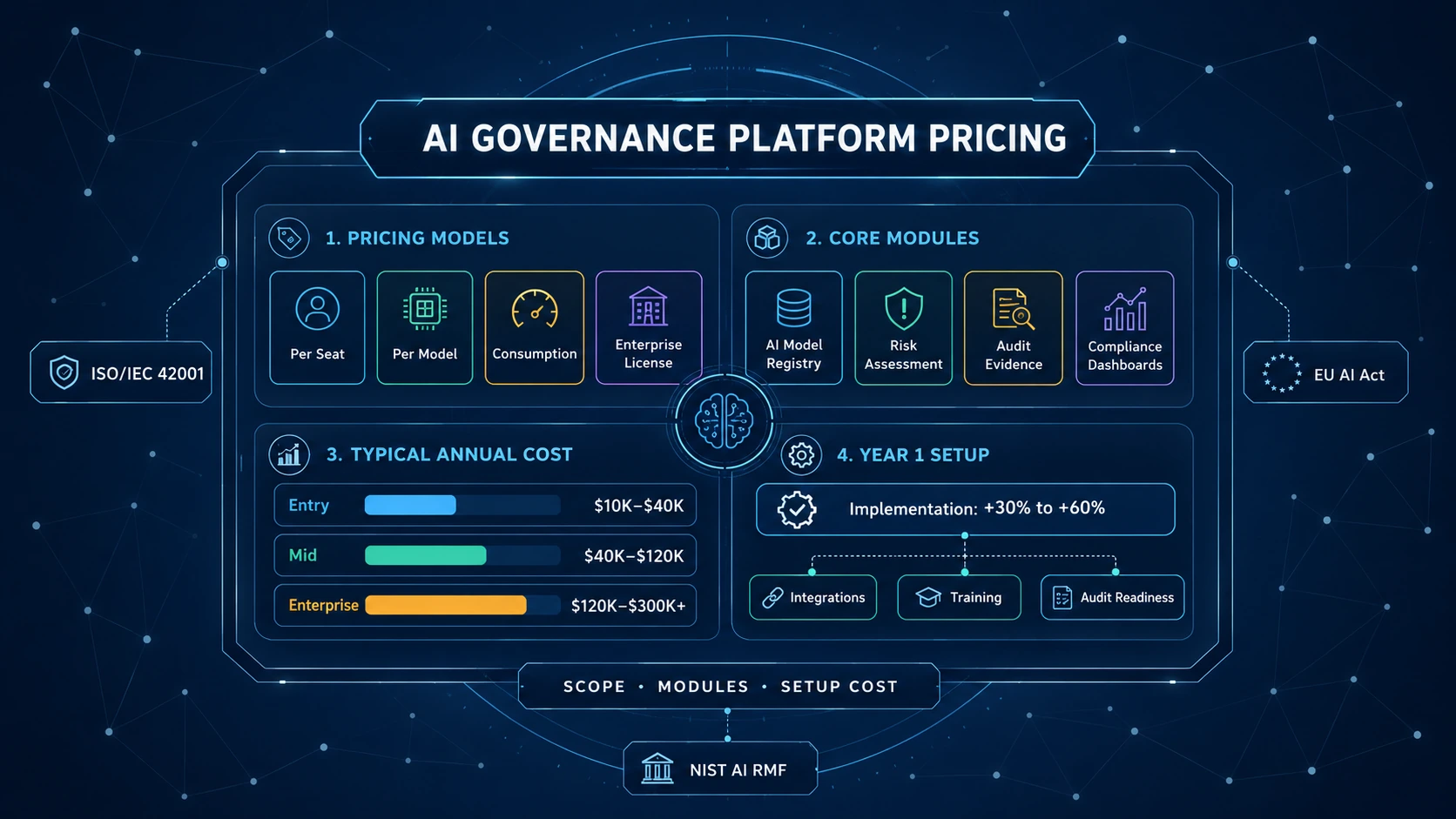
For a U.S. mid-market company, expect $150,000 to $400,000 in the first year covering staff time, training, tooling, and external advisory. ISO/IEC 42001 certification audit fees add roughly $25,000 to $60,000 depending on scope and certifying body. The return shows up in faster sales cycles with regulated buyers, lower incident remediation costs, and reduced regulatory exposure all of which show up in finance reporting within 18 months when measured.
The Bottom Line
AI governance is no longer a nice-to-have or a brand exercise. It’s the operating layer that determines whether your organization can deploy AI at speed without absorbing disproportionate legal, reputational, and operational risk. The frameworks that work share a common shape: clear executive ownership, named roles, risk-tiered processes, lifecycle controls that produce evidence as a byproduct, and assurance that tests whether any of it actually functions. Start with the inventory. Build the committee. Pick one control and do it well. The rest follows.
Governance doesn’t have to be a six-month implementation. Govern365 is built to take you from zero to audit-ready in days, not quarters.