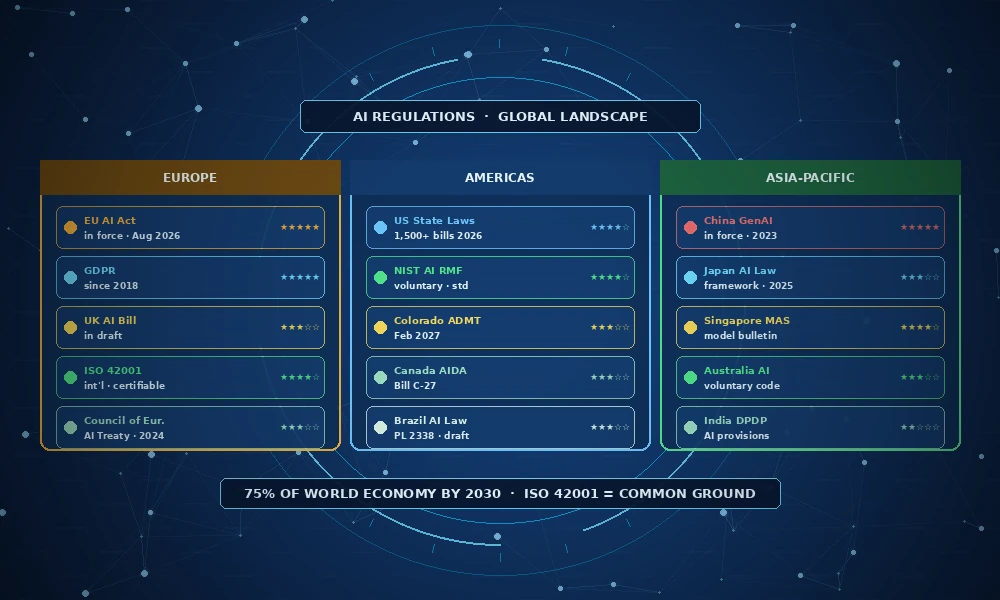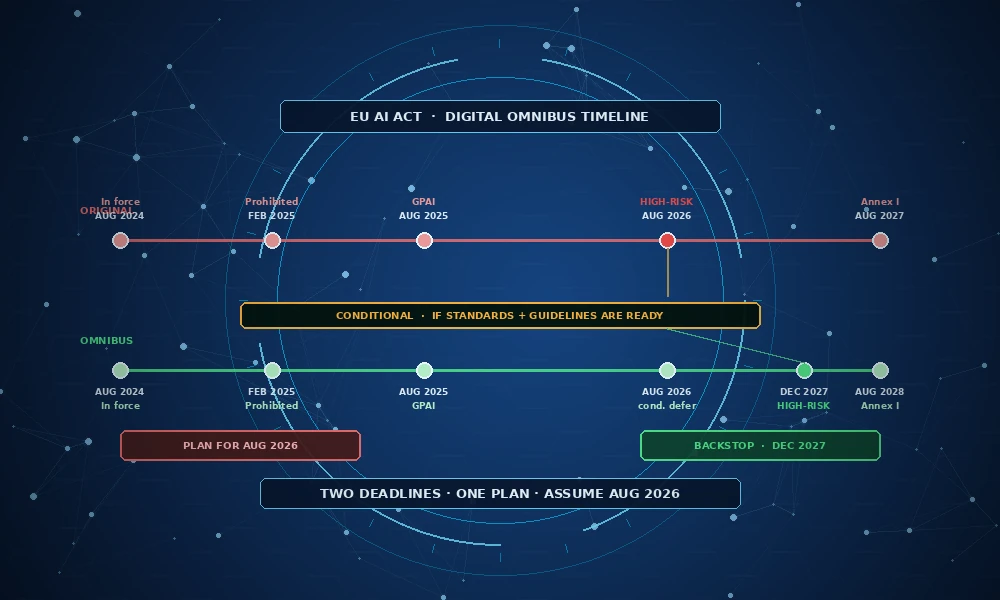
Enterprises without a structured AI governance programme are 2.5x more likely to face regulatory action under the EU AI Act, according to projections from the European Commission’s AI Office. With ISO 42001 now published and the EU AI Act’s high-risk system requirements in force, that window is closing fast.
An AI governance platform is what closes the gap between policy documents and operational compliance. This article explains exactly what a complete platform covers across five interconnected pillars: model inventory, risk assessment, approval workflows, audit evidence management, and compliance reporting and how those pillars map to ISO 42001, the EU AI Act, and the NIST AI RMF.
What an AI Governance Platform Actually Does
Most enterprises reach for AI governance platforms after one of two triggers: a board mandate driven by regulatory news, or the realisation that their existing GRC tools weren’t built for AI-specific risks. Both are valid. Neither requires starting from scratch but both require understanding what “AI governance” means as an operational capability, not just a policy aspiration.
An AI governance platform is purpose-built software that manages the full lifecycle of AI systems across an organisation. The distinction from generic GRC tools matters more than it might seem. Enterprise risk platforms built for financial controls or IT security assume that the assets you’re managing are relatively static, well-understood, and bounded. AI systems aren’t. They change behaviour as data shifts, produce outputs that affect real people in real time, and carry regulatory obligations that standard risk frameworks weren’t designed to capture.
The ISO/IEC 42001:2023 standard introduced the AI Management System (AIMS) construct precisely because AI governance requires a management system approach not just a risk register and a policy document. An AIMS defines how an organisation establishes, implements, maintains, and continually improves its governance of AI. An AI governance platform is the technology layer that makes an AIMS operational.
Why Generic GRC Tools Don’t Cover AI Governance
ServiceNow, Archer, and similar platforms can be configured to track AI systems as assets. Some organisations have done this, and it works until the moment a certification auditor asks for version-controlled risk assessments mapped to ISO 42001 Clause 6.1 controls, or a regulator asks for evidence that high-risk AI systems under EU AI Act Article 9 have documented human oversight measures. Generic GRC tools weren’t designed to answer those questions at least not without significant custom development.
The gap isn’t about features. It’s about the underlying data model. AI governance requires entities AI systems, risk classifications, lifecycle stages, approval decisions, evidence artefacts, framework obligations that relate to each other in ways that generic platforms don’t capture natively.
The Five Pillars and Why They’re Connected
This is where most descriptions of AI governance platforms go wrong. They list five capabilities as if they’re independent modules you can select from a menu. They aren’t. Each pillar feeds the next:
The AI model registry (inventory) is the foundation you cannot assess risk, route approvals, collect evidence, or report on systems you haven’t catalogued. The risk assessment process takes the registry as its input and scores each AI system against defined criteria, producing a risk classification that determines what happens next. That risk classification drives approval workflow requirements a low-risk system may require a single-stage sign-off; a high-risk system under the EU AI Act triggers a multi-stage review with documented human oversight. Every approval decision generates a dated, attributed record that flows into audit evidence management alongside risk assessments, policy acknowledgements, test results, and monitoring outputs. All of that feeds the compliance dashboard and reporting layer, which makes the governance posture visible to compliance teams, C-suite executives and when the time comes certification auditors and regulators.
Remove any pillar and the system breaks. Run them as disconnected point tools and you’re back to spreadsheet governance with extra steps.
Building Your AI Inventory: The Model Registry Foundation
The first thing every AI governance implementation runs into is the same problem: nobody knows how many AI systems the organisation is running.
This isn’t negligence. It’s the predictable result of AI adoption happening faster than oversight structures. Business units buy SaaS tools with embedded AI. Development teams deploy models in production environments without formal procurement processes. Existing software vendors quietly add AI features to platforms already in use. The result is what practitioners call “shadow AI” and according to a 2024 IBM Institute for Business Value report, more than 40% of AI deployments in large enterprises were not formally tracked by any central function. The model registry’s first job is to surface that shadow inventory.
What Belongs in an AI Model Registry
A governance-grade AI model registry is not a spreadsheet with system names. Each entry should capture, at minimum:
- System identification: Name, version, owning business unit, technical owner, business owner
- Use case documentation: What the system does, what decisions it influences or automates, which populations it affects
- Data inputs and lineage: What data the system uses, where that data comes from, any third-party data sources
- Risk classification: The system’s EU AI Act tier and ISO 42001 risk level
- Applicable frameworks: Which regulatory obligations apply EU AI Act, NIST AI RMF, ISO 42001 AIMS scope
- Lifecycle status: Development, testing, deployed, under review, deprecated
- Last review date and next scheduled review date
- Linked evidence: References to the risk assessment, approval records, and monitoring outputs for this system
ISO 42001 Clause 4.4 (understanding AI systems in context of the organisation’s activities) establishes the documentation baseline. EU AI Act Article 51 goes further, requiring registration of high-risk AI systems in the EU database maintained by the Commission a regulatory obligation the registry must support.
Shadow AI: The Inventory Problem Most Organisations Underestimate
One of the most consistent findings in AI governance implementation work is that initial inventory counts run 40-70% below the eventual verified total. Teams begin by cataloguing the AI systems they know about their internally developed models, their major vendor contracts. Then the cross-functional discovery exercise starts: department heads get a structured questionnaire, IT runs an integration audit, procurement reviews SaaS contracts for AI capability descriptions. Suddenly the list doubles.
This matters for two reasons. First, ungoverned AI systems are unclassified AI systems and under the EU AI Act, operating an unregistered high-risk AI system is not a defence to enforcement. Second, ISO 42001 certification scope must match operational reality. An AIMS that governs 20 systems when the organisation runs 60 isn’t a management system it’s a partial one.
AI Risk Assessment: From Classification to Residual Risk
Risk assessment in AI governance is more structured than most practitioners expect on first encounter and significantly more nuanced than it is in standard enterprise risk frameworks.
EU AI Act Risk Tiers and What Each Requires
The EU AI Act establishes a four-tier risk classification that determines which obligations apply to a given system:
| Risk Tier | EU AI Act Category | Example AI Use Cases | Key Obligations |
| Prohibited | Unacceptable risk | Social scoring by public authorities, real-time biometric surveillance in public spaces | Banned cannot be deployed |
| High Risk | Article 6 + Annex III | Recruitment screening, credit scoring, medical device AI, education assessment, law enforcement | Full conformity assessment, risk management system (Article 9), human oversight, registration, post-market monitoring |
| Limited Risk | Transparency obligations | Chatbots, AI-generated content, emotion recognition | Must disclose AI nature to users |
| Minimal Risk | Minimal obligations | Spam filters, AI-assisted manufacturing optimisation | No specific EU AI Act obligations |
Classification isn’t always straightforward. A hiring tool that recommends candidates sits firmly in the high-risk category. An internal knowledge management chatbot is limited risk. But a performance management system with algorithmic promotion recommendations? That requires a careful read of Annex III categories and the intended deployment context the kind of judgement that should be documented in the risk assessment, not resolved informally.
ISO 42001 Clause 6.1: What a Compliant Risk Assessment Includes
ISO 42001 Clause 6.1 requires the organisation to plan actions to address risks and opportunities associated with its context and objectives. For AI governance specifically, this means:
- Identifying which AI systems or intended uses create risks to individuals or groups
- Assessing the likelihood and severity of potential harm (including third-party harm)
- Determining what controls are needed to bring residual risk to an acceptable level
- Documenting the assessment process not just the output as audit evidence
The distinction between inherent risk and residual risk is critical here. Inherent risk is what exists before controls are applied. Residual risk is what remains after. Certification auditors want to see both: the inherent assessment establishing why controls were selected, and the residual assessment confirming controls were effective.
Risk assessments under ISO 42001 are also not one-time events. Clause 6.1 connects to Clause 10 (improvement), which requires that risk assessments be updated when significant changes occur a new data source, a change in deployment scope, a material update to the model itself. This is where the connection to approval workflows becomes operationally critical.
Approval Workflows: Governing the AI Lifecycle
The majority of AI governance incidents don’t happen at initial deployment. They happen at change: a model retrained on new data that shifts its behaviour, a feature extended to a new user population, an integration with a third-party system that wasn’t in the original risk assessment. Approval workflows are the governance mechanism that catches these changes before they become incidents.
The Seven AI Lifecycle Stages That Require Governance Gates
ISO 42001 Clause 8 (operation) establishes that operational processes must be planned, implemented, and controlled. In practice, this means defining where in the AI lifecycle a governance review is required:
- Concept approval – Before development begins: is this AI use case within the organisation’s AIMS scope? Does the intended use align with policy?
- Development sign-off – Before testing: has the model been documented? Have bias and fairness assessments been conducted?
- Pre-deployment review – Before production release: does the risk assessment approve this deployment? Are human oversight mechanisms in place?
- Change management – Before any material change to a deployed system: does the change trigger a re-classification or re-assessment?
- Third-party AI review – Before integrating a vendor AI system: has the vendor’s system been assessed under the organisation’s risk framework?
- Periodic operational review – At defined intervals: is the system performing as expected? Have any incidents occurred?
- Decommissioning sign-off – Before retirement: has data handling for the decommissioned system been addressed?
Not every stage requires the same level of scrutiny. A low-risk, minimal-obligation system may route through an expedited approval process. A high-risk AI system under the EU AI Act has specific requirements for human oversight and post-market monitoring that must be documented at each relevant stage.
What “Accountability” Actually Means in an Approval Workflow
Accountability in AI governance means that a named individual not a team, not a department has accepted responsibility for a decision about an AI system, at a specific point in time, based on specific evidence. An approval workflow enforces this by requiring:
- The reviewer’s identity
- The date and time of the approval
- The evidence reviewed (linked to the model registry entry and risk assessment)
- The decision made (approve, conditional approval, reject)
- Any conditions attached to the approval
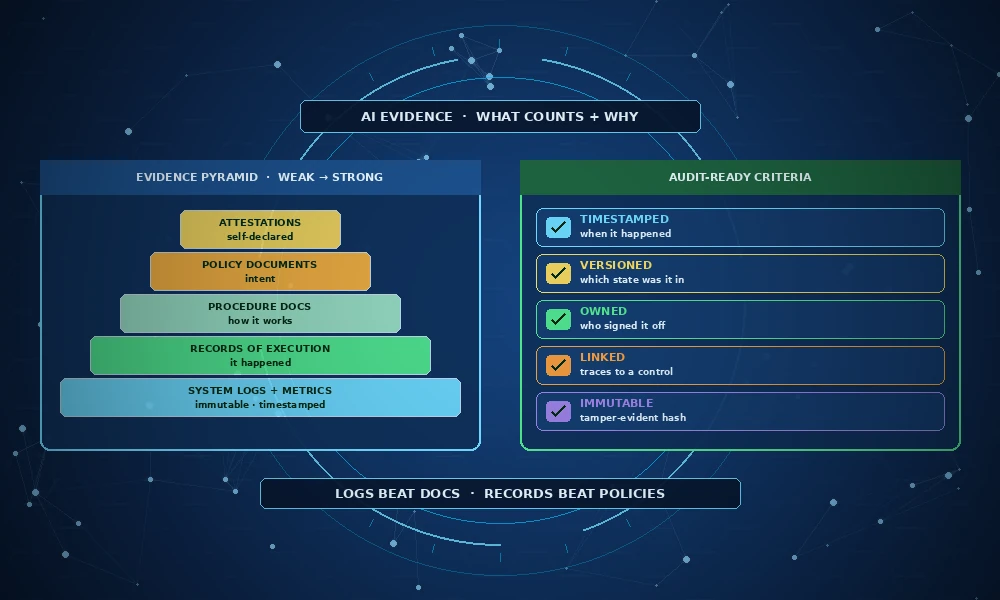
This creates the dated, attributed evidence trail that auditors need to confirm the governance process actually operated. “We have an approval process” is not audit evidence. “Here is the approved risk assessment for System X, approved by the Head of Compliance on [date], conditional on monthly bias monitoring, with the monitoring outputs linked” that is audit evidence.
Audit Evidence Management: From Documents to Certification
Most compliance teams treat audit preparation as an event: a certification audit is announced, someone sends a frantic email asking for documentation, and the next three weeks are spent hunting through shared drives, email threads, and project management tools for records that may or may not reflect the current state of the system. This is expensive, stressful, and unnecessarily risky.
Audit evidence management converts that event-driven scramble into a continuous process. The principle is simple: if the governance workflow generates evidence as it runs risk assessments, approval records, monitoring outputs, non-conformity findings, corrective actions then the evidence package is always current, and “audit readiness” is a permanent state, not a project.
What ISO 42001 Auditors Actually Look For (Clause by Clause)
ISO 42001 certification audits assess documented evidence against clause requirements. The table below maps key clauses to the evidence a platform generates:
| Clause 4.4 | AI system context documented | Model registry entries with use case, data, and scope documentation |
| Clause 6.1 | Risk assessment conducted and documented | Risk assessment records with inherent/residual risk, controls, and owner |
| Clause 6.2 | AI governance objectives established | Documented objectives with progress tracking |
| Clause 8.1 | Operational controls planned and implemented | Approval workflow records showing controls applied at each lifecycle stage |
| Clause 9.1 | Performance monitoring and measurement | Monitoring logs, KPI reports, dashboard exports |
| Clause 9.2 | Internal audit conducted | Internal audit records, findings, and responses |
| Clause 9.3 | Management review conducted | Management review records, attendance, decisions |
| Clause 10.1 | Non-conformities identified and addressed | Non-conformity records with corrective action status and closure evidence |
One distinction that trips up many first-time certification preparations: ISO auditors need evidence that processes operated, not just that processes exist. A risk assessment template is not evidence. A completed, dated, reviewed, and approved risk assessment for a specific named AI system is evidence. This is why a governance platform’s value compounds over time the longer it runs, the richer the evidence base it has built.
The Evidence Trail: How Platform Outputs Feed Certification
Every action taken in a well-structured AI governance platform generates a record. The model registry entry creates the foundation document. The risk assessment builds on it, referencing the registry entry and adding risk scores and control decisions. The approval workflow runs against the risk assessment, generating a dated decision record. Monitoring outputs accumulate against the approved deployment. If a non-conformity is found in an internal audit or a monitoring alert the corrective action is tracked to closure.
Govern365.ai‘s audit evidence manager presents this chain as a linked, searchable, version-controlled archive not a folder of PDFs with inconsistent naming conventions. The difference in audit preparation time is substantial: organisations using structured evidence management platforms report completing their evidence compilation in days rather than weeks.
Compliance Reporting: Dashboards the Board Can Read
The people making strategic decisions about an organisation’s AI portfolio the CTO, CISO, CDO, CLO, and increasingly the Chief AI Officer rarely need to know which ISO clause applies to a specific model’s risk assessment. They need to know three things: how exposed the organisation is, what’s being done about it, and whether it’s working.
What a Board-Ready AI Governance Dashboard Includes
A well-structured AI governance reporting layer presents different views of the same underlying data:
Board/C-suite view focuses on strategic exposure and programme health:
- AI risk posture by business unit (how many high-risk, medium-risk, low-risk systems)
- Certification and compliance status (ISO 42001 certification stage, EU AI Act registration completeness)
- Open non-conformities and time-to-resolution trends
- Approval workflow status (how many systems pending review, how many overdue)
Compliance team operational view supports day-to-day programme management:
- System-by-system risk and control status
- Evidence collection completeness by framework requirement
- Internal audit schedule and findings
- Upcoming review dates and reminder queues
Regulatory/auditor view supports inspection readiness:
- Exportable evidence packages by system or by framework
- Audit trail of all governance decisions with timestamps and attribution
- Non-conformity history with corrective action closure status
Regulatory Reporting Requirements: EU AI Act and Beyond
The EU AI Act introduces specific reporting obligations for providers and deployers of high-risk AI systems that go beyond internal dashboards. Article 72 requires post-market monitoring the continuous collection of data on system performance after deployment, with the obligation to report serious incidents and malfunctioning to national competent authorities. Article 17 requires a quality management system that produces documentation demonstrating compliance.
For US-facing organisations, the NIST AI RMF GOVERN function establishes that AI risk should be reported to organisational leadership and communicated to relevant stakeholders. A compliance dashboard built around the RMF’s four core functions (GOVERN, MAP, MEASURE, MANAGE) provides the governance visibility the framework expects.
What this means practically: reporting is not the end of the compliance process it’s the feedback loop that makes the process self-improving. Dashboards that surface emerging risks early enough to act on them are worth more than reports that confirm what happened three months ago.
Framework Alignment: ISO 42001, EU AI Act, and NIST AI RMF
Three frameworks now define the AI governance landscape for enterprises operating across the US, EU, and global markets. Understanding how they relate is the difference between building three separate compliance programmes and building one that satisfies all three simultaneously.
ISO 42001 and EU AI Act: More Aligned Than They Appear
ISO/IEC 42001:2023 is a management system standard it defines how an organisation should structure its AI governance, not the specific obligations for specific AI systems. The EU AI Act is regulatory law it defines what organisations must do for specific categories of AI system, particularly high-risk AI.
These two are complementary, not competing. ISO 42001 provides the management system architecture (documented processes, internal audit, management review, continual improvement) that makes EU AI Act compliance repeatable and auditable. A compliant ISO 42001 AIMS, applied to high-risk AI systems, covers the majority of what Article 9 (risk management system) and Article 17 (quality management system) require.
The overlap is substantial. ISO 42001 Clause 6.1 risk assessment requirements and EU AI Act Article 9 risk management requirements address the same operational need from different angles the standard from a management system perspective, the regulation from a legal obligation perspective. Organisations that implement a robust AIMS under ISO 42001 are simultaneously building the evidentiary infrastructure that EU AI Act compliance requires.
NIST AI RMF for US-Facing Enterprises
The NIST AI Risk Management Framework 1.0, published in January 2023, provides the primary risk vocabulary for US organisations and those subject to US regulatory expectations. Its four core functions map cleanly to AI governance platform capabilities:
| GOVERN | Policies, accountability structures, organisational risk tolerance for AI | Model registry (ownership), approval workflows (accountability), compliance dashboard (leadership reporting) |
| MAP | Identifying and classifying AI systems and their risks | AI inventory, risk assessment, risk classification |
| MEASURE | Assessing and monitoring AI risks over time | Risk scoring, control effectiveness monitoring, operational metrics |
| MANAGE | Responding to identified risks with controls and decisions | Approval workflows, corrective action tracking, evidence management |
For organisations subject to White House Executive Order 14110 requirements on AI safety, or sector-specific AI guidance from bodies like the OCC (banking) or FDA (medical devices), the NIST AI RMF provides the connective tissue between sector obligations and an enterprise-wide governance programme. ISO 42001 and the RMF are sufficiently aligned that implementing one creates substantial foundations for the other.
Getting Started: AI Governance Platform Implementation
The governance programmes that succeed do so because they start narrow and build. The ones that struggle tend to attempt a comprehensive governance framework across all AI systems simultaneously — and stall under the weight of their own scope.
The Four Implementation Phases
A structured AI governance platform implementation typically runs through four phases, each building on the last:
Phase 1: Discovery and Inventory (Weeks 1-6)
The objective is a defensible inventory of all AI systems in scope. This means cross-functional discovery not just IT-known systems, but business unit self-declaration, procurement review, and vendor contract audit. By the end of Phase 1, the model registry should contain every known AI system with at minimum: name, owner, business unit, use case description, and a preliminary risk classification.
Phase 2: Risk Assessment and Classification (Weeks 4-10)
Risk assessments run in priority order highest-risk systems (EU AI Act high-risk category, mission-critical systems, systems affecting large populations) assessed first. Each assessment documents inherent risk, control gaps, and required actions. The risk classification output determines Phase 3 approval requirements.
Phase 3: Workflow and Evidence Infrastructure (Weeks 8-16)
Configure approval workflows based on risk classification. Define the governance gates for each lifecycle stage. Begin evidence collection in the platform rather than in shared drives. This phase establishes the operational habit of evidence-as-you-go rather than evidence-at-audit-time.
Phase 4: Reporting and Certification Readiness (Weeks 14-20)
Build the compliance dashboard views for each stakeholder audience. Run the first internal audit cycle using the platform’s evidence base. Identify and close any non-conformities before the external audit. Confirm the evidence package is complete for certification scope.
| 1: Discovery | Cross-functional AI inventory exercise | Populated model registry | Weeks 1-6 |
| 2: Risk | Risk assessment for all in-scope systems | Risk classification and control plan | Weeks 4-10 |
| 3: Workflow | Approval workflow configuration, evidence collection begins | Operating governance workflow | Weeks 8-16 |
| 4: Reporting | Dashboard configuration, internal audit, gap closure | Certification-ready evidence package | Weeks 14-20 |
The Most Common Implementation Mistakes (and How to Avoid Them)
Starting with policy documents before completing the inventory is the most common mistake. Policy is important, but it governs systems and if you don’t know what systems you have, the policy has no operational purchase.
Treating governance as a project with an end date is the second. AI governance is a management system it operates continuously, improves with each audit cycle, and adapts as the AI landscape changes. The platform is the infrastructure that makes continuous operation sustainable.
The third mistake is scoping too broadly on the first iteration. An AIMS that attempts to govern every AI tool in the organisation from day one will collapse under its own complexity. Start with the highest-risk systems, build the workflow and evidence discipline there, then expand scope progressively.
Frequently Asked Questions
What is an AI governance platform?
An AI governance platform is purpose-built enterprise software that manages AI systems across an organisation’s full lifecycle. It provides five core capabilities: an AI model registry (system inventory), risk assessment, approval workflows, audit evidence management, and compliance reporting, all mapped to frameworks including ISO 42001, the EU AI Act, and the NIST AI RMF.
What is the difference between AI governance and AI risk management?
AI risk management is one component of AI governance. Risk management focuses on identifying, assessing, and mitigating risks from AI systems. AI governance is the broader management system that encompasses risk, but also accountability structures, policy frameworks, lifecycle controls, audit processes, and regulatory compliance. ISO 42001 defines the management system (governance); EU AI Act Article 9 defines specific risk management obligations for high-risk AI systems.
What should an AI model registry include?
A governance-grade model registry captures system identification, use case documentation, data inputs and lineage, risk classification (including EU AI Act tier), applicable framework obligations, lifecycle status, ownership, and links to associated risk assessments, approval records, and monitoring outputs. A list of AI tool names is a starting point; a model registry is a system of record with version history and evidence linkage.
How does an AI governance platform support ISO 42001 certification?
ISO 42001 requires documented evidence that governance processes operated — not just that they were designed. A governance platform generates that evidence as its normal output: completed risk assessments, dated approval decisions, internal audit records, monitoring reports, and non-conformity closure evidence. This converts certification preparation from a point-in-time scramble into a continuous process where the evidence package is always current.
What are the EU AI Act requirements for AI risk management systems?
EU AI Act Article 9 requires providers of high-risk AI systems to establish a risk management system covering: identification and analysis of reasonably foreseeable risks, estimation and evaluation of risks, adoption of appropriate risk management measures, and post-market monitoring of risk management effectiveness. This must be documented and maintained throughout the AI system’s lifecycle.
How is AI audit evidence different from regular compliance documentation?
Standard compliance documentation describes what a process is supposed to do. Audit evidence demonstrates that the process actually operated on a specific date, for a specific system, producing a specific output, reviewed by a named individual. An AI governance platform generates audit evidence as a byproduct of normal operation: every risk assessment completed, every approval decision made, every monitoring alert reviewed creates a dated, attributed record.
Who is responsible for AI governance within an organisation?
Accountability typically spans multiple roles: the Chief AI Officer or CIO owns the programme; the CISO or Chief Risk Officer owns the risk framework; the CLO owns the regulatory compliance obligations; business unit leaders own the AI systems deployed within their areas. The AI governance platform enforces accountability at the system level every model registry entry has a named technical owner and business owner, and every approval decision is attributed to a named reviewer.
How long does it take to implement an AI governance platform?
A structured four-phase implementation inventory, risk assessment, workflow and evidence configuration, reporting and certification readiness typically runs 16-20 weeks to a point of ISO 42001 certification readiness. The timeline depends primarily on the complexity of the AI portfolio and the state of existing documentation. Organisations with mature GRC functions and some prior AI documentation can move faster; those starting from a cold discovery will spend more time on Phase 1.
Can an AI governance platform work alongside existing GRC tools?
Yes, and this is standard in enterprise deployments. AI governance platforms handle AI-specific obligations (ISO 42001, EU AI Act, NIST AI RMF) that generic GRC tools aren’t designed for, while existing GRC infrastructure handles enterprise risk, IT controls, and other compliance domains. Integration points typically include SSO, ticketing system integration for approval workflow notifications, and API-level data exchange with enterprise risk platforms.
What is the NIST AI RMF and how does it relate to ISO 42001?
The NIST AI Risk Management Framework (AI RMF 1.0) is a voluntary US framework published in January 2023 comprising four functions: GOVERN, MAP, MEASURE, and MANAGE. ISO 42001 is an international management system standard for AI, published in December 2023. The two are complementary: the NIST AI RMF defines the risk management functions; ISO 42001 provides the management system architecture that makes those functions repeatable, auditable, and certifiable.
Conclusion
The organisations that will navigate the next phase of AI regulation without significant disruption are not the ones with the most detailed AI ethics policies. They’re the ones that built governance infrastructure systems that make policy operational, make risks visible, make accountability traceable, and make audit preparation continuous rather than reactive.
A complete AI governance platform covering inventory, risk, approvals, evidence, and reporting as a connected workflow is that infrastructure. Each pillar depends on the others. Start with the inventory; everything else follows from knowing what you have.
The practical next step is simpler than most teams assume: begin the AI discovery exercise. Pull together IT, procurement, and three business unit leads. Give them a structured questionnaire. You will have a working inventory within two to three weeks and a much clearer picture of where your highest-priority governance gaps are.
| Start your 14-day free trial and build your AI governance dashboard on a platform designed by the people who wrote the standard. |