According to a February 2026 Gartner press release, the global AI governance platform market is expected to reach $492 million in 2026 and surpass $1 billion by 2030 driven almost entirely by the regulatory pressure now bearing down on organisations deploying AI in consequential decisions. For mid-market companies, that pressure is not abstract. The EU AI Act’s high-risk obligations now carry the force of law for many use cases, US state-level frameworks are multiplying, and customer due diligence questionnaires increasingly include AI governance clauses. The challenge: most mid-market compliance teams were not built to absorb another discipline at scale. This post explains what a purpose-built AI governance platform actually does, why it changes the calculus for lean teams, and what to look for when evaluating one.
Why Mid-Market Companies Face a Disproportionate Governance Burden
Compliance programmes at large enterprises run on headcount. A team of twelve can absorb ISO 42001 implementation, EU AI Act mapping, NIST AI RMF documentation, and ongoing audit evidence management as a coordinated effort across dedicated roles. Mid-market companies deploying the same AI systems credit scoring tools, hiring algorithms, supply chain optimisation models face identical regulatory obligations with a fraction of that capacity.
The disparity becomes concrete at the audit stage. ISO 42001 certification follows a three-year cycle. Year one involves a multiphase audit covering your AI management system (AIMS) scope, risk assessment methodology, policy documentation, and evidence of operational controls. Surveillance audits follow in years two and three. For a two-person compliance team already managing ISO 27001, SOC 2, and GDPR obligations, adding AIMS documentation to an existing workload is not a prioritisation question it is a capacity question.
The EU AI Act adds a second dimension. Mid-size organisations operating high-risk AI systems face initial compliance investments in the range of $2 to $5 million, with annual ongoing costs of $500,000 to $2 million, according to independent analysis published by the Cloud Security Alliance in March 2026. That range assumes manual compliance processes. Structured AI governance tooling compresses those cost curves considerably not by eliminating the compliance work, but by making it executable without specialist headcount for every task.
There is also a strategic risk that does not show up in a compliance budget: shadow AI. In most mid-market organisations, AI adoption has outpaced governance. One team signs up for a procurement AI. Another embeds a generative AI writing tool. A developer connects an AI code assistant to a codebase that handles customer data. None of these decisions required a sign-off process because no sign-off process existed. By the time compliance or legal becomes aware, the AI footprint is complex, scattered, and partially undocumented exactly the condition that produces non-conformities in an ISO 42001 audit and regulatory exposure under the EU AI Act.
The right AI governance platform does not prevent AI adoption. It makes that adoption auditable, risk-assessed, and defensible from the start.
What an AI Governance Platform Actually Does for a Lean Team
The term ‘AI governance platform’ covers a wide range of tools. At the functional core, a platform designed for lean compliance teams needs to do three things well.
First: maintain a structured AI model registry.
Every AI system in scope for ISO 42001 or EU AI Act obligations needs to be documented its purpose, the data it processes, the decisions it influences, its risk classification, and which regulatory requirements apply to it. Doing this in a spreadsheet works until the system count reaches double digits or an auditor asks for version history. A structured model registry replaces that spreadsheet with a searchable, version-controlled record that maps each AI system to its applicable frameworks automatically.
Second: execute risk assessments that produce audit-ready evidence.
ISO 42001 Clause 6.1 requires organisations to identify and assess AI-related risks, define risk acceptance criteria, and document treatment decisions. The EU AI Act’s Article 9 risk management requirements cover similar ground for high-risk systems, with specific requirements for residual risk assessment and human oversight logging. Running these assessments in a purpose-built platform produces structured output that satisfies both frameworks — rather than running parallel documentation processes for each regulatory requirement.
Third: generate compliance dashboards and audit evidence packages without manual assembly.
For a lean team, the hours spent preparing for an audit are almost as significant as the hours spent maintaining compliance between audits. A platform that continuously monitors control status and produces evidence packages on demand eliminates the audit sprint the frantic two weeks before a certification audit during which the team reconstructs six months of activity into a presentable format.
Govern365.ai’s compliance dashboard and audit evidence management capabilities were built specifically for this operational reality. The platform maps AI systems to ISO 42001 clauses, EU AI Act risk categories, and NIST AI RMF functions simultaneously, so a compliance team managing multiple frameworks does not maintain three separate documentation streams.
The ISO 42001 Certification Path for Mid-Market Organisations
ISO/IEC 42001:2023 is the international standard for AI management systems. It establishes requirements for organisations that develop, deploy, or operate AI systems setting out what a governed AI programme looks like structurally and what evidence an organisation must produce to demonstrate conformance.
For mid-market organisations, the most important feature of ISO 42001 is its scalability. The standard is explicitly designed to apply across organisation sizes and sectors. An organisation can scope its AIMS to cover only the AI systems that are material to regulatory exposure or customer risk, rather than every experimental tool or internal chatbot. That scoping decision, made early in implementation, determines how much documentation work the standard actually requires.
The certification path runs in four broad phases:
- Gap assessment — mapping your current AI governance practices against ISO 42001 requirements to identify where formal controls are absent or insufficient. The major gaps for most mid-market organisations are in risk assessment methodology (Clause 6.1), AI system impact assessment documentation (Annex A), and oversight records (Clause 9.1).
- AIMS design and documentation — building or formalising the policies, procedures, and controls that will define your AI management system. This includes an AI policy, risk criteria, a documented risk treatment process, and roles and responsibilities.
- Implementation and evidence accumulation — operating the AIMS for a sufficient period (typically three to six months) before a Stage 1 audit, so that evidence of control operation exists.
- Certification audit — a two-stage process. Stage 1 reviews documentation; Stage 2 tests whether the documented system is actually operating.
The Colorado AI Act, signed into law in 2024, explicitly references adherence to ISO 42001 as a potential safe harbour for demonstrating responsible AI governance and compliance, according to Schellman making certification a dual-purpose investment for US companies with regulated AI use cases.
Where most mid-market organisations stall is in the evidence accumulation phase. Without a platform that continuously captures control evidence, the compliance team has to reconstruct that evidence retrospectively from logs, emails, and meeting notes. Structured tooling replaces reconstruction with record-keeping.
EU AI Act Obligations for Mid-Market US Companies
The EU AI Act has extraterritorial reach. Any organisation whose AI systems are used within the EU, or whose AI outputs affect EU residents, falls within scope regardless of where the company is headquartered. A US-based mid-market company using AI for credit assessment, hiring decisions, or customer service routing that serves European customers is operating within the regulation’s scope even if every server is in North America.
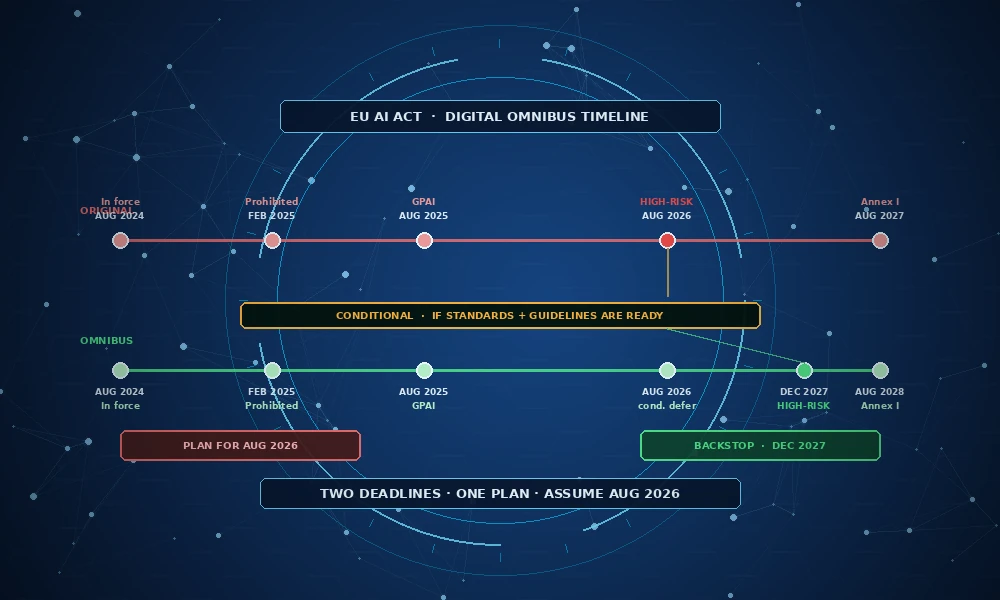
The original high-risk enforcement deadline of August 2, 2026 has shifted following a political agreement reached on May 7, 2026. According to a Travers Smith briefing, Annex III high-risk systems (employment, biometrics, critical infrastructure, education) now face a December 2, 2027 compliance deadline. Annex I product-embedded systems have until August 2, 2028. The core obligations remain unchanged only the timeline has extended.
For high-risk AI systems, the EU AI Act requires:
- A documented risk management system (Article 9) covering residual risk assessment and iterative review
- Data governance measures addressing training data quality and bias evaluation (Article 10)
- Technical documentation (Article 11) sufficient for a conformity assessment body to evaluate the system
- Logging and audit trail capabilities (Article 12) to enable post-market monitoring
- Human oversight mechanisms (Article 14) ensuring a human can intervene in or override AI decisions
- Accuracy, robustness, and cybersecurity specifications (Article 15)
For lean compliance teams, the documentation burden of Articles 11 and 12 is the primary operational challenge. These requirements are not satisfied by a policy document or a one-time audit they require continuous, structured evidence of how each system was monitored and what actions were taken when anomalies appeared.
The overlap between EU AI Act Article 9 risk management requirements and ISO 42001 Clause 6.1 controls is substantial. Organisations that build their ISO 42001 AIMS to satisfy certification requirements simultaneously accumulate much of the documentation the EU AI Act requires. Governance platforms that map controls across both frameworks prevent the duplication of compliance effort that would otherwise force a lean team to maintain two parallel documentation programmes.
NIST AI RMF and the Multi-Framework Reality
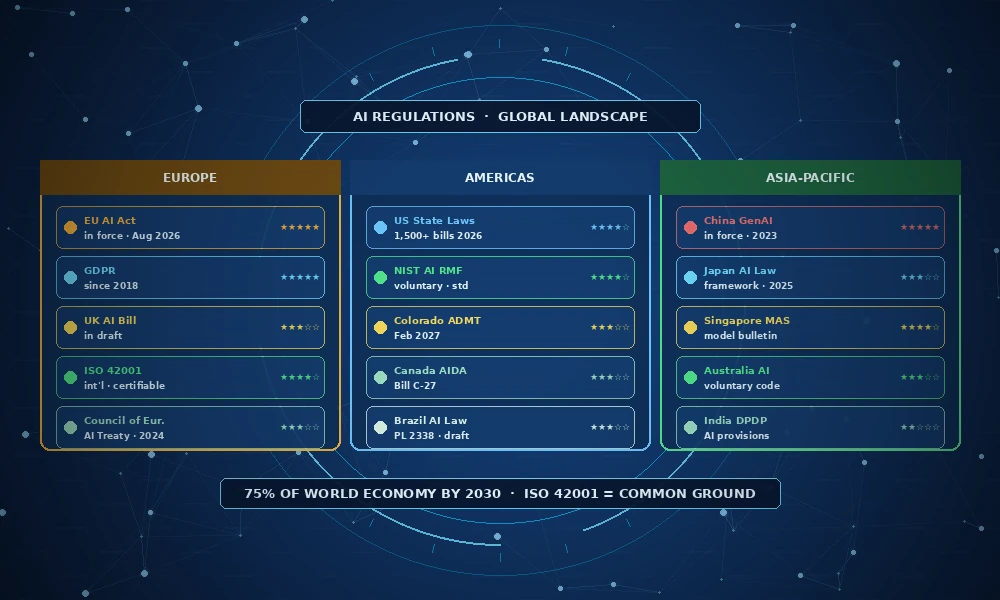
Most mid-market compliance teams operating in the US are not navigating a single AI framework. They face ISO 42001 for international certification credibility, the NIST AI RMF for voluntary alignment with US federal expectations and sector-specific requirements, and the EU AI Act for any operations touching European customers.
The NIST AI Risk Management Framework, published in January 2023, organises AI governance work into four core functions: Govern, Map, Measure, and Manage. These are not certification requirements the NIST AI RMF does not lead to a third-party certificate but they represent the conceptual language US regulators and enterprise procurement teams increasingly use when evaluating an organisation’s AI governance posture.
The governance operational reality this creates is significant. A compliance team maintaining ISO 42001 documentation, EU AI Act technical files, and NIST AI RMF evidence is effectively running three parallel documentation workflows for overlapping requirements. The controls are similar risk assessment, oversight mechanisms, monitoring records, policy documentation but the format, terminology, and evidence structure differ enough that manual maintenance creates real duplication of effort.
A governance platform that maps a single control implementation to all three frameworks simultaneously is not a convenience. For a two-person compliance team, it is the difference between a workload that is manageable and one that is not.
What Mid-Market Companies Get Wrong When Evaluating AI Governance Platforms
Most mid-market buyers approach AI governance platform selection as they would evaluate any enterprise software: feature checklist, integration capabilities, pricing. Three things consistently get underweighted.
Over-indexing on automation at the expense of framework depth.
Several platforms in the market automate evidence collection and compliance monitoring effectively, but generate output too generic to satisfy an actual ISO 42001 or EU AI Act audit. ‘Automated’ documentation that references framework requirements at the category level rather than at the clause or article level produces audit preparation problems rather than solving them. Before purchasing, ask the vendor to show you what their EU AI Act Article 11 technical documentation output looks like for a real AI system.
Treating the AI model registry as a secondary feature.
The registry is the foundation of every downstream compliance activity. Risk assessments are impossible without a defined scope. EU AI Act technical documentation cannot be produced without a complete inventory of in-scope systems. ISO 42001 AIMS scope documentation requires accurate system records. Platforms that offer a registry as a supplementary module rather than a core architectural component create data integrity problems as the system inventory grows.
Underestimating the ongoing maintenance requirement.
Compliance is not a project it is an operating condition. AI systems change (model updates, new training data, scope expansion), regulations change, and audit requirements evolve. A platform that produces a point-in-time compliance record without version control or change tracking creates compliance gaps between audit cycles. Version-controlled, continuously updated documentation is not a premium feature; it is a baseline requirement for any organisation serious about maintaining certification.
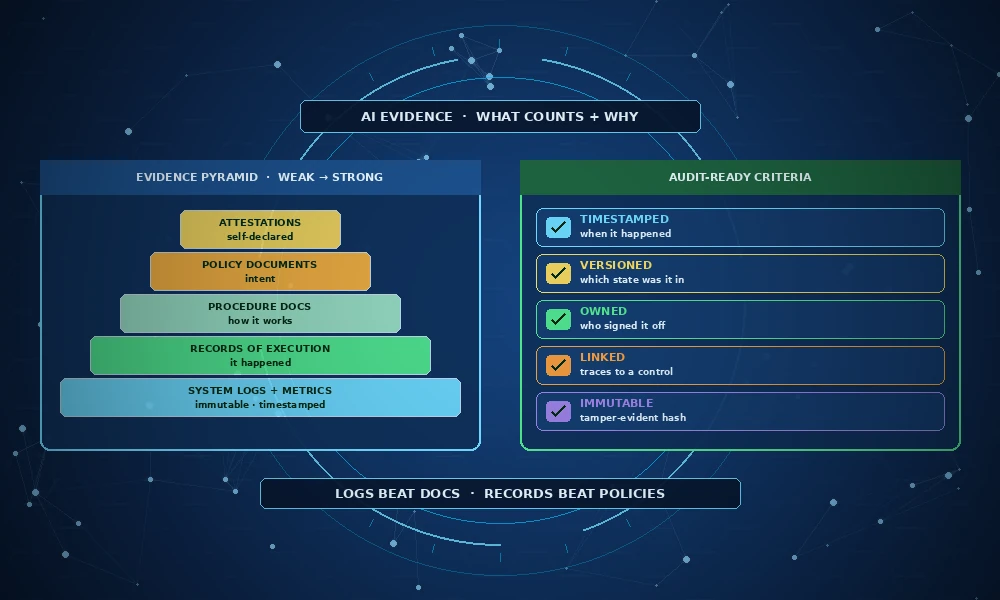
One pattern that reliably separates organisations that pass their first ISO 42001 audit from those that do not is documentation culture: whether the compliance record reflects how AI systems are actually operated, or whether it reflects how the organisation hoped they were operated when the auditors arrived.
Building an AI Governance Programme Without a Dedicated Team
The practical question for most mid-market companies is not whether to build an AI governance programme. It is whether they can build one that is proportionate to their actual risk profile and operational capacity.
A proportionate programme for a mid-market organisation operating two to ten AI systems in consequential processes looks like this:
- Define scope precisely. Not every AI system requires the same level of governance attention. Start with the systems that make consequential decisions those affecting individuals, regulated processes, or high-value business outcomes. Document them in your AI model registry with a risk classification.
- Conduct an AI system impact assessment. ISO 42001 Annex A and the EU AI Act both require organisations to evaluate the broader impacts of their AI systems before the risk assessment stage. For each in-scope system, document: purpose and context, affected individuals or groups, potential adverse outcomes, and current oversight mechanisms.
- Apply a risk-based control structure. ISO 42001 allows organisations to apply tiered governance to systems with different risk profiles. A lower-risk internal productivity tool does not require the same documentation intensity as an algorithm used in credit decisions. Define your risk tiers explicitly and apply controls accordingly.
- Build ongoing monitoring into your operating model. Compliance between audits matters more than compliance at audit time. Schedule quarterly control reviews, track changes to in-scope AI systems through your model registry, and ensure that human oversight logs are maintained continuously rather than reconstructed when needed.
- Generate and retain audit evidence systematically. For ISO 42001 certification, the auditor will ask for evidence of control operation over time not just policy documents. Retention of meeting records, risk assessment outputs, oversight logs, and incident reports is not optional. A platform that captures this evidence as a byproduct of normal operations is substantially more sustainable than a manual documentation process.
This five-step structure is achievable with one or two compliance professionals supported by the right tooling. It is not achievable manually at the same quality level.
Frequently Asked Questions
What is an AI governance platform?
An AI governance platform is software that helps organisations manage the risk, compliance, and oversight requirements associated with their AI systems. Core capabilities typically include an AI model registry, risk assessment workflows, compliance dashboards, and audit evidence management. Platforms designed for regulatory compliance map AI system documentation to specific frameworks including ISO 42001, the EU AI Act, and the NIST AI Risk Management Framework.
Does a mid-market company need ISO 42001 certification?
Not in all cases ISO 42001 is currently a voluntary standard in most jurisdictions. However, customer procurement requirements, sector-specific regulatory expectations, and the Colorado AI Act’s safe harbour provision for ISO 42001 adherents make certification increasingly valuable for mid-market companies in regulated industries. Organisations operating high-risk AI systems subject to the EU AI Act are also likely to find that ISO 42001 AIMS documentation satisfies a significant portion of the technical documentation requirements under Articles 9 through 15.
How many people does it take to implement AI governance for a mid-market company?
A well-scoped AI governance programme can be implemented and maintained by one to two compliance professionals using structured platform tooling. The critical factor is scope definition limiting AIMS coverage to AI systems that create material regulatory or business risk and avoiding manual documentation processes that scale poorly with system count. Platform capabilities that automate evidence collection, control mapping, and audit package generation reduce the labour intensity significantly.
How does the EU AI Act affect US-based companies?
The EU AI Act applies extraterritorially. Any organisation whose AI systems are used within the EU or whose AI outputs affect EU residents falls within scope, regardless of the company’s physical location. US-based companies using AI in credit assessment, hiring, content moderation, or customer service that serve European customers should assess their obligations under the Act’s high-risk system categories (Annex III) and general-purpose AI provisions. The revised compliance deadline for Annex III systems is December 2, 2027.
What is the difference between AI governance and general GRC software?
General GRC software covers controls management, risk registers, and audit workflows across a broad range of frameworks (SOC 2, ISO 27001, PCI DSS). AI governance platforms add capabilities specific to AI system oversight: AI model registries, AI system impact assessments, lifecycle monitoring for deployed models, and framework mapping specific to AI regulations. For organisations with significant AI deployment, an AI governance platform provides the depth of AI-specific data models and control structures that generic GRC tools lack.
Can AI governance platform tooling help with NIST AI RMF alignment?
Yes. The NIST AI RMF’s four functions Govern, Map, Measure, and Manage map closely to the core capabilities of an AI governance platform. Govern function requirements (policies, roles, risk tolerance) align with policy management and AIMS documentation. Map and Measure functions (AI system categorisation, impact measurement) align with risk assessment workflows. The Manage function (response and recovery for AI risks) aligns with incident management and control monitoring. Platforms that support simultaneous multi-framework mapping allow a single governance programme to generate NIST AI RMF-aligned artefacts without maintaining a separate documentation process.
The Compliance Advantage That Compounds Over Time
The regulatory environment for AI is not getting simpler. More frameworks, more jurisdictions, and more enforcement are the trajectory not less. For mid-market organisations, the choice is not whether to build AI governance capacity but whether to build it manually (expensive, error-prone, and unsustainable) or with tooling designed for the purpose. A platform with a structured AI model registry, multi-framework control mapping, and continuous evidence generation makes ISO 42001 certification and EU AI Act compliance achievable without a large GRC team. The operational advantage compounds over time: organisations with structured governance programmes spend their compliance hours maintaining and improving, not reconstructing.
If your organisation is deploying AI in consequential processes and has not yet formalised governance, the window for proactive implementation is shorter than it looks. Start your 14-day free trial of Govern365.ai, by the Global AI Certification Council, and build your AIMS on the platform built by the people who wrote the standard.