Forrester projects that spending on AI governance software will reach $15.8 billion by 2030, growing at roughly 30% per year. That number reflects something more than market enthusiasm it reflects organisations discovering that the tools they already own cannot do the job.
The compliance infrastructure most enterprises built over the last decade GRC platforms anchored to ISO 27001, SOC 2, and COSO was designed for a different kind of risk. Static controls. Annual audits. Stable frameworks. AI does not work that way, and neither do the regulations now governing it.
This piece explains exactly where an AI governance platform and a GRC tool diverge, which regulatory requirements each can and cannot satisfy, and how to make the right architectural decision for your compliance programme.
Why the GRC Category No Longer Covers AI Governance
Every GRC platform on the market today was built around a core assumption: risk is something you document, classify, and review on a cycle. A control is in place or it is not. Evidence is collected. An auditor reviews it. Repeat annually.
That model works for information security, financial controls, and vendor management. It does not work for AI.
ISO/IEC 42001:2023, the international standard for AI management systems, requires a Plan-Do-Check-Act framework that is ongoing throughout the AI system lifecycle. Not periodic. Not annual. The EU AI Act reinforces this: Article 9 requires a risk management system that is established, implemented, documented, and maintained continuously. These are not documentation requirements. They are operational requirements.
Consider what happens with a machine learning model over time. The model drifts as the data distribution it encounters in production shifts away from its training distribution. The context in which it is deployed changes. New bias patterns emerge that were not present at deployment. Each of these changes has governance implications — and none of them trigger an event in a GRC platform’s control library.
GRC tools were built to store evidence. AI governance platforms are built to track living systems. That architectural difference is where the two categories permanently diverge.
What an AI Governance Platform Actually Does
The term is overused. Vendors apply it to tools that range from sophisticated AI management system infrastructure to basic spreadsheet replacements with a SaaS interface. For this comparison to be useful, the capabilities need to be specific.
The AI model registry
The defining capability. An AI model registry is a structured, version-controlled inventory of every AI system an organisation develops, procures, or deploys mapped to its technical characteristics, risk tier, applicable regulatory obligations, responsible owners, and control status.
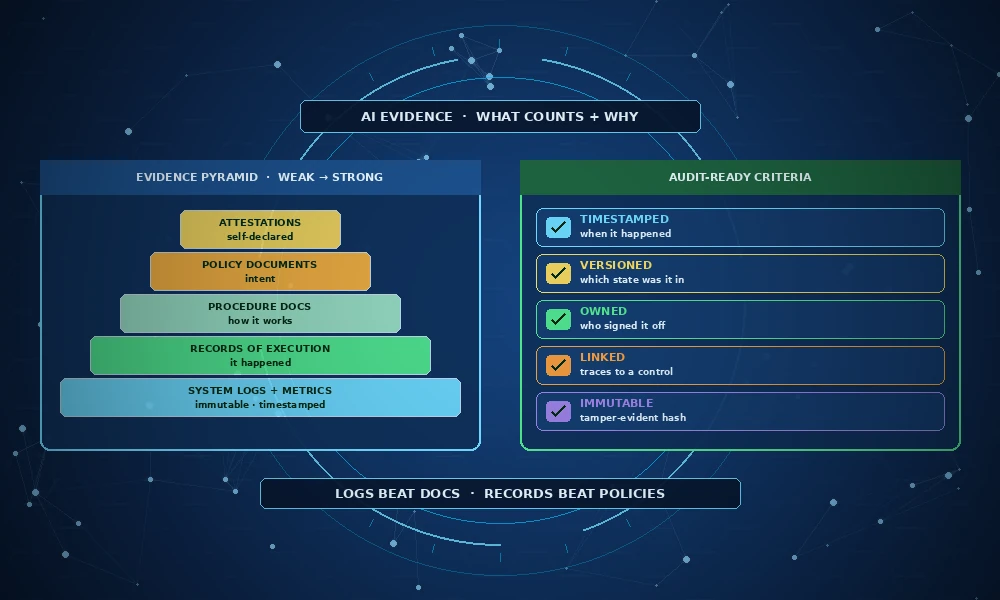
This is not a document repository. It is a relational record where each AI system entry is linked to its ISO 42001 Annex A controls, its EU AI Act risk classification, its data governance lineage, and the audit evidence that demonstrates ongoing compliance. When an auditor asks for evidence that a specific system’s risk was assessed against Clause 6.1 of ISO 42001, the registry surfaces it in seconds rather than days.
Risk assessment for AI-specific characteristics
AI systems carry risks that do not appear in conventional GRC risk taxonomies: algorithmic bias, model explainability failures, training data quality issues, autonomous decision-making without adequate human oversight, and unintended outputs in edge-case scenarios.
A purpose-built AI governance platform structures risk assessments around these characteristics, mapping them to the appropriate ISO 42001 Annex A controls and EU AI Act risk tier. A GRC tool’s risk assessment engine maps inputs to whatever risk taxonomy the platform supports which, for most incumbents, was defined before ISO 42001 existed.
Audit evidence management at clause level
Both tool categories manage evidence. The difference is granularity and structure. In a GRC tool, evidence is attached to a control in a control library. In an AI governance platform, evidence is attached to a specific AI system instance, a specific compliance requirement, and a specific point in time in that system’s lifecycle. When ISO 42001 Clause 8.4 requires documented evidence of AI system testing and validation, that evidence needs to be traceable to the system, not just to a generic ‘testing’ control.
Govern365.ai’s AI model registry maps each system to its applicable ISO 42001 clauses and EU AI Act risk categories, generating audit-ready evidence automatically. For organisations preparing for ISO 42001 certification, this structural difference can reduce audit preparation time significantly rather than manually reconstructing evidence trails from a GRC platform that was not designed for AI.
What a GRC Tool Does and Does Well
This is not an argument that GRC tools are inadequate. They are precisely adequate for what they were built to do.
For enterprise compliance programmes managing ISO 27001, SOC 2, HIPAA, GDPR, or COSO, a mature GRC platform remains the operational backbone. Control libraries that span multiple frameworks. Cross-functional audit workflows. Vendor and third-party risk management. Policy lifecycle management. These are significant capabilities that purpose-built AI governance platforms do not replicate.
The important distinction is what happens when a GRC vendor adds an ‘AI governance module.’ These additions are, with rare exceptions, documentation overlays. They allow teams to create a new risk category called ‘AI risk’ and attach documents to it. What they cannot do is model the dynamic relationship between an AI system’s technical characteristics and its compliance obligations across ISO 42001’s 38 Annex A controls.
That gap is structural, not cosmetic. And it is precisely what the EU AI Act and ISO 42001 certification processes will expose.
The Specific Gaps: ISO 42001 and the EU AI Act
Most comparisons stay at the feature level. This one goes to the clause level, because that is where auditors actually look.
| Requirement | GRC Tool Capability | AI Governance Platform Capability |
|---|---|---|
| ISO 42001 Clause 6.1 – AI risk assessment methodology | Generic risk assessment form; no AI system characteristics taxonomy | Structured assessment mapped to AI system properties (bias, explainability, data quality, deployment context) |
| ISO 42001 Annex A – 38 AI-specific controls | Not present in standard control libraries; requires manual configuration | Native Annex A control mapping with pre-built evidence templates per control |
| EU AI Act Article 9 – Ongoing risk management system | Point-in-time control testing; no lifecycle monitoring | Continuous monitoring with drift alerts and lifecycle stage tracking |
| EU AI Act Article 14 – Human oversight documentation | Generic task/ticket workflows; no AI system linkage | Human oversight workflows tied to specific AI systems and decisions |
| EU AI Act Annex III – Conformity assessment evidence | Document attached to control; no system-level traceability | Evidence linked to AI system instance, clause, and timestamp for conformity audit trail |
| ISO 42001 Clause 9 – Performance evaluation | Periodic review triggers; no AI-specific KPIs | Framework-aligned AI governance metrics and continuous performance dashboards |
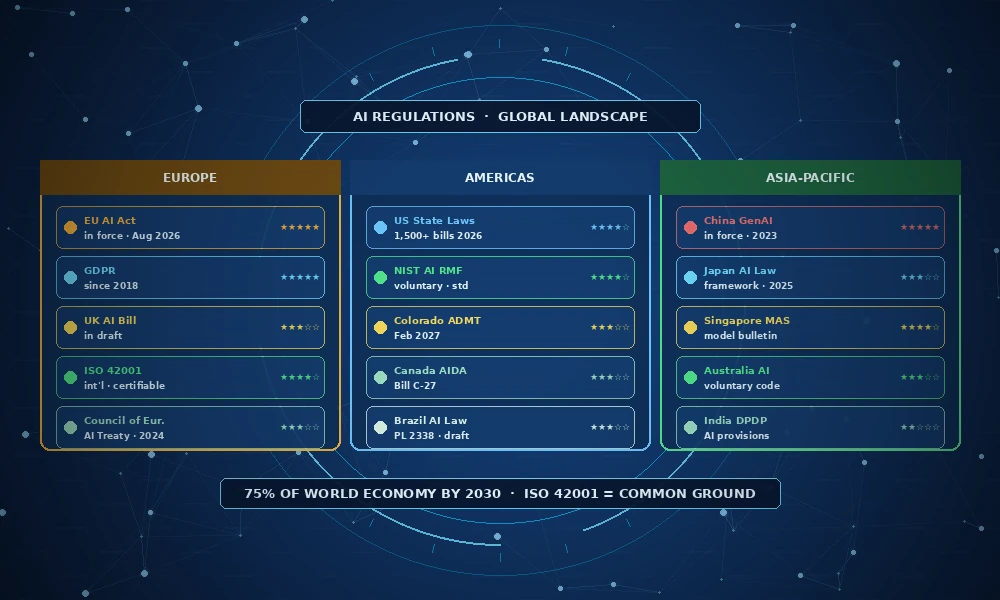
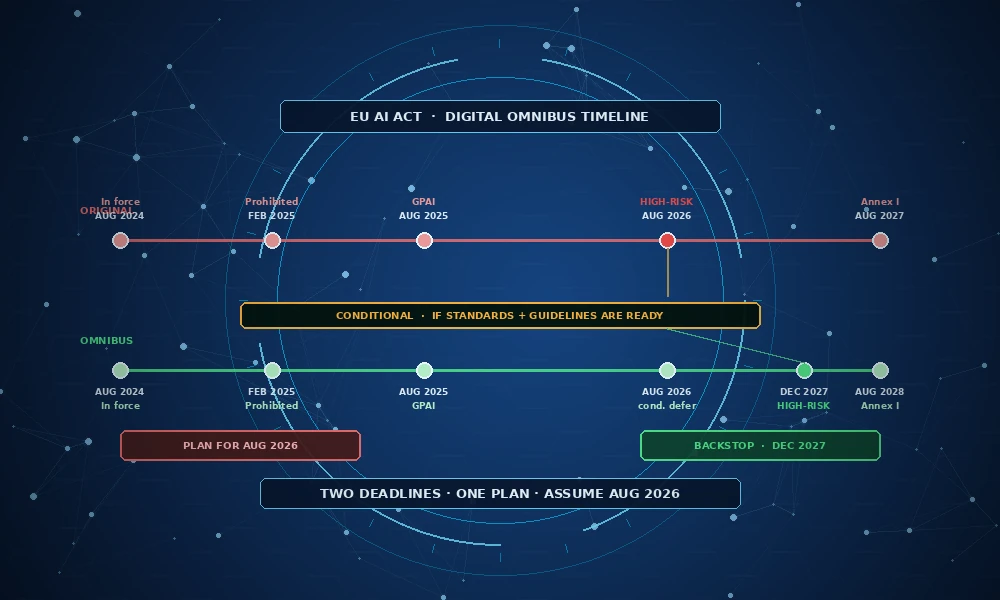
The EU AI Act’s August 2026 enforcement deadline for high-risk AI systems (covering Annex III categories including employment screening, credit decisioning, education, and biometric identification) makes these gaps operationally urgent. Organisations that have not yet mapped their AI systems to EU AI Act risk tiers or ISO 42001 Annex A controls are running out of runway. Note: the EU Parliament voted in April 2026 on a possible extension to August 2027, but as of this writing the Council of the EU has not confirmed this delay – prudent compliance planning treats August 2026 as the operative deadline.
Framework Mapping Matrix: ISO 42001, EU AI Act and NIST AI RMF
These three frameworks are frequently discussed as if they are competing choices. They are not. They address different aspects of AI governance and function best as a layered programme.
| Function / Requirement Area | ISO/IEC 42001 Clause | EU AI Act Article/Annex | NIST AI RMF Function |
|---|---|---|---|
| Organisational context and AI policy | Clauses 4 & 5 | Articles 4, 5 (prohibited practices) | GOVERN (GV-1, GV-2) |
| AI risk identification and assessment | Clause 6.1 + Annex A | Article 9 | MAP (MP-2, MP-3) |
| AI system operation and lifecycle controls | Clause 8 + Annex A | Articles 10-15 (high-risk obligations) | MEASURE (MS-1, MS-2) |
| Human oversight and transparency | Annex A 8.6, 8.7 | Articles 13, 14 | GOVERN (GV-5); MANAGE (MG-3) |
| Monitoring, review and continuous improvement | Clause 9, 10 | Article 9 (ongoing risk mgmt) | MEASURE (MS-4); MANAGE (MG-4) |
| Incident response and corrective action | Clause 10.2 | Article 73 (serious incidents) | MANAGE (MG-4) |
The practical implication: organisations doing ISO 42001 implementation work are simultaneously advancing their EU AI Act readiness and their NIST AI RMF alignment. An AI governance platform that cross-maps controls across all three frameworks can eliminate significant duplicated effort at audit time.
For a detailed comparison of NIST AI RMF and ISO 42001 implementation approaches, SureCloud’s analysis offers a practitioner-level breakdown worth reading alongside your implementation plan.
When You Need One, the Other, or Both
The question practitioners actually bring to this comparison is rarely abstract. It is: ‘We already have [GRC platform]. Do we also need an AI governance platform?’
Here is a clear decision framework:
| Scenario | Recommended Approach |
|---|---|
| ISO 42001 certification in scope | AI governance platform required. GRC tools cannot satisfy Annex A controls without significant custom development that will not survive an external audit. |
| EU AI Act high-risk system obligations | AI governance platform required. Article 9 ongoing risk management and Article 14 human oversight documentation require AI-native tooling. |
| Managing enterprise risk, ISO 27001, SOC 2, GDPR | GRC tool sufficient. These frameworks operate within GRC’s architectural strengths. |
| Mature GRC programme + new AI governance requirements | Both, integrated. Use your GRC platform for enterprise-wide risk and policy; use an AI governance platform for AI system-specific evidence and AIMS management. The platforms should share data. |
| Early-stage AI governance programme, limited GRC investment | AI governance platform first. Build the AIMS infrastructure. Add broader GRC capabilities as the programme matures. |
The integration point matters more than the tool selection. AI-specific risks identified in the governance platform should flow into the enterprise risk register your board reviews. Treating the two environments as separate silos produces the exact reporting fragmentation that AI governance programmes are supposed to eliminate.
Frequently Asked Questions
Can my existing GRC platform handle ISO 42001?
Not without significant customisation that will not hold up under external audit. ISO 42001’s Annex A contains 38 controls specific to AI systems covering data quality, algorithmic bias, explainability, and human oversight none of which exist in standard GRC control libraries built for ISO 27001 or SOC 2. You can add them manually, but auditors will look for evidence that the controls were applied to specific AI systems, not just configured in a tool.
What is an AI model registry and why is it important?
An AI model registry is a structured inventory of every AI system an organisation uses or develops, with each entry linked to its risk classification, applicable regulatory obligations, responsible owners, and compliance evidence. It is important because you cannot govern what you have not inventoried. Most enterprises discover they are operating significantly more AI systems than their compliance team is aware of a phenomenon often called shadow AI and the registry is the starting point for closing that gap.
Do I need a separate AI governance tool if I already have OneTrust or ServiceNow GRC?
For ISO 42001 certification and EU AI Act high-risk system conformity: yes. Both OneTrust and ServiceNow have added AI governance functionality, but these are documentation layers built on privacy or IT GRC foundations. They do not provide the AI system lifecycle infrastructure the model registry, Annex A control mapping, and continuous monitoring that ISO 42001 certification and EU AI Act Article 9 require. You should evaluate whether the AI governance features meet the specific clause-level requirements of the frameworks you are pursuing.
How does ISO 42001 relate to the EU AI Act?
They are complementary, not duplicative. ISO 42001 provides the management system infrastructure the AIMS that operationalises the EU AI Act’s Article 9 risk management requirements. Completing ISO 42001 implementation covers a substantial portion of EU AI Act high-risk system obligations, particularly around risk assessment methodology, documentation, and continuous monitoring. Organisations that treat ISO 42001 as their AIMS foundation are simultaneously building their EU AI Act compliance posture.
What is shadow AI and how does an AI governance platform address it?
Shadow AI refers to AI systems deployed within an organisation without formal IT or compliance oversight employees using third-party AI tools, departments procuring AI-enabled SaaS without disclosure, or teams building models outside the governed development pipeline. A GRC tool cannot detect what it has not been told about. AI governance platforms with discovery capabilities actively scan the environment for unregistered AI usage, bringing it into the governance programme before it creates regulatory exposure.
What counts as a high-risk AI system under the EU AI Act?
EU AI Act Annex III defines eight categories of high-risk AI systems: biometric identification and categorisation, critical infrastructure management, education and vocational training, employment and workforce management (including applicant screening), access to essential services (including credit scoring), law enforcement, migration and border management, and administration of justice. US-headquartered enterprises deploying AI in these categories for EU customers or employees face conformity obligations regardless of where the system is developed.
How long does ISO 42001 certification typically take?
Preparation typically takes 8-18 months depending on organisation size, the number of AI systems in scope, and the maturity of existing governance documentation. Organisations using structured AI governance tooling with pre-built Annex A control templates and automated evidence collection have reported substantially shorter timelines compared to those building their AIMS in spreadsheets or adapting existing GRC platforms.
The Difference Is Architectural, Not Cosmetic
The gap between an AI governance platform and a GRC tool is not about which has more features. It is about what each was designed to govern. GRC tools are built for static control environments with periodic audit cycles. AI systems are dynamic, probabilistic, and lifecycle-dependent. The regulatory frameworks now governing AI – ISO 42001, the EU AI Act, NIST AI RMF were written with that reality in mind.
The clearest diagnostic is specific: open your current GRC platform and ask whether it can satisfy ISO 42001 Annex A’s 38 AI-specific controls with system-level evidence. If it cannot, that is your decision point.Start your 14-day free trial of Govern365.ai, by the Global AI Certification Council, the AI governance platform built by the people who wrote the standard, not just the people who sell compliance tools.