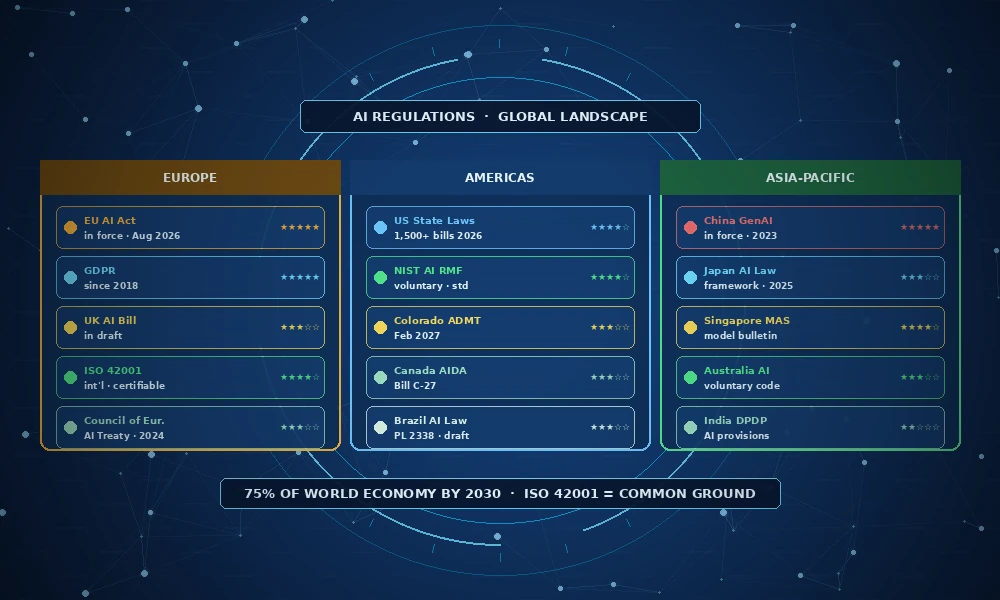
According to a February 2026 Gartner press release, global spending on AI governance platforms is projected to reach $492 million in 2026 more than double the 2024 figure driven by regulatory expansion that will cover 75 percent of the world’s economies by 2030. Organisations that deploy specialised platforms are 3.4 times more likely to achieve high governance effectiveness than those that don’t.
For risk and compliance teams, that data creates an immediate procurement problem: the market is moving fast, vendor claims are difficult to verify independently, and a poorly scoped RFP wastes months on the wrong shortlist. Most existing RFP templates treat AI governance software as a GRC add-on a few extra rows in a standard vendor questionnaire. That approach misses the capabilities that actually determine whether a platform can support ISO/IEC 42001 certification, EU AI Act compliance, and NIST AI RMF alignment at scale.
This template gives you the questions, evaluation criteria, and scoring framework you need to run a rigorous procurement process one that results in a platform your GRC team can operate, your governance professionals can trust, and your C-suite can report against.
1. Why Standard GRC RFPs Fall Short for AI Governance
Most enterprise risk and compliance software evaluations start from a familiar template: security certifications, uptime SLAs, data residency, integration APIs. That framework works well for static controls and policy management. AI governance is neither.
The core problem is that AI systems have properties that legacy GRC tooling wasn’t designed to track. Models change a vendor may update an LLM’s underlying weights without notifying you. Outputs drift over time. Risk classifications under the EU AI Act depend on use-case context, not just system type. And audit evidence for an AI management system isn’t a PDF attachment; it’s a versioned record of decisions, assessments, and controls across the system lifecycle.
Three specific gaps appear consistently in AI governance RFPs built on standard GRC templates:
- No requirement for an AI model registry that tracks system-level metadata, risk classification, version history, and applicable framework controls as a single linked record.
- No evaluation of how the platform maps controls across ISO 42001, EU AI Act, and NIST AI RMF simultaneously forcing compliance teams to maintain separate tracking for each framework.
- No assessment of audit evidence management: whether the platform captures evidence at the control level, links it to specific AIMS requirements, and produces audit-ready packages rather than folders of documents.
A procurement process that misses these capabilities will shortlist platforms that look comparable on a standard scorecard but diverge significantly in operational reality. The template below is structured around the gaps, not the familiar questions.
The shift mirrors what happened with information security a decade ago. SOC 2 and ISO 27001 moved from optional differentiators to table-stakes procurement requirements. ISO 42001 certification is on the same trajectory. Enterprise procurement processes are already including AI governance certification as a vendor qualification criterion particularly in financial services, healthcare, and critical infrastructure.
2. Regulatory Context: What Your RFP Must Account For
Before writing a single RFP question, compliance teams need to be explicit about which regulatory obligations they’re building toward. The answer shapes which vendor capabilities are mandatory versus nice-to-have.
Three frameworks dominate enterprise AI governance procurement in 2026:
| Framework | Type | Key Obligation | RFP Implication |
| ISO/IEC 42001:2023 | Certifiable standard (voluntary; procurement-required) | Establish, implement, and continually improve an AI management system (AIMS) | Platform must map controls to AIMS clauses and support third-party audit evidence |
| EU AI Act | Binding regulation (extraterritorial reach) | Risk classification, conformity assessment, transparency, post-market monitoring | Platform must classify AI systems by risk tier and track Article 9 risk management obligations |
| NIST AI RMF | Voluntary framework (US federal procurement expectation) | Govern, Map, Measure, Manage AI risk across the lifecycle | Platform must support the four core functions and align with AI RMF profiles |
One operational consideration that most RFPs miss: the EU AI Act and ISO 42001 share substantial control overlap. A credible governance platform should map a single control to both frameworks, eliminating duplicate effort. According to analysis published by
Modulos, published estimates of EU AI Act / ISO 42001 overlap vary by methodology but most credible crosswalks land in the 40 to 50 percent range. Platforms that manage each framework in a separate module force compliance teams to deduplicate manually which in practice means it doesn’t get done.
For US-headquartered organisations, NIST AI RMF alignment is increasingly expected by federal procurement and referenced across agency guidance from the FTC, CFPB, and SEC. State-level legislation adds further complexity: Colorado’s AI Act requires risk management policies aligned with NIST AI RMF, ISO 42001, or an equivalent recognised framework. Texas offers NIST alignment as an affirmative defence. Your RFP must specify which jurisdictional obligations apply to your organisation and require vendors to demonstrate support for each.
3. What to Include in an AI Governance Software RFP
The following eight categories form the structural backbone of a complete AI governance software RFP. Each category maps to a specific operational capability that separates purpose-built AI governance platforms from GRC tools with AI modules bolted on.
- AI Model Registry and Inventory Management
- Risk Assessment and Classification
- Compliance Dashboard and Framework Mapping
- Audit Evidence Management
- Integration and Technical Architecture
- Vendor Governance and Certification
- Implementation and Ongoing Support
- Commercial and Contractual Terms
The sections below expand each category into specific RFP requirements and vendor evaluation questions.
3.1 AI Model Registry and Inventory Management
An AI model registry is the foundational capability of any serious governance platform. Without it, every other function risk assessment, compliance mapping, audit evidence is operating on incomplete and manually maintained data.
Mandatory requirements:
- Centralised inventory of all AI systems with structured metadata: system name, owner, purpose, deployment environment, applicable jurisdictions, and risk classification.
- Version tracking: the platform must record each time a model is updated, retrained, or replaced, with timestamps and change attribution.
- Linkage between each AI system and its applicable regulatory obligations specifically ISO 42001 clauses, EU AI Act risk tier, and NIST AI RMF categories.
- Supplier and third-party AI system tracking: for organisations using third-party AI, the registry must capture vendor details, contractual obligations, and delegated governance responsibilities.
RFP questions to ask vendors:
- Describe how your platform structures an AI system inventory entry. What metadata fields are included by default, and which are configurable?
- How does the registry handle third-party AI systems where your organisation is a deployer rather than a developer?
- What version control or change management capabilities exist for tracking model updates and associated risk re-assessments?
3.2 Risk Assessment and Classification
The EU AI Act’s Article 9 requires high-risk AI providers to implement a risk management system that identifies risks and estimates their probability of occurrence. ISO 42001 Clause 6.1 covers essentially the same ground from a management system perspective. A capable platform handles both without requiring separate processes.
Mandatory requirements:
- Configurable risk assessment workflows that align with ISO 42001 Clause 6.1 and EU AI Act Article 9 simultaneously.
- Automated risk classification based on use-case attributes, with manual override and justification logging.
- Risk scoring methodology: the platform must expose its calculation logic so assessors can audit how scores are derived.
- Residual risk tracking: after controls are applied, the platform must record and report residual risk at the system and portfolio level.
RFP questions to ask vendors:
- How does your platform handle AI systems that straddle multiple EU AI Act risk tiers depending on deployment context?
- Can risk assessments be triggered automatically when a model update is recorded in the registry? Describe the workflow.
- How does the platform document the risk assessment rationale for audit purposes?
3.3 Compliance Dashboard and Framework Mapping
Compliance dashboards are where AI governance becomes visible to the people who need it most: the C-suite stakeholders sponsoring the programme, the GRC team running it, and the external auditors assessing it.
Mandatory requirements:
- Real-time compliance status views at the portfolio level (across all AI systems) and the individual system level.
- Cross-framework control mapping: a single control mapped to its equivalent requirements in ISO 42001, EU AI Act, and NIST AI RMF not three separate compliance trackers.
- Board-ready reporting templates: exportable compliance status reports suitable for audit committee presentation, without manual formatting.
- Gap analysis views: which controls are not yet implemented, which are partially implemented, and what evidence is missing.
RFP questions to ask vendors:
- Provide a demonstration of the compliance dashboard for an organisation subject to both ISO 42001 and the EU AI Act simultaneously.
- How does the platform handle control mapping when two frameworks have overlapping but non-identical requirements?
- What reporting formats are available for board and audit committee presentation?
3.4 Audit Evidence Management
This is the capability that separates mature AI governance platforms from everything else and the one most frequently underspecified in procurement templates.
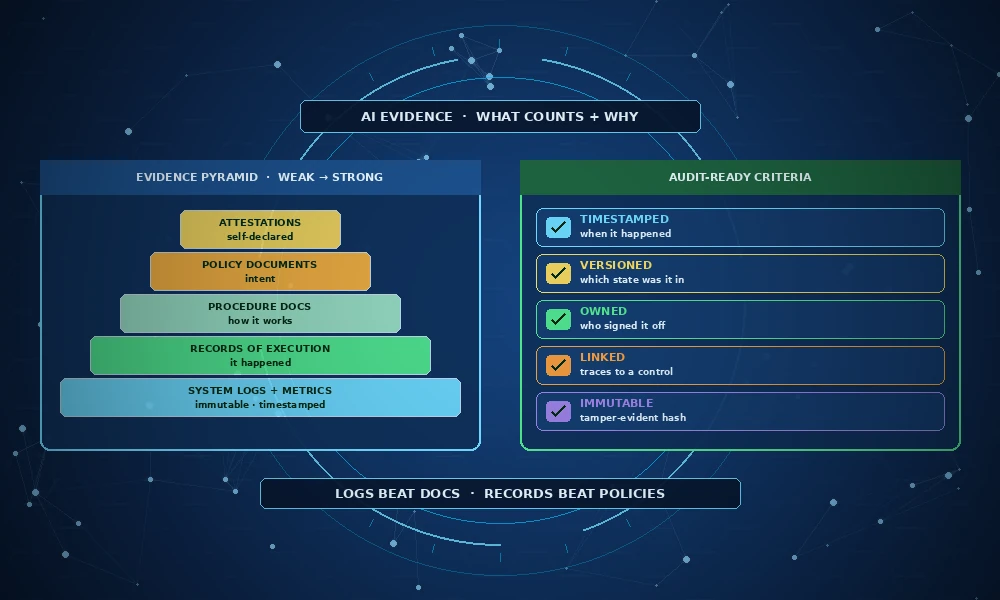
ISO 42001 certification requires an organisation to demonstrate that its AI management system is implemented and effective, not merely documented. That means auditors will request evidence at the control level: not a policy document stating that risk assessments are conducted, but records showing that a specific risk assessment was conducted, by whom, when, with what outcome, and what subsequent action was taken.
Mandatory requirements:
- Control-level evidence attachment: each AIMS control must be linkable to specific evidence artefacts (documents, assessment records, approval logs).
- Evidence versioning and tamper logging: the platform must maintain an immutable record of when evidence was uploaded, by whom, and whether it was modified.
- Audit package generation: the platform must be able to assemble a structured evidence package for a specific audit scope not a flat export of all documents, but an organised, scope-mapped collection.
- Evidence expiry and review scheduling: the platform must alert teams when evidence is due for refresh based on configurable review cycles.
RFP questions to ask vendors:
- Describe the evidence management workflow from initial upload through to audit package generation.
- How does the platform handle evidence that applies to multiple controls across different frameworks?
- What audit trail does the platform maintain for evidence submissions who uploaded what, when, and whether any modifications were made?
4. Technical Architecture and Integration Requirements
A governance platform that doesn’t integrate with the systems where AI development happens will be populated manually which means it won’t be populated accurately. Technical architecture requirements should be evaluated with the same rigour as functional capabilities.
Minimum integration requirements for enterprise deployment:
- REST API with documented endpoints for all core objects: AI systems, assessments, controls, evidence, and users.
- Authentication support: SAML 2.0 and/or OIDC for enterprise SSO integration.
- Role-based access controls (RBAC) with sufficient granularity to support segregation of duties across governance, assessment, and evidence roles.
- Webhook or event-streaming support for integration with CI/CD pipelines, model training platforms, and ITSM systems.
- Deployment flexibility: confirm whether the platform supports cloud, on-premises, and hybrid deployments and whether governance data can be configured to remain within a specific geographic region for data residency compliance.
Additional questions for vendors with AIMS certification scope:
- Does the platform itself hold ISO/IEC 42001 certification either organisational AIMS certification or product conformity assessment? Provide the certification body, scope, and date of most recent audit.
- What is the platform’s SOC 2 Type II status, and can you provide the most recent report summary?
- Describe your vendor incident notification process. If a security or availability incident occurs, what is the notification SLA and escalation path?
5. Vendor Evaluation Scorecard
Once RFP responses are received, scoring against a consistent rubric is what separates a rigorous procurement process from one that defaults to the most confident presenter. The following scorecard structure maps to the eight capability categories above.
Recommended weighting for enterprise AI governance procurement (adjust based on your regulatory profile):
| Capability Category | Weight (%) | Score (1–5) | Notes |
| AI Model Registry and Inventory | 20% | ||
| Risk Assessment and Classification | 20% | ||
| Compliance Dashboard and Framework Mapping | 15% | ||
| Audit Evidence Management | 20% | ||
| Technical Architecture and Integrations | 10% | ||
| Vendor Governance and Certification | 10% | ||
| Implementation and Support | 5% | ||
| Commercial and Contractual Terms | Threshold only | Pass/fail on data portability and exit terms |
Two practical notes on scoring: First, commercial terms should be evaluated as a threshold, not a weighted dimension a platform that scores well technically but has unacceptable data portability or vendor lock-in terms should be disqualified before weighted scoring begins. Second, vendor demonstrations should be scored against the same rubric as written responses, not as a separate track. Require vendors to demonstrate specific workflows not polished product tours for the capabilities you’ve weighted most heavily.
One question that separates vendors who understand AI governance from those who’ve added a module to a GRC tool: ask them to demonstrate what happens when a model is updated in production. Can the platform automatically trigger a re-assessment? Does it preserve the version history? Does it link the new assessment to the existing audit evidence chain? The answer reveals whether the product was built for AI governance or retrofitted for it.
6. Red Flags in Vendor RFP Responses
Knowing what a strong response looks like is useful. Knowing what evasion looks like is more useful.
Flag 1: Vague framework alignment claims.
If a vendor states they ‘support ISO 42001 and EU AI Act compliance’ without mapping specific features to specific clauses or articles, the claim is marketing, not capability. Require vendors to complete a controls crosswalk: for each ISO 42001 clause you’ve specified as mandatory, they must name the feature that supports it and describe the evidence it generates.
Flag 2: Certification gaps on the vendor’s own AI systems.
A vendor selling AI governance software that does not hold ISO 42001 certification for its own AI management system or can’t explain why not deserves scrutiny. This isn’t a disqualification criterion, but it warrants a direct question about their certification roadmap.
Flag 3: Evidence management described as a document library.
‘We provide a repository where you can store compliance documents’ is a file folder, not audit evidence management. Evidence management requires control-level linkage, version history, tamper logging, and structured export. If the demo shows drag-and-drop file upload to a folder tree, keep looking.
Flag 4: Framework mapping done through spreadsheet exports.
If a vendor’s answer to ‘how do you map controls across frameworks?’ involves downloading an Excel template, the cross-framework deduplication problem has been exported to your team. That’s not governance software; that’s a template with a subscription fee.
Flag 5: No answer on data portability.
Ask what happens to your AI registry, assessments, and evidence records if you terminate the contract. Vendors with genuine confidence in their product will have a clear, contractual data export and transition process. Evasion on this question is a contractual risk, not just a technical one.
7. How to Scope the RFP for Your Organisation’s Profile
Not every organisation needs the same RFP. The regulatory obligations, operational complexity, and internal maturity that determine which capabilities are mandatory versus optional vary significantly by sector, size, and geographic footprint.
Use the following scoping framework before issuing the template:
- Identify your regulatory scope. Which frameworks create legal or contractual obligations for your organisation? EU AI Act applies to any organisation deploying AI in EU markets, regardless of headquarters. ISO 42001 certification may be required by enterprise customers or supply chain partners even where no regulator mandates it. NIST AI RMF is expected in US federal procurement and increasingly referenced by financial regulators.
- Map your AI system portfolio. Before issuing an RFP, you need an approximate count of AI systems in scope not a precise audit, but enough to evaluate whether a platform can handle your operational scale. Vendors should be asked to demonstrate the platform against a portfolio of your approximate size.
- Determine your certification timeline. If ISO 42001 certification is a near-term objective (within 18 months), audit evidence management and AIMS clause-level control mapping become mandatory requirements, not preferred ones. If certification is exploratory, you may weigh compliance dashboard capability more heavily.
- Assess your integration environment. Which MLOps platforms, model training systems, and data governance tools does the AI governance platform need to connect with? List these explicitly in the RFP and require vendors to demonstrate or confirm integration support for each.
Govern365.ai’s compliance dashboard and AI model registry are built specifically for multi-framework environments mapping controls once across ISO 42001, EU AI Act, and NIST AI RMF, and generating board-ready reporting without manual formatting. For teams building toward certification, the platform’s audit evidence management was designed to the AIMS audit requirements, not retrofitted from a document management system.
8. Common RFP Mistakes That Cost Compliance Teams Months
The procurement process itself carries risk. The following mistakes consistently delay AI governance deployments by six months or more.
Issuing an RFP before defining your compliance scope.
Vendors can’t respond usefully to requirements that haven’t been defined. An RFP that says ‘must support AI compliance’ without specifying which frameworks, which clauses, and which use cases creates a shortlist of platforms that look similar on paper but diverge completely in implementation.
Treating the demo as the primary evaluation.
Product demonstrations are the most controllable part of a vendor’s sales process. A platform can look authoritative in a 45-minute demo while lacking the operational depth you’ll need at audit time. Weight written responses to specific technical questions more heavily than demonstrations.
Excluding the GRC team from the evaluation.
Purchasing decisions for AI governance platforms are often led by IT or legal functions, with GRC teams consulted late in the process. The people who will operate the platform day-to-day running assessments, uploading evidence, producing compliance reports should evaluate vendor demos against their actual workflows, not a generic capability checklist.
Negotiating price before confirming data portability.
Exit terms and data portability should be threshold requirements evaluated before commercial negotiation begins. Discovering that your AI registry and evidence records are locked into a proprietary format after contract signature is a governance risk, not just a commercial inconvenience.
FREQUENTLY ASKED QUESTIONS
What is the difference between an AI governance platform and a GRC tool with AI features?
A purpose-built AI governance platform is structured around the AI system lifecycle model registry, risk assessment, controls mapping, and audit evidence as its primary architecture. GRC tools with AI features add these capabilities as modules to a system designed for policy management and risk registers. The operational difference shows up at audit time: a purpose-built platform produces AIMS-ready evidence packages; a GRC add-on typically requires manual compilation.
Does an AI governance platform need to hold ISO 42001 certification itself?
Not necessarily, but it’s a meaningful signal. A vendor that has pursued ISO 42001 certification for its own AI management system either organisational AIMS certification or product conformity assessment has operationalised the requirements it’s selling. Ask vendors directly about their certification status and timeline. Evasion on this question warrants scrutiny in the evaluation.
How many AI systems does an organisation typically need to govern?
According to research cited in a SecurePrivacy analysis of the AI governance market, organisations no longer deploy one or two experimental AI models they operate dozens or hundreds of systems across departments, use cases, and jurisdictions. Most enterprise compliance teams undercount their AI systems significantly before a formal inventory exercise. Scope your RFP for the portfolio you’ll discover, not the one you currently know about.
What is the EU AI Act’s Article 9 requirement for high-risk AI systems?
Article 9 requires providers of high-risk AI systems to establish, implement, document, and maintain a risk management system throughout the entire lifecycle of the AI system. This includes identification and analysis of known and foreseeable risks, estimation and evaluation of risks arising from intended use and foreseeable misuse, and risk mitigation measures. Your AI governance platform must support documentation and evidence generation for each of these requirements.
Should the AI governance RFP cover generative AI systems specifically?
Yes. Generative AI systems introduce specific governance requirements that standard AI governance templates don’t address: output logging, prompt management, model version pinning, and human-in-the-loop oversight design. If your organisation deploys or plans to deploy generative AI, add a dedicated section to the RFP covering these capabilities. The NIST AI RMF Generative AI Profile and COSO’s 2026 guidance on internal control over generative AI provide the specific requirements to reference.
How long does an AI governance software implementation typically take?
Implementation timelines vary from 8 to 24 weeks depending on portfolio size, integration complexity, and the depth of evidence migration required. Organisations that enter the implementation with a pre-populated AI system inventory and defined control mappings to their target frameworks consistently complete faster. Require vendors to provide a detailed implementation plan not a generic timeline as part of the RFP response.
Start Your Evaluation With the Right Framework
AI governance software is no longer a speculative investment. With ISO 42001 certification becoming a procurement requirement across enterprise supply chains, the EU AI Act creating legal obligations for any organisation operating in EU markets, and NIST AI RMF alignment expected in US federal procurement, the question for risk and compliance teams isn’t whether to deploy a governance platform it’s which one can actually support certification, not just claim to.
The RFP template above is a starting point. Tailor the framework to your regulatory profile, your integration environment, and your certification timeline. The questions that matter most are the ones about audit evidence, model registry architecture, and cross-framework control deduplication because those are the questions that will reveal whether a platform was built for AI governance or retrofitted for the market.
Start your 14-day free trial of Govern365.ai, by the Global AI Certification Council and see how an AI management system built to the standard looks when it’s also built as a platform.