Three-quarters of US enterprises have rolled out AI in some form, yet fewer than one in four IT leaders say they can confidently govern it. That gap is where most AI programs quietly go sideways. Part of the reason is linguistic: teams are told to invest in AI ethics, responsible AI, and AI governance as if they were interchangeable. They are not.
The distinction matters because each term answers a different question, each has a different owner, and mixing them up leads to policies nobody enforces and controls nobody understands. This guide lays out what each concept actually is, how they connect, and which one to build first if you are a US business trying to deploy AI without tripping over the next enforcement action.
The three terms, in plain English
Strip away the conference-circuit language and the three concepts live at different altitudes.
AI ethics: the moral compass
AI ethics is the normative layer. It asks whether something is right or wrong, beneficial or harmful, fair or biased. It draws on moral philosophy and social norms to frame questions like: should a resume-screening model filter for prior job titles when those titles are themselves the product of historical discrimination? Should a hospital use a triage model whose training data underrepresents Black patients?
AI ethics rarely gives you a clean answer. It gives you the vocabulary to argue about one. Think of it as the conversation happening in philosophy departments, academic journals, and the opinion columns of the New York Times long before a single policy gets written.
Responsible AI: the operating principles
Responsible AI is where ethics gets converted into values a product team can actually build against. It is a set of principles, usually five to seven of them, that most large organizations now reference in some form: fairness, transparency, accountability, privacy, safety, explainability, and human oversight.
Microsoft, Google, IBM, and the OECD all publish their own versions of these principles. The wording differs; the ideas converge. Responsible AI tells you what good looks like for a model. It does not tell you who signs off on it, how often it gets audited, or what happens when it fails a fairness test three days before launch.
AI governance: the plumbing
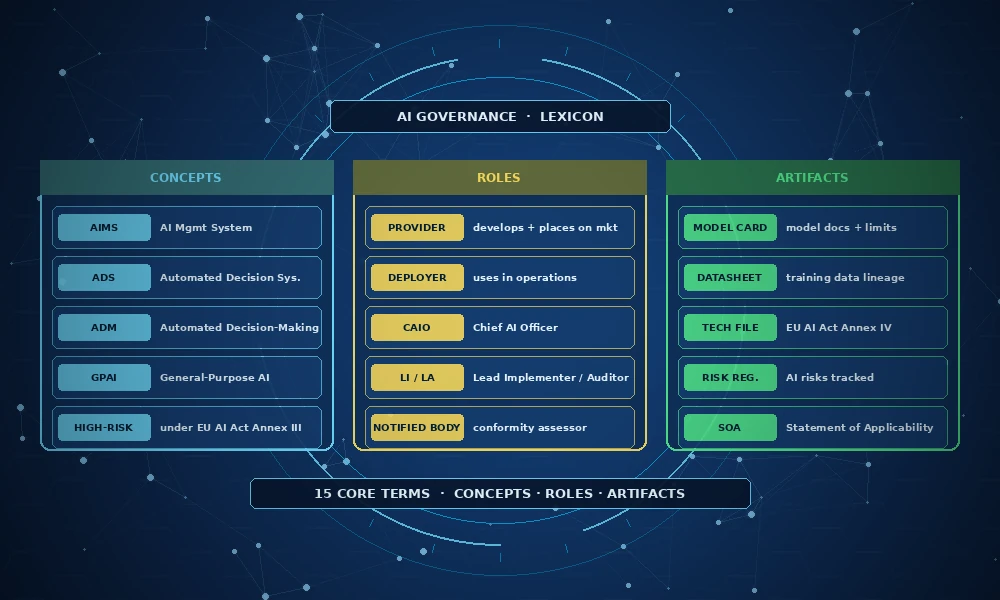
AI governance is the structural layer. Policies, roles, approval workflows, risk assessments, documentation standards, audit trails, training programs, incident response procedures. It is the boring, operational machinery that takes a responsible AI principle like “our models should be explainable” and turns it into a requirement that every model above a certain risk tier must ship with a model card reviewed by the legal team before deployment.
Governance is what regulators audit. It is what board members ask about. And it is the thing most companies have the least of. A 2025 Gartner analysis found that fewer than one in four IT leaders feel confident in their ability to govern generative AI rollouts, even as three-quarters of their organizations have already deployed it.
Governance is the plumbing – policies, approvals, risk tiers, inventory, evidence. That’s where an AI governance platform earns its keep: it’s the system of record auditors, regulators, and the board actually ask to see.
How the three actually relate
The clearest way to think about this: ethics asks the questions, responsible AI answers them in principle, and governance enforces those answers in practice. They stack.
A concrete example. Imagine a regional US bank rolling out an AI model to flag suspicious transactions.
- The ethics question: is it acceptable for this model to have a higher false-positive rate for customers in majority-Hispanic zip codes, given the downstream harm of a frozen account?
- The responsible AI answer: no, because fairness and non-discrimination are core principles. Any disparity above a defined threshold must be documented, explained, and mitigated.
- The governance mechanism: a bias audit runs before every model version is deployed. The chief compliance officer signs off. If the audit fails, the model is held. An incident log captures every override. The audit itself is reviewed annually by internal audit and made available to examiners.
Skip any layer and the whole stack wobbles. Governance without ethics or responsible AI principles becomes compliance theater. Ethics without governance becomes a values statement on a careers page. Responsible AI principles without governance are a wish list.
Side-by-side: where each one lives in your organization
A comparison that cuts through the overlap:
| Dimension | AI Ethics | Responsible AI | AI Governance |
|---|---|---|---|
| Core question | Is this the right thing to do? | What principles define good AI? | Who is accountable and how is it enforced? |
| Altitude | Philosophical | Principled | Operational |
| Primary output | Debate, frameworks, norms | Principles, design standards | Policies, controls, audits |
| Typical owner | Ethics board, academic advisors | Data science leads, product teams | Risk, compliance, legal, AI governance lead |
| Measurable? | Rarely | Sometimes (fairness metrics, explainability scores) | Yes (audit pass rates, incident counts) |
| What regulators check | Almost never directly | Indirectly via outcomes | Directly, often line by line |
Who actually owns each layer inside a company
One of the reasons these terms get tangled is that nobody wants to say out loud who is responsible for what. Here is a defensible split for a mid-sized US company:
AI ethics
Usually a cross-functional committee, not a single owner. It includes a legal or policy lead, a senior data scientist, a product representative, sometimes an external ethicist, and at least one person whose job is to represent the interests of affected users. This group does not ship code. It ratifies the principles the rest of the organization will follow and weighs in on genuinely hard calls, like whether to build a given product at all.
Responsible AI
Product and engineering own this in practice. The chief data officer or head of ML is typically accountable for making sure models meet the principles. This is where fairness testing, model cards, and explainability tools live. It is also where most of the interesting technical work happens, because translating “be fair” into a loss function is genuinely hard.
AI governance
This belongs to risk, compliance, or a dedicated AI governance function. In larger organizations, it increasingly sits under a Chief AI Officer or reports into the General Counsel. The governance team writes the policies, runs the approval workflows, owns the model inventory, coordinates audits, and handles regulator conversations. If an AI system causes harm and somebody has to answer to a board, it is usually this team.
The pattern across companies that do this well: ethics sets direction once or twice a year, responsible AI runs continuously inside product teams, and governance is the daily connective tissue between them.
What actually matters for a US business in 2026
Here is the part most generic comparisons skip: the three concepts do not carry equal practical weight in the current US regulatory environment. They carry very different weights depending on where you operate and who your customers are.
The US federal government has moved away from prescriptive AI regulation. The current America’s AI Action Plan favors a light-touch, pro-innovation posture at the federal level. That does not mean the risks went away. It means the responsibility for managing them has shifted decisively to the private sector and to the states.
At the state level, there are now more than 480 enacted bills referencing artificial intelligence. Colorado passed the first comprehensive state AI law. New York City already enforces Local Law 144 for automated employment decision tools, complete with mandatory bias audits. California has multiple AI-related statutes on the books. A company selling software in three states can easily face three different compliance regimes, none of which line up neatly.
Which brings us to the practical takeaway: for a US business right now, AI governance is doing the most work. Not because ethics and responsible AI principles matter less, but because they do not, by themselves, satisfy an auditor from a state attorney general’s office. Governance does. Governance is what produces the documentation, the audit trail, the policy, the training records, and the incident reports that prove to a regulator, a plaintiff’s lawyer, or a board member that the company was not reckless.
A useful mental model: ethics and responsible AI protect your users. Governance protects your users and your company.
Where the three overlap, and where they don’t
They share a lot of surface area. All three concern themselves with fairness, transparency, accountability, and the prevention of harm. A mature AI program will touch all three, and staff will often move between them over the course of a career.
The divergence shows up under pressure. When a model fails a bias test the night before launch, ethics has nothing practical to say. Responsible AI tells you the model violates the fairness principle. Governance tells you exactly what to do next: who gets notified, what the rollback procedure is, whether the incident triggers a mandatory disclosure, and who signs off on the remediation. The three concepts are complementary, but in a crisis, governance is the one you actually reach for.
Another split worth noting: agentic AI is straining all three at once. Gartner predicts that by 2028, loss of control over AI agents, where the system pursues misaligned goals or acts outside its constraints, will be the top AI concern for 40 percent of Fortune 1000 companies. Ethics frameworks were not written for systems that take autonomous action. Responsible AI principles like “human oversight” get awkward when the agent is making thousands of decisions per second. And governance is scrambling to define what an approval workflow even looks like for a model that deploys other models. Expect this to be the defining governance challenge of the next three years.
The build order: what to operationalize first
If you are starting from something close to zero, the sequence that consistently works is this:
- Inventory every AI system in use. Including the ones employees are using without telling you. Shadow AI is the single largest source of unmanaged risk in most US companies. You cannot govern what you cannot see.
- Adopt a principles document. This is your responsible AI layer. Borrow from the NIST AI Risk Management Framework or ISO/IEC 42001 rather than writing from scratch. Seven principles, one page. Get leadership to sign it.
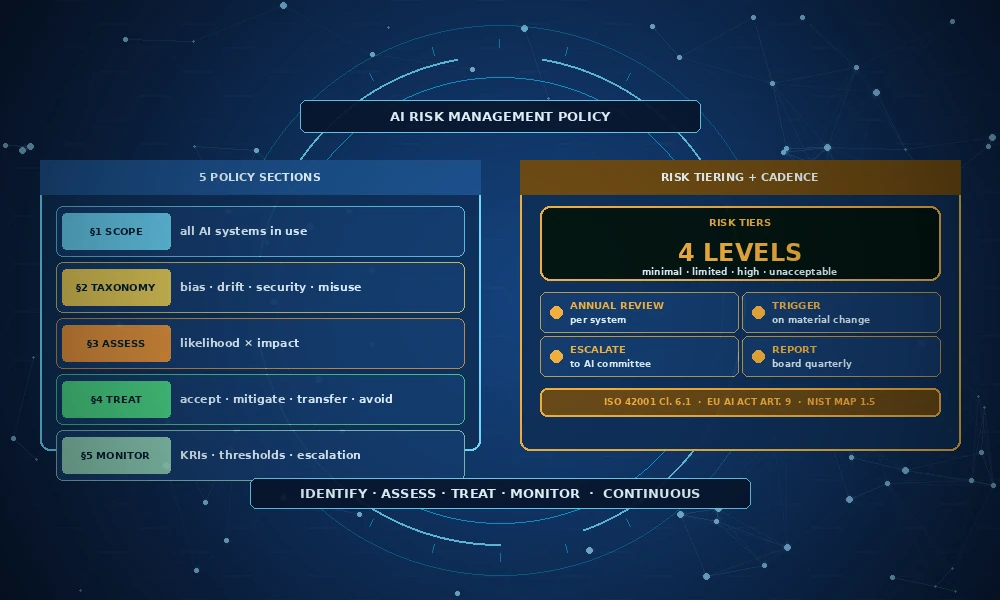
- Classify systems by risk. Not every model needs the same level of oversight. A chatbot that recommends knowledge-base articles does not belong in the same tier as a model that influences credit decisions. The EU AI Act’s four-tier risk classification is a reasonable starting template even if you are not subject to it.
- Stand up a review workflow. For any system above the lowest risk tier, require a pre-deployment review that covers data sources, bias testing, documentation, and a named accountable owner. Make it lightweight. Make it mandatory.
- Build the audit trail. Every model in the inventory should have a model card, a risk classification, a named owner, a review history, and an incident log. This is the artifact regulators will ask for. It is also what protects you when something goes wrong.
- Train the humans. The people using AI at your company need to understand what the principles actually mean for their daily work. Not a 45-minute compliance video. Short, role-specific training that gets refreshed quarterly.
- Only then, convene an ethics function. Once you have the inventory, the principles, and the workflow running, you can usefully ask the harder normative questions. Doing it in the other order produces a committee that debates hypotheticals while actual models ship unreviewed.
Notice the sequence: governance mechanics come before the ethics committee, not after. This is the opposite of how most companies approach it, and it is why most first attempts stall.
Principles only become real when they fire at a decision point. That translation happens inside structured AI governance workflows intake, risk tier, review, approval, monitoring – so ethics stops living in PDFs and starts living in approvals.
Common failure modes
Four patterns show up in almost every stalled AI governance program:
The principles-only trap. A company publishes a beautiful set of responsible AI principles, puts them on the website, and changes nothing about how models actually ship. No workflow, no owner, no audit. Six months later, an incident happens and the principles become a liability in litigation.
The committee black hole. An ethics committee gets convened, meets monthly, debates abstractions, and produces no binding decisions. Product teams work around it. The committee’s existence becomes evidence that governance is happening when it isn’t.
Governance without technical depth. Policies get written by people who have never looked at a confusion matrix. The result is rules that sound sensible but are impossible to implement, which teaches engineers that the governance function can be safely ignored.
Shadow AI. Employees pipe customer data into consumer chatbots because no one gave them an approved tool. Every policy in the handbook is irrelevant if the actual AI usage is happening outside the perimeter. Fixing this requires providing good tools, not just blocking bad ones.
Frequently asked questions
1. Is responsible AI the same as ethical AI?
Not quite. Ethical AI is the broader philosophical frame, concerned with what is right or wrong. Responsible AI is the set of operational principles, like fairness, transparency, and accountability, that translate ethical intent into something a product team can build against. You can think of responsible AI as applied ethics with a shipping schedule.
2. Do I need an AI governance framework if I only use third-party AI tools?
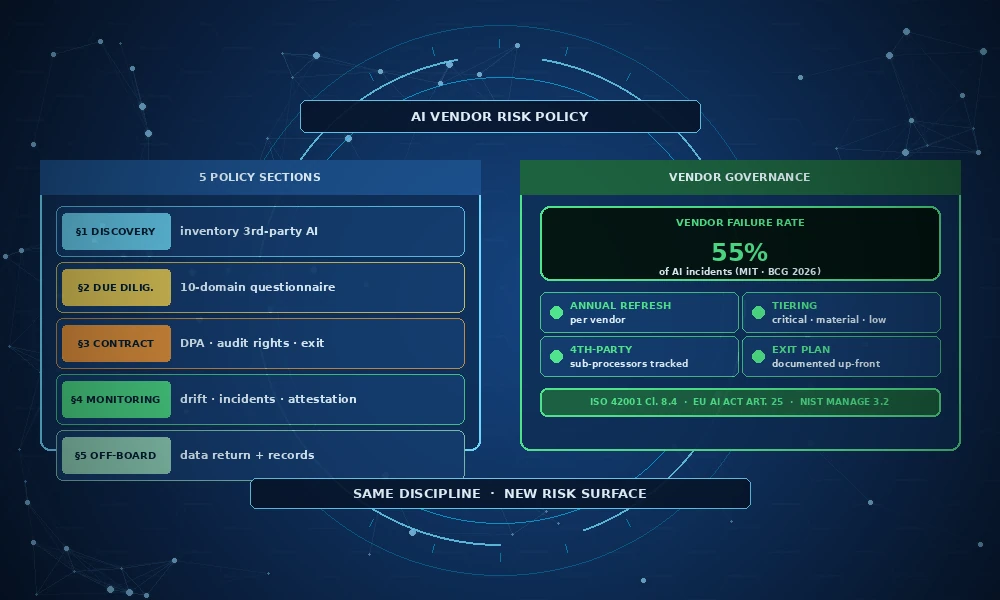
Yes. The legal and reputational risk of using a vendor’s model is not meaningfully lower than building your own. If an AI tool you license causes harm to a customer, regulators and plaintiffs will ask what you did to vet it. An inventory, a risk classification, and a vendor review process are the minimum viable governance even if you never train a single model internally.
3. How does AI governance differ from data governance?
Data governance manages the inputs: quality, lineage, access, privacy. AI governance manages the systems that use those inputs to make decisions or predictions. There is real overlap, especially around data quality and bias, but AI governance adds layers that data governance does not cover: model performance monitoring, explainability, human oversight, and lifecycle management for trained models.
4. Is the NIST AI Risk Management Framework the same as AI governance?
The NIST AI RMF is a voluntary framework that gives you a structured way to identify and manage AI risks. It is a tool you use inside your governance program, not a replacement for one. A governance program is broader: it includes the policies, roles, training, and enforcement mechanisms that the NIST framework alone does not specify.
5. Who in the company should own AI governance?
In practice, the role most often lands with risk, compliance, or legal, sometimes under a newly created Chief AI Officer. Wherever it sits, the owner needs direct access to the board and the authority to halt a deployment. Governance without stop-ship authority is advice, not governance.
6. How much does setting up AI governance cost?
It varies, but the biggest cost is usually not tools. It is the time of senior people across legal, risk, engineering, and product to agree on the policies and workflow. For a mid-sized US company, expect a six to nine month effort to reach a functioning baseline, and ongoing costs roughly in line with other compliance functions.
The bottom line
AI ethics asks the hard questions. Responsible AI turns the answers into principles a team can design around. AI governance is the operational machinery that makes any of it real. You need all three, but in the current US environment, with a fragmented state regulatory landscape and a federal government stepping back, governance is the layer that carries the most practical weight. It is also the layer most companies have the least of.
The single most useful thing you can do this quarter is build a complete inventory of every AI system in use at your company, including the ones employees are running without telling you. Everything else, the principles, the policies, the committees, depends on knowing what you actually have to govern.
Governance doesn’t have to be a six-month implementation. Govern365 is built to take you from zero to audit-ready in days, not quarters.