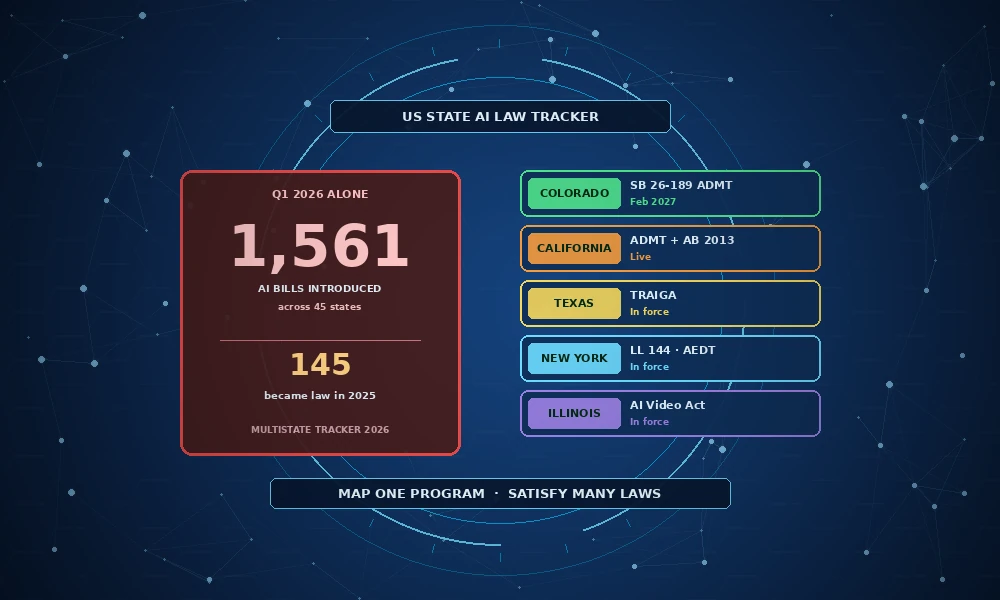
According to the NIST AI Risk Management Framework (NIST AI 100-1), an AI system without a documented risk assessment is not a governed system, regardless of how well it performs. That single principle now drives compliance programs across U.S. enterprises preparing for ISO 42001 certification, state-level AI laws, and federal procurement requirements. The pressure is real: the Colorado AI Act (SB24-205) takes effect February 2026 and requires deployers of high-risk AI to complete annual impact assessments. This guide gives you a working AI risk assessment template, a step by step process to populate it, and the framework mappings that turn a one-off assessment into a defensible audit artifact.
What an AI Risk Assessment Actually Is (and Where Most Teams Get It Wrong)
An AI risk assessment is a structured evaluation of how an AI system could cause harm, fail to meet its intended purpose, or expose the organization to legal, financial, or reputational damage. It documents the system’s context, identifies risks across categories, scores them, and assigns mitigations with owners. That part is straightforward.
The part that trips most teams up is treating an AI risk assessment like a standard IT risk register. They are not the same artifact. A traditional IT risk assessment focuses on confidentiality, integrity, and availability of data and systems. An AI risk assessment has to cover those, and then add a layer on top: bias and fairness, model drift, explainability, training data lineage, third-party model risks, and downstream impact on the rights of affected individuals.
ISO/IEC 42001:2023 Clause 6.1.2 makes this explicit. The standard requires organizations to assess risks to the AI system, the organization, and individuals or society. That third category is what most spreadsheet-based assessments miss entirely. The EU AI Act Article 9 goes further for high-risk systems and demands a continuous risk management process across the full lifecycle, not a point-in-time checkbox.
What most people get wrong: An AI risk assessment template is not a one-time document. It is a living artifact that gets updated whenever the model is retrained, the use case shifts, the deployment context changes, or new regulatory guidance lands. Treating it as a static deliverable is the single most common reason organizations fail their first ISO 42001 surveillance audit.
How AI Risk Assessment Differs from Traditional Risk Assessment
| Dimension | Traditional IT Risk Assessment | AI Risk Assessment |
|---|---|---|
| Primary focus | CIA triad (confidentiality, integrity, availability) | CIA plus fairness, transparency, accountability, robustness |
| Failure modes | Mostly known and deterministic | Probabilistic, emergent, often discovered post-deployment |
| Scope of harm | Organization and its data | Organization, data subjects, society, downstream users |
| Update cadence | Annual or on major change | On retraining, drift detection, use-case shift, or material guidance change |
| Required evidence | Controls, logs, policies | Controls, logs, policies, plus model cards, datasheets, evaluation results, lineage |
Three Frameworks That Anchor a Defensible Template
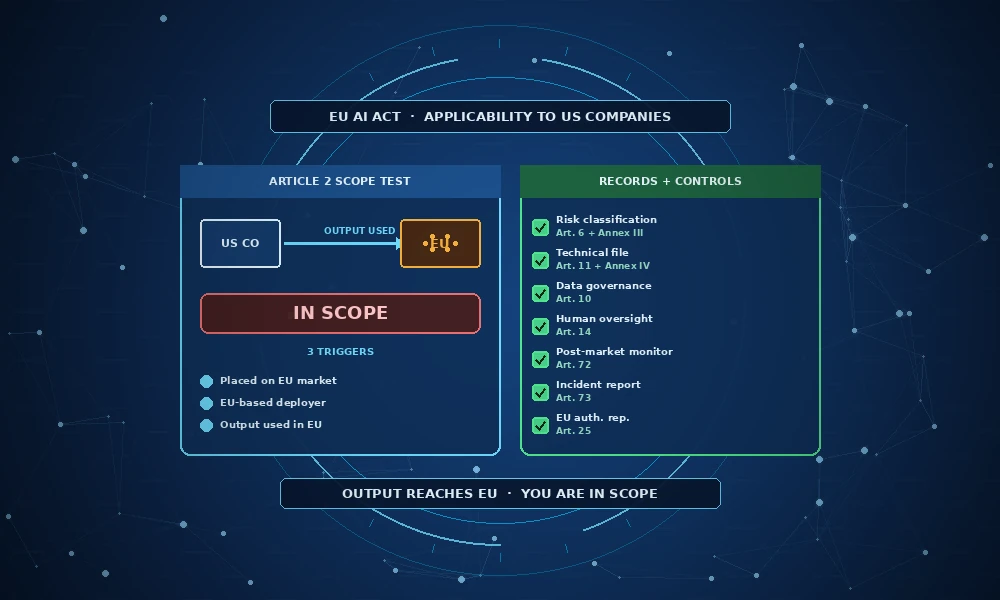
A useful AI risk assessment template is not invented from scratch. It is built on the intersection of three frameworks that U.S. organizations are most likely to face in 2026: NIST AI RMF, ISO/IEC 42001, and the EU AI Act (which applies to any U.S. company whose AI outputs are used in the EU).
Each framework asks slightly different questions. Mapping your template to all three at once means you build the assessment once and use the same artifact across multiple compliance programs.
NIST AI RMF: The Functional Backbone
The NIST AI Risk Management Framework organizes AI risk management into four functions: Govern, Map, Measure, and Manage. The Map function is where risk assessment lives. NIST AI RMF 1.0 specifies that mapping requires identifying the AI system’s context, intended purpose, capabilities, limitations, stakeholders, and the categories of harm it could produce. The Generative AI Profile (NIST AI 600-1), released in July 2024, adds twelve specific risks unique to generative systems, including confabulation, dangerous or violent content, and intellectual property exposure.
Treat NIST AI RMF as your functional backbone. Its categories are the most operationally specific and translate cleanly into template fields.
ISO/IEC 42001: The Audit-Grade Structure
ISO/IEC 42001 is the world’s first AI Management System (AIMS) standard, published in December 2023. Clause 6.1.2 requires a documented risk assessment process, and Annex A specifies 38 controls across nine domains. Where NIST tells you what to assess, ISO 42001 tells you how to document it so an external auditor can verify the process. If certification is on your roadmap, your template needs an explicit ISO 42001 column.
EU AI Act: The Legal Floor for High-Risk Systems
Even U.S.-only companies have to take the EU AI Act seriously if their systems touch EU users. Article 9 requires a continuous risk management system for high-risk AI systems, covering identification, estimation, evaluation, and mitigation of foreseeable risks across the full lifecycle. The European Commission’s AI Act compliance timeline places general-purpose AI obligations from August 2025 and high-risk system obligations from August 2026. A template that maps to Article 9 future-proofs your assessment against EU enforcement.
| Template Field | NIST AI RMF | ISO/IEC 42001 | EU AI Act |
|---|---|---|---|
| System context | Map 1.1 | Clause 4.1, A.6.2.2 | Article 9(2)(a) |
| Intended purpose | Map 1.6 | A.6.2.3 | Article 9(2)(b) |
| Risk identification | Map 5.1 | Clause 6.1.2 | Article 9(2)(b)(c) |
| Measurement and metrics | Measure 2 | A.6.2.4 | Article 9(7) |
| Mitigation and treatment | Manage 1, 2 | Clause 6.1.3, A.6.2.5 | Article 9(5) |
| Continuous monitoring | Manage 4 | Clause 9.1, A.6.2.6 | Article 9(2)(d), 72 |
The AI Risk Assessment Template (Field by Field)
Below is a template that satisfies NIST AI RMF, ISO/IEC 42001, and EU AI Act Article 9 in a single artifact. It has eight sections. Every AI system in your inventory should have a completed version of this template, version-controlled, and updated on the triggers listed in the previous section.
Section 1: System Identification
- System name and unique identifier (used across the AI inventory)
- System owner, technical lead, and accountable executive
- Deployment status: in development, in production, decommissioned
- Date of first deployment and date of last material change
- Version of underlying model or models, including third-party foundation models
Section 2: Context and Purpose
- Intended purpose described in plain language
- Out-of-scope uses explicitly listed (this is what auditors check first)
- Affected stakeholders: end users, data subjects, third parties, regulators
- Operational context: industry, jurisdiction, deployment environment
- Decision impact: advisory, automated, or autonomous
Section 3: Risk Classification
Classify the system against each applicable framework. For EU AI Act, this is binding: prohibited, high-risk, limited-risk, or minimal-risk. For NIST and ISO 42001, this drives the depth of assessment.
- EU AI Act risk tier (with Article reference for the classification)
- Internal risk tier (high/medium/low based on your organization’s matrix)
- Sensitive use flags: biometric, employment, education, essential services, law enforcement, migration, justice, democratic processes
Section 4: Risk Identification
This is the section that gets the most attention from auditors and the least attention from teams under deadline pressure. Identify risks across at least seven categories. Use the questions below as prompts; the goal is not to list every conceivable risk but to ensure no category is silently skipped.
| Risk Category | Diagnostic Questions |
|---|---|
| Bias and fairness | Could outputs systematically disadvantage a protected class? Has the system been tested across demographic subgroups? Is training data representative of the deployment population? |
| Robustness and security | How does the system behave on adversarial or out-of-distribution inputs? Are prompt injection and data poisoning controls in place? What happens when the model fails? |
| Privacy and data protection | Does training or inference involve personal data? Is there a lawful basis under applicable privacy law? Could outputs reveal information about training data subjects? |
| Transparency and explainability | Can affected individuals understand why a decision was made? Are model cards and datasheets maintained? Is there a meaningful human review path? |
| Accuracy and reliability | What are the documented accuracy thresholds? How are confabulations or hallucinations detected? What is the drift detection cadence? |
| Third-party and supply chain | Does the system rely on foundation models, APIs, or training data from third parties? What contractual protections cover model changes, breaches, or service withdrawal? |
| Societal and human rights | Could deployment affect access to employment, housing, credit, healthcare, or justice? Could it concentrate market power, displace labor, or amplify misinformation? |
Section 5: Risk Analysis and Scoring
For each identified risk, score likelihood and impact. A 5×5 matrix is enough; greater precision implies false confidence at this stage. Use plain definitions for each scale point so different assessors converge on similar scores.
- Likelihood (1-5): from rare event to near-certain in normal operation
- Impact (1-5): from negligible to catastrophic, defined separately for individuals, the organization, and society
- Inherent risk score (likelihood x impact, before controls)
- Residual risk score (after planned controls)
- Risk owner and review date
Section 6: Controls and Mitigations
Every risk above your acceptance threshold needs a treatment. Treatments fall into four categories: avoid, reduce, transfer, or accept. The template should record which treatment applies, the specific controls, who owns them, and the evidence that proves they are operating.
Section 7: Evidence and Artifacts
Auditors do not score your assessment on the words you wrote. They score it on the evidence behind each claim. Required artifacts typically include the model card, the datasheet for the dataset, evaluation results, fairness test outputs, security testing reports, third-party model agreements, and the training data lineage. Link each artifact directly from the template field it supports.
Section 8: Approval and Review
- Sign-off from system owner, accountable executive, and independent reviewer (typically the AI governance lead or equivalent role)
- Date of next scheduled review (no longer than 12 months for high-risk systems, often shorter)
- Triggers that force an out-of-cycle review: retraining, material accuracy change, new regulatory guidance, post-incident analysis
Step by Step: Populating the Template for One AI System
The template is the artifact. The process below is how you fill it in defensibly. Allow two to four hours for a first pass on a single system, more for complex or high-risk deployments.
Step 1: Scope the Assessment
Confirm what counts as one system. If you are assessing a customer support chatbot, the boundary includes the foundation model, the retrieval layer, the prompt logic, the moderation filter, and the human escalation path. Drawing the boundary too narrowly leaves risks outside the assessment. Drawing it too broadly produces a document no one will maintain.
Step 2: Build the Stakeholder List
Identify everyone who is affected by the system, including those who never interact with it directly. For a credit scoring model, that includes applicants, branch staff, the compliance team, the regulator, and rejected applicants who may exercise rights of explanation. NIST AI RMF Map 1.2 and 1.3 require this stakeholder analysis before risk identification, and skipping it is the most common reason assessments miss societal-level risks.
Step 3: Classify the System Against Each Framework
Walk through the EU AI Act Annex III high-risk list, the NIST AI RMF context categories, and your internal risk matrix. Document the classification reasoning, not just the result. If you classify a hiring tool as not high-risk under the EU AI Act, the auditor will want to see the analysis that led there. The OECD AI System Classification Framework provides useful structure for the reasoning if your internal taxonomy is still maturing.
Step 4: Identify Risks Across All Seven Categories
Use the diagnostic questions from Section 4 of the template. Run the exercise as a structured workshop with the technical lead, a domain expert, a legal or privacy reviewer, and a representative of affected users where possible. A solo assessment misses risks. The goal is to produce a list, not yet to score.
Step 5: Score Likelihood and Impact
Score each risk twice: once before controls (inherent) and once after planned controls (residual). The gap between inherent and residual is what your treatment plan has to close. Use the same scale definitions across every assessment in your inventory; inconsistent scoring across systems is one of the most visible audit findings.
Step 6: Define Treatments and Assign Owners
For each risk above your acceptance threshold, document the treatment, the specific controls, the owner, the implementation date, and the evidence that will demonstrate the control is operating. ISO 42001 Clause 6.1.3 requires this treatment plan to be documented; absent ownership and dates, it is not a plan.
Step 7: Attach Evidence
Link the model card, datasheet, evaluation results, and any external testing reports directly to the relevant template fields. A risk assessment with claims but no linked evidence is a story, not a control. The 2024 enforcement record on AI bias claims (across the EEOC, FTC, and state AGs) shows that organizations without contemporaneous evidence settle quickly and pay more.
Step 8: Approve, Publish, and Schedule the Next Review
Route the completed assessment for sign-off. Publish it to a location that the second-line risk function and (for ISO 42001 certification) the external auditor can access. Set the review trigger calendar in the same system that runs the assessment, so a model retraining event automatically opens a review task. Manual reminders break.
Common Mistakes That Create Audit Findings
Across enterprise governance programs preparing for ISO 42001 certification or EU AI Act readiness, the same patterns produce non-conformities. Five of them recur.
Treating the Assessment as a Compliance Document
If the assessment is written for the auditor and never read by the engineering team, it is not a control. The strongest assessments are written so the technical lead actually uses them when triaging incidents or planning the next training run.
Confusing the Risk Assessment with the Impact Assessment
They are related but distinct. The risk assessment looks at what could go wrong with the system. An algorithmic impact assessment (required under the Colorado AI Act, NYC Local Law 144, and several federal procurement rules) looks at how the system affects specific populations and rights. The same template can feed both, but the questions are different.
Skipping Out-of-Scope Use Cases
Auditors test the boundary of the system, not the center. A document that lists three approved uses but never lists the uses that are explicitly prohibited (e.g., “this customer service model must not be used for credit decisions”) gets flagged. The prohibitions are often more diagnostic than the permissions.
Missing the Third-Party Layer
If your system uses a foundation model from a third party, the third party’s risks are now your risks. Your assessment must cover what happens when the upstream model is updated, deprecated, or breached. Contractual protections for model change notice, evaluation access, and incident disclosure should be referenced from the assessment.
Static Documents in a Dynamic System
This is the largest single failure mode. Models drift. Training data changes. Use cases expand. Regulators issue new guidance. A risk assessment that has not been updated in eight months on a system that was retrained four months ago is not a current control. Auditors check version history before they read content.
Practitioner note: Govern365.ai’s AI model registry was designed around this exact failure pattern. Each registered system links to its current risk assessment, automatically maps it to the relevant ISO 42001 clauses and EU AI Act articles, and triggers a review task when a retraining event or material change is logged. The point is not the tool; the point is that any sustainable AI risk assessment process has to be event-driven, not calendar-driven.
From a Template to a Risk Assessment Program
One completed template is a control. A program is a system that produces, maintains, and improves those controls across an entire AI inventory. Three things separate the two.
An inventory that the assessment lives in. If you do not know how many AI systems your organization runs, you cannot have a risk assessment program. The first deliverable is the inventory; the assessment template attaches to each row.
Defined roles. ISO 42001 Clause 5.3 requires defined roles and responsibilities. At minimum, this means a system owner, an AI governance lead, an independent reviewer, and a clear path to executive accountability. The Chief AI Officer or equivalent role exists in roughly half of Fortune 500 organizations as of late 2025; in the rest, the responsibility usually sits with the CISO, CDO, or CTO. The title matters less than the documented authority.
Continuous evidence collection. Audit-grade assessments are built on contemporaneous evidence, not reconstructed at audit time. The platforms that solve this problem (Govern365.ai is one of several) treat evidence as a first-class object: model cards, evaluation results, third-party model agreements, and incident records all attach to the system record and roll up into the assessment automatically.
Frequently Asked Questions
How long should an AI risk assessment take to complete?
For a single system, expect two to four hours of focused work for a low-risk deployment, and one to two days for a high-risk system that touches regulated decisions. The first assessment in an organization always takes longer because the templates, scoring scales, and stakeholder list have to be built. Subsequent assessments use the same artifacts and move faster.
Who should sign off on an AI risk assessment?
At minimum, three people: the system owner (accountable for the system in operation), the AI governance lead or equivalent (independent reviewer), and an executive sponsor with budget authority. For high-risk systems under the EU AI Act or for ISO 42001 certification, add the legal or compliance function. Single-signature approvals are an audit finding waiting to happen.
Do I need a separate template for generative AI?
No, but the same template needs additional risk categories. NIST AI 600-1 (the Generative AI Profile, July 2024) lists twelve risks specific to generative systems, including confabulation, dangerous content, and intellectual property exposure. Add these as additional rows in Section 4 of the template rather than maintaining a parallel document.
How does an AI risk assessment differ from a Data Protection Impact Assessment?
A DPIA assesses risks to personal data and the rights of data subjects under privacy law. An AI risk assessment assesses risks across the full set of AI-specific harms, of which privacy is one. Where personal data is processed, both are typically required. The AI risk assessment can reference the DPIA rather than duplicating its content.
How often should the risk assessment be reviewed?
On a fixed cadence (typically 12 months for high-risk systems, sometimes shorter), and on event triggers: model retraining, material change in use case, new regulatory guidance, post-incident analysis, or a significant change in the deployment population. EU AI Act Article 9 requires the risk management system to operate continuously, which in practice means event-driven review, not calendar-only.
What evidence does an external auditor expect to see?
Beyond the completed template: the model card, the datasheet for the dataset, fairness and accuracy test results with timestamps, security and adversarial testing reports, third-party model agreements where applicable, training data lineage records, the version history of the assessment itself, and meeting minutes or sign-off records for material changes. Contemporaneous evidence is the standard; reconstructed evidence is not.
Can I use the same template for an internal AI tool and a customer-facing AI tool?
Yes. The fields stay the same; the answers and the evidence depth differ. Customer-facing systems typically have more affected stakeholders, higher impact scores, and a deeper evidence trail. Internal tools often have lower impact but novel risks (e.g., shadow AI in productivity tools). One template, calibrated answers.
The Bottom Line on AI Risk Assessment Templates
A defensible AI risk assessment template is not a long document. It is eight tightly defined sections that map cleanly to NIST AI RMF, ISO/IEC 42001, and EU AI Act Article 9, populated with contemporaneous evidence and updated on the events that change the system. The template is the easy part. The discipline of running it across every AI system, every time the system materially changes, is what separates organizations that pass their first ISO 42001 surveillance audit from those that do not.
Start with one system this week. Use the eight sections above. Score honestly. The next 30 will go faster.
Ready to operationalize your AI risk assessments?
Govern365.ai gives you a model registry, a pre-built risk assessment template mapped to ISO 42001, NIST AI RMF, and the EU AI Act, and the audit evidence layer that holds it all together.
Start your 14-day free trial – Govern365.ai, by the Global AI Certification Council