The EU AI Act’s penalty regime became active on 2 August 2025, according to the European Commission’s official implementation timeline. At that moment, regulators gained the authority to impose fines of up to EUR 35 million or 7% of a company’s total worldwide annual turnover, whichever is higher, for the most serious violations. For a company reporting USD 10 billion in global revenue, that is a USD 700 million exposure, and that is before any market withdrawal orders, civil liability claims, or reputational damage.
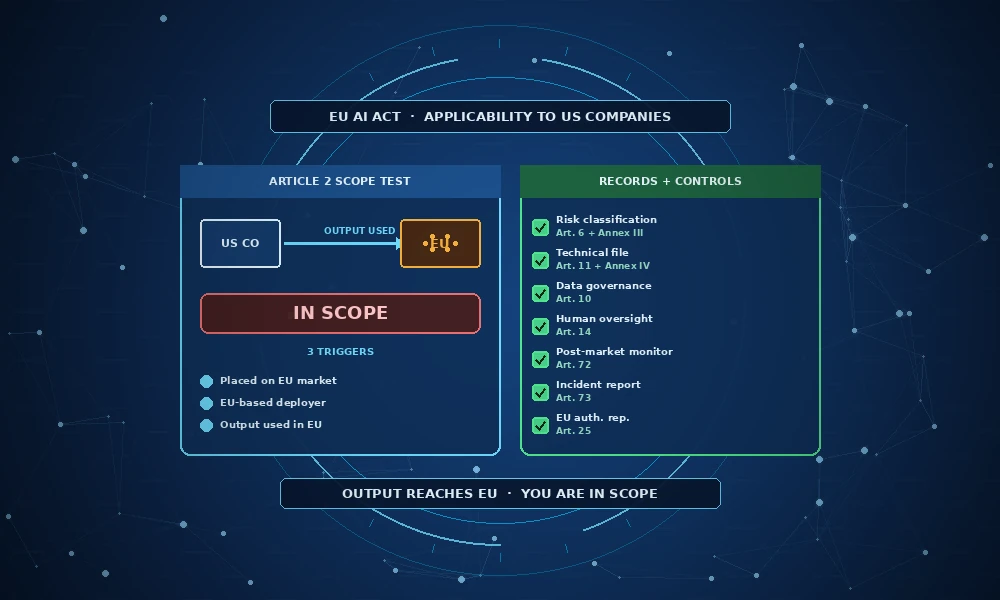
For US organisations with any EU market exposure, the regulation’s extraterritorial scope means this is not a European problem to watch from a distance. If your AI system’s output affects EU residents, you are in scope. The prohibited practices bans have been enforceable since February 2025. The full high-risk AI framework arrives in August 2026. The compliance window is closing.
This article maps the complete EU AI Act penalty structure, explains who faces which fines for which violations, and outlines the concrete steps that turn regulatory exposure into managed risk.
1. Why the EU AI Act’s Penalties Exceed GDPR
Most compliance teams benchmarked the EU AI Act against GDPR and concluded they had seen this before. That assessment underestimates the exposure.
GDPR’s maximum fine is EUR 20 million or 4% of global annual turnover. The EU AI Act’s ceiling for its most serious category is EUR 35 million or 7%, according to Article 99(3). That is 75% higher in absolute terms and 75% higher as a percentage of revenue.
The reason the EU legislature set the bar higher is structural. GDPR protects data. The EU AI Act protects against a broader category of harms: manipulation, discrimination, loss of fundamental rights, and systemic risks to critical infrastructure. The regulatory logic is that greater potential harm justifies greater deterrence.
There is also a second difference that matters operationally: the EU AI Act imposes obligations at multiple points in the supply chain simultaneously. A high-risk AI system can expose its developer (the provider), its user (the deployer), its importer, and its distributor to separate enforcement actions under separate articles. GDPR’s controller/processor framework is simpler by comparison.
| Key comparison: GDPR maximum: EUR 20M or 4% of global turnover. EU AI Act maximum: EUR 35M or 7% of global turnover. For a USD 5B revenue company, the difference between GDPR’s worst-case and the AI Act’s worst-case is approximately USD 150M. |
2. The Three-Tier Penalty Structure: A Full Breakdown
The EU AI Act structures its penalties across three tiers. The tier that applies to your organisation depends on which article you violate, not on whether the violation was intentional. Understanding the tier mapping is the starting point for any honest risk assessment.
| Violation Type | Max Fine (EUR) | Max Fine (% Turnover) | Key Articles |
| Prohibited AI practices (Article 5) | EUR 35 million | 7% of global annual turnover | Art. 5, Art. 99(3) |
| High-risk AI / operator obligations | EUR 15 million | 3% of global annual turnover | Art. 16, 26, 99(4) |
| GPAI model obligations | EUR 15 million | 3% of global annual turnover | Art. 101 |
| Misleading information to authorities | EUR 7.5 million | 1% of global annual turnover | Art. 99(5) |
| SME / startup (same offence) | Whichever is LOWER of amount or % | Protected threshold | Art. 99(6) |
Table source: EU AI Act Regulation (EU) 2024/1689, Article 99 (official text via artificialintelligenceact.eu)
Tier 1 — EUR 35 Million / 7% of Global Turnover: Prohibited Practices
The eight practices banned under Article 5 of the EU AI Act became enforceable on 2 February 2025. These are absolute prohibitions with no grace period, no conformity assessment pathway, and no transitional arrangement that delays them. They include:
- AI systems that use subliminal or manipulative techniques to materially distort behaviour in ways that cause harm
- Systems that exploit vulnerabilities based on age, disability, or social or economic situation
- Social scoring systems operated by public or private actors
- Real-time remote biometric identification in public spaces (outside narrow law enforcement exceptions)
- Untargeted scraping of facial images from the internet or CCTV to build recognition databases
- Emotion recognition in workplace or educational settings without safety justification
- Biometric categorisation systems used to infer protected characteristics
- Predictive policing based on profiling or assessment of individual traits
For US organisations, the practical risk in this tier comes from consumer-facing AI products. Recommendation engines optimised for engagement through psychological vulnerability exploitation, dark-pattern personalisation systems, and certain HR AI tools that score employees based on inferred characteristics all sit in territory where enforcement counsel should be consulted immediately.
Tier 2 – EUR 15 Million / 3% of Global Turnover: High-Risk AI Obligations
This tier covers non-compliance with the substantive obligations for high-risk AI systems and their operators. Under Article 99(4), it applies to violations by providers (Article 16), authorised representatives (Article 22), importers (Article 23), distributors (Article 24), deployers (Article 26), notified bodies, and transparency obligations under Article 50. The same maximum EUR 15 million or 3% of global turnover also applies to GPAI model providers under Article 101.
High-risk AI systems are defined primarily by their domain of application. Annex III identifies eight categories, including AI used in biometric identification, critical infrastructure management, education, employment and worker management, access to essential private and public services, law enforcement, migration and border control, and the administration of justice. A recruitment screening algorithm, a credit decisioning model, or a benefits eligibility system operated by a US company and affecting EU residents qualifies.
Full enforcement of the high-risk framework under Annex III begins on 2 August 2026. But preparation takes longer than most compliance teams realise. Technical documentation packages for complex AI systems typically require three to six months to complete properly. Conformity assessments, for systems requiring third-party review, add further time. Organisations that begin this work in the second half of 2026 will not meet the deadline.
Tier 3 — EUR 7.5 Million / 1% of Global Turnover: Misleading Authorities
Under Article 99(5), providing incorrect, incomplete, or misleading information to notified bodies or national competent authorities carries fines of up to EUR 7.5 million or 1% of global turnover. This tier is not trivial it is specifically designed to deter organisations from managing a regulatory investigation through selective disclosure or misrepresentation.
One practical implication for in-house legal and compliance teams: the same information governance standards that apply to GDPR investigations and competition proceedings now apply to AI Act enforcement. Correspondence with national market surveillance authorities, documentation produced in response to information requests, and technical records provided to notified bodies all carry legal risk if they are incomplete or misleading.
3. The Enforcement Timeline: What’s Active Right Now
The EU AI Act does not switch on all at once. Its obligations apply on a staggered schedule, which means different exposures are live at different points. The table below maps the enforcement calendar against the compliance actions each milestone requires.
| Date | What Became Enforceable | Action Required |
| 1 Aug 2024 | EU AI Act entered into force | Begin AI system inventory |
| 2 Feb 2025 | Prohibited practices (Art. 5) + AI literacy (Art. 4) NOW ACTIVE | Audit all systems against banned list immediately |
| 2 Aug 2025 | GPAI obligations + EU AI Office operational + Penalty regime active | GPAI providers: technical documentation, copyright compliance, training data summaries |
| 2 Aug 2026 | Full high-risk AI framework (Annex III) + GPAI fines enforceable | Complete conformity assessments, register in EU database, implement post-market monitoring |
| 2 Aug 2027 | High-risk AI embedded in products (Annex I) + GPAI model grace period ends | Legacy system compliance deadline |
Source: EU AI Act Article 113 implementation timeline; DLA Piper analysis (August 2025).
Several points in this timeline deserve emphasis for US teams assessing their current exposure:
- February 2025 violations are already actionable. Market surveillance authorities can investigate and fine organisations for prohibited practices right now. If your AI systems include any of the eight banned practices, this is not a future compliance task.
- The EU AI Office is operational. As of 2 August 2025, the EU AI Office the central enforcement body for GPAI models and cross-border systemic risks is fully operational and resourced. Investigations into large-scale AI systems have begun.
- August 2026 is the moment compliance becomes universal. The full Annex III high-risk framework, transparency obligations under Article 50, and GPAI fines all converge in August 2026. For enterprises with complex AI portfolios, the preparation work needs to start now.
4. Who Faces Penalties: Roles, Responsibilities, and the Value Chain
One of the distinguishing features of the EU AI Act compared to prior regulatory frameworks is its explicit allocation of obligations across multiple roles in the AI supply chain. Misidentifying your role or assuming that purchasing an AI system from a vendor absolves your organisation of liability is itself a compliance error.
| Role | Definition | Core Obligations | Penalty Exposure |
| Provider | Develops or places AI on EU market | Conformity assessments, technical documentation, risk management system, EU database registration | Highest full obligation stack |
| Deployer | Uses AI systems in business operations | Human oversight, transparency to affected persons, FRIA (certain systems), employee notification | Art. 26 violations up to EUR 15m / 3% |
| Importer | Brings non-EU AI into EU market | Verify provider compliance, cooperate with authorities | Art. 23 violations up to EUR 15m / 3% |
| Distributor | Makes AI available in EU without modifying it | Check compliance marks, register, report risks | Art. 24 violations up to EUR 15m / 3% |
The role that carries the highest burden is the provider. If your organisation develops an AI system and places it on the EU market even if you are headquartered in the US, even if you have no EU office you are a provider and subject to the full stack of Article 16 obligations.
A complication arising in 2025 and 2026 is the quasi-provider concept under Article 25. A company that takes a third-party AI system and substantially modifies it before placing it on the EU market assumes the obligations of a provider for that modified system. This matters for US enterprises that are building custom AI applications on foundation models. If the customisation is material enough to change the system’s intended purpose or risk profile, the enterprise becomes the responsible party for compliance, not the foundation model provider.
| Practical test for US enterprises:Do you develop or substantially modify an AI system used by EU residents? You are likely a provider.Do you use an AI system in business decisions that affect EU residents? You are a deployer.Do you source AI products from non-EU vendors and sell them in the EU? You may be an importer.Each role carries distinct legal obligations and distinct penalty exposure. Running a role audit before the August 2026 deadline is not optional it is the precondition for everything else. |
5. Extraterritorial Reach: Why US Companies Are Already In Scope
The EU AI Act follows the same territorial logic as GDPR: regulation is triggered by where the impact occurs, not where the technology originates. Article 2(1) is explicit. The Act applies to providers placing AI systems on the EU market regardless of their location, deployers located in the EU, and providers and deployers in third countries where the AI system’s output is used within the EU.
As a February 2026 analysis by DLA Piper notes, a US company does not need a European office, European employees, or a European entity to fall within scope. The triggering factor is whether your AI system’s output affects EU residents.
The practical implications are straightforward but frequently underestimated:
- SaaS platforms with EU customers: If your platform is accessible to EU users and uses AI for any function covered by the Act — content recommendations, credit scoring, hiring decisions, risk profiling the relevant provisions apply to those use cases.
- APIs consumed by EU companies: If EU enterprises integrate your API into their products and the AI output affects their EU users, you have EU market exposure.
- AI tools used in global HR processes: If a US enterprise uses AI for recruitment or performance management, and that process applies to EU-based employees, the deployer obligations under Article 26 apply to those specific deployments.
The “Brussels Effect” the tendency for EU regulatory standards to become de facto global standards due to market size is already reshaping how US enterprises approach AI governance. Companies that align their AI compliance frameworks with EU AI Act requirements now are building infrastructure that will serve them across jurisdictions as global AI regulation converges.
6. Beyond Fines: The Non-Financial Consequences of Non-Compliance
Framing the EU AI Act exclusively around financial penalties misses a significant portion of the actual business risk. The consequences of non-compliance extend well beyond the fine amounts set out in Article 99.
Market Withdrawal and Product Bans
National market surveillance authorities have the power to order the withdrawal or recall of non-compliant AI systems from the EU market. For a software company generating material revenue from EU customers, a product ban is existential in a way that a EUR 15 million fine is not. Italy’s implementing legislation (Law No. 132/2025), which entered into force in October 2025, goes further: it explicitly includes disqualification from contracting with public administrations and exclusion from grants and subsidies as available enforcement measures.
Civil Liability
The EU AI Act establishes individual rights, including the right to explanation for automated decisions under Article 86 and the right to lodge a complaint with a market surveillance authority under Article 85. These rights create a basis for civil claims. Organisations deploying high-risk AI systems in domains like credit, employment, and benefits assessment face concurrent exposure to regulatory enforcement and private litigation from individuals affected by non-compliant AI decisions.
Criminal Liability in National Jurisdictions
The Act itself is an administrative regulation, but several Member States are implementing it in ways that create criminal exposure for senior individuals. Italy’s Law 132/2025, referenced above, establishes criminal penalties including imprisonment for specific AI-related offences. Legal counsel in each relevant jurisdiction needs to assess whether executive liability provisions apply.
Reputational Risk
For enterprises that compete on trust financial services, healthcare, HR technology the reputational consequences of a public enforcement action under the EU AI Act may exceed the financial penalty. National competent authorities are required to publish the fines they impose. Market surveillance actions and product withdrawals are public. The first major enforcement cases under the EU AI Act will generate significant press coverage and set the tone for how regulators use their powers.
7. How Penalties Are Assessed: The Factors That Determine Severity
The fine amounts in Article 99 are maximums, not default outcomes. The regulation explicitly requires that penalties be effective, proportionate, and dissuasive. Enforcement authorities will assess each case individually, and the factors they weigh matter for how organisations should structure their compliance defence.
The key aggravating and mitigating factors include:
- Nature, gravity, and duration of the violation: Systemic failures affecting large numbers of EU residents, or violations that persist after the organisation becomes aware of them, attract heavier penalties.
- Intentionality or negligence: Deliberate deployment of prohibited AI practices will be treated differently from a failure of technical documentation in a first-generation compliance programme.
- Degree of responsibility and cooperation: Organisations that identify compliance gaps and engage proactively with authorities generally fare better than those that resist investigation.
- Previous violations: Repeat offences are explicitly considered in penalty calibration.
- Size of the organisation and market: Penalties for SMEs apply at whichever of the fixed amount or percentage is lower. For large enterprises, the percentage typically produces the higher figure.
- Whether the violation involved personal data: Where AI non-compliance intersects with GDPR violations, enforcement may involve both the market surveillance authority and the data protection authority, compounding the total exposure.
One consequence of this structure is that documented compliance efforts carry real evidentiary value. An organisation that can demonstrate a systematic risk classification programme, evidence-based technical documentation, and active human oversight processes is better positioned in any enforcement proceeding than one that cannot show its governance reasoning.
8. Connecting to ISO 42001: The Compliance Architecture That Reduces Penalty Risk
Penalty avoidance under the EU AI Act is, fundamentally, a governance problem. The regulation requires organisations to demonstrate structured, documented, and auditable AI management. That is precisely what ISO/IEC 42001:2023 the international standard for AI Management Systems provides.
ISO 42001 establishes requirements for an AI Management System (AIMS) that maps directly to the EU AI Act’s technical and governance obligations. The standard’s Clause 6.1 risk management requirements align with the risk management system required under Article 9 of the AI Act. Its audit evidence and documentation requirements align with Article 11 (technical documentation) and Article 12 (record-keeping). Its human oversight provisions parallel the deployer obligations under Article 26.
For organisations that have already implemented GDPR compliance through ISO 27001 or 27701, the AIMS architecture is familiar. The key difference is that ISO 42001 adds AI-specific elements: AI system lifecycle management, algorithmic risk assessment, AI impact assessment, and training data governance documentation.
Organisations certified to ISO 42001 are not automatically compliant with the EU AI Act the two frameworks have different scope and different specific requirements. But a well-implemented AIMS gives enforcement authorities a structured evidence base that demonstrates governance intent and operational control. In penalty assessment, that evidence base matters.
| PRODUCT INTEGRATIONGovern365.ai’s AI model registry automatically maps each AI system in your inventory to its applicable ISO 42001 clauses and EU AI Act risk categories, generating the documentation structure required for both certification and regulatory audit preparation. This is the kind of structured evidence base that transforms penalty risk from an open question into a managed position. |
9. A Practical Compliance Roadmap: From Inventory to Audit-Ready
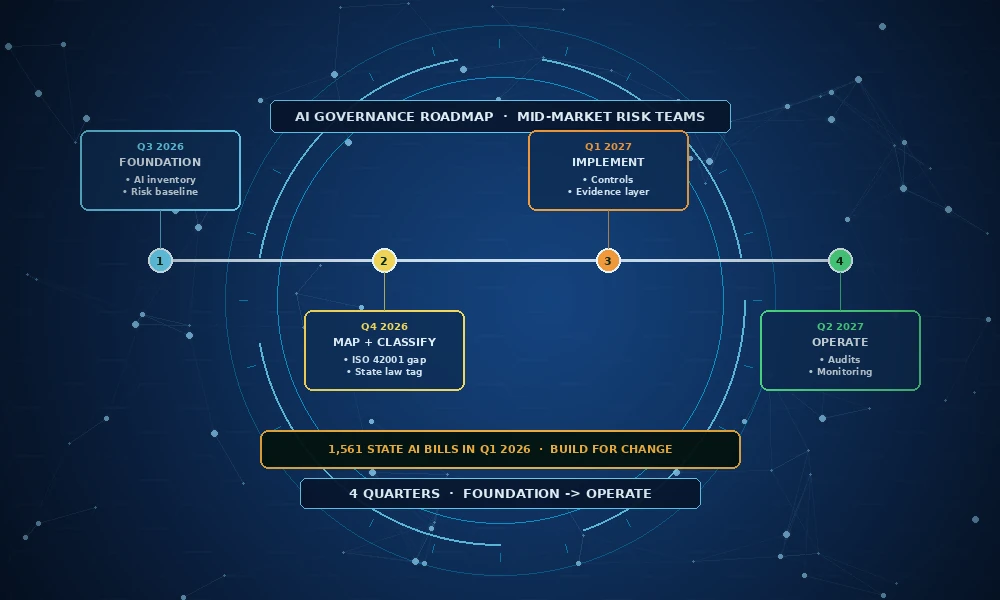
The compliance work required under the EU AI Act is sequenced. Each step enables the next. Skipping steps or running them in the wrong order creates downstream gaps that are expensive to correct. The following sequence reflects current regulatory guidance and the practical experience of organisations that have gone through early compliance programmes.
- AI System Inventory. Catalogue every AI system your organisation develops, deploys, imports, or distributes that could affect EU residents. This includes third-party and off-the-shelf AI tools embedded in your operations. Without a complete inventory, risk classification is guesswork.
- Risk Classification. For each system in your inventory, assess whether it falls into the prohibited, high-risk, limited-risk, or minimal-risk categories. The classification determines the entire compliance obligation set. Getting it wrong in either direction is costly over-classifying wastes resource; under-classifying creates unmanaged exposure.
- Prohibited Practice Audit. Review every AI system against the eight banned practices in Article 5. This audit should already be complete, given the February 2025 enforcement date. If it is not, it should be the immediate priority.
- Role Identification. For each high-risk system, determine your role: provider, deployer, importer, distributor, or quasi-provider. Role determines obligation set. If your role has changed because of recent system modifications, reassess.
- Technical Documentation. For high-risk systems where you are the provider, prepare the documentation package required under Article 11 and Annex IV. This includes intended purpose, technical specifications, training data governance, risk management system documentation, accuracy metrics, and instructions for use.
- Conformity Assessment. For systems requiring third-party conformity assessment, identify and engage a notified body. Assessment timelines vary; begin this process well before August 2026.
- EU Database Registration. High-risk AI systems must be registered in the EU AI Act database before they are placed on the market or put into service.
- Ongoing Post-Market Monitoring. The EU AI Act’s obligations do not end at deployment. Providers must establish post-market monitoring systems, report serious incidents to authorities, and update technical documentation when systems change.
For organisations with large, diverse AI portfolios, this sequence requires dedicated governance infrastructure not a spreadsheet. The operational data volumes involved in maintaining conformity across dozens of AI systems, keeping technical documentation current, and coordinating incident reporting across jurisdictions require systematic tooling.
Frequently Asked Questions
Note for editors: Apply FAQPage schema markup to this section for featured snippet eligibility.
What is the maximum fine under the EU AI Act?
The highest fine under the EU AI Act is EUR 35 million or 7% of an organisation’s total worldwide annual turnover for the preceding financial year, whichever is higher. This applies to violations of the prohibited AI practices in Article 5. For large enterprises, the percentage of turnover calculation typically produces the higher figure. SMEs and startups face the lower of the two amounts rather than the higher.
Do EU AI Act penalties apply to US companies?
Yes. The EU AI Act has extraterritorial scope under Article 2(1). It applies to providers placing AI systems on the EU market regardless of their location, and to deployers and providers based outside the EU where the AI system’s output is used within the EU. A US company serving EU customers, processing EU resident data, or using AI in decisions affecting EU employees falls within scope for the relevant provisions.
When did EU AI Act penalties come into force?
The penalty regime under Article 99 became active on 2 August 2025. However, the prohibited practices in Article 5 which attract the highest fines became enforceable on 2 February 2025. Penalties for GPAI model providers under Article 101 become enforceable from 2 August 2026. The full high-risk AI enforcement framework (Annex III) also fully activates in August 2026.
What triggers an EU AI Act investigation?
Investigations can be triggered by complaints filed by individuals or organisations with national market surveillance authorities, by whistleblower reports under Article 87, by the EU AI Office’s own monitoring activity (particularly for GPAI models), or by incidents reported under the mandatory incident reporting requirements. National competent authorities can also conduct proactive audits and request documentation from providers and deployers.
Is ISO 42001 certification required for EU AI Act compliance?
ISO/IEC 42001 certification is not mandated by the EU AI Act, but it provides a structured governance architecture that addresses many of the Act’s technical and operational requirements. An AI Management System built to ISO 42001 covering risk management, documentation, human oversight, and audit evidence aligns closely with the obligations required of high-risk AI system providers and deployers, and provides auditors with a structured evidence base.
What happens if a high-risk AI system fails a conformity assessment?
If a high-risk AI system does not pass conformity assessment, it cannot be legally placed on the EU market or put into service within the EU. The system must be withdrawn, modified to address identified non-conformities, and re-assessed before deployment. Continuing to operate a system that has failed conformity assessment exposes the organisation to enforcement action under Article 99(4), with fines up to EUR 15 million or 3% of global turnover.
Can providing false information to EU regulators lead to criminal charges?
Under the EU AI Act itself, providing misleading information to competent authorities results in administrative fines up to EUR 7.5 million or 1% of turnover. However, several EU Member States are implementing national legislation that creates additional criminal liability for AI-related offences. Italy’s Law 132/2025, for example, creates criminal penalties including imprisonment for specific conduct related to AI misuse and false reporting. Legal counsel should assess jurisdiction-specific criminal exposure.
What the Compliance Window Demands
The EU AI Act is not a regulation that rewards delay. Prohibited practices have been enforceable since February 2025. The full penalty framework activated in August 2025. The high-risk AI deadline arrives in August 2026. Enforcement authorities are operational, resourced, and actively monitoring the market. The cost of non-compliance measured in fines, market withdrawal, civil liability, and reputational exposure is concrete, documented in the regulation’s text, and calibrated to create board-level attention at any company size.
The organisations that will navigate this well are those that start with a complete AI inventory, run an honest risk classification, and build the documentation and governance infrastructure that transforms compliance from a reactive exercise into an ongoing operational capability.
| Govern365.ai, by the Global AI Certification Council, provides the AI model registry, risk assessment workflows, compliance dashboards, and audit evidence management your organisation needs to build that capability from day one. Start your 14-day free trial at govern365.ai |