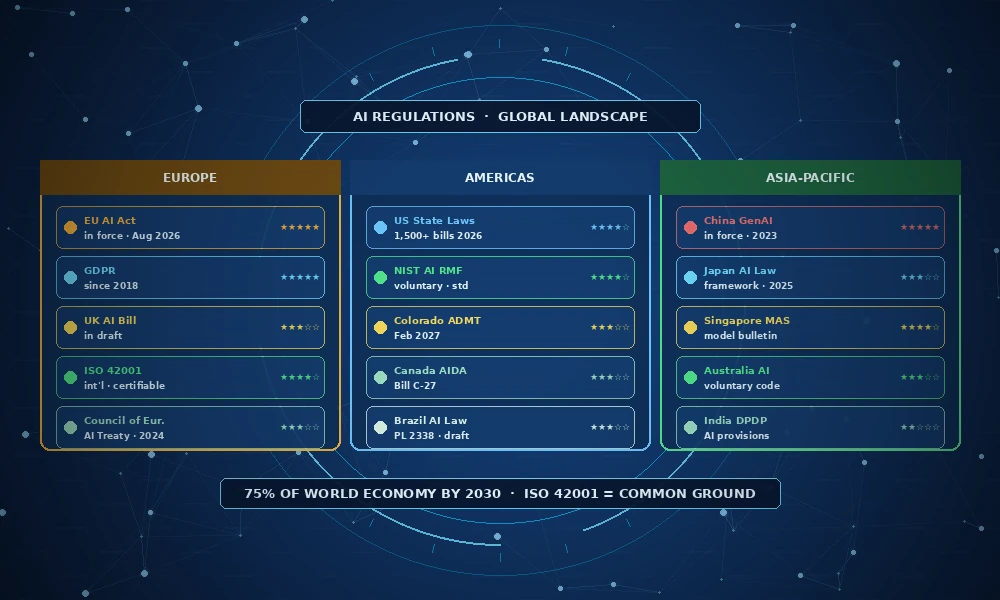
Forty-five state legislatures introduced more than 1,561 AI-related bills by March 2026 alone, according to MultiState’s AI legislation tracker, and 145 of those bills became law the year before. For a mid-market risk team without a dedicated regulatory affairs staff, that pace turns AI governance into a moving target instead of a fixed project.
Add a federal executive order aimed at preempting state AI laws, an EU AI Act timeline that shifted twice in 2026, and a Colorado law that was rewritten before it ever took effect, and the real challenge isn’t understanding any single rule. It’s building a governance program that survives the next rewrite.
This roadmap lays out what mid-market risk teams need on the calendar through 2027, how ISO/IEC 42001, the EU AI Act, and the NIST AI Risk Management Framework overlap enough to satisfy with one program instead of three, and where a lightweight inventory and a documented review process do more than any single piece of software.
Why Mid-Market Risk Teams Can’t Wait for Federal Clarity
There is still no comprehensive federal AI statute in the United States, and there won’t be one in 2026. In December 2025, the administration issued Executive Order 14365, directing the Department of Commerce to identify state AI laws that burden interstate commerce or distort “truthful outputs” for referral to a new AI Litigation Task Force. The Department of Justice stood up that task force in January 2026. By March 2026, the White House had followed up with a National Policy Framework for Artificial Intelligence, a four-page document urging Congress to preempt certain state laws, according to K&L Gates’ analysis of the framework.
None of that has stopped states from legislating. The framework organizes recommendations; it does not impose obligations, preempt state law, or resolve liability questions. Meanwhile Colorado, California, Texas, Illinois, and New York have all moved AI-specific obligations onto the books in the first half of 2026, and Connecticut’s companion-AI provisions start rolling out from July 2026 through January 2027.
For a mid-market organization operating in more than one state, the practical result is a compliance surface built from disclosure rules, hiring-tech notice requirements, and consumer correction rights rather than a single unified standard. Waiting for Congress to sort this out is not a strategy. Building one program that maps cleanly to the frameworks regulators actually reference, ISO/IEC 42001, the EU AI Act, and NIST AI RMF, is.
The 2026-2027 Compliance Calendar Risk Teams Actually Need to Track
Five dates matter more than the rest of the patchwork combined. Missing any one of them creates real exposure for a mid-market deployer, and each one changed at least once in the last twelve months, which is exactly why a static compliance memo goes stale fast.
Key US and EU AI compliance dates for mid-market risk teams
| Date | Requirement | Jurisdiction |
|---|---|---|
| January 1, 2026 | Texas Responsible AI Governance Act (TRAIGA) takes effect, primarily government-use focused with categorical bans on manipulative and discriminatory AI | Texas |
| August 2, 2026 | EU AI Act Article 50 transparency obligations apply (deployer-facing disclosure and labeling duties) | EU |
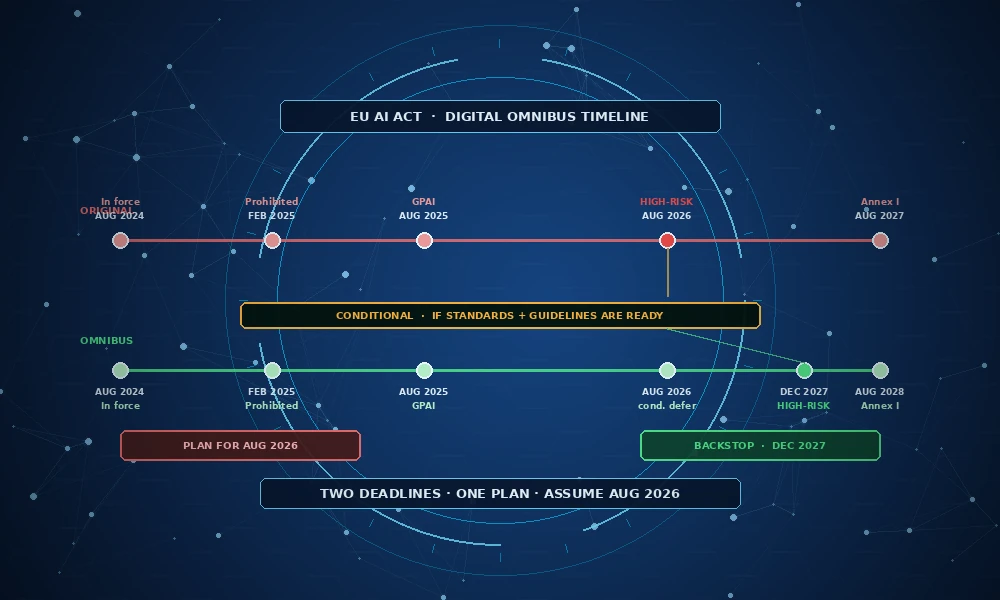
| December 2, 2026 | EU AI Act Article 50(2) watermarking obligations for AI-generated content apply, per the Digital Omnibus agreement | EU |
| January 1, 2027 | Colorado SB 26-189 (revised Colorado AI Act) takes effect, covering automated decision-making technology in consequential decisions | Colorado |
| December 2, 2027 | EU AI Act high-risk obligations apply to stand-alone Annex III systems (recruitment, credit scoring, education, and similar categories) | EU |
The Colorado date is the one most mid-market risk teams have been tracking loosely since 2024, and it is worth being precise about what changed. The original Colorado AI Act, SB 24-205, would have required a formal duty of care, algorithmic impact assessments, and a risk management program for high-risk AI systems. It never took effect. A federal court enjoined its enforcement in April 2026 in xAI v. Weiser, and on May 14, 2026, Governor Polis signed SB 26-189, which repeals and replaces it entirely, according to Crowell & Moring’s analysis of the revised law.
SB 26-189 drops the duty of care, the risk management program mandate, and the impact assessment requirement. In their place: a pre-use notice when a covered automated decision-making technology (ADMT) materially influences a consequential decision, a post-adverse-outcome disclosure within 30 days, a right to correct inaccurate personal data, and a right to meaningful human review. There is no private right of action. The Colorado Attorney General enforces it as a deceptive trade practice under the Colorado Consumer Protection Act, with a mandatory 60-day cure period through January 1, 2030.
One nuance mid-market teams frequently miss: SB 26-189’s definition of “covered ADMT” does not require the system to infer from inputs to generate outputs, the way SB 24-205’s “artificial intelligence system” definition did. A simple automated scoring tool that checks whether an output falls within a set range can qualify. Don’t assume a system is exempt just because it’s simpler than a machine learning model.
On the EU side, the Digital Omnibus on AI reached political agreement on May 7, 2026, was endorsed by the European Parliament on June 16, and received the Council’s final green light on June 29, 2026, with formal publication in the Official Journal expected in July 2026, ahead of the original August 2 deadline, according to the European Commission’s AI Act implementation page. If your organization sells into the EU or operates AI systems affecting EU residents in recruitment, credit, or education contexts, the deferral buys planning time, not an exemption. Article 50 transparency duties still apply from August 2026 regardless.
The AI System Inventory: The Foundation Every Framework Requires
Every framework in this roadmap, ISO/IEC 42001, the EU AI Act, NIST AI RMF, and Colorado’s SB 26-189, starts from the same premise: you cannot govern what you haven’t inventoried. An AI system inventory is the single artifact that satisfies the most requirements across the most frameworks, and it’s usually the piece mid-market teams underinvest in because it looks like a spreadsheet exercise rather than a compliance deliverable.
A usable inventory captures more than “tool name” and “owner.” For each AI system, mid-market risk teams need: the business function it supports, whether it materially influences a consequential decision under state definitions, whether it falls into an EU AI Act Annex III category, the data types it processes, whether it’s internally built or vendor-sourced, and who has authority to modify or retire it. NIST AI RMF’s “Map” function and ISO 42001’s Clause 8.2 both assume this level of detail exists before risk treatment can begin.
For vendor-built systems specifically, SB 26-189 puts new documentation obligations on developers, not just deployers, requiring them to describe intended uses, known limitations, and training data categories, and to notify deployers of material updates. That means a mid-market risk team’s inventory needs a field for “developer disclosure received” and “last updated,” not just “vendor name.” Without it, a deployer has no way to demonstrate the reasonable review the law expects when a vendor pushes a model update mid-quarter.
Cross-Framework Mapping: ISO/IEC 42001, EU AI Act and NIST AI RMF Side by Side
This is where most AI governance content stops short. Guides explain ISO 42001 in one article, the EU AI Act in another, and NIST AI RMF in a third, leaving the reader to build the connective tissue themselves. Mid-market teams don’t have a compliance function large enough to do that translation work three separate times, so it’s worth mapping the overlap directly.
Clause-level overlap across the three core AI governance frameworks
| Governance Activity | ISO/IEC 42001:2023 | EU AI Act | NIST AI RMF 1.0 |
|---|---|---|---|
| AI system inventory and scoping | Clause 4.3, Clause 8.2 (AI system impact assessment) | Art. 6-7 (classification), Annex III (high-risk categories) | MAP 1.1-1.3 |
| Risk management program | Clause 6.1, Annex A.6 | Art. 9 (risk management system) | GOVERN 1, MANAGE 1 |
| Human oversight | Annex A.9 | Art. 14 (human oversight) | GOVERN 3.2, MANAGE 2.2 |
| Data governance and quality | Annex A.7 | Art. 10 (data and data governance) | MAP 2.3, MEASURE 2.2 |
| Transparency and disclosure to affected persons | Clause 7.4, Annex A.10 | Art. 13, Art. 50 (transparency) | GOVERN 4.1, MAP 5.1 |
| Monitoring and post-deployment review | Clause 9.1, Clause 10 | Art. 26, Art. 72 (post-market monitoring) | MEASURE 3, MANAGE 4 |
| Third-party and vendor AI systems | Clause 8.4 (externally provided processes) | Art. 25 (provider/deployer obligations) | GOVERN 6, MANAGE 3 |
Read across a single row and the practical benefit becomes clear: a documented human-oversight procedure, built once against NIST’s GOVERN 3.2 and MANAGE 2.2 categories, satisfies the substance of ISO 42001’s Annex A.9 control and goes a long way toward EU AI Act Article 14 compliance, since all three are describing the same underlying control: a named individual with the authority and training to review and override an automated output. The specific evidentiary formats differ, but the control itself does not need to be built three times.
ISO/IEC 42001 Annex A sub-control numbers are cited here at the general level because the full standard text sits behind ISO’s paywall; verify exact sub-clause references against a licensed copy before publishing them in an audit-facing document.
Use the NIST AI Risk Management Framework to build AI inventories, governance processes, risk management, and ongoing monitoring as part of your roadmap
Risk Tiering Without a Federal Risk-Tiering Law
The EU AI Act gives you Annex III. Colorado gives you “consequential decisions.” NIST gives you a risk management process without prescribed tiers at all. Mid-market risk teams need one internal tiering model that borrows from all three, because building separate tiering logic per jurisdiction doesn’t scale past a handful of AI systems.
A workable approach: classify each inventoried system as high, medium, or low impact based on two questions. First, does it materially influence a decision about an individual’s access to employment, housing, credit, insurance, healthcare, or education, the categories that show up almost verbatim across Colorado’s SB 26-189, the EU AI Act’s Annex III, and most other state consequential-decision definitions? Second, does a human meaningfully review the output before it affects that individual, or does the system’s recommendation flow through largely unchecked?
Systems that touch a consequential-decision category and lack meaningful human review sit in the high-impact tier and get the full governance treatment: documented risk assessment, vendor disclosure review, and human-review pathway. Systems that touch those categories but pass through robust human review can often sit in a medium tier with lighter documentation. Everything else, internal productivity tools, content drafting, code assistance, sits in the low tier with baseline inventory and acceptable-use policy coverage only.
This mirrors what SB 26-189 itself does at the statutory level: it explicitly excludes systems used to “summarize, organize, or present information for human review” where no score, ranking, or recommendation materially affects the outcome, according to Ogletree’s analysis of the law. That carve-out matters for the common case where AI drafts a summary but a person makes the actual call.
The Mid-Market AI Governance Program Checklist
This is the sequence that gets a mid-market risk team from zero to an auditable program, with the framework each step primarily satisfies noted alongside it.
- Build the AI system inventory covering business function, data types, vendor status, and consequential-decision exposure. [NIST AI RMF (MAP 1.1) / ISO 42001 (Clause 8.2)]
- Classify every system into high, medium, or low impact using the consequential-decision and human-review test. [Colorado SB 26-189 / EU AI Act Annex III]
- Assign a governance owner and a named human reviewer with override authority for each high-impact system. [EU AI Act Art. 14 / NIST AI RMF (GOVERN 3.2)]
- Collect developer disclosures (intended use, known limitations, training data categories) for every vendor-sourced system. [Colorado SB 26-189 (developer obligations)]
- Draft pre-use and post-adverse-outcome notice templates for any system touching Colorado residents in employment, housing, credit, insurance, or healthcare contexts. [Colorado SB 26-189]
- Establish a documented human-review and correction-request pathway with response-time targets. [Colorado SB 26-189 / EU AI Act Art. 14 / ISO 42001 Annex A.9 [VERIFY]]
- Map each high-impact system’s risk assessment against ISO 42001 Clause 6.1 and NIST’s MAP/MEASURE/MANAGE functions to avoid duplicating the assessment three times. [ISO 42001 / NIST AI RMF]
- Review vendor contracts for indemnification clauses attempting to shift discrimination liability, several of which are now void as against public policy under Colorado’s revised law. [Colorado SB 26-189]
- Build a quarterly board-level reporting cadence covering inventory changes, high-impact system count, and open remediation items. [ISO 42001 Clause 9.1 (management review)]
- Set a recurring legislative-monitoring cycle, quarterly at minimum, given how frequently state and EU obligations have shifted in the past year. [Cross-framework]
Vendor and Third-Party AI Risk: What Changes When Developers and Deployers Split Obligations
Most mid-market organizations are deployers, not developers, of AI. They buy applicant tracking systems, underwriting tools, and customer service platforms with AI features built in rather than training their own models. That distinction matters more under SB 26-189 than it did under the original Colorado law, because the revised statute places specific, separate documentation duties on developers.
Under SB 26-189, a developer must give deployers technical documentation describing the covered ADMT’s intended uses, categories of training data, known limitations, and instructions for appropriate use and human review, and must notify deployers of material updates. A mid-market deployer’s practical obligation is to actually request, receive, and file that documentation, then re-review it when a vendor pushes a model update, rather than treating a signed vendor contract as the end of the diligence process.
The law also voids certain contract clauses that try to shift discrimination liability for a party’s own use of a covered ADMT onto another party, according to Crowell & Moring’s client alert. That’s a direct signal to review AI procurement contracts now: an indemnification clause that assumed it transferred risk to the vendor may not hold up, which means the deployer’s own governance documentation becomes the primary defense if a regulator or plaintiff comes asking.
Board and C-Suite Reporting: What AI Governance Maturity Looks Like in 2026
Board members asking about AI governance in 2026 are usually asking one of three questions: are we exposed anywhere we don’t know about, are we spending appropriately relative to peers, and can we show a regulator or auditor a program rather than a policy document. A board-ready report answers all three without requiring the board to read a 40-page risk assessment.
The AI governance software market itself reflects how fast this expectation has moved. Gartner estimated the market at $492 million in 2026, projecting it to exceed $1 billion by 2030, with organizations using dedicated governance tooling reporting a 3.4x effectiveness multiplier over ad hoc, spreadsheet-based approaches. That’s not a reason to buy a platform reflexively, but it is a signal that board-level scrutiny of AI governance spend and structure is now a standing agenda item rather than an annual check-in.
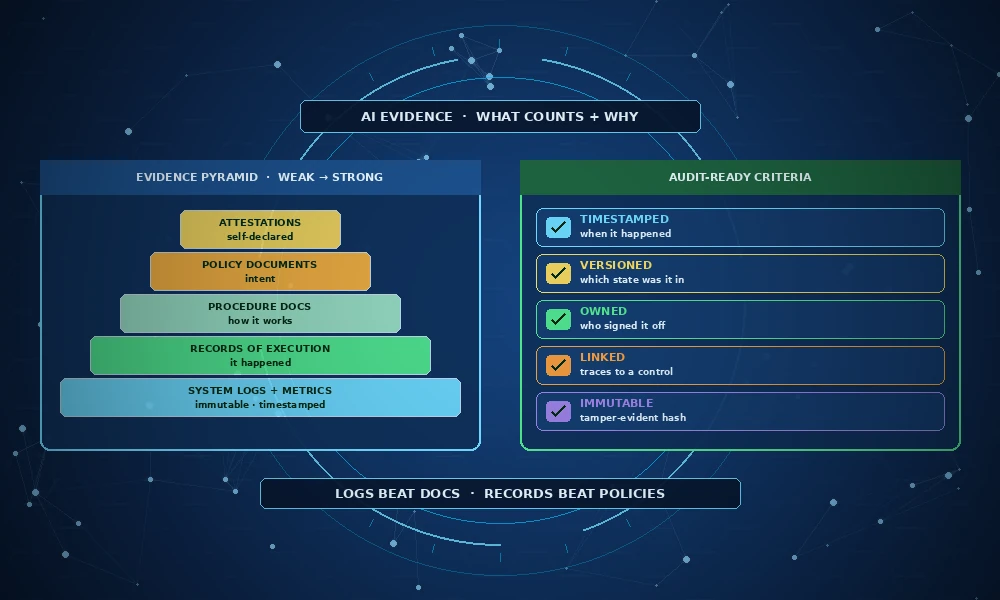
A useful quarterly board packet covers four things: total AI systems in the inventory and how that number changed, count and status of high-impact systems, any open items from vendor disclosure reviews or human-review requests, and upcoming regulatory deadlines in the next two quarters. Keep it to one page. Boards that receive a one-page AI governance dashboard alongside the standard risk report tend to ask sharper, more specific questions, which is generally the point of the exercise.
Common Mistakes Mid-Market Risk Teams Make Building This Roadmap
Three patterns show up repeatedly in mid-market AI governance programs, and each is avoidable.
The first is treating the inventory as a one-time project. AI systems get added by individual departments faster than most compliance calendars refresh, and a marketing team piloting a new content tool rarely thinks to notify risk or legal. Build the inventory update into procurement and IT intake processes directly rather than relying on a periodic survey.
The second is over-indexing on the EU AI Act’s Annex III categories while under-preparing for state-level notice requirements that apply sooner. The EU’s high-risk obligations don’t bite until December 2027 for most standalone systems, but Colorado’s notice and disclosure duties apply from January 2027, and several state hiring-tech laws, Illinois’s video interview provisions among them, are already in effect. Sequence the work by effective date, not by which framework has the most media coverage.
The third is assuming a signed vendor contract discharges governance responsibility. As the vendor-risk discussion above covers, SB 26-189 specifically voids liability-shifting clauses for a party’s own discriminatory use of ADMT. A vendor contract is a starting point for diligence, not a substitute for it.
If your organization operates across multiple jurisdictions, stay current with evolving requirements using the US State AI Law Tracker
Frequently Asked Questions
Do mid-market companies need to comply with the EU AI Act if they only operate in the US?
You need to comply if your AI systems affect people located in the EU, regardless of where your company is headquartered. If your organization has no EU customers, employees, or applicants interacting with the system, the EU AI Act generally does not apply, though NIST AI RMF and applicable US state laws still do.
What happened to Colorado’s original AI Act, SB 24-205?
It was signed in 2024 but never took effect. A federal court enjoined its enforcement in April 2026, and the Colorado legislature repealed and replaced it with SB 26-189 on May 14, 2026. The new law takes effect January 1, 2027, with a substantially different, lighter-touch framework focused on disclosure rather than risk management programs.
Is there a safe harbor for using the NIST AI RMF under Colorado’s new law?
No. SB 24-205 would have included a rebuttable presumption of compliance for organizations following frameworks like NIST AI RMF. SB 26-189 removed that provision entirely. NIST AI RMF remains a strong operational baseline, but it does not create a legal safe harbor under the revised Colorado statute.
How long does ISO/IEC 42001 certification typically take for a mid-market organization?
Certification timelines vary by organizational readiness and AI system complexity. Organizations using structured governance processes and existing AI inventories tend to move through certification meaningfully faster than those starting from scratch, since much of the preparation work overlaps with NIST AI RMF and EU AI Act documentation. [VERIFY] specific timeline benchmarks against current ISO certification body data before publication.
What counts as a ‘consequential decision’ under state AI laws?
Most state definitions, including Colorado’s, converge on the same categories: decisions affecting an individual’s access to or terms of employment, education, housing, financial or lending services, insurance, healthcare, or essential government services. If an AI system materially influences an outcome in one of these areas, it likely triggers notice and disclosure obligations.
Does using AI for internal productivity tasks trigger these regulations?
Generally no, provided the tool doesn’t materially influence a consequential decision about an individual. Code assistance, internal drafting, and summarization tools typically fall outside high-impact tiering, though they should still appear in your AI system inventory and be covered by an acceptable-use policy.
What’s the difference between a developer and a deployer under Colorado’s revised AI law?
A developer creates, modifies, or makes an ADMT commercially available. A deployer is a business that uses that ADMT to make decisions. Most mid-market organizations are deployers. SB 26-189 places distinct documentation and disclosure duties on each role, and deployers must actively collect the documentation developers are required to provide.
How often should a mid-market risk team review its AI governance program?
Given the pace of change in 2025 and 2026, a quarterly legislative and framework review is a reasonable minimum, with an immediate ad hoc review triggered any time a state passes new AI legislation or the EU adopts a formal AI Act amendment.
Conclusion
The regulatory picture will keep shifting, Colorado already proved that a signed law can be rewritten before its effective date ever arrives. What doesn’t shift is the underlying discipline: know what AI systems you run, understand which ones touch a consequential decision, and document the human oversight behind them. Build that once, mapped across ISO/IEC 42001, the EU AI Act, and NIST AI RMF, and each new state law becomes a smaller lift than the last.
Start with the inventory. It’s the one artifact every framework in this roadmap assumes already exists.
Govern365.ai‘s AI model registry maps each system you add to its applicable ISO 42001 clauses, EU AI Act risk category, and NIST AI RMF functions automatically, so the cross-framework mapping in this article becomes a live view of your own inventory instead of a one-time exercise. Start your 14-day free trial and see your current AI systems mapped across all three frameworks in one pass. Govern365.ai, by the Global AI Certification Council