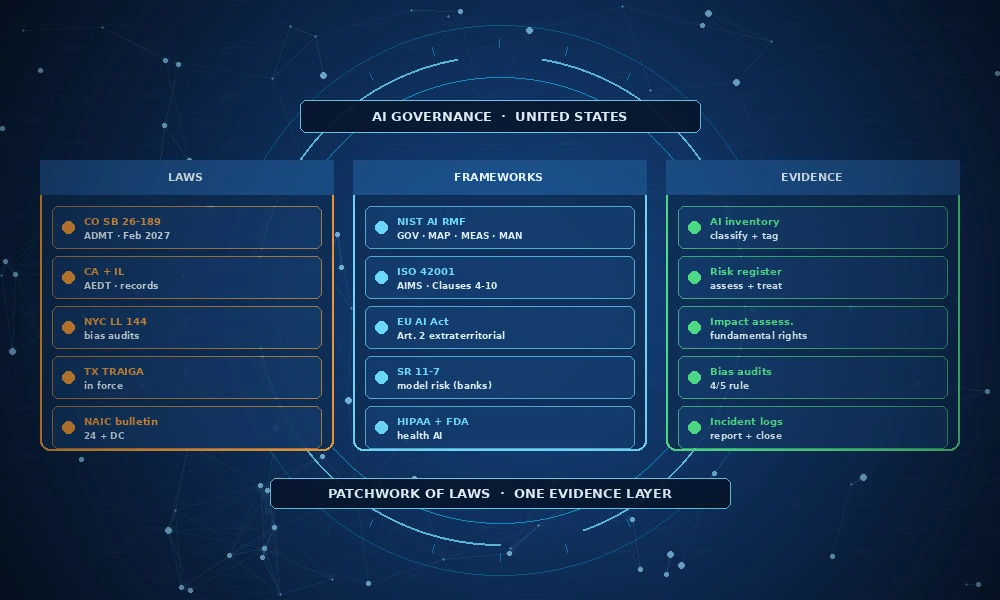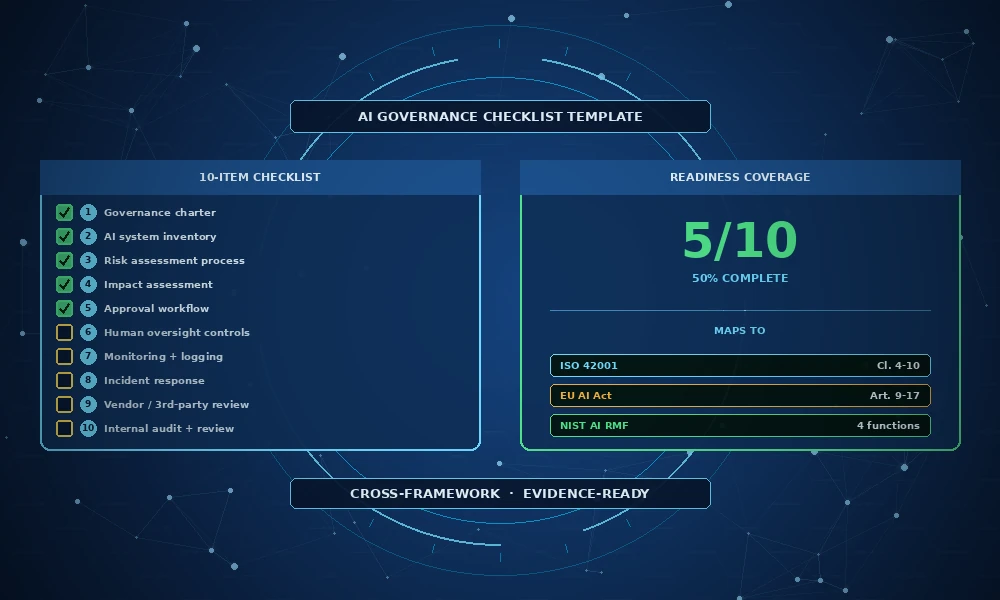
Spending on AI governance platforms will reach $492 million in 2026 and pass $1 billion by 2030, according to a February 2026 Gartner press release, which also found that organizations running dedicated governance tooling are 3.4 times more likely to reach high effectiveness than those stitching their own controls together. The NIST AI Risk Management Framework is where most US enterprises start that work. It is voluntary, yet sector regulators now treat it as the benchmark for reasonable care. This guide shows how to put the framework into practice across the three jobs that decide whether an AI governance program survives its first audit: inventory, risk, and monitoring.
Why NIST AI RMF became the default US playbook
The framework is not law, and that is exactly why it spread. Published in January 2023, the NIST AI Risk Management Framework (AI RMF 1.0) gives organizations a structured, flexible way to identify and treat AI risk without waiting for a single federal statute that may never arrive. In the absence of one omnibus US AI law, agencies filled the gap by reference. The FTC, SEC, CFPB, FDA, and EEOC now cite framework principles when they judge whether an AI practice meets a reasonable standard of care.
That creates a strange status: voluntary on paper, operationally expected in practice. Federal contractors face explicit pressure to show NIST-aligned governance. Enterprise buyers bake AI questions into security questionnaires, so a vendor without a documented program faces longer sales cycles and extra diligence. One widely referenced figure suggests 83% of organizations already use AI tools while only about a quarter have a mature governance program in place.
A word of caution on the regulatory backdrop, because it has shifted. Executive Order 14110, which once directed agencies toward the framework, was rescinded in January 2025 and should not be cited as active. Colorado briefly offered a legal safe harbor for organizations aligned to NIST AI RMF or ISO 42001 under its 2024 AI Act; that law was repealed and replaced by SB 26-189, and the framework safe harbor did not survive into the new statute. The framework’s authority today comes from market and regulator expectation, not a single binding mandate.
The four functions and where inventory, risk, and monitoring live
The framework organizes everything into four functions: Govern, Map, Measure, and Manage. GOVERN is the cross-cutting layer, your culture, accountability, and policy, applied organization-wide. The other three operate at the level of each individual AI system. MAP establishes context and surfaces risk. MEASURE analyzes and tracks it with real metrics. MANAGE prioritizes, treats, and monitors it over time. Beneath those functions sit 19 categories and 72 subcategories that you tailor to your own environment.
Read against the title of this guide, the mapping is clean. Your AI inventory is the backbone of MAP. Your risk assessment is the heart of MEASURE. Your continuous monitoring is the engine of MANAGE. GOVERN holds all three accountable. Most teams that fail do so because they complete GOVERN, write the policies, stand up a committee, and stop, mistaking documentation for practice.
| What most people get wrong: GOVERN is the foundation, not the framework. A governance charter and a committee calendar prove intent, not control. Without an operational MAP, MEASURE, and MANAGE, you have a binder, not a program, and auditors can tell the difference within the first hour. |
Building the AI inventory: the MAP function in practice
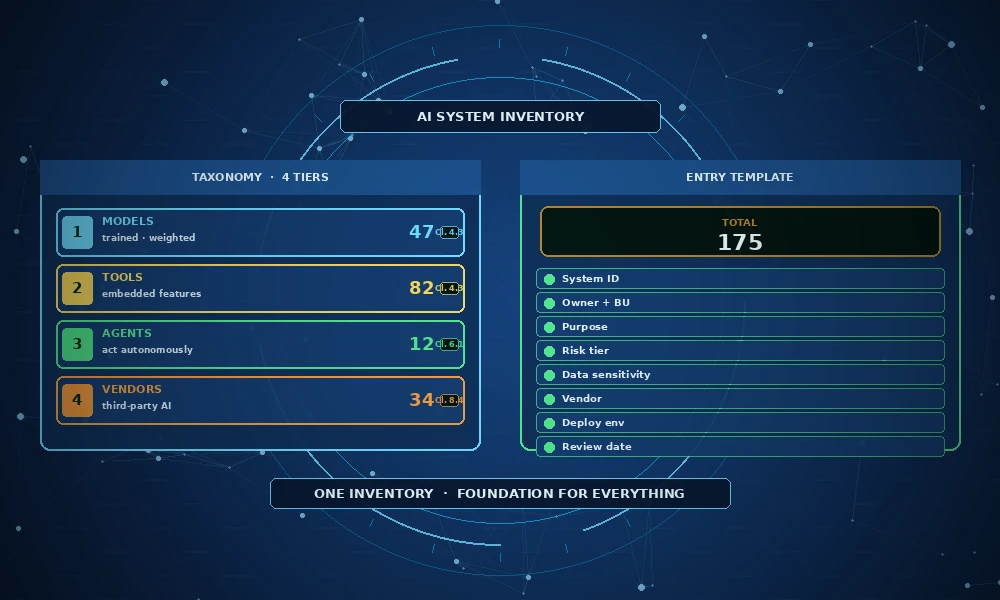
You cannot govern what you cannot see. The first real task in any implementation is a complete inventory of AI systems in production, in development, and in pilot, including the ones nobody told you about. That means foundation model APIs called from a single microservice, AI features embedded inside SaaS platforms your teams already pay for, and the shadow AI a marketing analyst wired up over a weekend. This is the step where MAP either succeeds or quietly fails.
A spreadsheet works for the first dozen systems. It stops working at the third audit, when the assessor asks for the version history of a risk classification and you have a single overwritten cell. An inventory has to be a living record with ownership, lineage, and change history, not a snapshot. For each system, capture at minimum the fields below, and note that each field is doing double duty for more than one framework.
- Intended purpose and deployment context – what the system is for, who it affects, and where it runs. Feeds NIST MAP 1.1, ISO 42001 Annex A impact assessment, and EU AI Act Annex III classification.
- System owner and accountable executive – a named human, not a team alias. Feeds NIST GOVERN 2.1 and ISO 42001 Clause 5.3.
- Model and data lineage – base model, fine-tuning data, third-party dependencies. Feeds NIST MAP 4 and EU AI Act technical documentation duties.
- Risk classification and tolerance – the system’s risk tier and the threshold you will not cross. Feeds NIST MAP 1.5 and MEASURE.
- Evidence and review status – testing records, last review date, open findings. Feeds NIST MANAGE and ISO 42001 Clause 9.
This is the point in an implementation where dedicated tooling earns its place. Govern365.ai’s AI model registry maps each system to its applicable NIST AI RMF subcategories, ISO 42001 clauses, and EU AI Act risk category as you onboard it, so the inventory becomes the evidence base rather than a separate artifact you reconcile later. The mapping is the work; doing it once and reusing it everywhere is the saving.
Current Profile vs Target Profile: turning the inventory into a baseline
Once the inventory exists, the framework gives you a way to measure where you stand. A Current Profile documents which GOVERN, MAP, MEASURE, and MANAGE subcategories you actually address today, and how. A Target Profile describes the future state you are aiming for, given your sector, risk tolerance, and obligations. The gap between them is your prioritized action plan. It is the same logic the NIST Cybersecurity Framework uses, which is why security teams find the model familiar.
Profiles matter because they convert a vague sense of “we should do better” into a sequenced backlog. A regulated lender and a marketing SaaS startup will set very different Target Profiles from the same framework, and both are correct. The framework deliberately does not set your risk tolerance for you; it expects you to declare it and defend it. That declaration is what an auditor tests against, so write it down before you need it.
AI risk assessment under MEASURE: closing the operational gap
Here is the failure mode that separates real programs from theater. Teams complete GOVERN and MAP on paper, then never operationalize MEASURE. Without continuous measurement, MANAGE has no evidence base and risk treatment becomes guesswork. MEASURE is where you define the metrics, run the tests, and track whether a system still behaves the way your risk classification assumed.
Good measurement under the framework is tied to the trustworthy AI characteristics: validity and reliability, safety, security and resilience, accountability and transparency, explainability, privacy, and fairness with harmful bias managed. For each high-risk system, that means concrete evaluation, not a self-attestation checkbox. A bias metric with a threshold. A drift indicator with an alert. An adversarial test with a result and a date. Generative systems need an extra layer here, which is what the NIST Generative AI Profile (NIST AI 600-1), released in July 2024, exists to provide.
This is where a risk assessment module saves weeks of manual work. Govern365.ai’s risk assessment ties each system’s controls to its framework obligations and flags the subcategories where evidence is missing, so MEASURE produces a live gap list instead of a static report that is stale the day it is signed.
Insurance companies implementing AI governance should also review the NAIC AI Model Bulletin checklist to align risk management practices with insurance regulatory expectations.
NIST AI RMF, ISO 42001 and the EU AI Act: a clause-level map
Most US enterprises do not implement NIST AI RMF in isolation. They run it as the operational layer beneath ISO/IEC 42001 certification and EU AI Act obligations, mapping one set of evidence to all three. The table below lines up the controls that overlap, so you collect evidence once and satisfy three frameworks. This is the single biggest efficiency in a multi-framework program, and the one most teams discover too late.
| Governance task | NIST AI RMF | ISO/IEC 42001:2023 | EU AI Act |
|---|---|---|---|
| AI system inventory & classification | MAP 1.1 – 1.5 | Clause 6.1.2; Annex A.4 | Art. 6 + Annex III |
| Roles & accountability | GOVERN 2.1 – 2.3 | Clause 5.3 | Art. 26 (deployers) |
| AI risk assessment | MAP 1.5; MEASURE 2 | Clause 6.1; Annex A.5 | Art. 9 (risk mgmt) |
| Data quality & lineage | MAP 4; MEASURE 2.3 | Annex A.7 | Art. 10 |
| Transparency & documentation | MEASURE 2.8 – 2.9 | Clause 7.5; Annex A.6 | Art. 11, 13, 50 |
| Continuous monitoring | MANAGE 4 | Clause 9.1; Annex A.9 | Art. 72 (post-market) |
| Incident response & logging | MANAGE 2.3 – 2.4 | Clause 10; Annex A.10 | Art. 12, 73 |
Two notes on the EU column, because the dates moved. Under the Digital Omnibus agreement reached in May 2026 and endorsed by the European Parliament in June, high-risk obligations for stand-alone Annex III systems are deferred to 2 December 2027, and product-embedded Annex I systems to 2 August 2028. Formal adoption is still pending, so treat these as the planning baseline rather than settled law. Article 50 transparency duties were not deferred and remain live.
The practical payoff is evidence reuse. A single documented risk assessment that satisfies MAP 1.5 also feeds ISO Clause 6.1 and EU Article 9. Govern365.ai automates that cross-mapping so one piece of audit evidence is attributed to every framework it satisfies, which is the difference between three parallel compliance projects and one.
Continuous monitoring and the MANAGE function
AI risk is not static, which is what breaks traditional, point-in-time risk management when it is applied to models. A system that passed every test at deployment can drift as input data shifts, as the world changes around it, or as an upstream model is silently updated by a vendor. MANAGE exists to catch that. The framework treats implementation as an ongoing cycle, not a project with an end date, and monitoring is the part that keeps the inventory and the risk assessment honest between audits.
Effective monitoring runs at a cadence matched to each system’s risk tier, not a single calendar reminder for the whole estate. The pattern below works for most enterprises.
| Cadence | What to monitor | Why it matters |
|---|---|---|
| Real-time / event-driven | Output anomalies, guardrail breaches, prompt-injection attempts | High-risk and generative systems can fail between scheduled reviews; alerts catch what calendars miss |
| Weekly to monthly | Performance drift, data distribution shifts, error rates | Drift is gradual; monthly review catches it before it crosses your risk tolerance |
| Quarterly | Control effectiveness, third-party model changes, evidence freshness | Vendor updates and config changes quietly invalidate prior assessments |
| Annual | Full reassessment, Target Profile review, classification changes | Confirms the system still fits the risk tier it was inventoried under |
Third-party risk deserves its own line. In 2026, a majority of organizations reported breaches involving third-party vendors, and most enterprises now rely on external AI services without full visibility into the underlying controls. Your monitoring has to extend to the integration points where your data enters someone else’s model.
Govern365.ai’s compliance dashboards surface drift, overdue reviews, and missing evidence across the estate in one board-ready view, which is what turns MANAGE from a quarterly scramble into a standing process.
Where implementations stall and how to sequence around it
The common failures are predictable, which means they are avoidable. Teams treat GOVERN as completion. They inventory on paper but never measure. They write a Target Profile and never revisit it. They monitor the model they built and ignore the foundation model API underneath it. Each one has the same root cause: treating the framework as a one-time documentation exercise instead of a program.
Sequence by dependency, because the functions are not independent. A workable order for most enterprises:
- Run a rapid posture assessment to produce your Current Profile.
- Inventory every AI system, including third-party and embedded, before anything else.
- Classify each system by risk and declare your risk tolerance.
- Stand up GOVERN structures in parallel, not as a prerequisite that blocks the rest.
- Operationalize MEASURE with real metrics on high-risk systems first.
- Wire MANAGE monitoring to the cadence table above and close the loop back to the inventory.
If you deploy generative AI or agents, layer the Generative AI Profile (NIST AI 600-1) on top of the base framework rather than replacing it. The base gives you the governance structure and process; AI 600-1 adds the risk taxonomy specific to foundation models, including the information-security category that covers prompt injection in agentic deployments. The two are designed to work together.
Organizations preparing for state AI regulations can complement their governance program with this Colorado AI Act compliance checklist for automated decision-making technology.
Frequently asked questions
Is NIST AI RMF mandatory in the United States?
No, the framework is voluntary at the federal level. In practice it is operationally expected: federal contractors are pushed toward NIST-aligned governance, and sector regulators including the FTC, SEC, and CFPB reference its principles when judging whether AI practices meet a reasonable standard of care. Enterprise buyers also demand it in security questionnaires, so adoption is a commercial necessity even without a single binding mandate.
How long does NIST AI RMF implementation take?
Most enterprises reach foundational adoption in three to six months and organization-wide integration in twelve to twenty-four months, depending on size and AI maturity. The variable is not the framework; it is the state of your inventory. Organizations that already know which AI systems they run move quickly. Those that have to discover shadow AI and third-party tools first spend most of their early effort on MAP.
What is the difference between a Current Profile and a Target Profile?
A Current Profile documents which framework subcategories you address today and how. A Target Profile defines the future state you are aiming for, based on your sector, risk tolerance, and obligations. The gap between the two becomes your prioritized action plan. Two organizations using the same framework can hold very different Target Profiles and both be correct, because the framework expects you to set tolerance yourself.
How does NIST AI RMF relate to ISO 42001 and the EU AI Act?
They are complementary. NIST AI RMF is the voluntary US operating model, ISO/IEC 42001:2023 is the certifiable international management-system standard, and the EU AI Act is binding regulation for systems touching the EU market. Many enterprises run NIST as the operational layer and map its evidence to the other two. A single risk assessment can satisfy NIST MAP 1.5, ISO Clause 6.1, and EU AI Act Article 9 at once.
What is the NIST Generative AI Profile (AI 600-1)?
Released in July 2024, NIST AI 600-1 extends the base framework to address risks specific to foundation models and generative AI, such as hallucination, data leakage, and prompt injection. It maps generative-AI risks to the four core functions and is meant to layer on top of AI RMF 1.0, not replace it. Use the base framework for structure and the profile for the generative-specific taxonomy and mitigations.
Do I need a platform to implement NIST AI RMF?
Not strictly; the framework is free and small estates can start in spreadsheets. The constraint is evidence. Once you have more than a handful of systems, multiple frameworks, and an audit cycle, manual tracking breaks down at the version-history and cross-mapping stage. A dedicated platform pays for itself by turning the inventory into reusable audit evidence and automating the mapping across NIST, ISO 42001, and the EU AI Act.
From framework to working program
The framework’s four functions are simple to describe and easy to under-deliver. The organizations that pass their first audit are the ones that treat inventory, risk, and monitoring as a continuous program rather than a binder, with each AI system mapped once and that mapping reused across every framework that asks for it. Start with the part most teams skip: build the living inventory first, because MAP, MEASURE, and MANAGE all depend on it.
Govern365.ai, by the Global AI Certification Council, gives you the model registry, risk assessment, and monitoring dashboards to run all three as one program instead of three. Start your 14-day free trial and turn the framework into evidence you can put in front of an auditor.