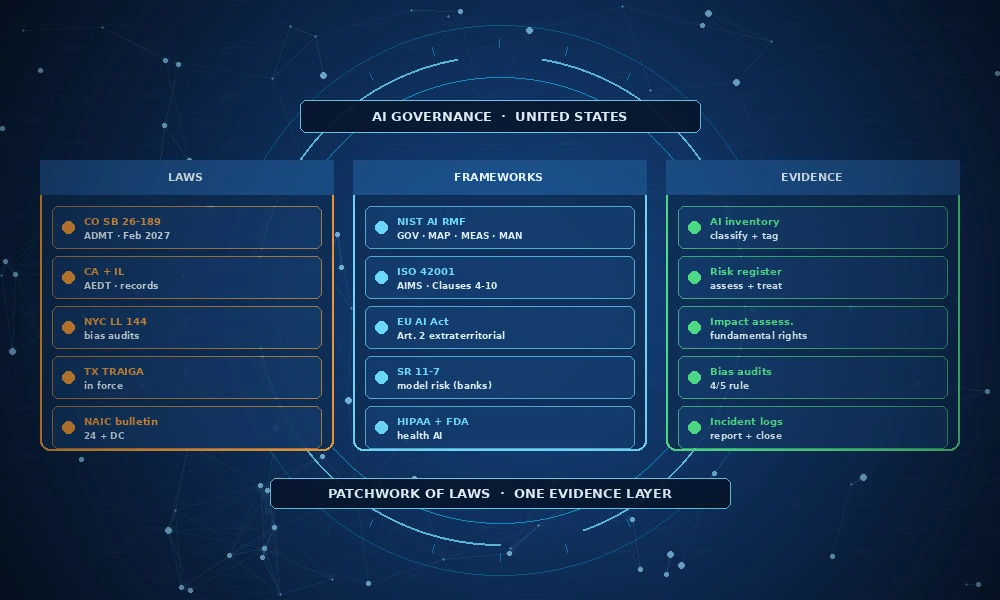
Global spending on AI governance platforms is projected to reach $492 million in 2026 and surpass $1 billion by 2030 as AI regulations expand to cover 75% of the world’s economies, according to Gartner, February 2026. None of that spending delivers defensible governance without one foundational artefact: a complete, current AI system inventory.
The timing matters. ISO/IEC 42001:2023 requires documented evidence of every AI system an organisation operates. EU AI Act Article 11 mandates technical documentation for high-risk AI systems. NIST AI RMF GOVERN 1.6 requires mechanisms to inventory AI systems resourced according to risk. All three frameworks assume the inventory exists. Most organisations are still building it in a spreadsheet, and most of those spreadsheets are already incomplete.
This article defines exactly what an AI system inventory must contain, walks through the four system types that require distinct tracking treatment, maps every core field to its regulatory requirement, and explains how to discover the systems that don’t show up in any procurement record.
What an AI System Inventory Actually Is (and Is Not)
An AI system inventory is a living governance record of every AI system an organisation develops, deploys, or uses, including machine learning models, AI-enabled tools, autonomous agents, and vendor-provided AI services. Unlike an IT asset register, it captures AI-specific metadata: system owner, risk tier, regulatory classification, data inputs, and oversight mechanism. It is the foundational artefact required by ISO/IEC 42001:2023 Clause 8, EU AI Act Article 11, and NIST AI RMF GOVERN 1.6.
That definition matters because “AI system inventory” gets conflated with adjacent records that serve different purposes. An AI model registry tracks model versions, performance metrics, and training lineage; it is narrower in scope and deeper in model-specific detail. An IT asset register or CMDB tracks infrastructure and software assets but lacks AI-specific metadata such as risk tier, human oversight mechanism, or regulatory classification. Neither is a substitute for the governance record the above frameworks require.
The operational word is “living.” A spreadsheet snapshot taken in January that hasn’t been touched since isn’t an inventory, it’s a historical document. An effective AI system inventory feeds governance workflows in real time: risk assessment draws from it to classify systems before they reach production, audit evidence is linked to individual records, and incident response identifies affected systems by querying it. A static list cannot do any of that.
Comparison: AI System Inventory vs. Related Records
| Record Type | Scope | AI-Specific Metadata | Regulatory Alignment |
|---|---|---|---|
| AI System Inventory | All AI systems: models, tools, agents, vendor AI | Full: owner, risk tier, oversight, classification | ISO 42001 Cl. 8, EU AI Act Art. 11, NIST GOVERN 1.6 |
| AI Model Registry | ML/AI models only (internally built or fine-tuned) | Model-level: version, metrics, training data lineage | Partial — model documentation only |
| IT Asset Register / CMDB | All software and infrastructure assets | None AI-specific | Not aligned to AI frameworks |
| AI Agent Registry | Autonomous agents specifically | Agent-level: permissions, tools, autonomy scope | Emerging — no single standard yet |
Before building an inventory, it is important to distinguish between an AI system registry and model inventory, as each serves a different governance purpose and captures different levels of detail.
Four Types of AI Systems That Must Be in Your Inventory
The most common reason AI system inventories are incomplete is scope ambiguity. Teams track what they built and forget what they procured, activated, or accidentally deployed. A governance-ready inventory covers four distinct system types, each with different discovery challenges and different metadata requirements.
1. Foundation and Custom Models
These are AI models your organisation built from scratch, fine-tuned on proprietary data, or trained internally. This category has the clearest ownership and the strongest existing governance processes (MLOps pipelines, model cards, version control), but it is also the category where teams tend to underestimate scope. Experimental models that quietly moved to production, legacy scoring models maintained by a single engineer, and fine-tuned variants of foundation models all belong here.
The key metadata beyond name and owner: training data provenance, evaluation metrics, current deployment environment, and the last date a human reviewed the model’s performance against its intended purpose.
2. AI-Enabled Tools and SaaS Applications
This is the category most organisations undercount. Any SaaS application that your team uses and that has embedded AI functionality qualifies: the writing assistant in your CRM, the predictive scoring in your HR platform, the document summarisation in your legal review tool. These tools appear in procurement records, but the AI capability within them often activates through a vendor update cycle, with no IT review, no risk assessment, and no notification to the team responsible for AI governance.
For this category, the most important inventory fields are: the specific AI feature in use (not just the product name), what data the feature processes, whether that data is sent to the vendor’s model training infrastructure, and whether a data processing agreement (DPA) is in place.
3. Autonomous AI Agents
AI agents are autonomous systems that take actions in the world: querying databases, calling APIs, executing code, sending messages, or coordinating other agents. They require fundamentally different inventory treatment than static models because the risk profile is driven not just by what the agent is, but by what it can do.
The metadata that matters here goes beyond the standard fields. Agent records must capture: the tools the agent can access (including MCP server connections), the permissions granted to it in each connected system, the autonomy level (fully autonomous vs. human-in-the-loop at defined checkpoints), the scope of actions it can take without approval, and the oversight mechanism that can pause or terminate it. A coding agent with write access to a production repository and a customer service agent that can only retrieve FAQ text are both “AI agents,” but they belong in different risk tiers and need different oversight controls.
Existing tools like CMDBs and MLOps platforms were not designed to capture this telemetry. Purpose-built AI governance tooling is increasingly necessary for this category.
4. Vendor and Third-Party AI Systems
Third-party AI includes foundation model APIs (OpenAI, Anthropic, Google), AI infrastructure services, and AI-as-a-service offerings procured for specific use cases. The distinction from AI-enabled SaaS tools is that these are purpose-procured AI systems, where the AI capability is the product itself rather than an embedded feature.
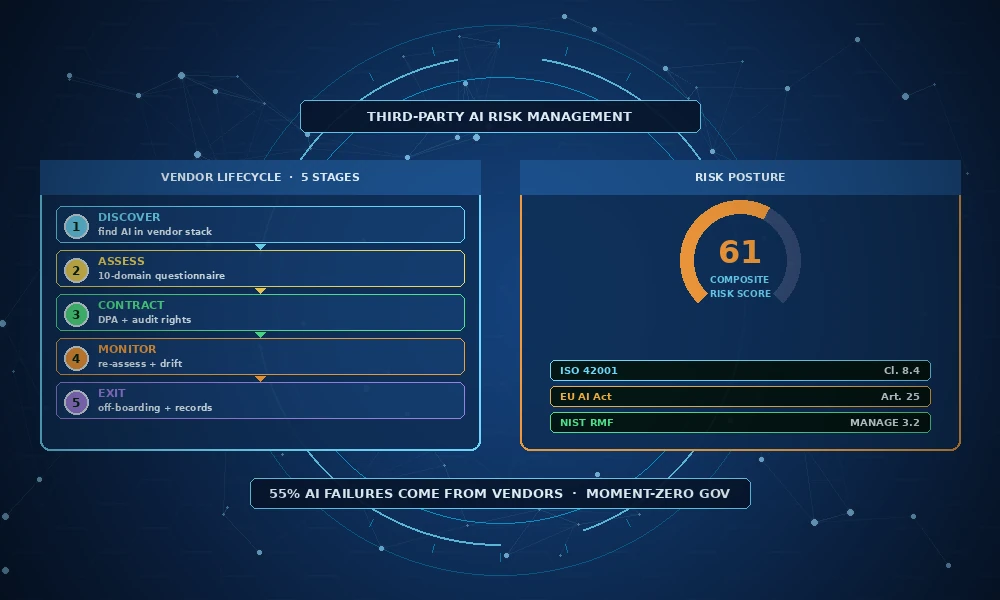
ISO/IEC 42001 Annex A.9 (supplier relationships) and EU AI Act obligations on deployers of third-party AI systems apply here. The minimum record for each vendor AI system: the supplier, the specific service, the intended use case, the data your organisation sends to it, a reference to the contract and DPA, and how the supplier’s AI governance posture was assessed. The last point is where most organisations have gaps. “We reviewed their security questionnaire” is not an adequate supplier assessment for a high-risk AI use case.
For teams setting up their inventory from scratch, this AI model inventory template for risk and audit evidence provides the fields needed to document ownership, risk, system context, and supporting records.
Four System Types at a Glance
| System Type | Examples | Unique Tracking Requirements |
|---|---|---|
| Foundation / Custom Models | Internally trained classifiers, fine-tuned LLMs, scoring models | Training data provenance, evaluation metrics, retraining schedule |
| AI-Enabled Tools (SaaS) | Copilot in CRM, summarisation in legal platform, predictive HR scoring | Specific AI feature, data sent to vendor, DPA status |
| Autonomous Agents | Coding agents, customer service agents, data pipeline orchestrators | Tool permissions, MCP connections, autonomy level, oversight checkpoint |
| Vendor / Third-Party AI | OpenAI API, Anthropic Claude, AI-as-a-service for document processing | Supplier AI governance assessment, contract reference, sub-processor list |
Core Fields Every AI System Inventory Record Must Capture
Field selection is where inventory design fails most often. Teams either over-engineer a 60-column spreadsheet that nobody maintains, or produce a minimal list of system names and owners that satisfies no audit requirement. The fields below represent the minimum viable set for a governance-ready record, organised by what they enable rather than by format.
Universal Fields (All System Types)
| Field | Description | Status | Framework Reference |
|---|---|---|---|
| System Name | Unique, human-readable identifier | Required | ISO 42001 Cl. 8 / EU AI Act Art. 11 |
| System ID | Unique alphanumeric identifier for cross-system reference | Required | All frameworks |
| System Type | Model / Tool / Agent / Vendor AI (from taxonomy above) | Required | NIST AI RMF MAP |
| Intended Purpose | What problem the system solves and in what context | Required | ISO 42001 Cl. 4 / EU AI Act Art. 9 |
| System Owner | Named individual (not team), with accountability for the record | Required | ISO 42001 Cl. 5.3 / NIST GOVERN |
| Business Unit | Organisational unit responsible for the system’s operation | Required | NIST AI RMF MAP |
| Deployment Status | Development / Staging / Production / Retired | Required | ISO 42001 Cl. 8 lifecycle |
| Data Inputs | Types of data processed; whether personal data is involved | Required | EU AI Act Art. 10 / ISO 42001 A.7 |
| Risk Tier | Low / Medium / High, with documented rationale | Required | EU AI Act Annex III / NIST MAP |
| Regulatory Obligations | Applicable frameworks and specific requirements | Required | All frameworks |
| Human Oversight Mechanism | How and by whom outputs are reviewed before action | Required | EU AI Act Art. 14 / ISO 42001 A.8 |
| Last Review Date | Date of most recent governance review | Required | ISO 42001 Cl. 9 / NIST Measure |
| Next Review Date | Scheduled date for next review (driven by risk tier) | Required | ISO 42001 Cl. 9 |
| Third-Party Dependencies | External models, APIs, or data services the system relies on | Recommended | ISO 42001 A.9 / EU AI Act Art. 9 |
| Incident History | Reference to any recorded incidents or near-misses | Recommended | ISO 42001 A.8.4 / NIST Manage |
Additional Fields for Autonomous Agents
Standard inventory fields are necessary but insufficient for agents. The following additional fields are required to capture the governance-relevant characteristics of autonomous systems:
- Tools accessible (list of APIs, databases, services the agent can call)
- Permissions granted per connected system (read / read-write / admin)
- MCP server connections (if applicable), with the scope of each connection
- Autonomy level: fully autonomous, semi-autonomous with defined approval gates, or human-in-the-loop for all actions
- Maximum action scope: what is the furthest-reaching action this agent can take without human approval?
- Termination mechanism: how can the agent be paused or stopped, and who has authority to do so?
Additional Fields for Vendor AI Systems
- Supplier name and specific AI service or model version
- Contract reference and effective date
- Data processing agreement (DPA) status: in place / pending / not applicable (with rationale)
- Sub-processor list provided by supplier: yes / no
- Supplier AI governance assessment: date conducted, method, findings
- Whether training data opt-out has been exercised (relevant for generative AI APIs)
Inventory records should connect to the underlying evidence rather than leaving teams to search for documents during an audit. A central AI evidence repository can help maintain those records in a structured and reviewable way.
Discovering AI Systems You Do Not Know About
The most common finding in AI governance gap analyses is that organisations have significantly more AI systems in operation than any manual inventory process captures. This is not a failure of intent. It is a structural consequence of how AI tools proliferate.
Consumer-grade AI tools require no installation, no IT involvement, and no procurement approval. Enterprise software procurement cycles run 60 to 120 days on average, but AI tools ship new capabilities weekly. Employees who need results today do not wait for procurement to catch up. The result: a persistent gap between “what we govern” and “what we actually use,” which represents the single largest unmanaged risk exposure in most AI governance programmes.
Closing that gap requires a structured discovery approach. A single survey or point-in-time scan will not do it. Four passes, conducted in parallel and repeated regularly, are the minimum:
- Top-down business unit survey. Ask each function head: which systems in your team score, rank, recommend, forecast, screen, or automate decisions? Finance, HR, customer support, claims processing, and product management are consistently the highest-density areas. This surfaces purpose-built tools and approved deployments, but misses embedded AI and shadow usage.
- Bottom-up technical scan. Audit code repositories for ML library imports, third-party AI API calls, and LLM SDK usage. Scan cloud environments for deployed model endpoints, AI-optimised compute instances, and connections to known AI service endpoints. CASB tools and endpoint monitoring can surface browser-based AI tool usage and unauthorised API subscriptions.
- Procurement contract audit. Search contracts for terms including “AI,” “ML,” “machine learning,” “automation,” “scoring,” “predictive,” and “generative.” Many AI capabilities appear in vendor contracts as minor line items or addendum features. This is where embedded SaaS AI is most reliably discovered, though it requires reading the actual contract rather than relying on vendor categorisation.
- Vendor security questionnaire revision. Add an explicit “AI usage” section to all vendor and project intake forms. Questions should address: does the product use AI to process our data? What AI capabilities are active by default? Are AI features updated through routine vendor update cycles without customer notification?
An AI inventory should not remain static after deployment. AI system lifecycle documentation helps maintain a record of changes, reviews, approvals, and decisions as the system evolves.
| Key Finding: Shadow AI is not primarily a security problem, it is a governance completeness problem. An organisation can build a comprehensive AI governance programme with robust policies and rigorous evaluation criteria. If 40% of AI systems in use were never registered, 40% of AI risk is completely unmanaged. The inventory is not an administrative formality. It is the precondition for every governance activity that follows. |
How Your Inventory Satisfies ISO 42001, EU AI Act and NIST AI RMF
A well-structured AI system inventory does not just satisfy one framework. With the right fields, a single record satisfies multiple framework requirements simultaneously. The key is knowing which fields map to which obligations, so you are not rebuilding the record three times for three different auditors.
ISO/IEC 42001:2023
ISO 42001 does not use the phrase “AI system inventory” in its normative text, but the requirement is embedded throughout. Clause 8 (Operation) requires organisations to establish, implement, and control the processes needed to meet requirements for AI systems across their lifecycle: design, development, acquisition, deployment, operation, monitoring, and retirement. You cannot demonstrate lifecycle control for systems you have not recorded.
Annex A.5 (AI system lifecycle) controls require documented evidence for each stage of each system’s lifecycle. Annex A.9 (third-party and supplier relationships) requires assessment of suppliers’ AI governance posture, which depends on having an accurate record of which systems involve third-party AI. The Statement of Applicability (SoA), a required ISO 42001 document, maps your selected Annex A controls to your actual AI systems, which presupposes you have an inventory to map from.
EU AI Act (Regulation 2024/1689)
The EU AI Act’s documentation requirements in Article 11 are explicit: providers of high-risk AI systems must draw up and maintain technical documentation containing the information specified in Annex IV. That documentation, which must be updated throughout the system’s lifecycle, is essentially a formalised inventory record for each high-risk system.
Article 9 (risk management system) requires that risk management be conducted as a continuous iterative process for each high-risk AI system. You cannot run that process without knowing which systems are in scope, which makes Annex III classification, the step that determines whether a system is high-risk, an inventory-dependent activity. As of August 2026, high-risk AI system requirements are fully applicable; the inventory is no longer a planning exercise, it is a live compliance obligation.
NIST AI RMF 1.0
The NIST AI RMF is explicit about the inventory requirement. GOVERN 1.6 states: “Mechanisms are in place to inventory AI systems and are resourced according to organizational risk priorities.” The MAP function then depends on that inventory: contextualising each AI system requires knowing what AI systems exist, what they do, and what data they process. The official NIST crosswalk maps GOVERN 1.6 directly to ISO 42001 Annex A.4 (Resources), confirming that the inventory is a shared obligation across both frameworks.
Cross-Framework Field Mapping
| Inventory Field | ISO 42001 | EU AI Act | NIST AI RMF |
|---|---|---|---|
| System Name / ID | Cl. 7.5 (Documented information) | Art. 11 / Annex IV | GOVERN 1.6 |
| Intended Purpose | Cl. 4.1, A.6.1 | Art. 9 (Risk mgmt system) | MAP 2.1 |
| System Owner | Cl. 5.3 (Roles & responsibilities) | Art. 16 (Provider obligations) | GOVERN 5.1 |
| Data Inputs (incl. personal data) | Annex A.7.1 (Data for AI systems) | Art. 10 (Data governance) | MAP 2.2 |
| Risk Tier | Cl. 6.1.2 (Risk assessment) | Annex III classification | MAP 5.1 |
| Regulatory Obligations | Cl. 4.2 (Interested parties) | Annex III / Art. 6 | GOVERN 1.1 |
| Human Oversight Mechanism | Annex A.8.3 | Art. 14 (Human oversight) | MEASURE 2.5 |
| Deployment Status / Lifecycle | Cl. 8 (Operation), Annex A.5 | Art. 11 (Lifecycle documentation) | MAP 3.5 |
| Third-Party Dependencies | Annex A.9 (Supplier relationships) | Art. 9(2) supply chain | GOVERN 6.1 |
| Incident History | Annex A.8.4 (Incident response) | Art. 72–73 (Incident reporting) | MANAGE 4.1 |
Govern365.ai’s AI system inventory module automatically maps each record to its applicable ISO 42001 Annex A controls, EU AI Act risk categories, and NIST AI RMF functions, eliminating the manual cross-referencing that typically adds weeks to audit preparation. Every field update generates a timestamped audit trail linked to the relevant framework requirement.
Keeping the Inventory Current: Intake, Triggers, and Review Cadence
Building the inventory is the easy part. The hard part is ensuring it reflects reality three months later, when two new vendor AI features have gone live, an engineering team has deployed a prototype agent to production, and a key system owner has changed roles without updating their record.
Three mechanisms keep an inventory from going stale: a mandatory intake gate, event-triggered updates, and a scheduled review cadence.
Mandatory Intake Gate
No AI system enters production without a completed inventory record. This is the single most effective control for inventory completeness. In practice, it means adding an “AI system registration” step to the existing procurement approval workflow, the software deployment pipeline, and the vendor onboarding process. The gate does not need to be burdensome: a minimum viable record with the required fields, reviewed by the AI governance function, is sufficient. The full risk assessment and oversight configuration can follow; the inventory record must precede production deployment.
Event-Triggered Updates
Certain events require an immediate inventory record update, regardless of the scheduled review cycle:
| Trigger Event | Action Required | Fields Updated |
|---|---|---|
| Model version change or retraining | Update record; reassess risk tier if use-case scope changed | Version, training data, evaluation metrics, risk tier |
| Use-case expansion | Create new record or update scope; re-run risk assessment | Intended purpose, risk tier, regulatory obligations |
| System owner change | Update owner field; confirm new owner has reviewed the record | System owner, review date |
| Vendor AI feature activation | Add new record for the specific AI feature | All fields (new entry) |
| Agent permission change | Update agent-specific fields; re-evaluate oversight mechanism | Tool permissions, autonomy level, oversight mechanism |
| Incident or near-miss | Link incident record; update incident history field | Incident history, oversight mechanism (if revised) |
| Regulatory change | Review regulatory obligations field; update risk tier if required | Regulatory obligations, risk tier |
| System decommissioning | Update status to Retired; retain record per Cl. 7.5 retention rules | Deployment status, retirement date |
Scheduled Review Cadence
Event triggers catch known changes. Scheduled reviews catch everything else. The minimum schedule: annual review for all systems; quarterly review for high-risk systems; continuous monitoring of agents (given the dynamic nature of agent permissions and tool access).
An AI Bill of Materials (AI-BOM), a machine-readable output format that documents every model, dependency, and configuration in a structured format, is increasingly used as the technical output of the inventory for automated monitoring and drift detection. Organisations implementing the NIST AI RMF Measure function will find AI-BOM exports useful for tracking inventory drift: systems added, decommissioned, or materially changed between review cycles.
Six Inventory Failure Modes and How to Avoid Them
Most inventory problems are predictable. They appear consistently across organisations regardless of size, sector, or existing governance maturity. Knowing them in advance is cheaper than discovering them during an audit.
| Failure Mode | What Goes Wrong | How to Fix It |
|---|---|---|
| Scope too narrow | Inventory tracks only internally built ML models; SaaS-embedded AI, agents, and vendor APIs are absent | Apply the four-type taxonomy as the intake checklist; require AI feature disclosure in vendor onboarding |
| Team-level ownership | System owner field lists a team (“Data Science”) rather than a named individual | Policy requirement: system owner must be a named individual with a role designation; reviewed at each management review |
| No intake gate | Inventory was accurate when built; six months later, five new systems are in production with no records | Add inventory registration as a mandatory step in procurement, deployment pipeline, and vendor onboarding |
| Risk tier without rationale | Every system is rated “Medium” with no documented rationale; fails audit scrutiny | Risk tier field requires a one-paragraph rationale referencing the assessment criteria used |
| Agents treated as static models | Agent records use the same fields as model records; tool permissions and autonomy level are not captured | Use the agent-specific field set; treat every permission grant as an update trigger |
| Vendor AI recorded at supplier level | “Approved vendor: Microsoft” appears instead of a record for the specific Copilot feature in use | Inventory at the feature/system level, not the supplier level; each distinct AI capability is its own record |
Frequently Asked Questions
What is the difference between an AI system inventory and an AI model registry?
An AI model registry is narrower in scope: it tracks machine learning models, including version history, training data, and performance metrics. An AI system inventory is broader: it covers all AI systems an organisation uses, including models, AI-enabled tools, autonomous agents, and vendor-provided AI services. The inventory also captures governance-specific metadata (risk tier, system owner, regulatory obligations, oversight mechanism) that a model registry typically does not. For ISO 42001 and EU AI Act compliance purposes, you need both.
Does ISO 42001 explicitly require an AI system inventory?
Yes, though not by that exact name. ISO/IEC 42001:2023 Clause 8 requires organisations to establish, implement, and control processes for AI systems throughout their lifecycle. Annex A.5 requires lifecycle documentation for each AI system. Auditors assessing ISO 42001 conformity will expect to see documented evidence of every AI system in scope for the AIMS, which in practice requires a maintained inventory. The ISO 42001 documentation checklist confirms the AI system inventory as a required document.
Which EU AI Act articles require inventory-level documentation?
Article 11 requires providers of high-risk AI systems to draw up and maintain technical documentation covering the system’s purpose, capabilities, performance metrics, data governance, and risk management approach. Article 9 requires a continuous risk management process for each high-risk system. Both obligations are system-specific and require knowing which systems are in scope, which depends on Annex III classification. High-risk AI system requirements have been fully applicable since August 2026.
How do I track vendor AI systems I did not build?
Inventory at the feature or capability level, not the supplier level. For each vendor AI capability your organisation uses, create a record that captures the specific service, what data your organisation sends to it, the contract and DPA reference, and the supplier’s AI governance assessment. ISO 42001 Annex A.9 (supplier relationships) provides the control framework. For vendor-embedded AI in SaaS tools, the procurement contract audit and vendor security questionnaire are the most reliable discovery methods.
What does NIST AI RMF GOVERN 1.6 require for the inventory?
GOVERN 1.6 states that mechanisms must be in place to inventory AI systems and must be resourced according to organisational risk priorities. In practice, this means the inventory function itself needs assigned ownership, tooling, and a defined process, not just a spreadsheet. High-risk systems should receive more frequent review and more detailed records than low-risk systems. The NIST AI RMF to ISO 42001 Crosswalk maps GOVERN 1.6 to ISO 42001 Annex A.4 resource controls.
What is different about tracking AI agents compared to traditional models?
Standard inventory fields (owner, purpose, risk tier, data inputs) are necessary but insufficient for agents. You also need to capture: which tools the agent can access and with what permissions, whether it connects to MCP servers, its autonomy level, the maximum action scope without human approval, and the mechanism to pause or terminate it. Risk tier for agents is driven by what the agent can do, not just what it is. A customer-facing agent with read-only FAQ access and a production database agent with write permissions may both be “AI agents,” but they belong in fundamentally different risk tiers.
How often should the AI system inventory be reviewed?
Minimum: annual review for all systems; quarterly for high-risk systems; continuous monitoring for autonomous agents (given the dynamic nature of agent permissions). Event triggers should prompt immediate updates regardless of schedule: model retraining, use-case expansion, ownership changes, vendor AI feature activations, and security incidents. ISO 42001 Clause 9 requires periodic monitoring and management review; building inventory review into the management review cycle is the most efficient approach.
Conclusion
Every governance activity downstream of the AI system inventory, risk classification, policy enforcement, audit evidence, incident response, board reporting, depends on the inventory being complete and current. The four-type taxonomy presented here (models, tools, agents, vendor AI) gives teams a practical scope that does not miss the categories regulators and auditors are increasingly focused on. The cross-framework field mapping confirms that a single well-designed record satisfies multiple obligations simultaneously.
Start with what you can do this week: run the top-down business unit survey. Even 10 to 20 records with complete fields across the four system types tells you more about your AI risk exposure than a 200-row spreadsheet with missing owners and no risk tiers.
When you’re ready to replace the spreadsheet with a governed, audit-ready system, start your 14-day free trial of Govern365.ai, build your AI system inventory on infrastructure designed for ISO 42001, EU AI Act, and NIST AI RMF compliance from day one.