Gartner projects that spending on AI governance platforms will reach $492 million in 2026 and pass $1 billion by 2030. One line in that February 2026 analysis matters more than the headline number: the capabilities regulators now expect are data usage mapping and evidence collection. Not a policy binder. Not a committee charter. A live record of every AI system you run, the risk each one carries, and the proof you are managing it. That is what an AI governance checklist has to deliver, and it is where most templates fall short. This guide gives you a working checklist built around three pillars, inventory, risk, and evidence, with each control point mapped to ISO/IEC 42001, the EU AI Act, and the NIST AI RMF so one set of work satisfies several regimes at once.
Why most AI governance checklists fail before the first audit
Most checklists you will find online are policy checklists wearing an operational costume. They ask whether you have an AI policy, whether you have named an owner, whether ethics principles are documented. Useful, but an auditor does not test your intentions. They test whether you can produce, on demand, a current list of AI systems, a risk rating for each, and a trail of decisions and controls that someone independent could follow.
That gap between policy and proof is the recurring finding in public-sector AI reviews. The Office of the Auditor General of Ontario’s May 2026 performance audit of government AI use flagged roughly ten governance gaps, including shadow AI in active use, missing bias testing, and vendor evaluation failures. US state AI offices are standing up similar review functions, and the pattern will repeat: programs that documented principles but never operationalized them.
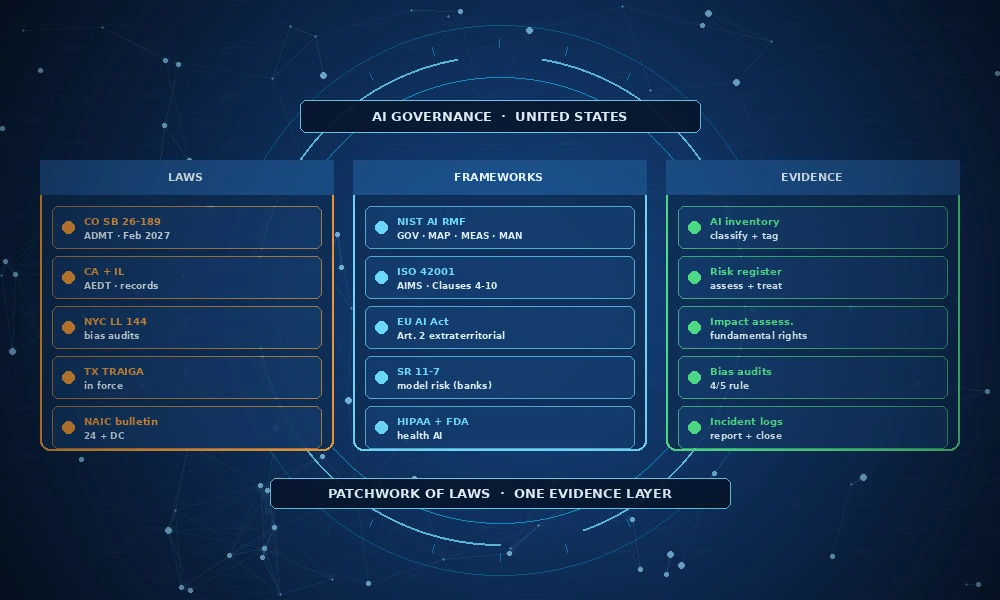
A checklist earns its place when it is structured around the three things every framework actually asks for. Strip away the vocabulary differences between ISO 42001, the EU AI Act, and NIST AI RMF and you are left with the same spine. Know what you have, which is inventory. Understand what could go wrong, which is risk. Show your work, which is evidence. Build your checklist on those three pillars and it maps cleanly to all of them. Build it around abstract principles and you will be reverse-engineering evidence the week before your audit, which is exactly when teams discover their AI register lives in someone’s personal spreadsheet with no version history.
Pillar 1 – The AI system inventory checklist
You cannot govern what you have not counted. The AI inventory is the foundation, and it is the single most common point of failure. Most organizations can deploy an AI tool in an afternoon but cannot tell you, on demand, every system they run and who owns each one.
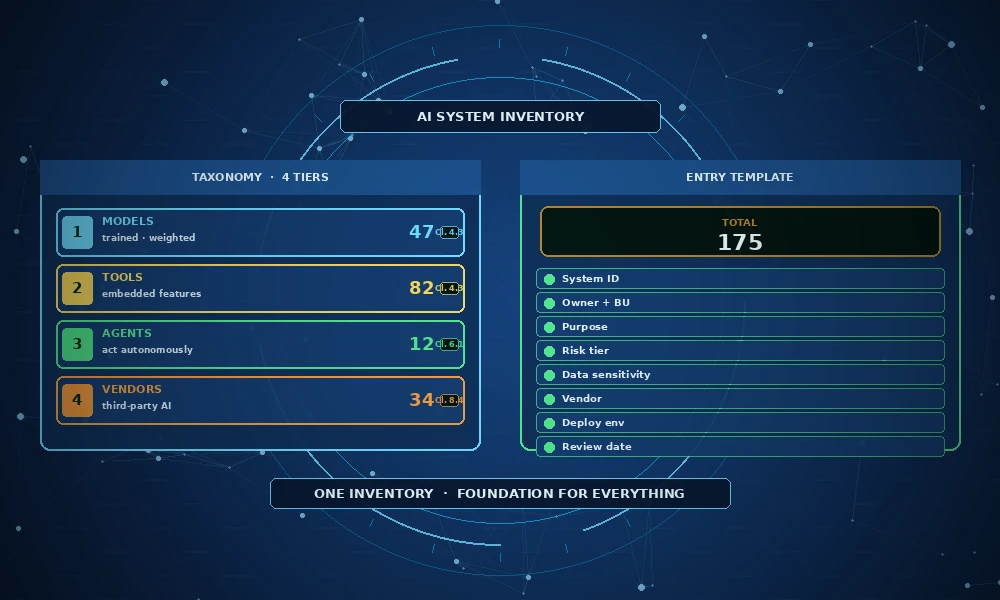
A complete inventory entry captures more than a system name. For each AI system, agent, and use case, your checklist should confirm you have recorded:
- A unique identifier and plain-language description of what the system does
- The named owner, accountable executive, and the business function it serves
- System type: internally built model, procured vendor model, embedded feature, or autonomous agent
- Lifecycle stage, from pilot to production to retired
- The data it consumes, including any special-category or personal data
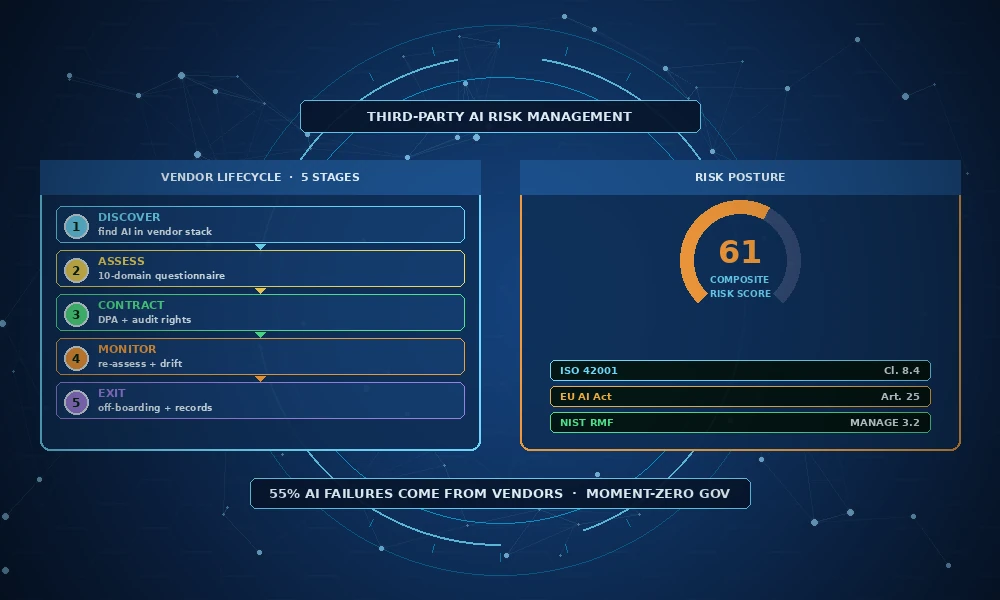
- Third-party and vendor dependencies, including the foundation model underneath
- Its risk tier, which links to Pillar 2
- Deployment jurisdictions, since this determines which regimes apply
The agent question deserves attention. An AI inventory built in 2024 for predictive models will miss the autonomous agents now acting on systems and data without a human in each loop. Unregistered agents are both a governance gap and a compliance gap, because regulators increasingly focus on what AI does, not just what it predicts. If your inventory has no row for an agent that can send emails, move money, or change records, your governance program has a blind spot the size of your biggest operational risk.
This pillar is not optional under any major regime. US federal agencies already operate under inventory mandates through Executive Order 13960, the Advancing American AI Act, and OMB Memorandum M-25-21 (April 2025), which requires a Chief AI Officer, a use-case inventory, and minimum risk-management practices for high-impact systems. The NIST AI RMF makes inventory an explicit GOVERN function under GOVERN 1.6. And the EU AI Act’s obligations, from risk classification to technical documentation, all depend on first knowing which systems you operate.
This is where a model registry stops being a spreadsheet problem. Govern365.ai’s AI model registry maps each registered system to its applicable ISO 42001 clauses and EU AI Act risk category at the point of entry, so the inventory and the compliance mapping stay in sync instead of drifting apart between audits.
Start by documenting every AI system in scope using an AI system inventory template that records ownership, purpose, deployment status, and relevant risk information.
Pillar 2 – The AI risk assessment checklist
A risk assessment that produces a label and stops is theater. The point is to classify each system, document why, decide what controls apply, and record what you did with that decision. Three frameworks converge here, and they are more aligned than their different vocabularies suggest.
Start with classification. The EU AI Act sorts systems into prohibited, high-risk, limited-risk, and minimal-risk tiers, with high-risk use cases listed in Annex III, covering areas like employment, credit scoring, education, and access to essential services. Your checklist should force an explicit tier decision for every inventoried system, with the reasoning written down, not assumed.
For each system, the risk checklist should confirm you have:
- Assigned a risk tier and documented the rationale for it
- Completed an AI system impact assessment covering effects on individuals, groups, and society
- Identified specific risks: bias, security, data quality, performance drift, misuse, and loss of human oversight
- Defined and assigned the controls that treat each material risk
- Recorded the residual risk and who formally accepted it
- Set the monitoring cadence and the metrics that would signal the risk has changed
ISO/IEC 42001 anchors this in Clause 6.1, which covers actions to address risks and opportunities, and in its Annex A control on AI system impact assessment. The EU AI Act sets a parallel obligation in Article 9, which requires a continuous risk management system across a high-risk system’s lifecycle. The Article 9 requirements overlap heavily with ISO 42001’s planning controls, which is why a single well-built risk assessment can serve both. NIST AI RMF carries the same logic through its MEASURE function, analyzing and tracking risk, and its MANAGE function, prioritizing and treating it.
Here is the part most risk templates leave out: the residual risk acceptance. A risk you identified but no one formally accepted is a finding waiting to happen. Auditors look for a named person who reviewed the residual risk and signed off. Without that signature, your assessment reads as an exercise rather than a decision.
Each system should then be evaluated using a documented AI risk assessment template so identified risks, treatment decisions, and residual risk can be recorded consistently.
Pillar 3 – The audit evidence checklist
Evidence is where governance programs either prove themselves or unravel. You can have a flawless inventory and a rigorous risk process, but if you cannot produce the artifacts that show the process ran, an auditor records a non-conformity. Demonstrating compliance is no longer a single point-in-time exercise. As Gartner notes, regulators expect you to show it continuously, as systems and the rules governing them evolve.
The evidence pillar is the least intuitive because it asks you to capture the proof while the work happens, not afterward.
Your evidence checklist should confirm you can retrieve, for any system:
- Dated records of risk assessments and impact assessments, with version history
- Approval and sign-off records, showing who decided what and when
- Technical documentation describing the system’s design, data, and intended purpose
- Automatically generated logs of the system’s operation over its lifetime
- Records of testing, validation, and bias evaluation
- Incident records and the corrective actions taken
- Internal audit results and management review minutes
- Training and competence records for the people running the system
Two regulatory anchors make this concrete. ISO/IEC 42001 Clause 9 requires performance evaluation through monitoring, internal audit, and management review, which generates much of this evidence as a byproduct of running the management system properly. The EU AI Act’s Article 12 requires high-risk systems to keep automatic logs throughout their lifetime, and Annex IV specifies the technical documentation high-risk providers must maintain.
Most compliance teams build their evidence trail in spreadsheets and shared drives. That holds until the third audit, when the auditor asks for the version history of a risk assessment from eighteen months ago and the file has been overwritten four times. Evidence that cannot show its own history is weak evidence. This is the practical case for audit evidence management that timestamps and versions artifacts as they are created, which Govern365.ai handles by linking each piece of evidence to the system and the control it supports.
The cross-framework mapping table: one checklist, three regimes
The reason a three-pillar checklist works is that ISO 42001, the EU AI Act, and NIST AI RMF are not three separate projects. They are three articulations of the same underlying discipline. The table below maps each checklist pillar to the specific clauses, articles, and functions in each framework, so you can see exactly where one piece of work satisfies multiple obligations. This is the mapping most checklists omit, and it is the difference between running three compliance programs and running one.
CROSS-FRAMEWORK MAPPING
| Pillar | Checklist control point | ISO/IEC 42001:2023 | EU AI Act | NIST AI RMF 1.0 |
|---|---|---|---|---|
| Inventory | Maintain a register of all AI systems, agents, and use cases | Clause 8.1; Annex A.4, A.6.2 | Art. 49 & 71 (registration); Art. 11 + Annex IV | GOVERN 1.6; MAP 1 |
| Inventory | Assign ownership and accountability | Clause 5.3; Annex A.3.2 | Art. 26 (deployer duties) | GOVERN 2; GOVERN 3 |
| Risk | Classify each system by risk tier | Clause 6.1.2 (AI risk assessment) | Art. 6 + Annex III (high-risk) | MAP 1.5; MEASURE 1 |
| Risk | Conduct AI system impact assessment | Clause 6.1.4; Annex A.5.2 | Art. 27 (FRIA) | MAP 5 |
| Risk | Treat risk and accept residual risk | Clause 6.1.3 (risk treatment) | Art. 9 (risk management system) | MANAGE 1 |
| Evidence | Keep documented information & technical records | Clause 7.5 | Art. 11 + Annex IV; Art. 18 | GOVERN 1 |
| Evidence | Maintain operational logs | Annex A.6.2 (event logging) | Art. 12 & 19 (auto logs) | MEASURE 2; MANAGE 4 |
| Evidence | Monitor, audit, and review | Clause 9.1-9.3 | Art. 72 (post-market monitoring) | MEASURE 4; MANAGE 4 |
| Evidence | Handle incidents & corrective action | Clause 10.2 | Art. 73 (serious incidents) | MANAGE 4.3 |
FRIA = fundamental rights impact assessment. Clause/article references current as of June 2026; EU AI Act high-risk dates reflect the provisional Digital Omnibus agreement pending formal adoption.
The practical takeaway from this mapping: do the work once, attribute it three ways. When you complete an AI system impact assessment, you are satisfying ISO 42001’s Annex A impact control, contributing to your EU AI Act Article 9 risk management file, and executing the NIST MAP and MEASURE functions in a single motion. Build your checklist around the shared spine and the framework-specific obligations resolve themselves.
Clear decision rights are equally important. An AI governance committee charter template can define who reviews significant AI risks, approves decisions, and provides governance oversight.
How the three pillars connect: inventory feeds risk feeds evidence
The pillars are sequential and dependent, not parallel. This is the lifecycle logic that turns a static checklist into a living governance system, and it is worth being explicit about because the order matters.
Inventory comes first because every downstream activity references it. A risk assessment needs a system to assess. Evidence needs a system to attach to. When a new AI system enters the inventory, it should automatically trigger a risk classification. The risk classification determines which controls apply. Those controls, once operating, generate the evidence. And the evidence feeds the monitoring that, in turn, updates the inventory and risk record when something changes.
Run that loop and your checklist stops being a document you fill out once a year. It becomes the operating rhythm of governance: every system accounted for, every risk classified and owned, every control producing the proof that it works. A static checklist tells you what good looked like on the day you wrote it. A connected one tells you whether governance is actually happening right now, which is the question a board, a regulator, and an auditor are all ultimately asking.
Governance also needs to cover how employees use AI tools in day-to-day work. An employee AI use policy template can establish clear expectations around permitted use, data handling, and individual responsibilities.
What most teams get wrong
A few failure patterns show up again and again, and they are worth naming because each is avoidable.
The first is treating the checklist as a one-time project. Teams complete a heroic inventory effort, classify everything, and then let it rot as new systems ship without registration. Within two quarters the inventory is fiction. Governance is a cadence, not a campaign.
The second is confusing a policy with a control. A policy says bias testing will happen. A control is the evidence that bias testing did happen, on this system, on this date, reviewed by this person. Auditors test for the second and find the first.
The third is scoping too narrowly. Many programs cover the models the data science team built and miss the AI embedded in procured software, the agents quietly automating workflows, and the shadow AI that staff adopted without telling anyone. Your checklist should explicitly hunt for these categories, because the systems you did not register are precisely the ones that will surface in an audit.
The fourth is skipping the residual risk sign-off, covered earlier, which converts a defensible decision into an open finding. The fix in every case is the same: structure, ownership, and a record that survives staff turnover and time.
Putting the checklist to work
A checklist only creates value when it drives action. Moving from a document to an operating program follows a predictable sequence, and you do not need to perfect each step before starting the next.
- Build the inventory first. Find every AI system, agent, and use case, including procured and embedded tools. Assign each a named owner. This is the foundation everything else references.
- Classify risk for each entry. Apply your tiering, complete impact assessments for higher-risk systems, and document the rationale and residual risk acceptance.
- Map your controls to a framework. Choose your primary standard, ISO 42001 if you are pursuing certification, NIST AI RMF if you are aligning with US expectations, and use the cross-framework table to cover the others.
- Stand up evidence capture. Decide how each control will produce its proof, and make sure that proof is versioned and timestamped from the start.
- Set the monitoring cadence. Define review frequencies by risk tier so high-risk systems get attention proportional to their exposure.
- Report it in a form a board can read. Translate the operational detail into a risk-tiered, board-ready view that answers the question leadership actually asks: are we governing our AI, and how do we know?
Organizations that deploy dedicated governance tooling are 3.4 times more likely to achieve high AI governance effectiveness than those assembling solutions from spreadsheets and point tools, according to Gartner’s February 2026 survey of 360 organizations. The checklist tells you what to do. The decision is whether to run it on infrastructure that keeps the inventory, the risk records, and the evidence connected, or to rebuild that connection by hand before every audit.
Policies and templates alone are not enough. Teams also need records showing that governance activities actually took place. This AI audit evidence checklist covers the evidence internal audit and compliance teams should be able to produce during a review.
Frequently asked questions
Is there a free AI governance checklist template I can download?
Many vendors and standards bodies publish free checklist templates, and they are a reasonable starting point. The limitation is that most are policy checklists rather than operational ones, and few map their items to specific ISO 42001 clauses, EU AI Act articles, and NIST AI RMF functions. Use a free template to understand the structure, then rebuild it around the three operational pillars: inventory, risk, and evidence.
Should my checklist follow ISO 42001 or NIST AI RMF?
Use whichever matches your primary goal, then map across. Choose ISO/IEC 42001 if you are pursuing third-party certification, since it is the certifiable AI management system standard. Choose the NIST AI RMF if you are aligning with US regulatory expectations, since it has become the de facto US standard and several state laws, including the Texas Responsible AI Governance Act, offer an affirmative defense for organizations that follow it. A well-structured checklist lets you satisfy both at once.
Does the EU AI Act delay change what my checklist needs?
Not as much as the headlines suggest. As of mid-2026, the Digital Omnibus agreement defers high-risk obligations for standalone Annex III systems to December 2027, pending formal adoption. But the Article 50 transparency obligations remain live from August 2, 2026, and the underlying work, inventory and risk classification, does not get easier with time. Treat the deferral as runway to do the high-risk work properly, not a reason to pause.
What information goes into an AI system inventory?
At minimum: a unique identifier, a plain description, the named owner, the system type, its lifecycle stage, the data it uses, vendor dependencies, the foundation model underneath, its risk tier, and the jurisdictions where it operates. The most overlooked entries are autonomous agents and AI embedded in procured software, which are exactly the systems audits tend to surface.
How often should the checklist be reviewed?
Tie review frequency to risk tier rather than the calendar. High-risk systems warrant continuous monitoring with formal review at least quarterly, while lower-risk systems may need only an annual check. The inventory itself should update in real time as systems are added, changed, or retired, since a stale inventory undermines every downstream control.
Can I run AI governance in a spreadsheet?
You can start there, but it breaks at scale. A spreadsheet cannot version your evidence, link a risk record to the control that treats it, or show an auditor the history of a decision. This is why Gartner found dedicated platforms make organizations 3.4 times more likely to achieve effective governance. The spreadsheet works until the audit asks a question only a system can answer.
What evidence do AI auditors actually ask for?
Dated risk and impact assessments with version history, approval and sign-off records, technical documentation, operational logs, testing and bias-evaluation results, incident and corrective-action records, and internal audit and management review minutes. The common thread is that the evidence must show when it was created and who was responsible, which is why capturing it as the work happens matters more than assembling it afterward.
Before an audit or formal review, use these 38 AI governance checks before an audit to identify missing controls, evidence gaps, and areas that still need remediation.
The bottom line on building your checklist
The frameworks differ in vocabulary but agree on the substance: know what AI you run, understand the risk it carries, and prove you are managing it. A checklist built on those three pillars, inventory, risk, and evidence, satisfies ISO 42001, the EU AI Act, and the NIST AI RMF at once, because they are all asking the same questions in different words. The teams that pass their first audit are not the ones with the best-written policies. They are the ones who can produce, on demand, the record that governance actually happened. Start by building the one artifact everything else depends on: a complete inventory of every AI system, agent, and use case you operate, each with a named owner.
Start your 14-day free trial of Govern365.ai, by the Global AI Certification Council, and turn the checklist into a working governance system.