Only 18% of organizations using AI have a fully implemented governance framework, according to the 2024 IAPP–EY AI Governance in Practice Report. The other 82% are improvising and most of that improvisation breaks down at the same place: documentation. When a regulator, auditor, or buyer asks what your model does, what it was trained on, and how you know it still works, the answer needs to live somewhere defensible. Not in a Slack thread. Not in a data scientist’s notebook. The fields below, and the reasoning behind each one, are what separates a credible AI program from a fragile one as the EU AI Act, ISO/IEC 42001, and US model risk expectations all tighten through 2026.
What AI Model Documentation Actually Is
AI model documentation is the structured record of what a model is, where it came from, what it is allowed to do, and how it is governed across its lifecycle. It is not a model card. A model card is one artifact within the documentation set, the same way a passport is one artifact in someone’s identity record.
Three distinct artifacts tend to get conflated, and pulling them apart is the first step toward a documentation system an auditor will accept.
| Artifact | Scope | Primary audience |
|---|---|---|
| Model card | A single trained model: purpose, data, metrics, limitations | ML engineers, internal reviewers, downstream users |
| System card | An entire AI system, often combining several models, retrieval layers, prompts, and guardrails | Product, security, governance, regulators |
| Datasheet for datasets | A specific dataset: collection method, composition, known biases, consent basis | Data engineers, privacy and legal teams |
Documentation is the connective tissue between these. It links a model card to the datasets it used, the system card it sits inside, the risk classification assigned to it, the controls applied to it, and the evidence that those controls are working. When ISO/IEC 42001 Clause 7.5 talks about “documented information,” this is what it means in practice — not a single file, but a coherent, navigable record.
| Practitioner note: if your team can’t draw a line from one specific model in production to (1) the dataset it was trained on, (2) its current performance metrics, (3) its risk classification, and (4) the person who owns it, the documentation isn’t there yet — regardless of how thick the policy binder is. |
Why AI Model Documentation Matters Right Now
Three forces have moved AI documentation from “good practice” to “non-negotiable” inside about eighteen months.
Regulatory enforcement is past the warm-up phase. The EU AI Act entered into force on 1 August 2024, and obligations for general-purpose AI models began applying on 2 August 2025, with high-risk system obligations following in August 2026, per the European Commission AI Act timeline. Article 11 and Annex IV of the Act require providers of high-risk systems to maintain technical documentation that lets a national authority assess conformity. “We’re working on it” is no longer a defensible position for any system in scope.
Auditors have an actual standard to test against. ISO/IEC 42001 was published in December 2023 as the first certifiable management system standard for AI. It mandates documented information across the AI lifecycle, AI impact assessments (Clause 6.1.4 and Annex A.5), and operational planning. Certifying bodies are now in the field, and the questions they ask are specific. Generic “we follow responsible AI principles” answers fail.
Buyer due diligence has caught up. Enterprise procurement teams are adding AI questionnaires to vendor reviews — often modeled on the NIST AI Risk Management Framework, which sits across Govern, Map, Measure, and Manage functions. The Map function alone effectively requires that you can describe each AI system’s intended use, context, and risk profile in writing. If you can’t, you lose deals.
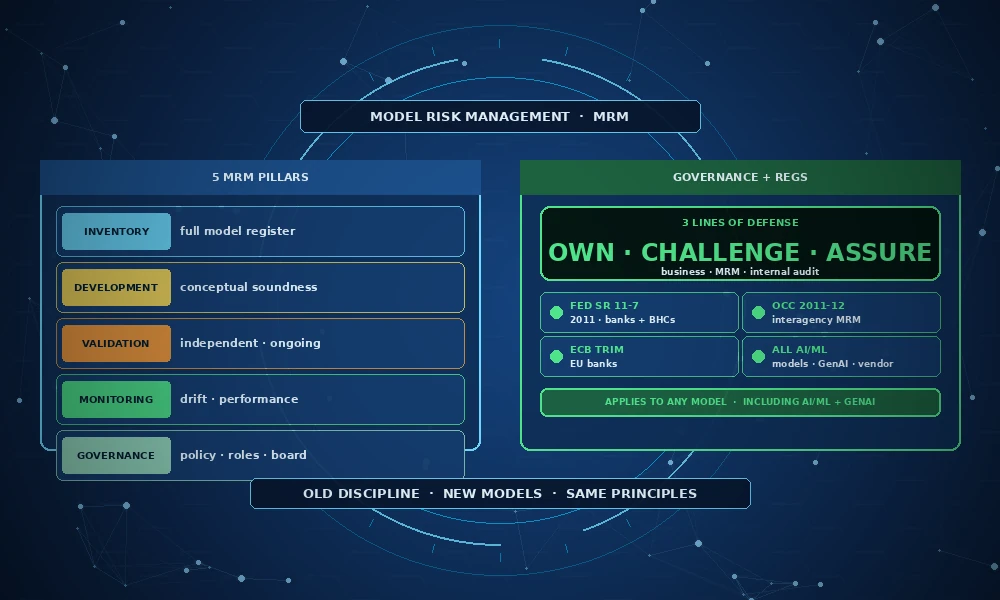
Layered on top of all this is what’s already been true in US financial services for over a decade. The Federal Reserve’s SR 11-7 model risk management guidance has required institutions to maintain comprehensive model documentation, including development, validation, implementation, and ongoing monitoring records. AI didn’t create the documentation problem in regulated industries. It just expanded who has to solve it.
The Documentation Fields That Actually Matter
The most common mistake in AI documentation is treating it as a free-text exercise. Auditors don’t want narrative — they want a schema, consistently applied, with the evidence behind each field. The minimum viable schema below comes from triangulating ISO/IEC 42001 Annex A controls, EU AI Act Annex IV, NIST AI RMF Map function, and SR 11-7.
1. Identity and ownership
- Unique model ID and version (semantic versioning, not “v_final_FINAL”)
- Model owner (named individual, not a team alias)
- Business owner or accountable executive
- Lifecycle status: in development, in production, deprecated, retired
2. Purpose and context
- Intended use, in plain language a non-engineer can act on
- Out-of-scope uses (often more important than in-scope)
- End users and affected populations, including any vulnerable groups
- Decision impact: advisory, automated decision, automated decision with human review
3. Data lineage
- Training datasets with versions, sources, and licensing/consent basis
- Validation and test datasets, kept separate from training
- Data preprocessing steps and known transformations
- Sensitive attributes present in the data, even if not used as features
4. Model technical detail
- Model type and architecture (e.g., gradient-boosted trees, transformer fine-tune, foundation model API)
- Hyperparameters and training environment for reproducibility
- Dependencies on upstream models or external APIs
- Known limitations and failure modes
5. Performance and fairness
- Primary performance metrics with test conditions
- Performance disaggregated across relevant subgroups
- Bias assessment results and mitigations applied
- Robustness testing: adversarial, out-of-distribution, edge cases
6. Risk and controls
- Risk classification (e.g., EU AI Act category, internal tiering)
- AI impact assessment outcome and date
- Applied controls mapped to the relevant standard or regulation
- Residual risk and accepted-by signature
7. Operations and monitoring
- Deployment environment and access controls
- Monitoring plan: drift, performance degradation, incident triggers
- Human oversight mechanism and escalation path
- Change history with approver, rationale, and date
Seven categories. Roughly thirty fields. That’s the ceiling for a defensible minimum, not a wishlist. Adding more fields without operational ownership for each just creates a different kind of unaudit-able mess.
How These Fields Map to Major Frameworks
The reason a single schema works is that the major frameworks ask for the same information in different vocabularies. The mapping below shows where each documentation category lands across four authoritative sources. Build the schema once, satisfy four obligations.
| Documentation category | ISO/IEC 42001 | EU AI Act | NIST AI RMF | SR 11-7 |
|---|---|---|---|---|
| Identity & ownership | A.6 Roles, A.4.2 Resources | Annex IV §1, Art. 16 | Govern 1.3, 2.1 | Section IV |
| Purpose & context | A.6.2.2, Clause 4.1 | Annex IV §1, Art. 13 | Map 1.1, 3.1 | Section V.1 |
| Data lineage | A.7 Data, A.7.4 | Annex IV §2, Art. 10 | Map 2.3, Measure 2.10 | Section V.2 |
| Technical detail | A.6.2.6 | Annex IV §2 | Map 4.1 | Section V.2 |
| Performance & fairness | A.6.2.4 Impact, A.9 | Annex IV §3, Art. 15 | Measure 2.11–2.13 | Section V.3 |
| Risk & controls | Clause 6.1, A.5 | Art. 9, Annex IV §4 | Map 5.1, Manage 1.2 | Section VI |
| Operations & monitoring | A.6.2.8 Operation | Art. 17, Art. 72 | Manage 2.2, 4.1 | Section VII |
Two practical observations. First, every framework treats data lineage and risk classification as load-bearing — these are the fields most likely to fail an audit if missing or stale. Second, monitoring documentation is consistently the weakest link in real implementations, even though it appears in every framework. Models that are documented thoroughly at launch and never updated again are arguably worse than undocumented ones, because they create a false sense of governance.
| What auditors actually ask: not “do you have a model card?” but “show me the most recent monitoring report for model X, the change that triggered the last impact reassessment, and who approved it.” If the documentation can’t answer those three questions in under five minutes, the audit goes long. |
Documentation Across the Model Lifecycle
Documentation is not an artifact you produce once at launch. It is a living record that has to track the model through every state change. The lifecycle below is the operating model that holds up under both ISO 42001 surveillance audits and SR 11-7 ongoing validation.
- Intake. Before any development starts, capture intended use, owner, expected risk classification, and an initial impact assessment. This becomes the seed record.
- Development. Add data lineage, technical detail, and validation results as they become available. Keep this in the same record — don’t fork it into MLflow without a sync back.
- Pre-deployment review. Trigger formal risk classification, controls assignment, and sign-off by the model owner, business owner, and governance reviewer. The EU AI Act’s conformity assessment for high-risk systems happens here.
- Production. Activate monitoring, log every material change with approver and rationale, and tie incidents back to the model record. This is where most documentation goes stale, and where most audit findings originate.
- Material change or retraining. Treat this as a new version, not an update. Re-run the relevant parts of the impact assessment. The old version’s record stays for audit history.
- Retirement. Document why the model was retired, what replaced it (if anything), and how long the record itself is retained. Many regulators expect retention well past the model’s operational life.
The unglamorous truth is that most organizations get steps 1–3 right and fall apart at steps 4–6. Stage gates between lifecycle states, with documentation completeness as the gate criterion, are what fix this. Without them, models drift faster than the documentation does.
Documenting Generative AI and Third-Party Models
The hardest documentation question right now is the one most teams hit first: how do you document a foundation model you didn’t train? An LLM accessed through an API, a fine-tuned variant of an open-weights model, a vendor product with a model black-boxed inside it — all three are common, and none of them fit the classic model card template cleanly.
The NIST AI 600-1 Generative AI Profile, published in July 2024, reframes documentation around the GenAI realities most teams now face: third-party model dependencies, prompt-based behavior changes, and evaluation suites instead of single metrics. Three adaptations to the standard schema follow from it.
First, for third-party foundation models, your documentation describes how you use the model, not how it was built. Capture the provider, model version, your prompts and system messages (under version control), guardrails and content filters, and evaluation results on your specific use cases. The provider’s own model card is referenced, not copied.
Second, evaluations replace single performance metrics. Document the evaluation suite — which benchmarks, which custom evals, which red-teaming exercises — along with results, dates, and the model version each result applies to. A single accuracy number is meaningless for a generative system.
Third, prompt and configuration changes are model changes. If a system prompt is rewritten, that is a versioned event with an approver and a rationale. Treating prompt changes as configuration tweaks rather than model changes is one of the fastest ways to lose audit trail integrity in a GenAI system.
From Spreadsheet Sprawl to a Living System
The first version of AI documentation in almost every organization is a spreadsheet. The second version is several spreadsheets, owned by people who have since changed teams. By the third audit, the spreadsheet approach collapses under three failure modes: version drift between teams, no link between documentation and evidence, and no way to prove who approved what when.
A working documentation system has four operational properties:
- A single source of truth — typically an AI model registry — where every model has one record, regardless of where it was built.
- Field-level ownership — different fields are owned by different roles (data lineage by data engineering, performance by ML, risk by GRC), but each field has exactly one owner.
- Linked evidence — every claim in the documentation points to the artifact that proves it (a test report, an approval ticket, a monitoring dashboard snapshot).
- Versioning and immutable change history — you can answer “what did the documentation say on the date of the incident?” without archaeology.
This is the gap Govern365.ai’s AI model registry is built to close. Each model has a single canonical record with field-level ownership, the schema is pre-mapped to ISO 42001, EU AI Act, and NIST AI RMF clauses, and every change is captured as audit evidence with the approver, rationale, and timestamp. The point isn’t that the platform replaces governance work — it’s that the platform makes the work visible, attributable, and ready for audit on demand instead of in a six-week pre-audit panic.
A Quick Way to Diagnose Where You Are
Documentation maturity tracks closely with overall AI governance maturity, which is why it’s a useful diagnostic. Most organizations sit at level 2 and assume they’re at level 3.
| Level | What it looks like |
|---|---|
| 1 – Ad hoc | Documentation exists for some models, in inconsistent formats, owned by individuals. |
| 2 – Templated | A standard model card template exists. Adoption varies. Updates are sporadic. |
| 3 – Systematic | A registry holds every model. A schema is enforced. Field-level owners exist. Most fields are current. |
| 4 – Linked to evidence | Every documented claim points to verifiable evidence. Change history is immutable. |
| 5 – Continuously assured | Documentation is monitored as a control. Gaps trigger alerts. External audits run with minimal preparation. |
If you can name three models in production right now and the date their documentation was last reviewed, you’re at level 3 or above. If you can’t, the honest answer is level 2 or below and that’s the more common starting point, including in organizations that have invested heavily in AI.
Frequently Asked Questions
What is the difference between a model card and AI model documentation?
A model card is one artifact within AI model documentation. The model card describes a single trained model — its purpose, data, metrics, and limitations. AI model documentation is the broader, governed record that includes the model card alongside risk classifications, controls, monitoring evidence, change history, and links to the system the model sits inside. Auditors and regulators expect the broader record, not the card alone.
Does the EU AI Act require AI model documentation for every system?
No. The EU AI Act requires technical documentation for high-risk AI systems and specific transparency documentation for general-purpose AI models. Article 11 and Annex IV define what’s required for high-risk systems, including data, design, performance, risk management, and post-market monitoring information. Lower-risk and minimal-risk systems still benefit from documentation but face lighter formal obligations.
Who should own AI model documentation in an organization?
Ownership is shared but not ambiguous. Each model has one named model owner accountable for the record’s completeness. Within that record, individual fields are owned by the function closest to the data: ML engineering for performance metrics, data engineering for lineage, GRC for risk classification and controls, and the business sponsor for intended use. A central AI governance function — often within GRC — owns the schema itself.
How often should AI model documentation be updated?
Documentation should update on two clocks: event-driven and time-driven. Event-driven updates are triggered by any material change — retraining, new data sources, prompt changes for GenAI systems, performance shifts, or incidents. Time-driven reviews happen at least annually for low-risk systems and quarterly for high-risk systems, even with no triggering events. Many organizations also align reviews with their internal audit cycle.
Do we need separate documentation for third-party foundation models?
Yes. Your documentation describes how you use the model rather than how it was built. Reference the provider’s own documentation, then add your specific use case, prompts and system messages, guardrails, evaluation results on your tasks, and your monitoring approach. Treat any change to prompts or configuration as a versioned model change with an approver, not a quiet update.
How does AI model documentation support ISO 42001 certification?
ISO/IEC 42001 Clause 7.5 requires documented information across the AI management system. Annex A controls — particularly A.5 (impact assessment), A.6 (lifecycle), A.7 (data), and A.9 (use) — explicitly require documented evidence. A consistent documentation schema, applied to every model in scope, with linked evidence and change history, is the most efficient way to demonstrate conformity during a certification audit.
Conclusion
AI model documentation is the substrate every other governance activity runs on. Without it, risk assessments lack a target, controls lack evidence, and audits become forensic exercises. With it, regulators, auditors, and buyers can answer their core question “do you actually know what your AI is doing?” in minutes instead of weeks. The fields and lifecycle described above are the working minimum. The next step is operational: pick one production model this week, write its complete record against the seven-category schema, and see exactly where the gaps are. That single exercise tends to clarify more about an organization’s AI maturity than any policy document.Govern365.ai, by the Global AI Certification Council, gives AI governance teams a model registry, schema, and audit-ready evidence trail built directly from ISO/IEC 42001, the EU AI Act, and NIST AI RMF. Start your 14-day free trialat govern365.ai