Scope arguments are won and lost on single elements of a definition, not on the definition as a whole. Somebody asks whether the forecasting model goes in the inventory, and the answer turns on one clause.
OECD AI Principles supplied the clause. The Recommendation of the Council on Artificial Intelligence, OECD/LEGAL/0449, was adopted on 22 May 2019. Its definition of an AI system was replaced on 8 November 2023, and the Recommendation itself was revised again on 3 May 2024.
The current definition reads: “An AI system is a machine-based system that, for explicit or implicit objectives, infers, from the input it receives, how to generate outputs such as predictions, content, recommendations, or decisions that can influence physical or virtual environments. Different AI systems vary in their levels of autonomy and adaptiveness after deployment.”
European Commission guidelines issued as C(2025) 924 final on 6 February 2025 break the version in Article 3(1) of the EU AI Act into “seven main elements”. Taking them one at a time, and asking at each what the OECD said and which copy changed it, answers the inventory question better than any summary of the five principles.
Element one: machine-based, and the phrase nobody touched
OECD element one survives every copy unaltered, which no other element does. The EU AI Act, the Council of Europe Framework Convention and the Texas statute all open with a machine-based system, and the NIST framework broadens it slightly to “an engineered or machine-based system”.
OECD drafters gave the element a wide berth on purpose, and nothing hangs on it in practice. Every candidate for an AI inventory runs on a machine, so the element excludes human judgment exercised without software and nothing else.
OECD element one is read broadly by the Commission, which treats “machine” as covering “both the hardware and software components that enable the AI system to function”, from processing units, memory and storage through to operating systems and applications. The guidelines go as far as contemplating biological or organic systems as machine-based “so long as they provide computational capacity”, which is a sentence written for a technology that barely exists and will read very differently in five years.
Interpretation: the element earns its place by making the definition technology-neutral at the outer boundary, which is why a later argument about whether a system is “AI enough” never starts here.
Element two: autonomy, a condition in Brussels and absent in Austin
OECD drafting places autonomy in a separate descriptive sentence: “Different AI systems vary in their levels of autonomy and adaptiveness after deployment.” That sentence observes variation rather than setting a test.
Article 3(1) of the EU AI Act moves it. The European text requires a machine-based system “that is designed to operate with varying levels of autonomy”, which converts an observation into a condition a system must satisfy to be in scope at all.
OECD autonomy acquired a gloss in Europe that the Recommendation never supplied. Recital 12 of the AI Act explains varying levels of autonomy as “some degree of independence of actions from human involvement and of capabilities to operate without human intervention”, and the guidelines add at paragraph 15 that autonomy and inference “go hand in hand”.
So a system a person must trigger for every output still has autonomy in the relevant sense, because the independence is in the mapping from input to output rather than in the decision to run it.
Texas deleted the sentence entirely. Section 551.001(1) of the Business and Commerce Code, added by House Bill 149, carries no autonomy language, so a fully deterministic system that infers can be an artificial intelligence system in Texas and can argue its way out in the European Union.
Two jurisdictions, one system, two answers. Interpretation: an inventory that records a single global in-or-out flag will be wrong somewhere, which is an argument for recording the element-level answers rather than the conclusion.
Element three: adaptiveness, and the systems that never change after deployment
OECD wording ties adaptiveness to autonomy, and every copy that keeps either keeps both together. The EU AI Act phrases it as a system “that may exhibit adaptiveness after deployment”, with “may” doing the work of making it optional rather than required.
OECD records explain why the concept was sharpened. Among the five edits the Council adopted on 8 November 2023 was one aimed at “reflecting the fact that some AI systems can continue to evolve after their design and deployment”.
OECD phrasing left adaptiveness undefined, and Recital 12 fills the gap by referring to “self-learning capabilities, allowing the behaviour of the system to change while in use”, with the guidelines noting that an adapted system “may produce different results from the previous system for the same inputs”. Same input, different output, no code change: that is the test, and it is a sharper one than most inventories apply.
Frozen models are the interesting case. A model trained once, versioned, and never retrained in production exhibits no adaptiveness after deployment, and the European wording accommodates that with “may” rather than excluding it.
Element four: objectives, and what “implicit” was added to catch
OECD objectives carry a qualifier that reads like boilerplate and is not. The clause “for explicit or implicit objectives” appears identically in the OECD text, the EU AI Act and the Council of Europe Convention, and the OECD’s own revision note says the 2023 edit aimed at “clarifying the objectives of an AI system (which may be explicit or implicit)”.
OECD objectives reach the systems nobody wrote a specification for, which is what implicit was added to catch. A recommender optimising engagement has an explicit objective. A language model fine-tuned on preference data pursues objectives nobody wrote down as a loss function, and a system whose goals emerge from training data rather than from a requirements document would escape a definition that required explicit objectives.
OECD editors also touched the input side of the same clause. The 2023 rationale lists an edit “underscoring the role of input which may be provided by humans or machines”, which settles a question that would otherwise recur constantly: a system fed entirely by other systems, with no human typing anything, is not excluded for that reason.
Texas altered this element and the alteration is easy to miss. Its text reads “for any explicit or implicit objective”, singular and with “any” added, which reads as broadening rather than narrowing.
Element five: inference, the line between a model and a rules engine
OECD inference language decides most real cases. OECD wording is “infers, from the input it receives, how to generate outputs”, reproduced identically in the EU AI Act and the Council of Europe text, and rendered by Texas as “infers from the inputs the system receives how to generate outputs”, with both commas removed, the noun pluralised and “the system” replacing “it”.
Commission guidelines do the practical work here. Paragraph 46 places outside the definition any “basic data processing system”, meaning one that “follows predefined, explicit instructions or operations” and operates “without any ‘learning, reasoning or modelling’ at any stage of the system lifecycle”, naming database management systems that sort or filter, “standard spreadsheet software applications which do not incorporate AI enabled functionalities”, and software calculating a population average.
Paragraph 49 goes further and excludes systems “whose performance can be achieved via a basic statistical learning rule”, offering the example of predicting tomorrow’s temperature from last week’s average.
Paragraph 42 is the one that surprises people. Systems “used to improve mathematical optimisation or to accelerate and approximate traditional, well established optimisation methods, such as linear or logistic regression methods, fall outside the scope of the AI system definition”, because “while those models have the capacity to infer, they do not transcend ‘basic data processing'”. An indication the guidelines suggest is that the method “has been used in consolidated manner for many years”.
OECD inference also separates a model from a rules engine in a way that is easy to state and hard to apply at the margin. A system that applies a threshold somebody chose is executing. A system that learned the threshold from data is inferring. A system that applies a threshold somebody chose to a score a model produced is doing both, and the analysis belongs to the component that produced the score.
Read that against a credit scorecard. The route out of the definition exists for exactly the model type most enterprise inventories list first, it is narrow, and using it means writing an analysis against all seven elements rather than asserting a conclusion.
Element six: outputs, and the word that arrived in 2023
OECD output lists look interchangeable across the copies and are not. OECD wording is “outputs such as predictions, content, recommendations, or decisions”. The EU AI Act reproduces it exactly. Texas writes “outputs, including content, decisions, predictions, or recommendations”, swapping the connector and reordering the list.
OECD output lists gained one word in 2023, and it is the word that matters. The OECD’s published rationale lists an edit aimed at “clarifying that the Recommendation applies to generative AI systems, which produce ‘content'”.
NIST AI Risk Management Framework 1.0 predates that edit and still shows it. Its definition lists “predictions, recommendations, or decisions” with no content, describes outputs “influencing real or virtual environments” rather than physical ones, has no inference clause at all, and cites its source as “OECD Recommendation on AI:2019; ISO / IEC 22989:2022”.
OECD wording replaced ten months later is what the framework still quotes, published in January 2023 and unrevised since. Interpretation: an organisation scoping its AI inventory to the NIST definition is using a test that omits generative output, which is the opposite of what a 2026 inventory needs.
Element seven: influence, and the difference between “can” and “may”
OECD influence wording closes the definition, and the two international texts diverge here by one word. The OECD says outputs “that can influence physical or virtual environments”. Article 2 of the Council of Europe Framework Convention says outputs “that may influence physical or virtual environments”, and also drops the comma before “or decisions”.
String comparison settles what the eye cannot. The OECD clause appears in the consolidated EU AI Act as an exact match and does not appear exactly in the Convention text, which confirms both differences rather than asserting them.
Commission guidelines gloss the element at paragraph 60, saying it “should be understood to emphasise the fact that AI systems are not passive, but actively impact the environments in which they are deployed”, reaching “tangible, physical objects (e.g. robot arm)” and “virtual environments, including digital spaces, data flows, and software ecosystems”.
Whether “may” and “can” produce different outcomes is unsettled. No adjudicated decision turning on the difference appeared in the searches run for this page, which is a statement about what was checked rather than a conclusion about the law.
The element Colorado deleted, which is the definition
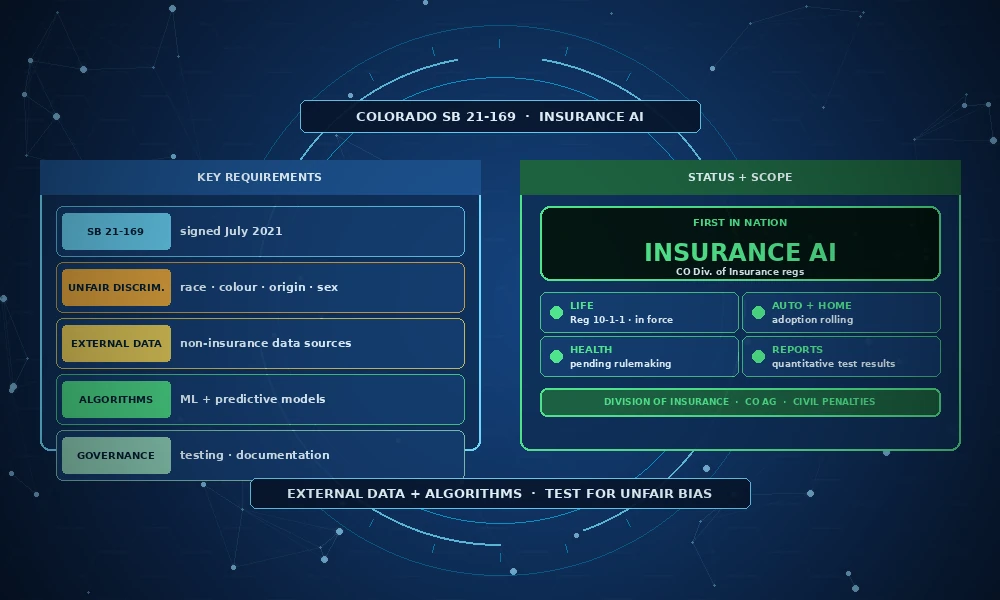
Colorado passed the first broad American AI act in 2024 and rewrote it in 2026, and the rewrite abandoned the vocabulary. Senate Bill 26-189 concerns “the use of automated decision-making technology in consequential decisions”, and the phrase “artificial intelligence” appears in it zero times on a count of the enrolled text.
Its defined terms are adverse outcome, consequential decision, covered ADMT, covered domain, deployer, developer, intentional and substantial modification, materially influence, material update and meaningful human review. Covered ADMT means automated decision-making technology used to materially influence a consequential decision, and the covered domains are education, employment, residential real estate, financial or lending services, insurance, health care and essential government services.
Nothing about that drafting is accidental. A definition built on inference invites argument about whether a system infers. A definition built on use and consequence asks what the technology decided and who it affected, which a regulator can answer without inspecting the architecture.
Interpretation: the seven elements describe a technology well and bound a regulated activity poorly, and Colorado chose to bound the activity. Anyone maintaining a single inventory across both models needs two fields, one for what the system is and one for what it decides.
Where the elements came from: five edits in 2023, seven aims in 2024
OECD process left an unusually clear record. The Digital Policy Committee approved a draft revised definition with its Working Party on AI Governance on 16 October 2023, the Council adopted it on 8 November 2023, and the published rationale lists five edits: clarifying that objectives may be explicit or implicit, underscoring that input may come from humans or machines, clarifying application to generative systems producing content, substituting “physical” for “real”, and reflecting that some systems continue to evolve after deployment.
May 2024 was a different exercise, touching the principles rather than the definition, and the instrument lists seven aims. The seven cover misinformation, disinformation and information integrity in the context of generative AI; uses outside intended purpose and intentional or unintentional misuse; the information AI actors should provide for transparency and responsible disclosure; safety, so that systems risking undue harm “can be overridden, repaired, and/or decommissioned safely by human interaction”; responsible business conduct across the lifecycle; interoperable governance between jurisdictions; and “an explicit reference to environmental sustainability”.
One structural change in 2024 matters more than any of the seven. The instrument records that “the text on traceability and risk management was further elaborated and moved to the ‘Accountability’ principle as the most appropriate” location, which means the traceability obligation everyone cites as principle 1.5(b) has sat there for barely two years.
What the Recommendation can and cannot do to you
OECD AI Principles carry no binding force, which is where the chain gets interesting. The OECD’s own description of its legal categories states that Recommendations “are adopted by Council and are not legally binding”, and “represent a political commitment to the principles they contain and entail an expectation that Adherents will do their best to implement them”.
OECD adherence runs to 47 as at September 2026 on its own count, which is arithmetically the 38 member countries, the European Union, and eight non-member adherents: Argentina, Brazil, Egypt, Malta, Peru, Romania, Singapore and Ukraine. The OECD.AI Policy Observatory alongside it publishes over 900 national AI policies and initiatives.
OECD AI Principles carry a second section most summaries skip, addressed to governments rather than companies. Its five recommendations cover investing in research and development, fostering an inclusive AI-enabling ecosystem, shaping an interoperable governance and policy environment, building human capacity and preparing for labour market transformation, and international co-operation, all introduced “with special attention to small and medium-sized enterprises”. A national strategy that funds compute, publishes open datasets and stands up a regulatory sandbox is usually implementing those recommendations whether or not it says so.
Adherence creates no obligation for any company. No adherent reports to the OECD on behalf of its firms, no certificate exists, and nothing attaches to the Recommendation by way of enforcement. Anyone selling conformity with the OECD AI Principles as a compliance product is selling alignment with a political commitment made by governments.
The Council of Europe Convention sits in a different and more interesting position. The Convention opened for signature on 5 September 2024, and Article 30(3) provides that it enters into force three months after five signatories, “including at least three member States of the Council of Europe”, consent to be bound.
The European Union ratified it and the text was published in the Official Journal at OJ L 2026/1081 on 13 May 2026. Checking the Council of Europe’s own page for this instrument returns 19 signatories and no stated entry-into-force date.
Reach also came through a route that has nothing to do with adherence. The instrument’s background section records that “in June 2019, at the Osaka Summit, G20 Leaders welcomed the G20 AI Principles, drawn from the Recommendation”, which put the same text in front of governments that have never adhered and are not members.
Traceability is the principle that fails visibly
OECD AI Principles number five: inclusive growth and well-being at 1.1, the rule of law and human rights including fairness and privacy at 1.2, transparency and explainability at 1.3, security and safety at 1.4, and accountability at 1.5. All five address AI actors, defined as “those who play an active role in the AI system lifecycle”, rather than states.
Principle 1.5(b) names a record rather than a value: “AI actors should ensure traceability, including in relation to datasets, processes and decisions made during the AI system lifecycle, to enable analysis of the AI system’s outputs and responses to inquiry, appropriate to the context and consistent with the state of the art.”
OECD accountability now carries the risk-management language as well, at 1.5(c), which asks AI actors to “apply a systematic risk management approach to each phase of the AI system lifecycle on an ongoing basis”, naming risks “related to harmful bias, human rights including safety, security, and privacy, as well as labour and intellectual property rights”. Read alongside 1.5(b), the accountability principle is now the operational half of the whole Recommendation.
Fairness, transparency and accountability can be asserted in a policy document and nobody outside can disprove the assertion. Traceability either exists as dated records tied to datasets, processes and decisions, or it does not, and the test arrives as a question from a regulator, a customer or a court.
Principle 1.3 sets the same trap in gentler language, asking for information “on the sources of data/input, factors, processes and/or logic that led to the prediction, content, recommendation or decision” and for a route by which those adversely affected can “challenge its output”. Both are answerable only from records kept at the time.
Vocabulary is where Europe parted company with the framework. “AI actor” appears 59 times in the NIST AI Risk Management Framework and zero times in the consolidated EU AI Act, which builds its duties on provider, deployer, importer, distributor and authorised representative instead. An AI actor is a description; a provider is a status that attaches obligations. Interpretation: a regulation needs addressees rather than participants, and that single choice explains most of the structural distance between the Regulation and the framework.
Running one system through all seven
OECD elements resolve into a paragraph of writing rather than a checkbox, and the exercise is worth doing once properly. Take a demand forecasting model built on gradient boosting, retrained monthly, whose output sets replenishment quantities.
Machine-based, yes. Autonomy, yes in the sense the guidelines describe, because the mapping from inputs to quantities is learned rather than specified. Adaptiveness, yes, because monthly retraining changes behaviour after deployment. Objectives, explicit. Inference, yes, and it transcends basic data processing because no person wrote the rules. Outputs, predictions that become decisions. Influence, physical, because stock moves.
Seven elements answered, one system in scope, one paragraph of reasoning, and a date. A rules engine applying a published fee schedule fails element five at the first question and the analysis stops there, which is also worth writing down, because the next person to ask will otherwise start again.
Record the answers with the date and the system version they were given for. A classification decision nobody wrote down will be made again, differently, by whoever is asked next.
Governance software earns its place at exactly that point, and definitional scope is the problem Govern365.ai was built around. Holding the inventory entry, the element-by-element rationale, the traceability records principle 1.5(b) asks for and the evidence that answers them in one dated place turns a judgement into a file.
Govern365.ai maps each obligation to the record that proves it across the EU AI Act, ISO/IEC 42001 and the NIST AI Risk Management Framework, so an organisation answering a European conformity assessment, a Texas enquiry and a customer questionnaire works from one artefact rather than three that drift apart.
Element by element, text by text
| Element | OECD/LEGAL/0449 | EU AI Act Article 3(1) | Council of Europe Article 2 | Texas HB 149 | NIST AI RMF 1.0 |
| Machine-based | Yes | Yes | Yes | “any machine-based system” | “engineered or machine-based” |
| Autonomy | Descriptive second sentence | Operative condition | Descriptive second sentence | Absent | Separate sentence, 2019 text |
| Adaptiveness | Descriptive second sentence | “may exhibit”, operative | Descriptive second sentence | Absent | Absent |
| Objectives | “explicit or implicit objectives” | Identical | Identical | “any explicit or implicit objective” | “a given set of objectives” |
| Inference | “infers, from the input it receives” | Identical | Identical | “infers from the inputs the system receives” | No inference clause |
| Outputs | predictions, content, recommendations, or decisions | Identical | Same list, no comma before “or decisions” | “including content, decisions, predictions, or recommendations” | predictions, recommendations, or decisions |
| Influence | “can influence physical or virtual” | Identical | “may influence physical or virtual” | “can influence physical or virtual” | “influencing real or virtual” |
Frequently Asked Questions
What are the seven elements of an AI system?
A machine-based system, designed to operate with varying levels of autonomy, that may exhibit adaptiveness after deployment, and that, for explicit or implicit objectives, infers from the input it receives how to generate outputs such as predictions, content, recommendations or decisions, that can influence physical or virtual environments.
Are the OECD AI Principles legally binding?
No. The OECD classifies Recommendations as not legally binding, representing a political commitment and an expectation that adherents will do their best to implement them.
How many countries have adhered?
Forty-seven as at September 2026 on the OECD’s own count, being the 38 member countries, the European Union, and eight non-member adherents: Argentina, Brazil, Egypt, Malta, Peru, Romania, Singapore and Ukraine.
Is the EU AI Act definition the same as the OECD one?
The core clause matches as an exact string. The European text moves autonomy and adaptiveness out of the OECD’s descriptive sentence and into the operative definition, which turns them into conditions.
Is a logistic regression model an AI system?
Paragraph 42 of the Commission guidelines places systems approximating traditional optimisation methods such as linear or logistic regression outside the definition, an argument that has to be written out against all seven elements rather than assumed.
Is a spreadsheet an AI system?
Paragraph 46 names standard spreadsheet applications without AI-enabled functionality as basic data processing, outside the definition.
Does a model that is never retrained fail the adaptiveness element?
The European wording says a system “may exhibit adaptiveness after deployment”, so adaptiveness is permissive rather than required, and a frozen model is not excluded on that ground alone.
Why does the NIST AI RMF definition look different?
OECD text from 2019 is what the framework quotes and cites, and it was replaced in November 2023. The framework was published in January 2023 and has not been updated since, so its output list omits content.
Does Texas apply an autonomy test?
No. House Bill 149 keeps the inference core with several edits and omits the autonomy and adaptiveness sentence entirely.
What happened to the artificial intelligence definition in Colorado?
Senate Bill 26-189 replaced it with covered ADMT, automated decision-making technology used to materially influence a consequential decision, and does not use the phrase artificial intelligence at all.
Is the Council of Europe AI Convention in force?
Article 30(3) requires five consents including three Council of Europe member states. The European Union has ratified and the text was published in the Official Journal on 13 May 2026, while the Council of Europe’s own page for the instrument lists 19 signatories and states no entry-into-force date.
Which OECD principle produces an auditable record?
Principle 1.5(b) on traceability, covering datasets, processes and decisions across the lifecycle, which the 2024 revision elaborated and moved into the accountability principle.