In March 2024, the International Association of Privacy Professionals launched the Artificial Intelligence Governance Professional (AIGP) credential. More than 4,000 professionals had already enrolled in the training before the first exam was sat. Two years later, that number is still small relative to demand, and AIGP is no longer alone on the shelf.
The reason matters. The EU AI Act becomes broadly applicable on 2 August 2026, with enforcement powers against general-purpose AI providers active from the same date. ISO/IEC 42001:2023, the first international standard for AI management systems, is now being written into enterprise procurement requirements. US state laws, including the Colorado AI Act, are pulling US organizations into the same orbit. AI governance certification is how individuals and organizations prove they can operate inside this new compliance perimeter.
This guide breaks down the programs, the costs, the benefits, and the right path for your role.
Why AI Governance Certification Matters in 2026
Three regulatory currents are now converging on the same point. The EU AI Act began its risk-based enforcement in February 2025 with bans on prohibited AI practices, then extended to general-purpose AI obligations in August 2025, and reaches its main applicability date on 2 August 2026 for high-risk AI systems. Penalties for AI Act violations can reach EUR 35 million or 7% of global annual turnover, whichever is higher.
The NIST AI Risk Management Framework gives US organizations a voluntary baseline that maps cleanly to ISO/IEC 42001. State-level activity is filling the federal gap, with the Colorado AI Act introducing prohibitions on algorithmic discrimination in high-risk use cases. The result is a multi-jurisdictional environment where a single AI system might face EU AI Act obligations, NIST RMF expectations, and state-level statutory duties at once.
Enterprise procurement has caught up. RFPs increasingly require evidence of AI governance maturity, and ISO/IEC 42001 is becoming a procurement gate the same way ISO 27001 became one a decade ago. A 2026 industry analysis from Elevate reports that 72% of enterprise buyers now screen for ISO 42001 during procurement [VERIFY]. That is the commercial driver.
Two kinds of certification respond to this pressure, and they do different jobs. Individual certifications, such as the IAPP AIGP, prove that a person can design and operate governance programs. Organizational certifications, such as ISO/IEC 42001, prove that the company itself runs an AI Management System (AIMS) that can withstand external audit. Most mature governance programs eventually need both.
Two Tracks: Individual vs Organizational Certifications
Before comparing specific programs, the distinction between credential and conformance matters.
| Individual certification | Organizational certification | |
|---|---|---|
| What it proves | A named person has demonstrated competence | The organization operates a conforming management system |
| How it is earned | Exam, sometimes coursework or experience | Stage 1 + Stage 2 audit by an accredited certification body |
| Who issues it | Professional body (IAPP, ISACA) or training provider | Accredited certification bodies under ISO/IEC 17021 |
| Renewal | CPE credits, periodic re-exam | Annual surveillance audits, recertification every 3 years |
| Procurement value | Signals capable hires | Satisfies vendor and regulator due diligence |
| Examples | AIGP, ISACA AAIA/AAISM, ISO 42001 Lead Implementer | ISO/IEC 42001 |
Practitioners and consultants typically need an individual credential to carry weight in advisory work. Organizations selling AI products to enterprise or regulated buyers typically need ISO 42001 conformance to clear procurement. The two tracks are complementary, not substitutes.
Top Individual AI Governance Certifications
The market has fragmented quickly. Five programs now serve most of the demand, each with a distinct centre of gravity.
IAPP AIGP – the broad governance credential
The Artificial Intelligence Governance Professional is the most widely recognized credential, partly because IAPP already operates the global privacy certification ecosystem (CIPP/E, CIPP/US, CIPM, CIPT). AIGP launched in March 2024 with the explicit goal of giving privacy, legal, compliance, and technical professionals a shared vocabulary for AI governance.
Key facts as of 2026:
- No prerequisites. Open to anyone.
- Body of Knowledge updates at least annually. BoK version 2.1.0 is in effect for exams from 3 February 2026, including new coverage of agentic AI and recently passed AI-specific regulations.
- Four domains: foundations of AI, AI impacts and responsible AI principles, AI law and policy, and AI governance across the lifecycle.
- Exam: scaled score 100 to 500, with 300 as the passing mark. Retake permitted after 7 days.
- Coverage: EU AI Act, NIST AI RMF, ISO/IEC 22989, ISO/IEC 42001, ISO/IEC 42005, plus US sector laws (Title VII, ADA, FCRA, ECOA, FHA, FTC Act, COPPA, HIPAA).
AIGP is the right starting point for anyone whose job is to advise, oversee, or build governance programs. It is not designed for ML engineers building models. The most common AIGP holders sit in privacy, legal, compliance, risk, audit, and product roles.
One detail to flag: AIGP is governed by IAPP’s standard certification policies, but it is not yet ANAB-accredited (unlike CIPP, CIPM, and CIPT). This does not affect employer recognition, but procurement teams sometimes ask, so it is worth knowing.
ISO/IEC 42001 Lead Implementer and Lead Auditor
These are training certifications, typically run by PECB and similar accredited training organizations, that prepare practitioners to either implement an AI Management System (Lead Implementer) or audit one (Lead Auditor). They are exam-based, usually after a 4 to 5 day course.
Lead Implementer is the standard credential for consultants and internal AIMS owners who will design the management system. Lead Auditor is for internal auditors and certification body auditors. Together they form the operational backbone of how ISO 42001 implementations actually get done. Holders need a working understanding of the standard’s 10 clauses and the 38 controls in Annex A.
ISACA AAIA and AAISM for assurance and security professionals
ISACA has published two AI-focused credentials. The Advanced in AI Audit (AAIA) targets audit and assurance professionals already working in IT audit. The AI Security Management (AAISM) credential is aimed at security leaders and typically requires an existing CISM or CISSP. Both lean towards organizations that already have mature audit and security functions and want to extend them into AI systems.
If your day-to-day involves SOX, ISO 27001 audits, or running second-line risk assurance, AAIA is the more natural fit than AIGP. The two are complementary rather than competing.
BABL AI Governance for Business Professionals
BABL’s program is the most accessible option for non-technical business stakeholders, with a capstone project as the centerpiece. It is well-regarded for managers in product, operations, and HR who need to lead governance conversations without becoming compliance specialists. It does not carry the same regulatory weight as AIGP for legal or compliance roles, but it fills a specific gap.
CAIDP and Heisenberg CAIG policy and practitioner specialisms
CAIDP runs an AI Policy Clinic and related programs that lean heavily into government and NGO use cases, with strong policy and human rights coverage. The Heisenberg Institute’s Certified Professional in AI Governance (CAIG) is a more recent practitioner-oriented credential that targets people directly implementing governance frameworks. Both are smaller programs than AIGP, but each has a defensible niche.
Quick comparison
| Credential | Issuer | Best for | Typical cost (USD) | Time to ready | Prerequisites |
|---|---|---|---|---|---|
| AIGP | IAPP | Legal, privacy, compliance, broad governance | $549–$749 exam | 6–12 weeks study | None |
| ISO 42001 Lead Implementer | PECB / accredited TPs | Consultants, internal AIMS owners | $2,000–$3,500 | 5-day course + study | ISO knowledge helps |
| ISO 42001 Lead Auditor | PECB / accredited TPs | Internal and external auditors | $2,500–$4,000 | 5-day course + study | Audit experience helps |
| ISACA AAIA | ISACA | IT audit professionals extending into AI | ~$575 [VERIFY] | 8–12 weeks study | Audit experience |
| ISACA AAISM | ISACA | AI security leaders | ~$595 [VERIFY] | 8–12 weeks study | CISM or CISSP |
| BABL Governance for Business | BABL AI | Non-technical business managers | $1,500–$2,500 [VERIFY] | 4–8 weeks | None |
Organizational Certification: ISO/IEC 42001
For the company rather than the person, ISO/IEC 42001 is the certification that matters. Published in December 2023, it is the first international standard that allows third-party certification of an AI management system. Its structure follows the same Annex SL pattern as ISO 27001 and ISO 9001, which is why organizations with existing ISMS or QMS programs can move faster.
The standard is built around 10 clauses, with Annex A providing 38 controls covering bias, fairness, transparency, explainability, data governance, and human oversight. Two clauses do most of the heavy lifting in a real implementation. Clause 6.1 requires a formal AI risk assessment process. Clause 6.1.4 introduces the AI system impact assessment, which evaluates the consequences of a system on individuals, groups, and society and is unique to AI management systems.
Documentation is non-trivial. ISO 42001 requires more than 20 documents at minimum, including the AI Policy, AIMS Scope, AI Risk Management Methodology, Statement of Applicability, AI Risk Treatment Plan, and AI impact assessment records. The Statement of Applicability is the single most important artifact during the audit, because it tells the certification body which Annex A controls are in scope and why.
The certification process itself follows a familiar shape:
- Gap analysis. Map current state against the standard. This is the most important step to budget for honestly.
- AIMS design and documentation. Build the policies, procedures, and risk methodology.
- Implementation and operation. Run the system long enough to generate audit evidence.
- Stage 1 audit. Documentation review, typically 1 to 2 days.
- Stage 2 audit. On-site evaluation of implementation effectiveness, typically 3 to 9+ days.
- Surveillance audits. Annual, lighter than the initial audit.
- Recertification. Every three years, full audit cycle.
Cost and timeline reality
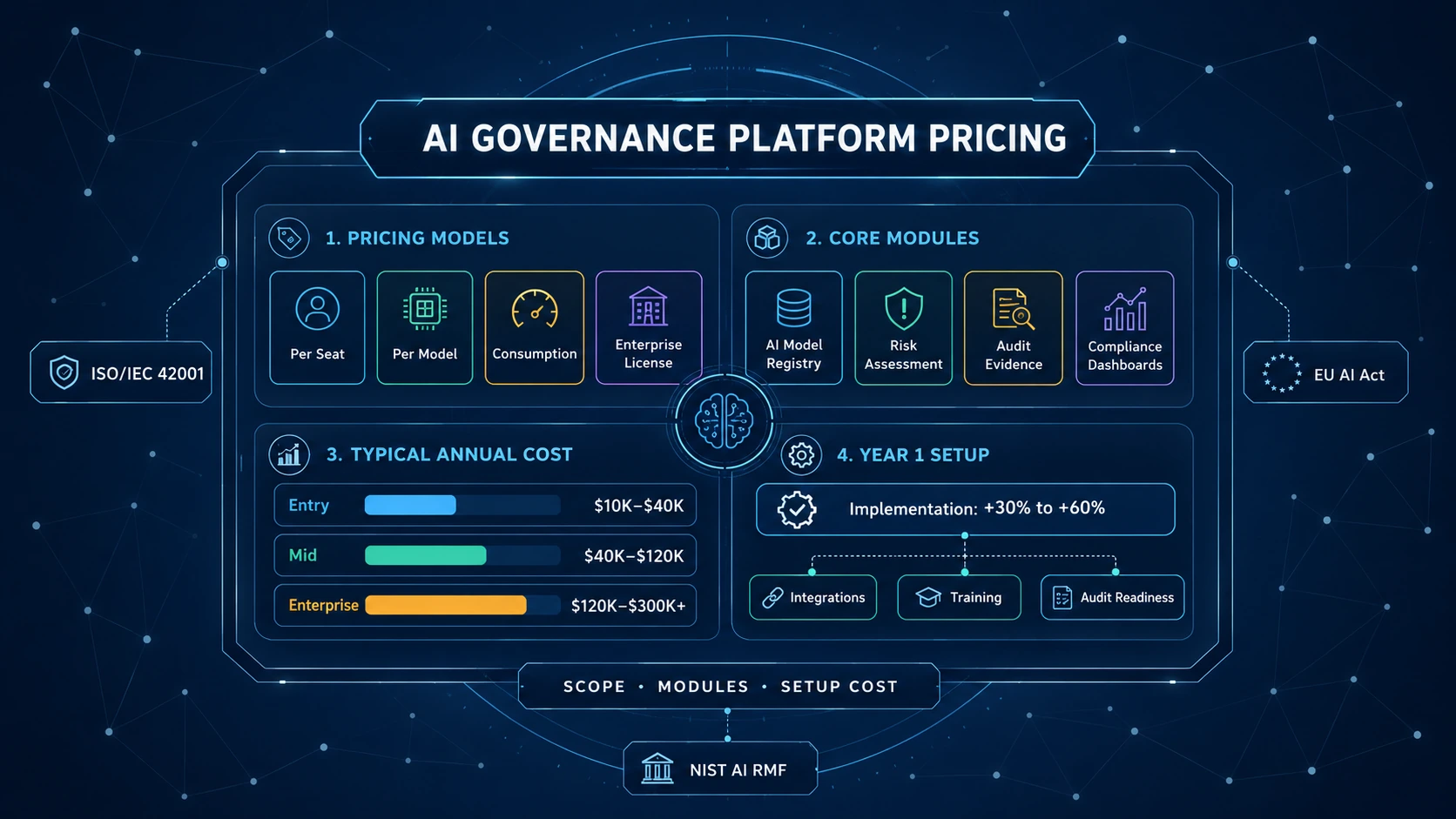
Numbers vary widely, and anyone quoting precise figures without scope context should be questioned. Glocert’s 2026 FAQ reports typical investment ranges of $15,000 to $40,000 for organizations under 50 employees, $30,000 to $80,000 for mid-sized organizations, and $60,000 to $200,000+ for large enterprises. Annual surveillance audits typically run at 30 to 40% of the initial audit fee, and recertification every three years runs at 60 to 70%.
Timelines depend almost entirely on existing certification maturity. Organizations starting from scratch typically need 6 to 12 months. Those with ISO 27001 already in place can compress the timeline to 4 to 6 months because much of the management system framework, internal audit programme, and document control infrastructure carries over. Large enterprises with complex AI portfolios should plan for 12 to 18 months, sometimes longer.
The cost driver most organizations underestimate is AI system scoping. Defining what counts as an AI system inside your AIMS scope is harder than scoping an ISMS, because almost every modern SaaS vendor now claims to use AI. Sorting in-scope from out-of-scope systems requires analytical work that did not exist for information security implementations.
This is where structured tooling pays back its investment. Govern365.ai’s AI model registry automatically maps each AI system to its applicable ISO 42001 clauses, EU AI Act risk categories, and NIST AI RMF functions, which compresses the scoping work and gives auditors a clear evidence trail at Stage 2.
How Certifications Map to AI Regulations
Different certifications cover different parts of the regulatory map. Understanding the overlap saves money and prevents redundant effort.
| Regulation / Framework | What it requires | Certifications that map well |
|---|---|---|
| EU AI Act (Regulation 2024/1689) | Risk-based classification, technical documentation, human oversight, post-market monitoring, transparency, conformity assessment for high-risk systems | ISO 42001 (organizational evidence), AIGP (provider/deployer fluency) |
| NIST AI RMF | Voluntary risk management framework: Govern, Map, Measure, Manage | AIGP, ISACA AAIA, ISO 42001 Lead Implementer |
| ISO/IEC 42001 | AIMS clauses 4–10, Annex A controls, AI impact assessment | ISO 42001 Lead Implementer (build), Lead Auditor (audit), AIGP (foundational) |
| Colorado AI Act (Feb 2026) | Prohibitions on algorithmic discrimination in high-risk consumer-facing AI; risk management programme | AIGP, ISO 42001 (substantive overlap on risk management) |
| NYC Local Law 144 | Bias audits for AEDTs in employment decisions | ISACA AAIA (audit specialism), AIGP |
| HIPAA / FCRA / ECOA (US sector-specific) | Data and decision rights | AIGP coverage of US sector laws |
ISO 42001 is not officially referenced inside the EU AI Act, but a properly implemented AIMS produces most of the evidence regulators are likely to ask for. Article 9 of the AI Act requires a risk management system across the lifecycle of a high-risk AI system; ISO 42001 Clause 6.1 and Annex A controls cover the bulk of those requirements when implemented seriously. The same is true for documentation (Article 11), record-keeping (Article 12), human oversight (Article 14), and post-market monitoring.
The practical implication is that ISO 42001 conformance is becoming the most efficient way to demonstrate AI Act readiness for high-risk systems, even though the Act does not technically demand it.
The Real Benefits: What Certification Actually Delivers
Marketing materials around AI governance certification tend toward abstraction. The concrete benefits fall into three categories.
For individuals. AIGP and similar credentials open the AI governance career path. The IAPP Salary and Jobs Report now includes AI governance roles, reflecting the rapid emergence of titles like AI Governance Lead, Head of Responsible AI, and Chief AI Officer. The supply of certified professionals is still thin against demand, which is what most career advice misses about AI governance: the certification is a market-entry signal in a market that does not yet have established gatekeeping. That gap is closing fast.
For organizations seeking ISO 42001 certification. The procurement effect is the most immediate return. Enterprise buyers, particularly in regulated sectors (financial services, healthcare, critical infrastructure), are now screening AI vendors for ISO 42001 the way they screened cloud vendors for ISO 27001 and SOC 2 a decade ago. Certified organizations report shorter enterprise sales cycles and fewer customised security questionnaires.
The audit and incident benefits show up later. Organizations that operate a documented AIMS catch more issues earlier, have clearer accountability when something goes wrong, and produce regulator-ready evidence packs without scrambling. Synthesia became the first AI video company certified to ISO/IEC 42001 in 2024, citing exactly this regulator and customer signal.
For C-suite sponsors. Certification gives boards and audit committees something to point at. AI risk has been on board agendas for two years without a clean reporting structure; an AIMS produces the artefacts (risk register, control performance, incident logs, impact assessments) that translate into board-level oversight. For a CISO, CDO, or Chief AI Officer, ISO 42001 is the framework that makes AI governance visible to the rest of the executive committee.
The benefits that consistently disappoint expectations are different. Certification does not, by itself, prevent AI failures. It builds the system that catches and corrects them. Organizations that treat the certificate as the goal instead of the operating system tend to generate beautiful documentation that no one uses, and they get caught at the second surveillance audit.
How to Choose the Right Certification Path
The right starting point depends almost entirely on role.
- Privacy, legal, or compliance lead. Start with AIGP. It maps directly onto the regulatory work you already do, and the BoK overlaps significantly with privacy fluency you likely already have.
- GRC manager or AI governance consultant. AIGP first, then ISO 42001 Lead Implementer. The combination covers both the policy framing (AIGP) and the operational build (Lead Implementer) of an AIMS.
- Internal auditor or risk professional. ISACA AAIA or ISO 42001 Lead Auditor are the natural fits. Both extend your existing audit skill set into AI systems without retraining the underlying methodology.
- Security leader (CISO, head of security). ISACA AAISM if you hold CISM or CISSP. The structure mirrors how you already operate.
- C-suite (CTO, CDO, Chief AI Officer, CISO). AIGP for personal fluency, organizational ISO 42001 for the function. As an executive, you do not need to be the implementer; you need to know enough to sponsor and challenge the work.
- Mature AI organization producing or deploying AI products. Organizational ISO 42001 certification is now the table-stakes outcome.
The stacking pattern that works best is one individual certification at the manager and director level (AIGP for governance roles, AAIA for audit roles, Lead Implementer for delivery roles), plus organizational ISO 42001 certification at the company level. This is the configuration that most efficiently covers regulatory exposure across EU, US, and APAC jurisdictions.
What most teams get wrong is sequencing. They send people on AIGP courses before defining the AIMS scope, which means certified individuals come back with broad knowledge but no concrete project to apply it to. The scope work, AI inventory, and risk methodology should be running in parallel with individual training, not after it.
Building the Business Case for Investment
The simplest business case combines three numbers: the cost of certification, the cost of remediating a regulatory finding without it, and the cost of a stalled enterprise deal. Even conservatively, ISO 42001 implementation tends to pay back inside the first 12 to 18 months in any organization that sells AI products to enterprise buyers or operates in a regulated sector.
A workable 12-month roadmap looks like this:
- Months 1–2. Build the AI inventory. Identify every AI system in scope, including third-party tools (Microsoft Copilot, ChatGPT Enterprise, embedded ML in SaaS products). Assign each a risk classification.
- Months 2–3. Run the gap analysis against ISO 42001 and the EU AI Act high-risk requirements. Send the AIMS owner and one or two senior practitioners through AIGP and Lead Implementer training in parallel.
- Months 3–6. Build the AIMS: AI Policy, risk methodology, Statement of Applicability, impact assessment template, control implementation. This is the hardest stretch.
- Months 6–9. Operate the AIMS long enough to produce evidence. Run the first internal audit. Schedule Stage 1 with the certification body.
- Months 9–12. Stage 1 documentation review, then Stage 2 implementation audit. Address findings. Receive the certificate.
The bottleneck is almost always evidence. Auditors at Stage 2 want to see records of AI system reviews, risk decisions made and signed off, impact assessments completed before deployment, and incidents handled with documented root cause. The teams that sail through Stage 2 are the ones that built evidence collection into their daily operations from month four onwards, not the ones that scrambled to assemble a binder in month eleven.
This is also where the integration between training (individual certifications), operations (AIMS), and tooling matters. Spreadsheet-based AI registers work for the first two AI systems and break by the time auditors ask for version history. Govern365.ai, by the Global AI Certification Council, is built specifically for this evidence challenge: the platform connects the AI model registry, risk assessments, control mappings to ISO 42001 and the EU AI Act, and audit evidence in a single source of record. For organizations preparing for ISO 42001 certification, it removes the most common reason Stage 2 audits run long.
Frequently Asked Questions
Is AI governance certification mandatory?
No certification is legally mandatory in most jurisdictions, but it is becoming functionally required. ISO/IEC 42001 is voluntary, yet enterprise procurement increasingly demands it. The EU AI Act does not require ISO 42001, but it does require evidence of risk management, documentation, and human oversight that ISO 42001 produces by design. Treat certification as a market access requirement, not a legal one.
AIGP or ISO 42001 Lead Implementer: which should I get first?
AIGP first if your role is governance, policy, or advisory. Lead Implementer first if your job is to build the AIMS itself. Most senior AI governance roles end up holding both within 12 to 18 months. AIGP gives you the regulatory and conceptual fluency; Lead Implementer gives you the operational skill to design a conforming management system.
How much does AI governance certification cost?
Individual exam fees range from roughly $549 (AIGP member) to $4,000 (ISO 42001 Lead Auditor including training). Organizational ISO 42001 certification ranges from $15,000 for small organizations to over $200,000 for large enterprises with complex AI portfolios. Annual surveillance audits add 30 to 40% of the initial audit fee. Existing ISO 27001 certification typically reduces ISO 42001 costs by 30 to 50%.
Does the EU AI Act require ISO 42001 certification?
No. The EU AI Act does not name ISO 42001 as a required standard. However, a properly implemented ISO 42001 AIMS produces most of the documentation, risk management, human oversight, and post-market monitoring evidence the AI Act requires for high-risk systems. Many organizations are pursuing ISO 42001 specifically as the most efficient route to AI Act readiness.
How long does ISO 42001 certification take?
Four to six months for organizations with existing ISO 27001 certification. Six to twelve months from scratch for most mid-sized organizations. Twelve to eighteen months or longer for large enterprises with complex, multi-system AI portfolios. The biggest variable is AI system scoping, which is harder than ISMS scoping because AI systems are embedded in third-party tools across the organization.
Are there prerequisites for the IAPP AIGP exam?
No formal prerequisites. AIGP is open to anyone, with the exam scaled from 100 to 500 and a passing mark of 300. Candidates typically come from privacy, legal, compliance, risk, audit, product, security, and data or ML backgrounds. Recommended preparation is around 60 to 80 hours of study, including IAPP textbooks, the official Body of Knowledge v2.1, and at least one full practice exam.
Conclusion
Regulation moved faster than the talent and tooling markets, and AI governance certification is the bridge across that gap. AIGP and the ISO 42001 family are now the credentials that matter for individuals; ISO/IEC 42001 is becoming the procurement standard that decides which AI vendors win enterprise deals. The certifications are not the goal. The functioning AI Management System they produce is.
The most useful next step today is the smallest one: take an inventory of every AI system your organization develops, deploys, or relies on, and assign each one a clear governance owner. From that single artefact, every certification path becomes navigable.
Start your 14-day free trial of Govern365.ai
Govern365.ai, by the Global AI Certification Council. Built for organizations operationalizing ISO/IEC 42001, the EU AI Act, and the NIST AI RMF. Visit govern365.ai.