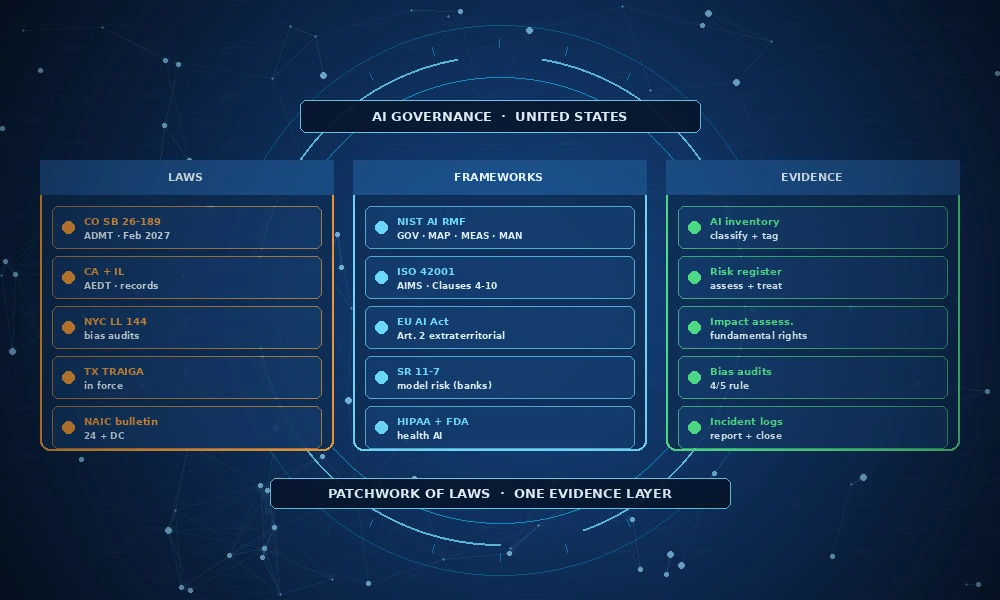
According to a February 2026 Gartner press release, organizations that deploy AI governance platforms are 3.4 times more likely to achieve high effectiveness in AI governance than those that do not yet most compliance teams still document AI risk in spreadsheets, one system at a time, with no consistent scoring methodology and no framework alignment. That gap shows up first in the risk assessment.
An AI risk assessment template is the foundation. Without it, your AI system inventory is just a list. With it, every model, tool, and automated workflow in your organisation carries a documented likelihood score, an impact rating, a set of mapped controls, and a calculated residual risk the minimum evidentiary standard for ISO/IEC 42001:2023 Clause 6.1, NIST AI RMF Map and Measure functions, and EU AI Act Article 9 compliance.
This article gives you the template structure, the scoring methodology, the AI-specific risk fields that most generic templates miss, and a clause-level cross-mapping across all three frameworks so your assessment works as both an operational tool and an audit artefact.
What an AI Risk Assessment Template Actually Does
A standard IT risk assessment asks: what could go wrong, how likely is it, and what does it cost us? An AI risk assessment asks those same questions and then several others that traditional frameworks were never built to handle.
Training data can encode historical bias that produces discriminatory outputs at scale. A model that performed accurately in testing can drift after deployment as the real-world data it processes diverges from its training distribution. A large language model can generate confident, plausible-sounding information that is factually wrong. An agentic system with tool access can take actions its operators did not anticipate. None of these failure modes appear in a standard IT risk catalogue.
The AI risk assessment template is the mechanism that surfaces these risks before they become incidents. Under ISO/IEC 42001:2023 Clause 6.1, your AI management system (AIMS) must document a formal process for identifying, evaluating, and treating risks related to every AI system in scope. Under the NIST AI RMF, the Map and Measure functions require per-system risk profiles. Under the EU AI Act, Article 9 mandates a risk management system for all high-risk AI systems with documented assessment records.
One template, properly structured, satisfies all three if the fields are designed for it.
Before assessing organizational AI risks, evaluate third-party providers using an AI vendor risk assessment questionnaire to identify security, compliance, transparency, and contractual risks.
The 8 Core Fields Every AI Risk Assessment Template Needs
Strip out the boilerplate and an AI risk assessment template comes down to eight essential fields. Each one maps to a specific framework requirement. Together, they produce a complete risk record that can survive an ISO 42001 audit, a NIST AI RMF review, or a regulator inquiry.
| Field | What to Capture | Framework Requirement |
|---|---|---|
| 1. AI System Identification | System name, vendor/developer, version, deployment environment, intended purpose, affected populations | ISO 42001 Cl. 6.1; NIST AI RMF Map; EU AI Act Art. 9(1) |
| 2. Risk Description | Specific risk event (not just risk category); causal pathway; who or what is harmed and how | ISO 42001 Cl. 6.1.2; NIST AI RMF MMA-1.1 |
| 3. Risk Category | Technical, operational, legal/regulatory, reputational, ethical/societal: plus AI-specific sub-type (see Section 4) | NIST AI RMF Map 5.1; ISO 42001 Annex A.6 |
| 4. Inherent Risk Score | Likelihood (1-3) x Impact (1-3) before controls applied; score range 1-9 | ISO 42001 Cl. 6.1.2; NIST AI RMF Measure 2.1 |
| 5. Controls Applied | Specific technical and procedural controls in place; human oversight mechanisms; monitoring frequency | ISO 42001 Cl. 8.2; EU AI Act Art. 9(2)(b); NIST AI RMF Manage 2.2 |
| 6. Residual Risk Score | Likelihood x Impact after controls; must be within risk appetite; requires documented sign-off | ISO 42001 Cl. 6.1.2; EU AI Act Art. 9(4) |
| 7. Accountability | Risk owner (named role); approver; review date; escalation path for high-risk findings | ISO 42001 Cl. 5.3; NIST AI RMF Govern 1.2 |
| 8. Review Trigger | Conditions that require reassessment: model update, data change, use case expansion, incident, regulatory change | ISO 42001 Cl. 6.1; EU AI Act Art. 9(6) |
Field 1 deserves particular attention. The unit of assessment is the AI system, not the AI model, and not the business function. A customer service chatbot powered by the same underlying model as your internal HR tool carries entirely different risk profiles different affected populations, different data inputs, different regulatory exposure. One record per workflow, not one record per model.
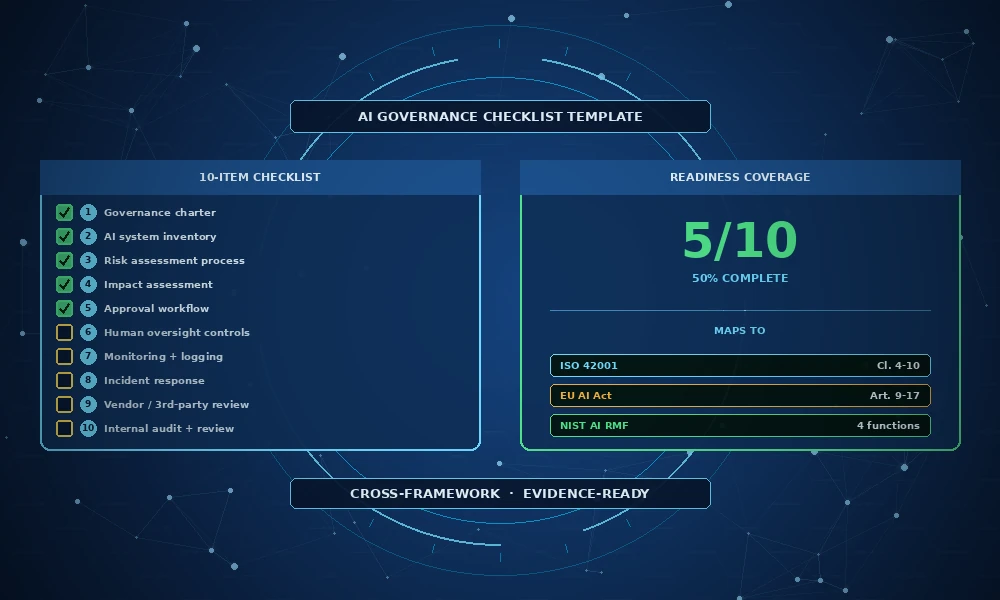
Once risks have been identified and documented, use an AI governance checklist to verify that governance controls, policies, and evidence are complete before an internal or external audit.
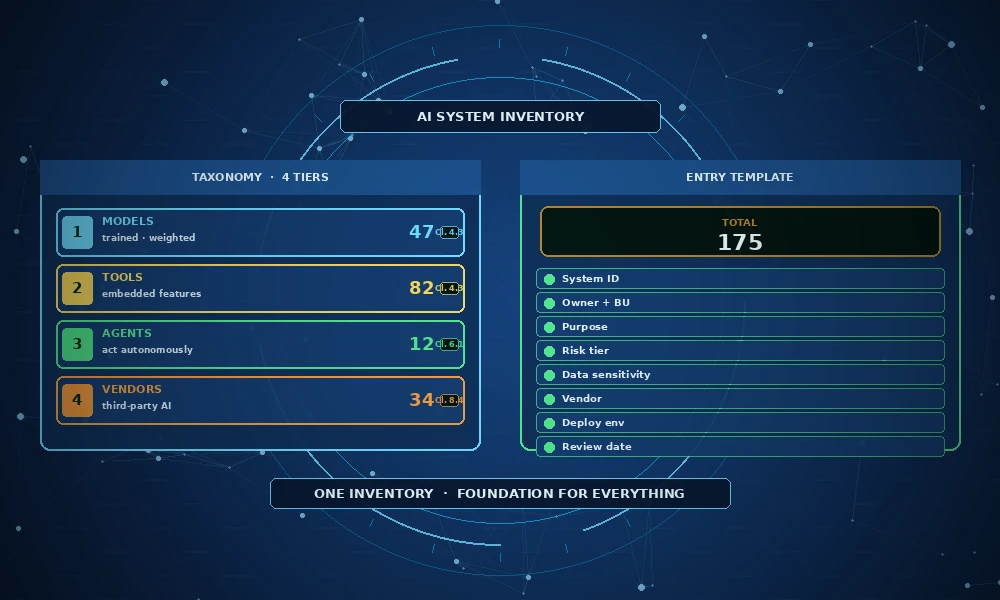
| PRACTICAL NOTE: If your organisation does not yet have a complete AI system inventory, complete that first. A risk assessment conducted against an incomplete inventory gives false assurance. ISO 42001 Clause 6.1 requires risk assessment across all AI systems in scope gaps in scope are themselves a non-conformity. |
How to Score AI Risk: Likelihood, Impact and When to Auto-Escalate
The most common failure in AI risk scoring is treating the matrix as the goal rather than the starting point. A 3×3 likelihood-impact matrix produces a number. The number only means something if the scoring criteria are defined, applied consistently, and calibrated to your organisation’s risk appetite before any assessments begin.
The Scoring Rubric
| Score | Likelihood | Criteria |
|---|---|---|
| 1 – Low | Unlikely | Risk event possible but no precedent in similar systems; strong preventive controls already in place |
| 2 – Medium | Possible | Risk event has occurred in comparable deployments; controls present but not fully tested |
| 3 – High | Probable | Risk event has occurred in this system or close analogues; controls immature or absent |
| Score | Impact | Criteria |
| 1 – Low | Minor | Limited effect on individuals; no regulatory exposure; fully reversible |
| 2 – Medium | Significant | Material harm to individuals or groups; potential regulatory inquiry; partially reversible |
| 3 – High | Severe | Irreversible harm to individuals; regulatory penalty exposure; loss of public trust; potential litigation |
Risk score = Likelihood × Impact. Scores 1-3 are low risk. Scores 4–6 are medium risk. Scores 7-9 are high risk.
The Auto-Escalation Rule
Score alone is not enough. Certain use cases must be classified as high-risk regardless of the matrix result. Both the EU AI Act and the Colorado AI Act (SB24-205) effective June 30, 2026 for high-risk deployers define categorical triggers based on use case, not score. If your AI system affects any of the following, treat it as high-risk regardless of your matrix outcome:
- Employment decisions (hiring, performance evaluation, termination)
- Credit, insurance, or financial services determinations
- Healthcare diagnosis, triage, or treatment recommendations
- Legal outcomes or risk scoring in criminal justice
- Access to education or housing
- Biometric identification at scale
This auto-escalation rule is not discretionary. Under EU AI Act Annex III and under Colorado’s definition of “consequential decisions,” systems touching these domains require specific controls documented human oversight, defined appeal mechanisms, and in some cases, conformity assessment.
AI-Specific Risk Categories Your Template Must Cover
Generic risk frameworks were not designed with AI failure modes in mind. A template that lists only “operational risk,” “cybersecurity risk,” and “reputational risk” will miss the AI-specific failure modes that regulators, auditors, and affected parties are now specifically looking for. These four categories are the ones most frequently cited in enforcement guidance and audit findings.
1. Bias and Fairness Risk
Algorithmic bias occurs when an AI system produces outputs that systematically disadvantage groups defined by protected characteristics race, gender, age, disability whether or not the training data explicitly contained those attributes. The mechanism can be subtle: a model trained on historical hiring data may encode past discriminatory patterns without any intentional design choice.
Template fields for this category: affected populations (defined explicitly), protected characteristics at risk, bias testing methodology applied, monitoring cadence for output distribution drift, and escalation procedure if disparity thresholds are exceeded.
2. Model Reliability and Drift Risk
AI systems are not static. A model that performs accurately against its validation data can degrade over time as the real-world data it processes diverges from its training distribution a phenomenon called model drift. This is particularly acute for systems making time-sensitive predictions (fraud detection, demand forecasting) where the underlying environment changes continuously.
Template fields: performance baseline metrics at deployment, acceptable degradation thresholds, monitoring frequency, retraining trigger criteria, and version control documentation linking each deployed model version to its assessment record.
3. Transparency and Explainability Risk
For AI systems making or informing consequential decisions, the inability to explain a specific output is itself a regulatory and operational risk. EU AI Act Article 13 requires high-risk AI systems to be designed for transparency. NIST AI RMF Measure 2.6 addresses explainability as a measurable characteristic. ISO 42001 Clause 8.5 covers transparency obligations.
Template fields: explainability method (LIME, SHAP, natural language explanation, or other), output documentation standard, user disclosure requirements, and mechanism for individuals to contest or query AI-informed decisions.
4. LLM and Agentic AI Risk (The Gap Most Templates Miss)
Large language models and agentic AI systems introduce risk types that simply do not appear in traditional risk taxonomies. According to the OWASP Top 10 for LLM Applications (updated December 2025 for agentic systems), the highest-severity risks include prompt injection, insecure output handling, training data poisoning, and excessive agency – where an AI system takes actions beyond its intended scope.
Template fields specific to LLMs and agentic systems:
- Prompt injection risk: Can inputs from users or external data sources manipulate the model’s instructions?
- Hallucination rate: What is the measured frequency of confident but incorrect outputs? What is the acceptable threshold?
- Tool access scope: For agentic systems, what external actions (API calls, file writes, web access) can the system take, and what approval gates exist?
- Multi-agent trust boundaries: If this system interacts with other AI systems, how is trust established and what data passes between them?
- Human override mechanism: Can a human interrupt or reverse the system’s actions in real time?
| TEMPLATE ADDITION Add a dedicated “AI System Type” field at the top of your template: Discriminative ML, Generative AI/LLM, Agentic AI, or Hybrid. The type drives which risk sub-categories are mandatory to complete. Auditors are increasingly checking whether risk assessments are tailored to the system type – not just copied from a generic template. |
Mapping Your Template Across ISO 42001, NIST AI RMF and EU AI Act
Most organisations end up maintaining three separate compliance processes for the same AI system: one for ISO 42001 certification, one for NIST AI RMF alignment, and one for EU AI Act obligations. The duplication is unnecessary. A well-structured AI risk assessment template can serve all three simultaneously – if the fields are deliberately mapped to each framework’s requirements.
The table below provides the only publicly available clause-level crosswalk connecting specific template fields to their counterparts across all three frameworks. Use it to build a single assessment record that satisfies multiple audit contexts.
| Template Field | ISO 42001:2023 | NIST AI RMF 1.0 | EU AI Act |
|---|---|---|---|
| AI System Identification | Cl. 6.1 (scope of assessment) | Map 1.1 (AI system categorization) | Art. 9(1) + Annex III (system identification) |
| Risk Description | Cl. 6.1.2 (risk identification) | Map 5.1 (risk identification) | Art. 9(2)(a) (risk identification obligation) |
| Risk Category | Annex A.6 (AI risk sources) | Map 5.1 (risk characterization) | Art. 9(2) (risk categories) |
| Inherent Risk Score | Cl. 6.1.2 (risk evaluation criteria) | Measure 2.1 (risk quantification) | Art. 9(2)(b) (risk estimation) |
| Controls Applied | Cl. 8.2 + Annex A controls | Manage 2.2 (risk response) | Art. 9(2)(b) + Art. 14 (human oversight) |
| Residual Risk Score | Cl. 6.1.2 (risk treatment outcome) | Manage 4.1 (residual risk monitoring) | Art. 9(4) (acceptable risk determination) |
| Accountability | Cl. 5.3 (roles and responsibilities) | Govern 1.2 (accountability structure) | Art. 9(1) (provider/deployer obligations) |
| Review Trigger | Cl. 6.1 (ongoing risk management) | Manage 4.2 (continuous monitoring) | Art. 9(6) (continuous review obligation) |
| AI System Impact Assessment | Cl. 6.1.4 (required separately for AIMS) | Map 3.5 (impact assessment) | Art. 10 / DPIA where personal data involved |
One practical note on the ISO 42001 AI System Impact Assessment (Clause 6.1.4): this is a distinct document from the risk assessment itself. Where the risk assessment evaluates internal organisational risk, the impact assessment evaluates consequences for external stakeholders – individuals, groups, and society. Both are required under a fully conformant AIMS. They can share data fields (system identification, use case description, affected populations), but they serve different audit purposes.
When AI Risk Becomes High-Risk: Classification and Regulatory Triggers
The term “high-risk AI” carries a specific legal meaning under the EU AI Act – it is not a risk score, it is a classification based on use case. Understanding the distinction matters for US-based organisations because it determines which compliance obligations apply, including mandatory risk management systems, technical documentation, human oversight mechanisms, and in some cases, third-party conformity assessment. For enterprises operating in or selling into EU markets, this classification is not optional.
EU AI Act Annex III defines eight domains where AI systems are categorised as high-risk:
- Biometric identification and categorisation
- Management and operation of critical infrastructure
- Education and vocational training (e.g., exam proctoring, admissions scoring)
- Employment, worker management, and access to self-employment
- Access to essential private and public services (credit scoring, social benefits)
- Law enforcement
- Migration, asylum, and border control management
- Administration of justice and democratic processes
For US organisations without direct EU operations, the practical question is whether your AI systems process data of EU residents or are used in contexts where EU law applies. For most mid-market enterprises deploying AI in HR, credit, or healthcare, that exposure exists.
Within the US, the Colorado AI Act takes a functionally similar approach: AI systems that make “consequential decisions” in employment, education, financial services, healthcare, housing, or insurance are subject to disclosure, impact assessment, and human review obligations for Colorado residents. Several other states have enacted or are considering comparable legislation.
Your AI risk assessment template should include a dedicated “Classification” field with four possible values: Unacceptable Risk (prohibited), High-Risk, Limited-Risk or Minimal-Risk – aligned to the EU AI Act risk pyramid. This classification drives which subsequent fields are mandatory and which controls the accountability section must document.
Turning a Template into a Repeatable Process
A completed AI risk assessment template is a point-in-time record. What ISO 42001 Clause 6.1 actually requires and what auditors check: is a repeatable, documented process that produces those records consistently across all AI systems and updates them when circumstances change.
Three things determine whether your assessment process is audit-ready.
1. Ownership and Sign-Off Workflow
The risk assessment must have a named owner not a team, a named role. The owner is responsible for completing the assessment before any AI system is deployed or materially changed, and for ensuring it is updated when review triggers occur. A second named role (senior compliance officer, CISO, or Chief AI Officer) must document sign-off on the residual risk determination.
In practice, the most functional model assigns the business unit owner as the primary risk owner (they understand the use case) with a centralised AI governance team reviewing against framework standards before sign-off.
2. Review Trigger Criteria
An AI risk assessment is not an annual document. The following events must trigger a reassessment document them explicitly in Field 8 of your template:
- Model update, retraining, or version change
- Data source change (new data types, new providers, changed retention)
- Use case expansion (new user populations, new decision contexts)
- Relevant regulatory change (new law, enforcement action, guidance update)
- AI system incident or near-miss
- Third-party audit finding related to this system
- Performance degradation below documented threshold
3. Integration with Your AI System Inventory
Every AI system in your inventory should have a corresponding active risk assessment record. The assessment record should be linked to the inventory entry by system ID, not by name names change, IDs persist. This link is what enables portfolio-level risk visibility: the ability to answer “how many of our AI systems currently carry a residual risk score above 6?” or “which systems have not been reassessed since their last model update?” without manual cross-referencing.
Govern365.ai‘s AI model registry maintains this link automatically each system entry connects to its live risk assessment record, flagging overdue reviews and exposing portfolio-level risk distribution to compliance teams and board-level dashboards without requiring manual reconciliation.
What a Completed Assessment Record Looks Like in Practice
Abstract frameworks are only useful if you can translate them into a concrete record. Here is a worked example of a completed AI risk assessment record for a hypothetical customer credit-scoring model populated against all eight template fields and cross-referenced to the framework mapping table above.
| Field | Example Content |
|---|---|
| AI System Identification | CreditScore-ML-v2.3 | Vendor: InternalDev | Purpose: Automated credit risk scoring for consumer loan applications | Affected populations: US retail banking customers seeking personal loans |
| Risk Description | Model may produce systematically lower credit scores for applicants in specific geographic ZIP codes historically associated with minority populations, leading to discriminatory loan denial rates that violate Equal Credit Opportunity Act obligations |
| Risk Category | Ethical/Societal: Algorithmic Bias | Sub-type: Proxy discrimination via geographic data |
| Inherent Risk Score | Likelihood: 3 (Probable: similar patterns documented in comparable models per CFPB 2024 guidance) | Impact: 3 (Severe: regulatory penalty + litigation exposure) | Score: 9 (High) |
| Controls Applied | (1) ZIP code removed as direct input; (2) Quarterly adverse impact analysis by protected class; (3) Human review required for all denial decisions; (4) Explainability report generated for each decision using SHAP values |
| Residual Risk Score | Likelihood: 2 | Impact: 3 | Residual Score: 6 (Medium) | Within risk appetite: Conditional: subject to continued quarterly monitoring |
| Accountability | Risk Owner: Head of Consumer Credit Analytics | Approver: Chief Compliance Officer | Approved: 2026-03-15 | Next review: 2026-09-15 or earlier if triggered |
| Review Trigger | Model retrain, data source change, adverse impact threshold breach (>4% disparity ratio), CFPB enforcement action, Colorado AI Act compliance review |
This record satisfies ISO 42001 Clause 6.1.2 documentation requirements, provides the NIST AI RMF Map and Measure evidence for this system, and documents the Article 9 risk management process required if this system processes EU-resident data.
Frequently Asked Questions
What is an AI risk assessment template?
An AI risk assessment template is a structured document used to identify, evaluate, and document the risks associated with a specific AI system before deployment and throughout its operational lifecycle. A complete template captures the risk description, likelihood and impact scores, controls applied, residual risk level, and accountability: mapped to framework requirements such as ISO 42001 Clause 6.1, NIST AI RMF, and EU AI Act Article 9.
How is an AI risk assessment different from a standard IT risk assessment?
A standard IT risk assessment covers system failures, security vulnerabilities, and data breaches. An AI risk assessment covers those and adds AI-specific failure modes that do not appear in traditional risk catalogues: algorithmic bias and fairness failures, model drift, explainability gaps, hallucination in large language models, prompt injection in agentic systems, and training data quality risks. The framework requirements are also different: ISO 42001, NIST AI RMF, and the EU AI Act each impose specific obligations that general IT risk frameworks do not address.
How often should AI risk assessments be reviewed?
At minimum, annually but in practice, review is triggered by events rather than calendars. A model update, data source change, use case expansion, relevant regulatory change, or performance incident each require reassessment regardless of when the last scheduled review occurred. ISO 42001 Clause 6.1 requires ongoing risk management. EU AI Act Article 9(6) explicitly requires continuous review for high-risk AI systems.
Does every AI system need its own risk assessment?
Yes. The unit of assessment is the AI system and its specific use case not the model, not the technology vendor, and not the business function. The same underlying model deployed for customer support and for HR decision-making requires two separate assessments: the use cases, affected populations, data inputs, and regulatory exposures are materially different.
What is the difference between inherent risk and residual risk in AI?
Inherent risk is the risk level before any controls are applied the raw likelihood-impact score. Residual risk is the risk level after controls are in place. Both must be documented. ISO 42001 requires that residual risk be within the organisation’s defined risk appetite and that this determination is signed off by an accountable individual. A residual risk score that exceeds risk appetite requires either additional controls or a formal exception with executive approval.
How does EU AI Act Article 9 relate to the risk assessment template?
EU AI Act Article 9 mandates that providers of high-risk AI systems establish and maintain a risk management system a documented, continuous process covering risk identification, evaluation, and control. This is not a one-time assessment; it is an ongoing process with defined review cycles. A properly structured AI risk assessment template, updated as required by review triggers, satisfies the evidentiary standard for Article 9 compliance when combined with an AI System Impact Assessment under Clause 6.1.4 of ISO 42001.
What does NIST AI RMF say about risk assessment?
The NIST AI RMF 1.0 addresses risk assessment primarily through the Map and Measure functions. Map function subcategories (particularly Map 1.1, 3.5, and 5.1) require AI systems to be categorised, contextualised, and their risks identified and characterised. Measure function subcategories (Measure 2.1, 2.6) require those risks to be quantified and evaluated against defined criteria. The Framework is voluntary in the US but is referenced in enforcement guidance by the FTC, CFPB, and other federal regulators. Per NIST, the AI RMF crosswalk to ISO 42001 means that organisations implementing either framework are simultaneously building evidence toward the other.
Can a spreadsheet handle AI risk assessment, or do we need a platform?
Spreadsheets work for the first few assessments. The problems emerge at scale: no version control for assessment records, no automated review trigger tracking, no portfolio-level risk visibility, and no audit trail proving that sign-offs occurred in the required sequence. For organisations with more than 10-15 AI systems in scope, or facing ISO 42001 certification or EU AI Act compliance deadlines, a purpose-built AI governance platform provides the structured evidence management that auditors require.
Conclusion
The gap between having an AI risk assessment template and having an AI risk management process is wider than most organisations recognise. A template gives you a format. A process gives you coverage every system assessed, every residual risk within appetite, every review trigger documented, and every record linked to its framework requirement.
Start with the eight fields and the scoring rubric in this article. Map your first five AI systems. Then ask what it would take to maintain that coverage as your AI system inventory grows. That question of sustainable, auditable, cross-framework risk assessment at scale: is where a structured governance approach becomes not just useful but necessary.
Start your 14-day free trial of Govern365.ai, by the Global AI Certification Council, and build your first AI risk assessment record in a platform designed to satisfy ISO 42001, NIST AI RMF, and EU AI Act requirements from a single interface.